
RENEWIOSITY / EXPLAINER
How Do Forests and Oceans Absorb Carbon Dioxide? Understanding Natural Carbon Sinks
Discover how forests, soils and oceans absorb CO₂, why natural carbon sinks matter, and what the revised Global Carbon Budget says about their limits.

Imagine a giant, invisible exchange system connecting the trees in a forest, the soil beneath your feet and the ocean beyond the coast. Every day, carbon dioxide enters and leaves these places. Some is stored in wood or soil, some dissolves in seawater and some returns to the air. The balance between these flows matters enormously for the climate [3,4].
A natural carbon sink is a system that takes up more carbon from the atmosphere than it releases over a stated period. Forests and other land ecosystems can act as sinks; the world’s oceans also absorb atmospheric carbon dioxide. But neither sink is limitless, and a sink can weaken or become a source when its conditions change [1,2].
This article follows the carbon, step by step, from air to tree, soil, seawater and deep-ocean storage. It also explains an important recent scientific update: the Global Carbon Budget 2025 estimates that the ocean and land absorbed about half of human carbon dioxide emissions over 2015–2024, while the other half accumulated in the atmosphere [1,2].
Learning objectives
- Explain what a natural carbon sink is and distinguish carbon uptake from carbon storage and release.
- Describe how photosynthesis moves atmospheric carbon dioxide into forest vegetation, roots and soils.
- Explain how ocean gas exchange and biological activity transfer carbon from surface water toward deeper reservoirs.
- Interpret the 2015–2024 Global Carbon Budget percentages without confusing decade averages with single-year results.
- Use a transparent hypothetical 100-tonne carbon-dioxide budget to calculate how emissions are divided among sinks and the atmosphere.
- Evaluate the limitations of natural sinks, including fire, deforestation, ocean warming and acidification, and explain why emissions cuts remain necessary.
1. What is a natural carbon sink?
A carbon reservoir is a place that holds carbon, such as the atmosphere, a tree trunk, soil, seawater or sediment. A carbon flux is a flow of carbon between reservoirs. A reservoir becomes a net carbon sink when its inflows exceed its outflows over the period being measured. If its outflows exceed inflows, it is a net source [3,4].
A healthy forest can store a great deal of carbon but still be nearly neutral in a particular year if growth is balanced by respiration, decomposition and other releases. Conversely, a growing forest may gain additional carbon and therefore act as a sink. The word “sink” refers to the net change, not simply the amount already stored.
The ocean is a particularly large reservoir. It continually exchanges CO₂ with the atmosphere; some regions absorb CO₂ and others release it. As a whole, the ocean has been a net sink for human-added CO₂ in the modern global budget [1,6].
2. Why does the carbon cycle matter for climate change?
Before large-scale industrial fossil-fuel use, carbon moved among air, living organisms, water, sediments and rocks through natural processes that were approximately balanced over relevant long-term periods. Burning coal, oil and gas transfers carbon from geological storage into the active atmosphere–ocean–land system much faster than the slow geological cycle can remove it [4].
Extra atmospheric CO₂ traps more outgoing infrared energy, contributing to global warming. Natural sinks remove part of that added CO₂ and therefore slow the rise of atmospheric concentration. However, they do not remove all of it: a substantial fraction continues to accumulate in the atmosphere [1,3].
Our related articles What Is the Greenhouse Effect? and What Is Climate Change? explain the physical climate processes behind this connection.
3. How do trees absorb carbon dioxide?
The central mechanism is photosynthesis. Leaves take up carbon dioxide through tiny pores called stomata. With sunlight, water and the machinery of plant cells, trees build energy-rich organic molecules from carbon dioxide and water. A simplified reaction is carbon dioxide plus water plus light forming carbohydrate and oxygen [4].
Carbon from that atmospheric CO₂ becomes part of a tree’s leaves, wood, roots and other tissues. Over years and decades, a growing forest can accumulate a substantial quantity of carbon in living biomass. But plants also respire, and some carbon goes back to the atmosphere as organic material breaks down.
Trees cannot simply keep absorbing more carbon forever. Growth depends on light, temperature, water, soil nutrients, age, competition, pests and weather. Increasing atmospheric CO₂ may stimulate some growth, but water or nutrient shortages can limit that response [3,4].
4. Where is forest carbon stored?
A forest is much more than its visible trunks. Carbon can be held in living trunks and branches, fine and coarse roots, leaves, fallen wood, litter and soil organic matter. Soil carbon may arise when plant material enters the ground and is partly transformed by organisms [5].
Carbon residence times vary. A leaf can fall and decompose in months; wood can persist for decades; some soil carbon can remain much longer under favorable conditions. These pools exchange carbon with one another continuously rather than forming a single permanent locked vault.
When scientists estimate forest carbon, they distinguish stocks (how much is present) from fluxes (how much changes per year). These are measured in different units and should never be treated as interchangeable.
In scientific accounting, the quantity of carbon in a forest is sometimes estimated in tonnes of carbon (t C), while emissions and removals are often reported in tonnes of carbon dioxide (t CO₂). One tonne of carbon corresponds to 44/12 tonnes of CO₂ by molecular mass. The units must be consistent before a forest stock can be compared with an emissions inventory. A stock measured today also cannot be claimed as a new removal unless a change relative to a sound baseline is established.
5. What makes a forest a carbon sink rather than a carbon source?
The balance depends on photosynthetic uptake minus carbon released through plant respiration, microbial decomposition, disturbance and harvesting. A forest can be a sink when annual gains exceed these losses. It can become a source after severe fire, drought, pest outbreaks or widespread clearing [5,12].
For example, a stand that gains carbon in growing trees might still show little net benefit if large amounts of existing soil carbon are lost during drainage or disturbance. It is the complete ecosystem balance that matters, not just new plantings.
Protecting mature forests is often important because they already contain substantial carbon stocks. Restoring degraded forests can add new storage over time, but the benefits depend on survival, species, land history and whether stored carbon remains protected [3,12].
6. How do carbon sinks appear in a forest diagram?
Follow the arrows in Figure 1. Atmospheric CO₂ enters through foliage. Some of the absorbed carbon becomes wood and roots; some reaches the soil as dead plant material. Carbon also flows outward through respiration, decay, wildfire and other processes. The diagram represents the pathways, not a measured annual flux for a particular forest.
An essential practical point is that planting a tree does not instantly erase a fixed amount of fossil-fuel emissions. The tree must grow, its carbon uptake must be measured over time and future losses must be considered. This is why legitimate carbon accounting depends on monitoring and boundaries.
Soil, forest age, habitat diversity and the needs of people living nearby all affect management. The goal is to maintain healthy ecosystems and durable carbon stocks, not merely count seedlings.
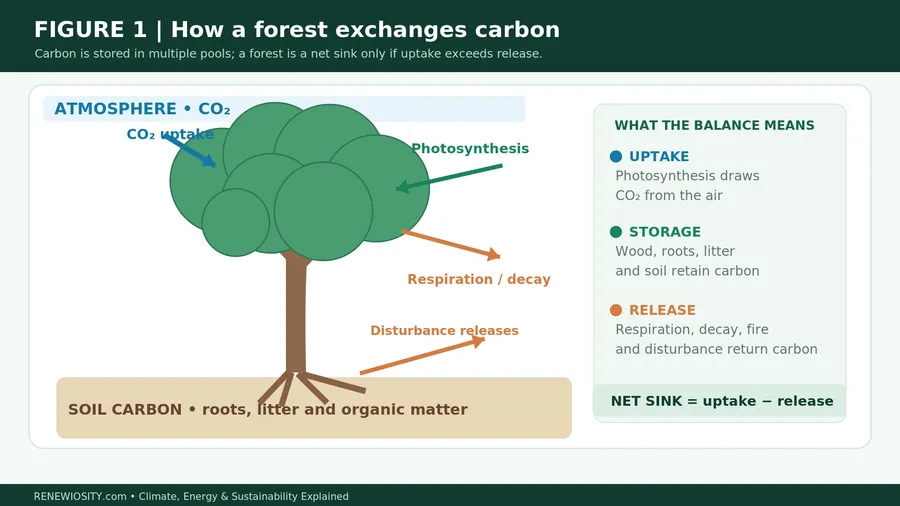
Figure 1. Trees take up CO₂ through photosynthesis, but respiration, decomposition and disturbances also return carbon. Net ecosystem uptake is the relevant measure.
7. How does the ocean absorb carbon dioxide from the air?
At the sea surface, CO₂ molecules pass between the atmosphere and ocean water. The net direction depends partly on the difference in CO₂ partial pressure between air and surface seawater. Where the air has relatively more CO₂, there is a tendency for net uptake into the water [6].
Dissolved CO₂ reacts with water and participates in a system of dissolved inorganic carbon species, including bicarbonate and carbonate ions. Physical circulation, wind-driven mixing and the transport of water into the ocean interior allow some of the carbon to move away from the surface [6,8].
Cold waters can generally dissolve more CO₂ than warm waters, but local currents, chemistry and biological activity also matter. This is why ocean uptake varies across regions and years rather than acting like one uniform sponge [6].
Oceanographers measure dissolved inorganic carbon, alkalinity, temperature, salinity and partial pressures to estimate CO₂ exchange. A patch of ocean can release CO₂ even while the global ocean is a net sink. Therefore, a map of local air–sea fluxes may show both directions at once, without contradicting the fact that the total modern ocean is absorbing a substantial quantity of human-caused CO₂.
8. What are the ocean’s solubility and biological pumps?
The solubility pump involves CO₂ dissolving into seawater and then being redistributed through ocean circulation and mixing. Some surface waters move into the deep ocean, carrying their dissolved inorganic carbon with them [6,7].
The biological pump starts in sunlit surface waters, where phytoplankton use dissolved CO₂ during photosynthesis. Some of their carbon becomes food for marine animals; some is respired back near the surface, while a portion sinks as particles or reaches deeper layers. Carbon that reaches depth may stay isolated from the atmosphere for long periods [7].
Neither pump implies that everything absorbed remains permanently stored. Upwelling and mixing may eventually return some deep-water carbon to the surface, and climate-driven changes in stratification can affect how quickly carbon moves through the ocean [6,7].
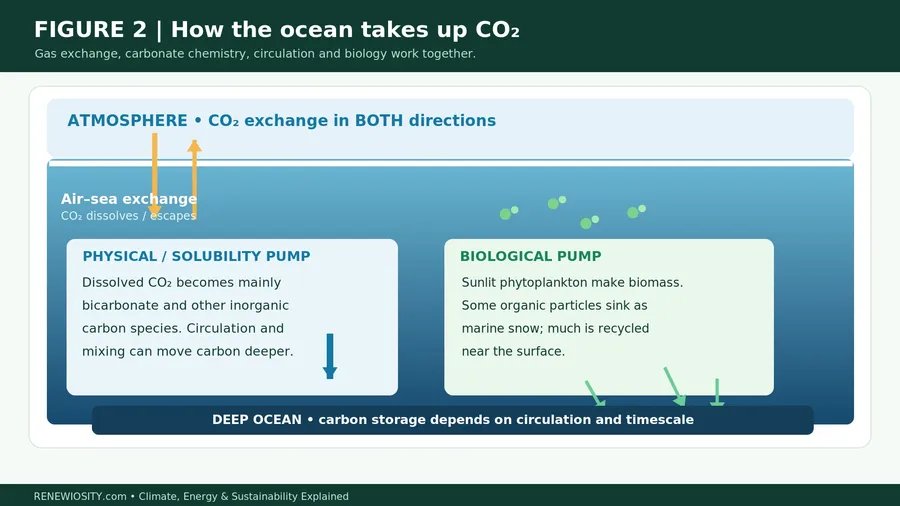
Figure 2. The ocean takes up CO₂ through air–sea exchange; dissolved carbon chemistry, ocean mixing and biological processes redistribute it.
9. Why do forests and oceans work differently?
Forests mainly add carbon to biomass and soils through photosynthesis. Oceans take up CO₂ through air–sea gas exchange, with ocean chemistry converting much of the dissolved CO₂ into other forms. Marine photosynthesis and circulation then help redistribute carbon [4,6,7].
A forest’s measurable uptake may change dramatically after logging, fire or drought. Ocean uptake responds to the air–sea concentration gradient, temperature, chemical buffering, winds and circulation. Both systems are dynamic, and both can be weakened by human impacts or climate feedbacks.
Crucially, the global land sink includes more than forests: grasslands, wetlands, soils, farms and other ecosystems also influence the net balance. The carbon-budget percentage assigned to land must not be described as a percentage captured by forests alone [1,3].
10. How much human CO₂ do land and ocean sinks absorb?
The peer-reviewed Global Carbon Budget 2025 provides revised estimates for the decade 2015–2024. Averaged across that decade, about 29% of human CO₂ emissions were absorbed by the ocean, about 21% by the net terrestrial sink and roughly 50% accumulated in the atmosphere [1,2].
These three shares are linked because the carbon emitted by humans must be accounted for among reservoirs, subject to measurement and model uncertainty. The percentages are rounded decade averages. They are not shares for every single year, and they are not claims that the whole terrestrial share comes from forests.
The IPCC’s earlier assessment of the 2010–2019 decade reported 23% ocean uptake, 31% land uptake and 46% atmospheric accumulation. These figures describe a different period and an earlier methodological assessment; they must not be mixed with the revised Global Carbon Budget 2025 shares [3].
It helps to separate the gross natural carbon cycle from the additional sink of human-added CO₂. Plants and soils exchange enormous amounts of carbon each year, as does the ocean surface, but most opposing natural flows approximately offset one another. The 29% and 21% figures represent estimated net uptake relevant to the modern human-driven carbon budget, not the total volume of CO₂ that leaves the atmosphere through photosynthesis or ocean exchange in every year.
11. What does a 100-tonne example tell us?
Consider a hypothetical 100 tonnes of human CO₂ emissions. If we apply the revised 2015–2024 average proportions solely for teaching purposes, roughly 29 tonnes would go into the net ocean sink, 21 tonnes into the net land sink and 50 tonnes would add to the atmosphere [1,2].
This is a percentage exercise, not a prediction that any particular year or individual source will cause exactly those flows. In reality, scientists estimate national and global carbon fluxes using measurements, ocean observations, atmospheric records and models; the uncertainties can be substantial, especially over land.
Figure 3 is a visual version of the same calculation. It makes the distinction between the destination of carbon over a decade and the size of existing carbon stocks. A huge stock in the ocean does not mean it absorbs all newly emitted carbon immediately.
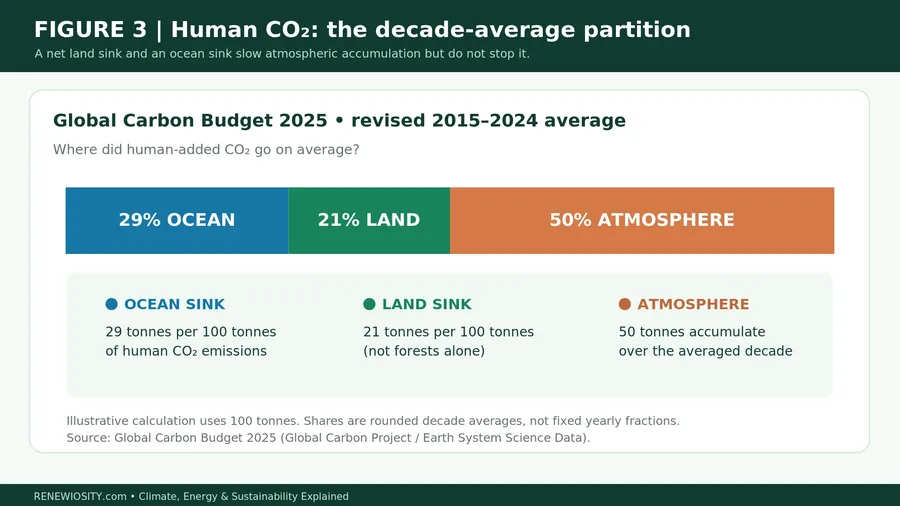
Figure 3. Revised Global Carbon Budget 2025 decade-average allocation of human CO₂ emissions (2015–2024): 29% ocean, 21% land, 50% atmosphere. Rounded estimates, not a single-year measurement.
Hypothetical 100-tonne exercise applying rounded Global Carbon Budget 2025 averages for 2015–2024; actual yearly emissions and carbon flows vary.
12. Why are these sinks under pressure?
Forests face rising risks from heat, prolonged drought, fire, pests, degradation and clearing. Some forests regrow and continue taking up CO₂; others can release carbon after major disturbances. Changes in water availability and soil processes can also reduce land uptake [3,12].
Ocean warming can reduce CO₂ solubility and alter mixing and circulation, while changes in biological productivity influence how carbon moves downward. The size and direction of individual responses differ across regions and time periods [6,7].
The 2025 carbon budget reports a relatively weak terrestrial sink in 2024 linked to El Niño conditions and disturbances, reinforcing why one year should not be mistaken for a stable long-term global uptake fraction [1,2].
A single year can depart sharply from the decade average. The updated global budget identifies substantial year-to-year variability in the terrestrial sink, including a weak land sink in 2024. That variability matters when interpreting news headlines such as “forests stopped absorbing carbon”: such claims may describe particular regions or years, while the global long-term budget may tell a different story. Always check the geography, period and method before drawing conclusions.
13. Does ocean carbon uptake have a hidden cost?
Yes. When more CO₂ dissolves in seawater, chemical reactions increase hydrogen-ion concentrations and shift the balance of dissolved carbonate species. This produces ocean acidification: ocean pH declines, even though the ocean remains alkaline overall [8,9].
Changing carbonate chemistry can make it harder for some corals, oysters and other organisms to build or maintain calcium-carbonate skeletons and shells. Impacts vary among organisms and habitats, and ocean acidification interacts with warming and other pressures [8,9].
Ocean absorption is therefore a climate-buffering service with ecological consequences. It is incorrect to describe the oceans as a harmless or unlimited disposal route for fossil-fuel CO₂.
14. What are mangroves, salt marshes and blue carbon?
Coastal vegetated ecosystems such as mangroves, salt marshes and seagrass meadows can store carbon in living plants and especially in waterlogged sediments. Their coastal carbon stocks are often called blue carbon [10,11].
These ecosystems also protect coastlines, provide habitat for wildlife, support fisheries and filter water. Protecting them can therefore support biodiversity and communities as well as carbon storage. Their gains are site-specific and depend on intact hydrology, ecological health and good management [10,11].
Blue carbon is not the same as the entire ocean sink measured in a global budget. Open-ocean gas exchange and deep-water circulation operate over vastly broader areas. Coastal restoration is valuable, but its contribution should not be exaggerated or counted twice.
Coastal wetland sediments are especially noteworthy because waterlogged conditions can slow decomposition and allow organic carbon to accumulate. Yet dredging, drainage or coastal development can reverse those gains. Good blue-carbon projects require baseline surveys, local participation, appropriate protection of habitat and follow-up monitoring. They are ecological interventions with many outcomes, not simply carbon-credit machines.
15. Can nature alone solve climate change?
No. Natural sinks take up a substantial part of current emissions, but the remaining CO₂ accumulates and affects climate for a very long time. The sinks are already responding to rising temperatures and changing environmental conditions [1,3].
Protecting forests, restoring wetlands and improving soil stewardship can be beneficial climate actions, especially when they also support biodiversity and local livelihoods. Their effect should be measured honestly and must not serve as an excuse to postpone the reduction of fossil-fuel emissions.
This distinction connects to What Does Net Zero Mean?: durable climate stabilization requires steep emissions reductions, with removals addressing residual emissions under credible accounting rules.
16. Five review questions and the main takeaway
Q1. Is a carbon reservoir automatically a carbon sink? No. A reservoir stores carbon; a sink has net uptake over the time period being assessed. Q2. Are all land sinks forests? No. Soils, grasslands, wetlands and other ecosystems contribute to the land balance.
Q3. Does every tonne absorbed by the sea remain there forever? No. Some carbon returns to the surface and atmosphere, while some reaches deeper stores. Q4. Does the 29/21/50 split apply in every year? No. It is a rounded 2015–2024 average from a specific research assessment.
Q5. Why can ocean absorption be harmful? Additional dissolved CO₂ changes seawater carbonate chemistry and lowers pH, affecting many marine organisms. The key takeaway is simple: forests and oceans are vital climate buffers, but protecting natural sinks and reducing emissions must happen together.
Technical discussions describe general principles; site-specific engineering decisions require appropriate professional evaluation.