
RENEWIOSITY / EXPLAINER
What Is Climate Change? Causes, Evidence and Consequences
What is climate change? Learn how the greenhouse effect, human emissions and natural variability shape Earth’s climate, and examine evidence from temperature, oceans, ice and sea level, plus practical responses.
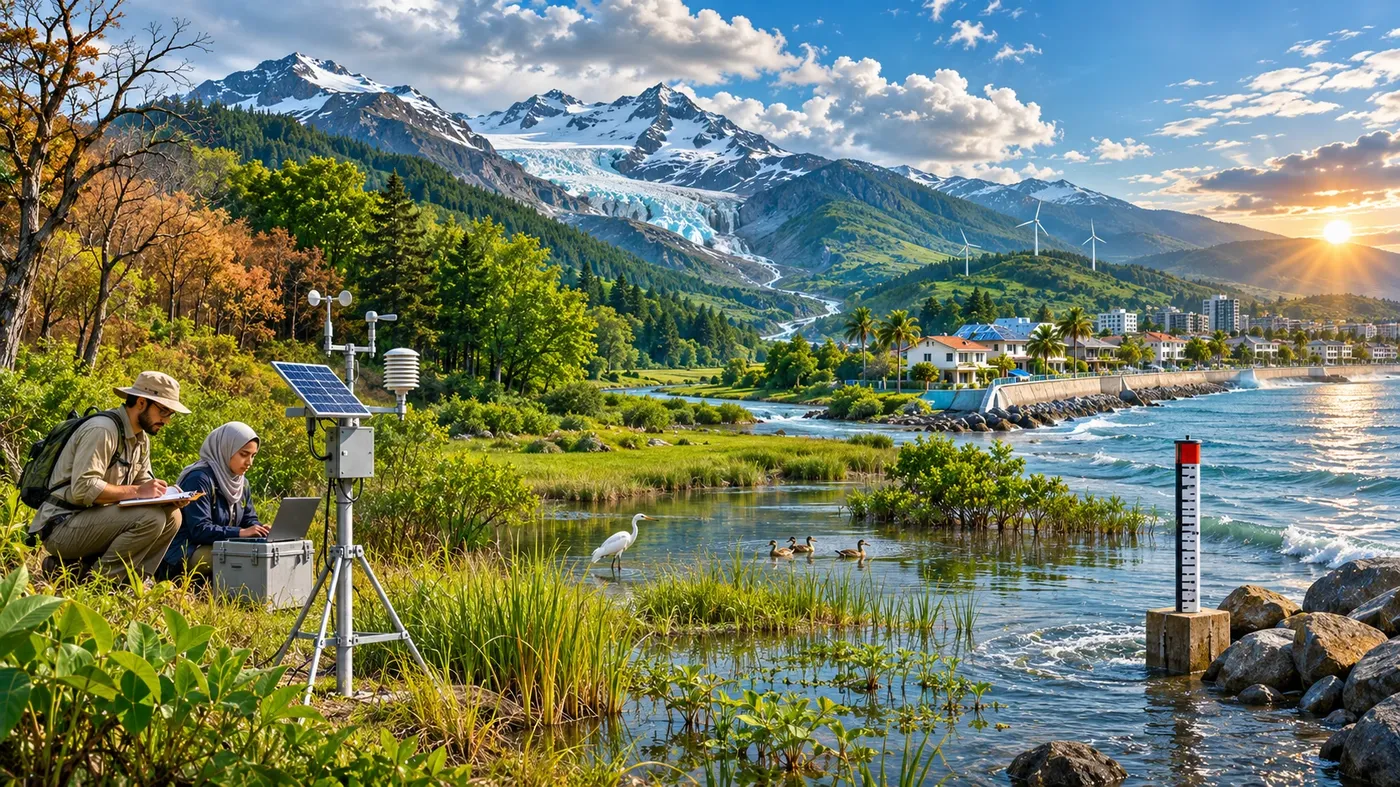
Climate change can sound like an enormous, distant subject: melting glaciers, unusually hot summers, coastal floods and arguments about greenhouse gases. Yet the first question is simple. What is climate change? It means a lasting change in Earth's climate, not merely a hot afternoon, a cold winter or one destructive storm. Today, the main driver of the warming trend is the buildup of greenhouse gases from human activity [1,3].
This guide starts with everyday experience and then follows the science. You will learn the difference between weather, climate, and global warming; what is changing in the atmosphere; how scientists know humans are responsible; which consequences are already observable; and what societies can do. We will separate measured facts from illustrations and from projections of a possible future.
Learning objectives
- Define weather, climate, global warming and climate change in clear everyday language.
- Explain the greenhouse-gas mechanism and identify the main human activities that increase emissions.
- Describe at least four independent observations that demonstrate a changing climate.
- Interpret a temperature anomaly and recognize why its reference baseline matters.
- Explain how climate change influences heat, rainfall, ice, oceans and people without attributing every event to a single cause.
- Distinguish mitigation from adaptation and recognize why both are needed.
1. What is climate change? A simple definition
Climate change is a persistent alteration in the usual patterns or statistical characteristics of climate over decades or longer. It includes changes in average temperatures, rainfall, the frequency of some extremes, the seasonal cycle, ocean conditions, ice and sea level. Earth has experienced natural climate changes in the distant past. The current rapid warming is predominantly human-caused [1,3,12].
Think about a town that has always experienced warm summers and cooler winters. Its temperature changes every day and every season. That alone is not climate change. But if the town experiences a sustained shift in temperature distributions over many decades, perhaps along with changed rainfall or more frequent dangerous heat, its climate has changed. The same idea applies to larger regions and to the globe.
The phrase global warming refers specifically to the long-term rise in the planet's average surface temperature. Climate change is broader: warming affects the water cycle, oceans, ice and ecosystems, and can change local conditions in complicated ways. A warming planet can still experience snowstorms or occasional cold days [1,2].
2. Weather versus climate: why a cold day does not disprove warming
Weather answers: What is the atmosphere doing right now? It describes today's rain, next week's wind or tomorrow's maximum temperature. Climate answers: What is typical for this place, and how is that pattern changing? Scientists often describe climate using observations spanning about 30 years, although longer or shorter intervals may be useful for specific questions [2].
A useful analogy is that weather resembles one person's daily steps, while climate is the pattern revealed by observing many days. One unusual day says little about a long-term trend. Likewise, one record-hot afternoon is not by itself proof of climate change, and one freezing night is not evidence against it. We need extensive records and careful comparisons.
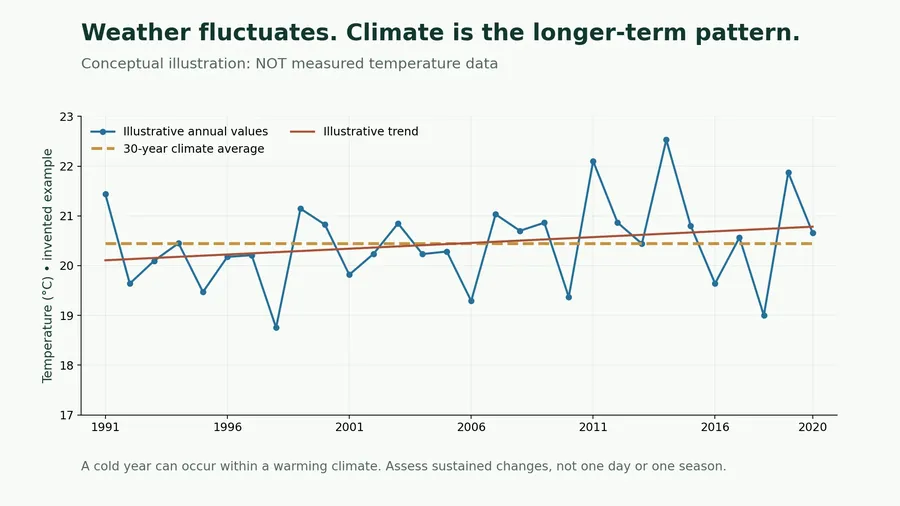
Figure 1. A conceptual, deliberately synthetic example shows year-to-year fluctuations around a longer-term pattern. These points are not observed climate measurements [2].
One important subtlety: climate is not only an average. It also involves the spread of possible conditions, seasonal timing, the probability of extremes and the relationships among temperature, moisture, winds and other factors. That is why a small shift in average temperature can matter significantly to extreme heat risk.
3. Why is the climate changing today?
Sunlight warms Earth's surface, which emits energy outward mainly as infrared radiation. Greenhouse gases such as carbon dioxide (CO₂), methane (CH₄) and nitrous oxide (N₂O) absorb and emit infrared radiation. Their presence changes how easily energy escapes to space. This natural greenhouse effect keeps Earth much warmer than it would be without an atmosphere. Adding more long-lived greenhouse gases increases the warming influence until the climate system adjusts [3,4].
Human activities add these gases in several ways. Burning coal, oil and natural gas releases CO₂; cement production also emits CO₂. Agriculture, fossil-fuel systems and waste release methane; fertilizers and some industrial activities add nitrous oxide. Deforestation and land-use change can release stored carbon and reduce the ability of ecosystems to absorb future emissions. The total impact depends on emissions, atmospheric lifetime and how the gases interact with Earth's energy budget [3,12].
Natural influences have not disappeared. Volcanic eruptions can temporarily cool the surface by injecting reflective aerosols; the Sun varies; El Niño and La Niña redistribute heat and influence individual years; and Earth's orbit affects climate over far longer periods. Scientists quantify these influences. They do not explain the dominant long-term warming observed since the middle of the twentieth century [4,11,12].
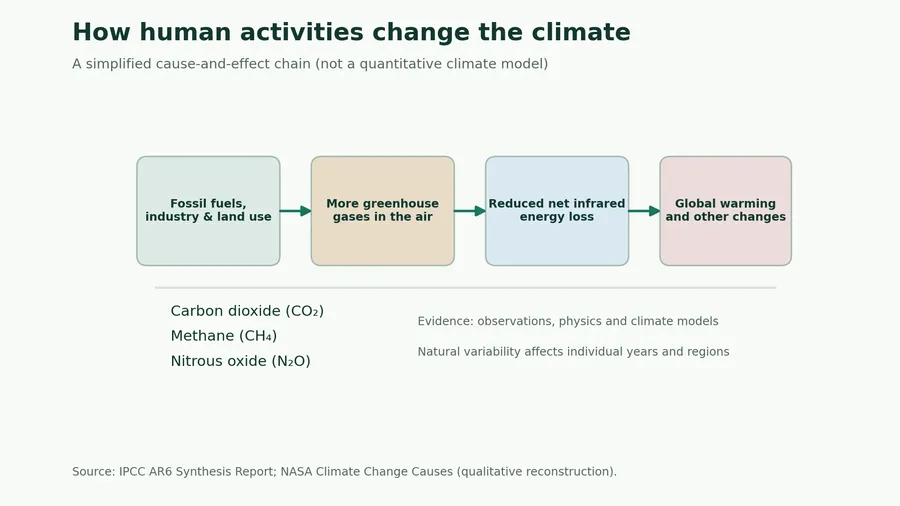
Figure 2. Simplified physical chain from human emissions to a changing climate. This is a conceptual figure, not a quantitative model [3,4].
4. How do scientists know humans are responsible?
Scientific attribution is not based on one thermometer or one climate model. Researchers combine laboratory physics, measured greenhouse-gas concentrations, the observed global temperature record, ocean measurements, satellite observations, geological evidence and computer simulations. Independent approaches converge on the same explanation: human activities, principally greenhouse-gas emissions, have unequivocally caused global warming [3,12].
There are recognizable physical fingerprints. The lower atmosphere and surface have warmed while the stratosphere has generally cooled, as expected from enhanced greenhouse-gas forcing rather than a stronger Sun. Satellite measurements show no sustained rise in incoming solar energy sufficient to account for recent warming. Models using natural drivers alone cannot reproduce the observed long-term trend as well as models that include human influences [4,11].
The IPCC estimated that human-caused global surface warming averaged about 1.1°C for 2011–2020 compared with 1850–1900. That is a historical multi-year comparison from its Sixth Assessment Report, not the temperature anomaly of a particular single year [3]. Its conclusion reflects a synthesis of a large body of research rather than a vote about one study.
5. The evidence: temperature, greenhouse gases, oceans and ice
The clearest sign is the temperature record. According to the World Meteorological Organization's State of the Global Climate 2025, global mean near-surface temperature in 2025 was approximately 1.43°C ± 0.13°C above the 1850–1900 average. The same report identifies 2024 as the warmest observed year, at around 1.55°C above that pre-industrial reference. The years 2015–2025 were the eleven warmest on record [6].
NASA independently reported that 2025 was cooler than 2024 but statistically close to 2023, and its published 2025 anomaly was 1.19°C relative to 1951–1980 [7,8]. These numbers should not be subtracted or compared as if they shared a reference period. Both are scientifically meaningful, but they use different baselines and data methods. This is a valuable lesson in interpreting climate statistics.
Greenhouse-gas measurements provide a second independent signal. NOAA maintains a global network for tracking atmospheric CO₂ [9]. The WMO reported a global mean CO₂ concentration of 423.9 ± 0.2 parts per million for 2024. That is a 2024 atmospheric concentration, not a claim about the 2025 annual mean [6]. The increase is consistent with the carbon released by human activities and with our understanding of the global carbon cycle.
The oceans provide a third major source of evidence. They absorb most of the excess energy accumulating in Earth's climate system, and ocean heat content reached a record high in 2025 according to WMO [6]. Warming seawater expands, while glaciers and ice sheets contribute additional water to the ocean. The IPCC estimated that global mean sea level rose by around 0.20 metres between 1901 and 2018, and satellite measurements show a continuing long-term rise [3,10].
A fourth line of evidence comes from the cryosphere, the frozen parts of Earth. Many mountain glaciers are retreating; land ice is being lost from Greenland and Antarctica; and Arctic sea ice has changed markedly. These observations do not all evolve smoothly every season. They form a consistent long-term picture when considered alongside changes in temperature, ocean heat and the water cycle [5,12].
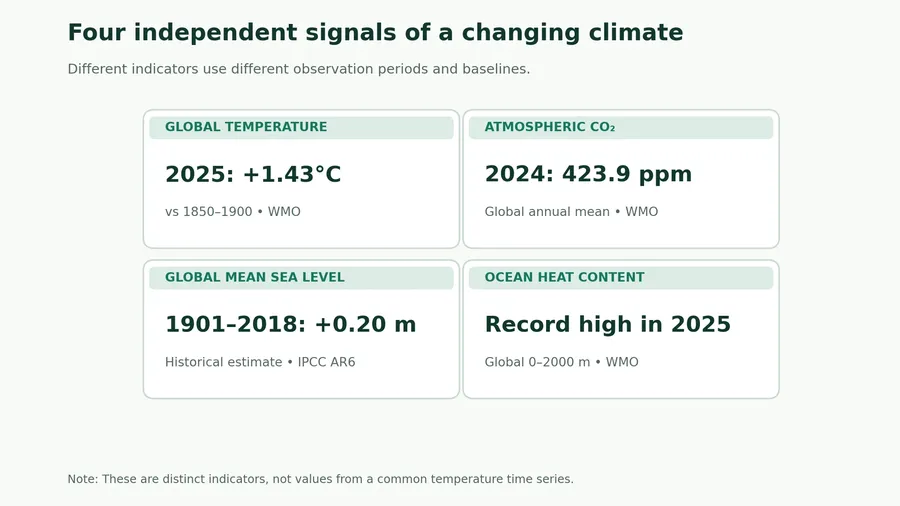
Figure 3. Four independent observations, with measurement years and baselines stated explicitly. The indicators do not form a single time series [3,6,9,10].
6. How should we interpret a temperature anomaly?
An anomaly is a difference from a specified reference average. It does not mean that the temperature itself is unusually close to zero. For example, an anomaly of +1.2°C tells us the observed value is 1.2°C higher than the chosen baseline. Scientists use anomalies because they allow fair comparisons between measurements from different regions and times, once the reference system is defined [7].
Consider a deliberately hypothetical town. Its baseline mean annual temperature is 25.0°C and its observed mean for a later comparison period is 26.2°C. Its anomaly is +1.2°C. These invented values illustrate the calculation only; they are not measurements from any real town, and they do not represent the global warming level.
The important requirement is to state which baseline was used. WMO often reports warming relative to an 1850–1900 estimate for pre-industrial conditions, while NASA's global-temperature indicator commonly uses 1951–1980. A number without its time period, geographical scope and observational method can mislead even when the arithmetic is correct [6,7].
7. What about the 1.5°C threshold?
The Paris Agreement aims to limit long-term global warming to well below 2°C, while pursuing efforts to limit it to 1.5°C above pre-industrial levels. A single calendar year that exceeds 1.5°C does not, by itself, establish that the long-term Paris Agreement warming threshold has been breached. Annual temperature fluctuates because of internal climate variability and other short-term influences [3,6].
At the same time, very warm individual years are serious evidence that the long-term climate is warming and approaching important risk levels. The distinction between a one-year value and a sustained warming level is not an excuse to dismiss the measurement. It helps avoid turning a meaningful scientific threshold into a misleading headline.
8. What consequences are already being observed?
Heat: A warmer background climate makes many hot extremes more likely and often more intense. Heat can affect health, outdoor work, crop yields, cooling demand and electricity systems. The severity of the effect depends on humidity, nighttime temperatures, housing, public-health preparedness and local conditions. A global average change does not mean that every region warms equally [3,12].
Heavy rainfall and flooding: Warmer air can hold more water vapour, which can increase the potential for intense rainfall when suitable weather systems are present. Actual flood damage also depends on terrain, drainage, land cover, river management and exposure. It is misleading to say that every flood was caused by climate change; it is also misleading to claim that warming cannot affect flood risks [3,12].
Drought, fire weather and water supplies: Changes in evaporation, precipitation, snowpack, soil moisture and circulation patterns alter risks differently across regions. For some places, greater heat intensifies drying even if annual rainfall changes little. Wildfire damage additionally depends on vegetation, ignition, suppression practices and settlement patterns [3].
Oceans and coasts: Rising seas increase the baseline water level on which storm surges and high tides occur. This raises risks for low-lying communities and coastal wetlands, especially where the land is also subsiding. Ocean warming affects marine ecosystems, and the ocean's absorption of CO₂ causes acidification, a chemically distinct process with important ecological consequences [3,10].
Ecosystems and food: Changing temperatures and rainfall can shift growing seasons, species ranges and the timing of biological events. Agricultural outcomes depend on crop type, water availability, pests, management and adaptation, so impacts vary substantially. These effects are connected to human health and livelihoods rather than confined to wildlife documentaries [3,5].
9. Does climate change cause every storm, drought or wildfire?
No. Individual events arise from many interacting influences. Scientists examine how warming has changed an event's probability or severity, compared with a hypothetical world without the human-caused climate change. This research is called event attribution. For some heat events, the human influence is strong and clear; for other event types or locations, the evidence and mechanisms are more complex [3,12].
Imagine that a loaded die is slightly more likely to land on a six. You cannot prove why one particular roll was a six just by looking at it, but you can detect the changing probabilities over many rolls. Climate risks are far more complicated than dice, yet the analogy helps explain why statements about likelihood and intensity are often more accurate than an absolute claim that warming caused or did not cause one disaster.
10. Can nature alone explain the current warming?
Earth's climate has always responded to natural influences, including orbital changes, volcanoes, variations in solar output and ocean-atmosphere cycles. Recognizing those processes is essential to climate science. But their characteristic timing and physical fingerprints do not match the full pattern of modern warming [4,11,12].
For example, there has been no sustained increase in solar energy received by Earth since the middle of the twentieth century that could explain the observed rapid rise in global temperature. The simultaneous warming of the lower atmosphere and cooling of the stratosphere supports increased greenhouse-gas forcing. A scientific explanation must fit all the independent evidence, not only one appealing alternative [11].
11. What does climate change mean for energy and engineering?
Climate change is closely connected to energy because most fossil-fuel combustion releases CO₂. Reducing emissions involves both producing energy with lower life-cycle greenhouse-gas impacts and using energy more efficiently. Wind, solar, hydropower, nuclear power, energy storage, electrification and improvements in industrial processes all have roles, with tradeoffs and technical limits that deserve honest analysis [3].
Reliable electricity systems need careful planning: grids must integrate variable renewable generation, storage, flexible demand and firm capacity. In industry, heat recovery, process efficiency, electrification and lower-carbon fuels can lower emissions. The relative benefits depend on geography, material supplies, operational conditions, costs and full life-cycle impacts. There is no universal technology that solves the whole challenge alone.
Readers wanting more technical detail can explore RENEWIOSITY's Industrial Energy Efficiency & Heat Recovery hub and Renewable Energy Economics & Optimization hub. For background, start with the greenhouse effect and the historical global clean-energy share.
12. Mitigation versus adaptation: two necessary responses
Mitigation means addressing the causes of climate change, principally by reducing greenhouse-gas emissions or increasing durable removal of CO₂ from the atmosphere. Examples include more efficient buildings, cleaner electricity, industrial process changes, methane leak control, protecting carbon-rich ecosystems and developing robust low-emissions infrastructure. The climate benefit depends on how much emissions are actually avoided or removed [3].
Adaptation means responding to the climate changes and risks that are already occurring or expected. Examples include heat-action plans, flood-warning systems, resilient water supplies, drainage and coastal planning, agricultural adjustments and better protection of vulnerable populations. Adaptation does not stop further warming, and mitigation cannot instantly remove all near-term risks. They are complementary, not competing, tasks [3].
Many projects can offer both kinds of benefits. For example, a well-designed urban tree programme can shade streets and reduce some cooling demand, while also helping people cope with dangerous heat. But projects must be evaluated carefully: water use, ecology, location, maintenance and social impacts affect whether a measure actually works.
13. How can someone assess a climate claim?
Before sharing a dramatic climate statistic, ask: What variable is being measured? Over which years and area? Relative to what baseline? From what source? Distinguish a trend from a short-term fluctuation, a global average from a local event, and a measured observation from a model projection. Look for primary datasets and major scientific assessments rather than a chart whose source and axes are missing.
It also helps to ask whether the claim confuses weather with climate, a single exceptionally warm year with a sustained threshold, or correlation with attribution. Scientists report uncertainty because measurements and models have limits. Properly explained uncertainty is a sign of careful analysis, not evidence that researchers know nothing.
Finally, consider sustainability as well as emissions. A proposed climate solution should be judged by whether it lowers climate impacts and by its broader effects on people, materials, land, water and ecosystems. Our companion guide, What Is Sustainability?, explains why a solution described as green is not automatically sustainable.
14. Frequently asked questions
Q1. Is climate change the same as global warming? No. Global warming is the long-term rise in global surface temperature. Climate change includes that warming and its wider effects on rainfall, oceans, ice, seasons, ecosystems and extremes [1].
Q2. How can global warming occur if some places experience severe cold? Weather varies naturally across days, regions and seasons. A changing global temperature distribution does not eliminate every cold event. Evaluate long-term records rather than isolated examples [2].
Q3. Is the Sun causing the modern warming trend? Solar changes influence climate, but measurements and atmospheric fingerprints do not support the Sun as the principal explanation for recent global warming [11].
Q4. Did one hot year mean the 1.5°C Paris target was permanently crossed? No. Annual deviations are not identical to a long-term warming threshold, although exceptionally warm years are a serious warning sign [3,6].
Q5. Why does a small global average temperature increase matter? It represents a shift across the entire planet. Land and polar regions can warm faster, and the probability of certain extremes changes. Effects on people and ecosystems depend on exposure and local conditions [3,12].
15. Key takeaways and a short review
Key point: Climate change is a persistent shift in climate patterns, not one unusual weather event. Current global warming is predominantly caused by human greenhouse-gas emissions. Multiple independent observations show rising temperatures, increasing greenhouse-gas concentrations, heating oceans, rising seas and changes in ice. Both reducing emissions and preparing for climate impacts are essential [3,5,6].
Try these review questions: (1) How would you explain the difference between weather and climate to a child? (2) Why is the climate anomaly baseline important? (3) Name three independent observations of global climate change. (4) What evidence points to greenhouse gases rather than the Sun as the primary modern driver? (5) Give one example each of mitigation and adaptation. The answers follow directly from the numbered sections above.
Technical discussions describe general principles; site-specific engineering decisions require appropriate professional evaluation.