
RENEWIOSITY / EXPLAINER
What Does Net Zero Mean? Carbon Neutrality and Net-Zero Emissions Explained
Net zero means balancing remaining human-caused emissions with genuine atmospheric removals after deep emissions reductions. Discover how net-zero CO₂ differs from net-zero greenhouse gases, why carbon neutrality claims need scrutiny, and what credible climate action looks like.
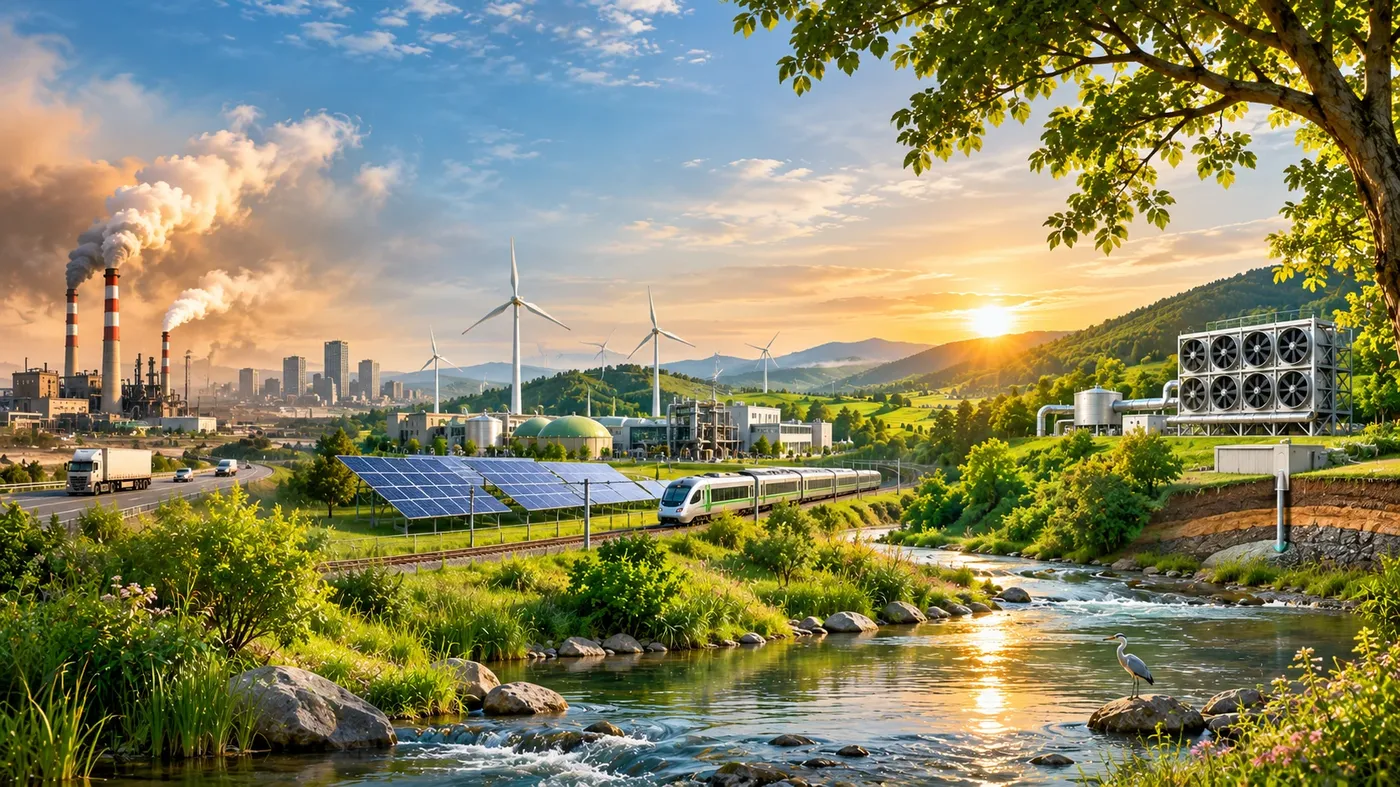
When an advertisement says a product is "carbon neutral" or a government promises "net zero by 2050," what has actually happened to the gases warming our planet? The answer is not simply "no more emissions." It is a carefully defined balance between emissions and genuine removals, built on deep reductions [1,2].
This guide explains the terms without assuming a scientific background. You will see a hypothetical calculation, learn why avoided emissions differ from atmospheric removals, compare CO₂-only and all-greenhouse-gas pledges, and discover practical questions to ask about a net-zero promise.
Learning objectives
- Define net-zero CO₂ emissions and distinguish them from an absolute absence of greenhouse gas emissions.
- Explain how residual emissions, actual atmospheric removals, and a defined reporting boundary determine a credible net-zero balance.
- Distinguish net-zero CO₂, net-zero greenhouse gases, carbon neutrality and avoided-emission carbon credits.
- Use a simple hypothetical tonnes-of-CO₂-equivalent calculation to find gross emissions, removals and net emissions.
- Identify Scope 1, Scope 2 and Scope 3 emissions and explain why incomplete inventories create misleading claims.
- Evaluate a net-zero pledge by inspecting its reductions, target year, accounting methods, removal durability and reporting.
1. What does net zero mean in simple words?
Imagine filling a bathtub while its drain is open. If water flows in faster than it leaves, the level rises. If the two flows become equal, the level stops increasing. This analogy captures the idea of net zero, but with an important difference: carbon dioxide can remain in the climate system for a very long time, so balancing its flows must happen through genuine emissions cuts and atmospheric removals, not by pretending that emissions have disappeared [1,2].
In climate science, net-zero carbon dioxide emissions means that human-caused CO₂ released to the atmosphere is balanced by human-caused CO₂ removed from it over a specified period. The word net signals a balance after counting both flows. It does not mean that every chimney, aircraft, farm or household has stopped emitting entirely [1].
A credible plan aims to eliminate as much gross pollution as possible first. Some remaining emissions may be unusually difficult to eliminate, such as particular industrial processes or parts of agriculture. Those residual emissions can require verified atmospheric removals. Net zero should therefore be understood as a destination reached through deep reductions, not as permission to continue avoidable emissions [2,3].
The relevant questions are: Which gases are counted? Which activities are inside the accounting boundary? How much gross pollution is truly reduced? What carbon is actually removed from the atmosphere, how durably is it stored, and when does the balancing occur? These questions give the term scientific meaning.
2. Net zero is a balance, not the absence of emissions
Suppose an imaginary small industrial facility emits 100 tonnes of CO₂-equivalent greenhouse gases in an initial reporting year. It upgrades its equipment, saves energy and changes its fuel supply, reducing gross emissions by 85 tonnes. If 15 tonnes still occur, a balancing removal of 15 tonnes would yield a net accounting balance of zero, provided those removals meet the relevant accounting rules and concern the same correctly defined gases [1,5].
The numbers in this example are hypothetical, not a measured facility, an official corporate threshold, or a universal requirement. They illustrate the arithmetic: emissions minus verified removals equals net emissions. In reality, non-CO₂ greenhouse gases require an explicitly chosen conversion metric, and one actor's declared neutral balance is not proof that the entire planet is at net zero.
If the same facility had instead continued emitting 100 tonnes and purchased 100 tonnes of avoided-emission credits elsewhere, that would be a different claim. Avoiding hypothetical emissions by another actor does not itself extract the facility's carbon from the air. Credible net-zero pathways distinguish the physical removal of carbon from the financing of emission reductions elsewhere [9,10].
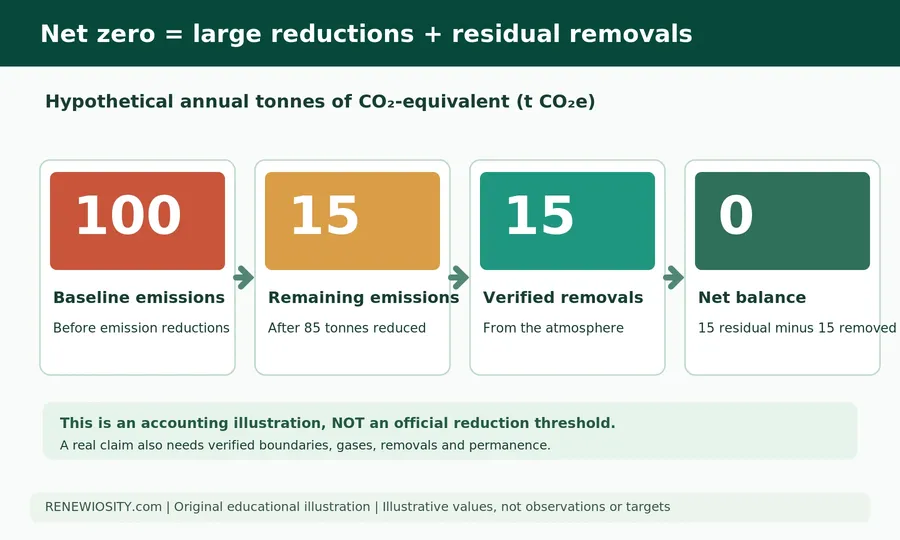
Figure 1. Hypothetical net-zero arithmetic: a large reduction in gross emissions precedes verified removals of a small residual. This is an explanatory example, not a standard-specific emissions threshold.
3. Net-zero CO₂ versus net-zero greenhouse gases
Carbon dioxide is the best-known greenhouse gas, but it is not the only one. Human activity also emits methane, nitrous oxide and fluorinated gases. Net-zero CO₂ refers to carbon dioxide emissions balanced with carbon dioxide removals. Net-zero greenhouse gas emissions covers a broader set of gases and weighs their emissions and removals with an explicitly chosen comparison metric [1,2].
The commonly used accounting unit CO₂-equivalent (CO₂e) expresses different gases on a shared scale, frequently using a specified global warming potential over 100 years. It is a reporting convention, not a statement that methane behaves physically like carbon dioxide. Methane is generally shorter-lived than CO₂ and its climate effects change on different timescales [1].
This distinction matters when someone promises 'net zero by 2050'. Are they addressing only CO₂ or all covered greenhouse gases? Is the promise for one business, all its suppliers, a country or the world? The boundary and metric must be stated; otherwise two impressive-sounding pledges may not describe comparable outcomes.
For the global temperature goal, the IPCC emphasizes achieving at least net-zero CO₂, alongside deep reductions in other greenhouse gases. Global net-zero greenhouse gases may occur later under many modelled pathways, and reaching it can imply net-negative CO₂ emissions [2].
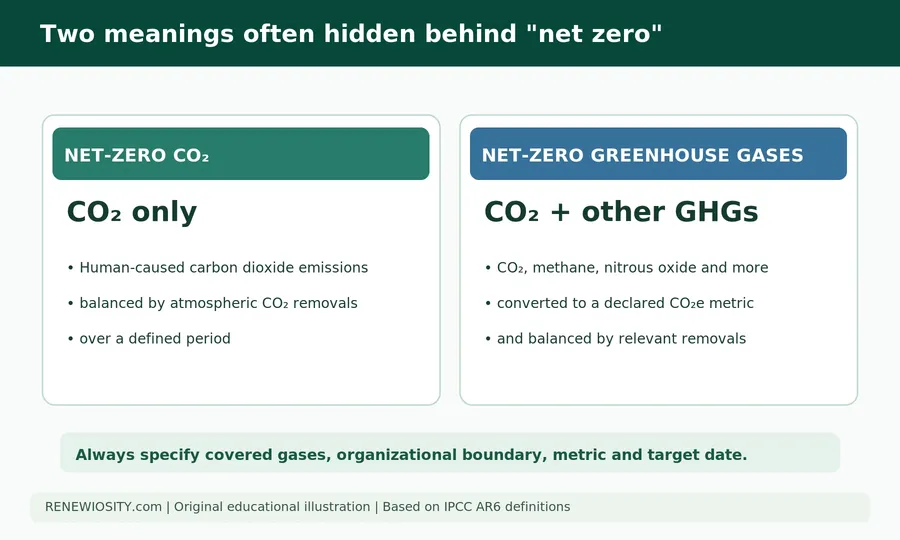
Figure 2. Net-zero CO₂ and net-zero greenhouse gases are related but distinct accounting outcomes. The latter uses an explicitly declared metric to compare several gases.
4. Net zero, carbon neutral, zero emissions and climate positive
The labels on products and company reports can sound interchangeable. They are not. Zero emissions suggests no emissions within the claimed boundary. Net zero permits a small residual balance if credible removals counter it. Carbon neutrality is an overlapping accounting concept whose use and requirements vary with context, scale and standards. Net negative means removals exceed emissions over the specified period [1,7].
At the global scale, the IPCC treats carbon neutrality and net-zero CO₂ as equivalent concepts. At the level of individual organizations or products, carbon-neutrality schemes may allow offsetting outside the reporting entity's direct boundary, while net-zero claims usually require far-reaching reductions in the entity's own operations and value chain plus appropriate treatment of residuals [1,7,8].
As of November 2026, ISO 14068:2026 is the current published ISO standard on carbon neutrality, replacing ISO 14068-1:2023. It prioritizes reductions and value-chain removals before offsetting and does not itself set requirements for net-zero greenhouse gases. Claims should specify which standard they follow, which years they cover and what they actually demonstrate [7].
Other phrases, including 'climate positive' and 'carbon negative', are used inconsistently in marketing. Treat them as prompts for investigation, not automatic scientific certifications. Ask for the emissions inventory, the accounting method, the reductions achieved and the evidence supporting removals [11].
5. Why net zero matters for global warming
Carbon dioxide accumulates because an important part of emissions persists in the atmosphere and the wider carbon cycle. As long as the world continues to add net human-caused CO₂, the cumulative amount rises, driving additional long-term warming. For stabilizing CO₂-induced warming, bringing global net CO₂ emissions close to zero is therefore crucial [2].
Net zero is not a switch that immediately restores a past climate. Oceans and ice sheets respond slowly, and some effects, including sea-level rise, can continue for a long time. Deep cuts in methane and other pollutants have additional benefits, and adapting to already-existing climate risks remains necessary [2].
The Paris Agreement calls for a balance between human-caused greenhouse gas emissions and removals in the second half of this century. Modelled pathways consistent with limiting warming around 1.5°C generally reach global net-zero CO₂ in the early 2050s, with substantial near-term reductions required well before that date [2,4].
There is no single magical target year for every country or sector. Historical responsibility, resources, technical options and equity influence fair national and sectoral pathways. But a distant year cannot replace action today: cumulative emissions between now and the target largely influence the warming outcome [2,11].
6. Worked example: calculating net emissions
A simple balance can make the idea tangible. Consider an invented company with 100 tonnes CO₂e of annual gross emissions in its baseline year. Through efficiency, electrification and process improvements, it cuts those emissions to 15 tonnes CO₂e in a later year. If the organization also has 15 tonnes CO₂e of independently verified, appropriate, atmospheric removals attributable to the same accounting period, its illustrative net balance is zero.
The important numbers are not only the final zero. The company has reduced its own gross emissions by 85%, and only the difficult residual remains. This percentage is not being presented as an SBTi threshold or a standard's universal requirement. Actual compliance depends on the applicable standard, reporting boundary, gases, target year and treatment of removals [5,8].
An auditor would also ask whether both figures use the same reporting year and accounting metric, whether the removals are additional and durable, and whether any emissions were omitted. A simple subtraction can illustrate the balance but cannot by itself establish the scientific integrity of the claim.
7. What are emissions reductions?
An emission reduction means preventing or decreasing greenhouse gases before they enter the atmosphere. Installing efficient motors, avoiding unnecessary heat losses, switching from fossil-fuel boilers to appropriate low-carbon heat, improving logistics and reducing methane leaks can all reduce gross emissions when assessed against a sound baseline [2,12].
Reductions should be measured against a clearly described starting inventory rather than a hypothetical future in which emissions might have been higher. An actual factory's annual emissions falling from 10,000 to 7,000 tonnes is a different accounting statement from saying it avoided 3,000 tonnes compared with a projected business-as-usual path. Both metrics can be informative, but should not be silently exchanged.
Practical decarbonization is not restricted to renewable electricity. Industrial process design, materials efficiency, product lifetimes, demand management, transport planning, sustainable land management and better energy systems also matter. RENEWIOSITY's engineering topics explore how technical changes turn these principles into measurable performance improvements.
8. What is carbon dioxide removal?
Carbon dioxide removal (CDR) refers to human activities that take CO₂ from the atmosphere and store it in geological, terrestrial or ocean reservoirs, or in durable products. Examples include certain forms of ecosystem restoration, carefully managed biochar, direct air capture with secure storage, and other approaches under development. Each method has limits and trade-offs [1,2,10].
Not every carbon-capture project is an atmospheric removal. Capturing CO₂ from a fossil-fuel power station can prevent some emissions from reaching the atmosphere, but that is normally emissions abatement, not removal of CO₂ already in the ambient air. Careful definitions matter when counting a net-zero balance [1].
Removals must be assessed for measurement uncertainty, whether the action genuinely adds storage beyond what would otherwise occur, leakage, reversal risks and the duration of storage. A forest can store carbon while it grows, but fires, disease or land-use change can release it. Well-managed geological storage may offer different durability characteristics and costs [10].
Removal capacity is currently limited relative to the scale of global emissions. That is why serious net-zero strategies prioritize large cuts in gross emissions rather than assuming future removal technology will make existing emissions harmless [2,10].
9. Carbon offsets: why claims need scrutiny
A carbon credit is a tradable unit issued under a particular programme for an asserted climate benefit, often described in tonnes of CO₂e. Some credits finance projects that avoid or reduce emissions relative to an estimated baseline. Others reflect removals and storage. These are not physically identical outcomes [10].
Suppose one company pays to help another avoid 100 tonnes of emissions. That funding may be useful, provided the reductions are real and additional. But the transaction does not automatically extract 100 tonnes of the buyer's previously emitted CO₂. If both companies claim the same outcome without appropriate accounting safeguards, double counting can also arise.
The revised Oxford Offsetting Principles urge organizations to cut their emissions first, then move toward removal-based compensation for genuine residual emissions, with storage that minimizes the risk of reversal. The United Nations High-Level Expert Group likewise warns against using credits as a substitute for interim value-chain emissions reductions [10,11].
This does not mean all climate-finance projects are worthless. It means financial support for broader climate action should be reported separately from what a company's own physical net-zero achievement has demonstrably accomplished.
10. Who is responsible for Scope 1, 2 and 3 emissions?
A credible organizational claim begins by saying what is counted. Under the GHG Protocol, Scope 1 concerns direct emissions from sources owned or controlled by a company, such as its own fuel-burning equipment. Scope 2 covers indirect emissions associated with purchased electricity, steam, heat or cooling. Scope 3 covers other indirect value-chain emissions, such as materials purchased, transport, product use and disposal [5,6].
Imagine a manufacturer that electrifies its own factory. Its on-site fossil-fuel combustion may fall, improving Scope 1. But the electricity used to power its equipment must still be accounted for in Scope 2. The emissions associated with producing materials and using or disposing of its products may sit in Scope 3. Looking at only one category can paint a misleading picture [5,6].
Some emissions cannot be calculated with perfect precision. Businesses use metered data, fuel records, supplier information and emissions factors, with methodological disclosures and periodic improvements. The goal is to avoid hiding large parts of the value chain behind an attractive headline.
11. A credible net-zero pathway: measure, reduce, remove, disclose
An effective sequence begins with a transparent inventory, a dated baseline and explicit organizational or territorial boundaries. Next, the entity sets near-term, measurable goals and reduces gross emissions across relevant operations and value chains. Only after addressing feasible reductions should residual emissions be matched with appropriately defined, high-integrity removals [8,9,11].
Progress reporting should distinguish gross emissions, emissions reductions, removals, carbon credits purchased or retired, and the net balance. Combining these figures into a single marketing number prevents readers from seeing what changed in the real world. Independent assurance can improve confidence but does not remove the need to examine a claim's scope [5,7].
Corporate climate target guidance continues to evolve. SBTi released Corporate Net-Zero Standard Version 2.0 in June 2026; in November 2026, Version 1.3.1 remains the applicable established validation route, with validation under Version 2.0 expected to begin in early 2027. Standards and validation dates should be checked against the current SBTi guidance rather than frozen permanently in an article [8,9].
A strong transition plan also states who is responsible, how capital and engineering decisions support the targets, and how progress will be reviewed. It should be consistent with investment decisions rather than relying on distant promises alone [11].
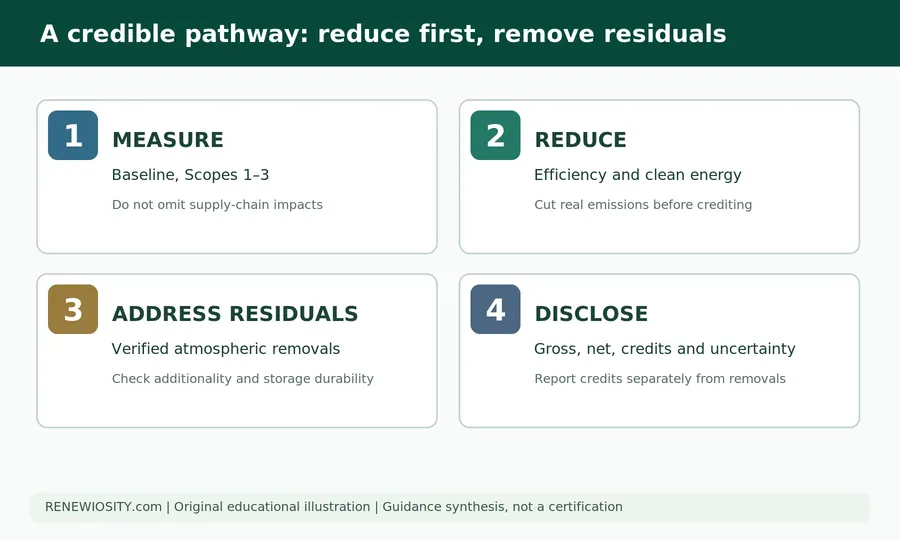
Figure 3. A credible climate strategy starts with an inventory and real reductions, then addresses residual emissions and discloses all accounting decisions. Source synthesis: IPCC, GHG Protocol, Oxford principles and SBTi.
12. What do net-zero goals mean for energy systems?
Power generation, transport, buildings and industry can reduce carbon emissions through combinations of efficiency, electrification, low-emission generation, process improvements and changes in materials or operations. Electricity is especially important because electrifying many end uses can make their emissions decline as the grid becomes cleaner [12].
Energy-sector pathways are scenarios, not predictions that automatically come true. The IEA's Net Zero Roadmap explores one possible transformation requiring rapid change in clean power, energy demand, transport, buildings and industry. Its calculations depend on assumptions about technology, policy and investment [12].
For RENEWIOSITY readers, the key connection is practical. Our article on the historical share of clean energy explains how quickly energy supplies have changed, while the industrial efficiency, battery, hydrogen and economics sections explain choices and constraints faced by real engineers. Net zero is the destination; engineering, policy, finance and behavior determine the route.
13. Net zero and sustainable development are not identical
A process may be low-carbon yet still create significant environmental or social impacts. Large infrastructure may affect land, water, mineral supply chains or nearby communities. A climate solution can help reduce emissions while still requiring careful design, safeguards and fair decision-making [2,11].
Conversely, a project can create social benefits without being compatible with a net-zero pathway. Climate accounting is therefore one necessary part of assessing sustainability, not a universal scorecard for water, biodiversity, jobs, human rights or resource depletion. This is why it helps to read What Is Sustainability? alongside this article.
Good public communication should acknowledge trade-offs rather than promise that every product or technology labelled 'green' is entirely sustainable. Net zero concerns a specified greenhouse gas balance; sustainability addresses wider questions about what societies can maintain over time.
14. How can you evaluate a net-zero claim?
When an airline, city, product or company announces that it is 'net zero', start by checking the exact claim. Is it an achieved result or a distant target? Which greenhouse gases, years and organizational boundaries does it cover? What are its reported gross emissions, not just its claimed net balance?
Then ask how much emissions reduction happened within that boundary, and whether there is a credible near-term pathway. Inspect the quantity and type of removals. Are they atmospheric removals or avoided-emissions projects? How long is carbon expected to remain stored? Are monitoring, independent verification, uncertainty and reversal risks explained [7,10,11]?
Finally, look for a public inventory, clear methodology, annual progress, independent scrutiny where appropriate, and honest treatment of suppliers and product use. Any claim that depends entirely on purchasing inexpensive credits while emissions continue unchanged deserves careful examination.
No single checklist can guarantee integrity. But these questions help readers distinguish meaningful reductions from a slogan, and they give businesses a constructive standard for improving their plans.
15. Five common questions about net zero
Q1. Does net zero mean no pollution at all? No. A net-zero greenhouse gas claim concerns a specified balance of covered climate-warming gases and removals. It does not automatically eliminate local air pollutants, water contamination or other environmental impacts.
Q2. Can tree planting make a fossil-fuel business net zero overnight? Planting trees can support ecosystems and may provide some long-term carbon uptake, but young trees take time to grow, storage can reverse, and a project must satisfy strict accounting rules. It should not replace avoidable emissions reductions [10].
Q3. Is carbon neutrality the same as net zero? Not necessarily at the company or product level. There is overlap, but the boundary, accounting approach and use of offsets can differ. State the exact standard and claim [1,7].
Q4. Is net zero by 2050 enough if emissions keep rising now? No. The cumulative amount emitted before that date matters enormously. Early cuts influence the total warming and later dependence on removals [2].
Q5. Is a product 'zero carbon' if its factory uses solar power? Not automatically. Materials, transport, electricity accounting, manufacturing, use and disposal may all contribute to its lifecycle footprint. A product claim needs an appropriately defined and assessed boundary [5,7].
16. Key takeaways and where to explore next
Net zero is a balance, but it must be a credible physical and accounting balance. Its defining feature is deep reduction of human-caused emissions, with well-defined removals addressing emissions that remain difficult to eliminate. It is not interchangeable with no emissions, a generic offset purchase or every type of carbon-neutrality label [1,7,10].
The clearest way to evaluate a target is to ask what is counted, how much gross emissions actually fall, what remains, what is removed from the atmosphere, and how the result is verified. That approach turns a vague promise into questions that can be answered with measurements, choices and transparent records.
For the background science, start with the greenhouse effect and climate change explained. To understand how energy supply is changing, visit the clean-energy timeline. For the broader societal context, read What Is Sustainability?. To pursue calculations and design, explore our industrial energy efficiency and energy economics hubs.
Technical discussions describe general principles; site-specific engineering decisions require appropriate professional evaluation.