
RENEWABLE ENERGY / KNOWLEDGE HUB
Industrial Energy Efficiency & Heat Recovery
Industrial energy efficiency is the engineering discipline of delivering the required products, heating, cooling and mechanical work with less wasted energy. Industrial heat recovery captures thermal energy that a process would otherwise reject and puts it to useful work in another part of the plant. This topic brings together heat transfer, thermodynamics, process integration, equipment design and industrial decarbonization.
Why industrial waste heat matters
Many chemical, manufacturing and energy facilities discharge hot flue gases, warm cooling water, heated products or surplus process steam. Recovery can reduce purchased fuel or electricity when there is a practical heat demand at the right temperature, location and time. However, waste heat is not automatically renewable energy. It is a resource-efficiency opportunity whose emissions benefit depends on the displaced energy source and the full system boundary.
Where recoverable heat appears
- High-temperature streams: furnace and kiln exhausts, combustion flue gases, hot reactor products and certain metallurgical operations.
- Medium-temperature streams: dryer exhausts, process condensate, compressor discharge and warm liquid processing streams.
- Lower-temperature streams: cooling water, refrigeration condenser heat, low-grade process water, wastewater and ventilation exhaust.
The labels high, medium and low temperature are application dependent. The relevant engineering test is whether the source can supply heat above the target process temperature after allowing for a feasible approach temperature, exchanger losses and operating variations.
Core recovery technologies
Heat exchangers and economizers transfer heat from hot process streams to incoming air, feedwater or other process fluids. Recuperators and regenerators reduce fuel demand in high-temperature applications. Waste-heat boilers can generate steam from suitable hot streams. Industrial heat pumps use additional work input to upgrade lower-temperature heat to a useful level. Organic Rankine cycle (ORC) systems may convert part of an appropriate heat stream into electricity, although the conversion efficiency depends strongly on temperature and the cooling sink. Thermal energy storage can bridge differences between when recovered heat is available and when it is needed.
Process integration and pinch analysis
A useful heat recovery project begins with a plant-wide inventory of hot and cold streams. Engineers record stream mass flow, heat capacity, inlet and target temperatures, batch schedules, fouling and corrosion risks, permissible pressure drop and available space. Pinch analysis helps identify heat-recovery opportunities and heating or cooling utility targets without proposing heat transfer that violates the required temperature driving force. Installed equipment must also satisfy safe operation and controllability.
A first engineering calculation
Suppose an exhaust stream flows at 2.0 kg/s with an approximately constant heat capacity of 1.05 kJ/(kg·K). Cooling it from 250 °C to 160 °C gives an ideal sensible-heat decrease of 2.0 × 1.05 × (250 − 160) = 189 kW. This is available sensible heat across the stated temperature interval, not a guaranteed delivered heat duty. Real output must allow for exchanger temperature approach, transfer losses, variable conditions and any downstream emissions or condensation constraints.
How to evaluate a real project
- Measure the heat-source temperature, flow and operating hours.
- Identify a compatible heat demand and its temperature requirement.
- Estimate useful heat duty using consistent mass and energy balances.
- Test temperature driving force, pressure drop, fouling, materials and process-control constraints.
- Compare direct heat exchange, heat pumping, storage and waste heat-to-power options.
- Calculate annual useful energy, avoided fuel or electricity, emissions effects and realistic project economics.
Engineering learning path
Begin with Industrial Waste Heat Recovery: Sources, Technologies and Opportunities, which will introduce practical heat-source mapping and the main recovery routes. Later lessons will develop pinch analysis, heat-exchanger networks, industrial heat pumps, ORC systems and energy/exergy calculations. These form a coherent engineering pathway from fundamental heat-transfer principles to plant-level design.
Related RENEWIOSITY lessons
- Solar Thermal Engineering Calculations — collector heat balances and useful energy.
- Biomass Combined Heat and Power — useful heat and electrical output on a common energy boundary.
- What Is Geothermal Energy? — another way of supplying useful heat.
Further reading
- U.S. Department of Energy: Waste Heat Recovery Basics
- U.S. Department of Energy: Finding Efficiencies in Process Heat
- International Energy Agency: Renewables for Industry
This is a technical educational overview. A commercial installation requires site measurements, detailed process design, hazard review and economic assessment.

ARTICLES & TECHNICAL GUIDES
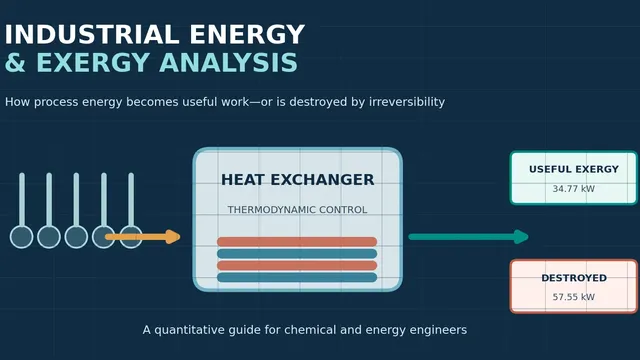
Industrial Energy and Exergy Analysis
Energy and exergy balances for industrial systems: useful-work potential, entropy generation, second-law efficiency and worked heat-exchanger and turbine calculations.
Read article ↗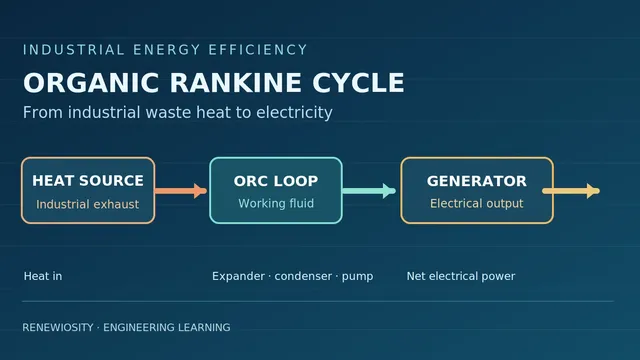
Organic Rankine Cycle for Waste Heat-to-Power
Organic Rankine cycle waste heat-to-power: thermodynamic balances, fluid selection, net electricity, worked SI engineering calculations and economic screening.
Read article ↗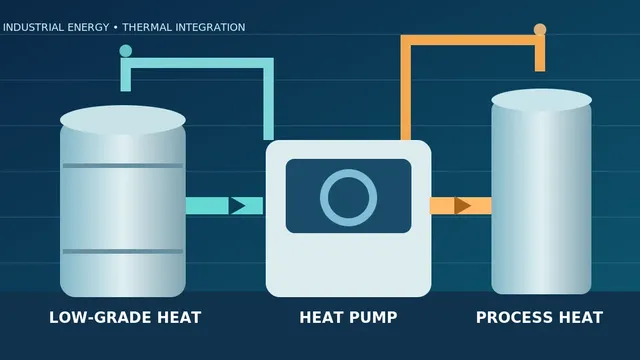
Industrial Heat Pumps and Low-Temperature Heat Recovery
Industrial heat pumps upgrade waste heat into useful process heating. Learn COP, temperature lift, source and sink duty, pinch integration and worked chemical engineering …
Read article ↗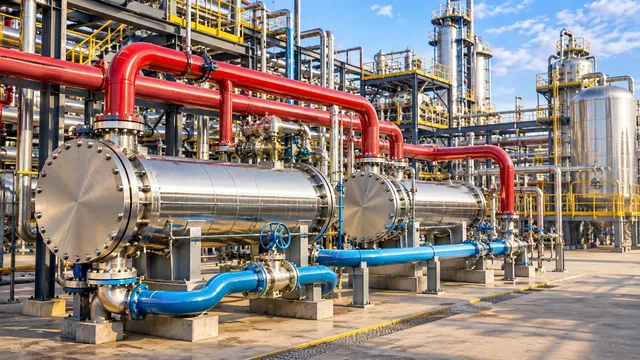
Pinch Analysis and Heat Exchanger Network Design
Pinch analysis and heat exchanger network design with composite curves, temperature shifting, a complete heat cascade, pinch rules and feasible worked exchanger matches.
Read article ↗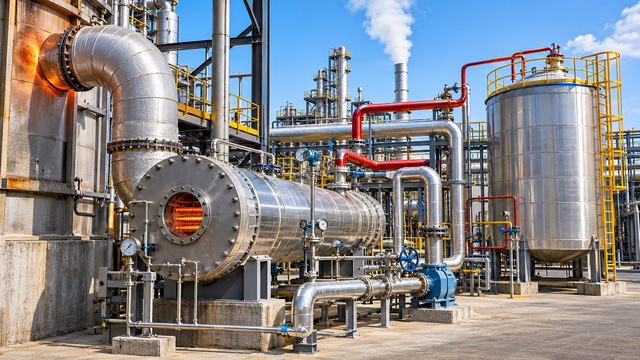
Industrial Waste Heat Recovery: Sources, Technologies and Opportunities
Industrial waste heat sources and recovery technologies explained with heat exchanger sizing, pinch analysis, exergy, fuel savings and a complete SI-unit engineering example.
Read article ↗