
RENEWABLE ENERGY / KNOWLEDGE HUB
Renewable Energy Economics & Optimization
Renewable energy engineering is not only about how much electricity or heat a technology can generate. It is also about how reliably a system performs, what it costs over its operating life, and whether its design creates value. Renewable Energy Economics & Optimization connects engineering performance with investment decisions, financing, risk and the trade-offs involved in real energy projects.
This learning hub is designed for interested readers, renewable-energy practitioners and senior undergraduate engineering students. We begin with clear definitions, then develop economic models using consistent units, explicit assumptions and worked examples. Our focus is the engineering decisions behind an economic result, not simply a final currency-per-kilowatt-hour number.
Why the economics of renewable energy matters
Solar PV, wind turbines, hydropower, bioenergy, geothermal systems, batteries and green-hydrogen plants differ in capital cost, resource availability, maintenance needs, output patterns and project lifetimes. Two systems with similar annual energy production can have very different economic outcomes when they face different financing rates, replacement schedules, curtailment or operating risks.
Economic analysis turns these factors into an auditable comparison. The goal is not to identify the cheapest technology in the abstract, but to evaluate the best solution for a defined energy service, site, time horizon and set of constraints.
The engineering and economics toolkit
- Levelized cost of energy (LCOE): compare appropriately discounted lifetime project costs with appropriately discounted delivered electricity or useful energy, using a stated boundary.
- Capital and operating expenditure: separate initial investment, routine operating costs, replacement costs, fuel or feedstock costs, and decommissioning assumptions.
- Financing and the time value of money: understand discount rates, capital recovery factors, weighted average cost of capital and the distinction between nominal and real currency values.
- Project cash flows: evaluate net present value (NPV), internal rate of return (IRR), revenues, tariffs, taxes and payback periods where the chosen financial model calls for them.
- Engineering optimization: size generation, storage and conversion equipment to balance cost, performance, reliability and physical constraints.
- Risk and sensitivity analysis: test how cost, resource conditions, capacity factors, equipment degradation, financing and curtailment change the outcome.
An engineering checkpoint: energy output before cost
Consider a hypothetical 1 MW solar PV installation delivering electricity at an annual net capacity factor of 20%. With 8,760 hours in a non-leap year, its approximate annual net output is 1 MW × 8,760 h/year × 0.20 = 1,752 MWh/year. The result is an energy estimate, not an LCOE. Calculating LCOE additionally requires a clear plant boundary, project costs, the timing of expenditure, lifetime energy production and a consistent discount-rate convention. Degradation and replacement must be treated appropriately when material.
Suggested learning path
- Start with the levelized cost of energy. Understand definitions, units, discounted cash-flow formulation, annualized approximations and common interpretation errors.
- Develop project financial models. Learn NPV, IRR, annuities, nominal-versus-real discount rates and investment decision rules.
- Connect engineering parameters to cost. Explore capacity factor, losses, system degradation, operation and maintenance, and equipment replacement schedules.
- Perform sensitivity and uncertainty analysis. Identify the variables that materially drive project results.
- Optimize the system. Compare equipment sizes, storage choices, dispatch strategies and constraints using transparent techno-economic objectives.
What LCOE does not capture
LCOE is useful for plant-level generation-cost comparison, but it does not on its own measure when electricity is delivered, its market value, network costs, system flexibility, reliability or the cost of balancing variable generation. A lower LCOE does not automatically establish a lower overall cost for an electricity system. Financial evaluations must also distinguish generation cost from tariff, revenue, profit, and customer electricity price. The appropriate comparison depends on the decision being studied.
Related RENEWIOSITY learning hubs
- Solar Energy — resource, module performance, losses and power-output calculations.
- Wind Energy — wind resources, turbine output and energy estimation.
- Energy Storage & Batteries — storage performance, efficiency and reliability trade-offs.
- Industrial Energy Efficiency & Heat Recovery — process energy balances and efficiency opportunities that can be screened economically.
References and further reading
- National Laboratory System Advisor Model (SAM): LCOE Calculator — fixed-charge-rate approach for preliminary project evaluation.
- International Renewable Energy Agency: Renewable Power Generation Costs in 2024 — costs, capacity factors and financing considerations.
Educational note: The calculations in this hub illustrate modeling principles. Real investments require site-specific technical, financial, regulatory and risk assessments; project examples should not be treated as financial advice.
ARTICLES & TECHNICAL GUIDES
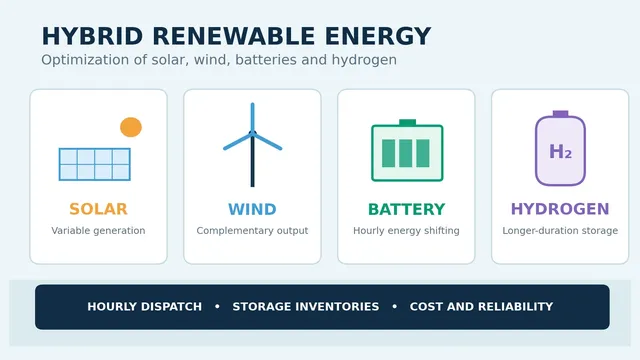
Hybrid Renewable Energy System Optimization: Solar, Wind, Batteries and Hydrogen
Learn how to optimize solar, wind, batteries and hydrogen using hourly dispatch, storage inventories, reliability constraints and lifecycle costs.
Read article ↗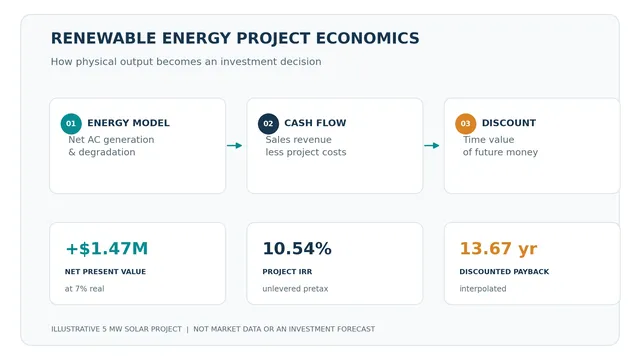
Renewable Energy Project Economics: NPV, IRR, Payback Period and Sensitivity Analysis
Learn NPV, IRR, simple and discounted payback, and sensitivity analysis through rigorous solar and wind project cash-flow calculations.
Read article ↗
Levelized Cost of Energy (LCOE): Meaning, Formula and Engineering Applications
Understand LCOE with a verified lifetime-cost formula, discounted energy, solar and wind examples, sensitivity analysis and engineering applications.
Read article ↗