A beginner-friendly guide to the terms behind renewable energy, electricity, energy storage, and engineering.
72 clear definitions · A–Z · For curious readers and future engineers
Showing 72 terms
A
Alternating current (AC)
Grid & Electrical
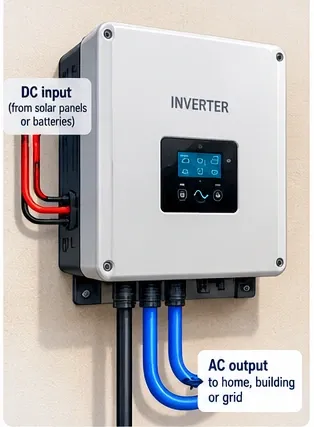
Electric current that periodically changes direction. Most electricity grids distribute power as AC because transformers can efficiently change its voltage for transmission and local use. Solar panels and batteries usually produce or store DC, so grid-connected systems often need an inverter.
Also known as: AC power, alternating-current electricity
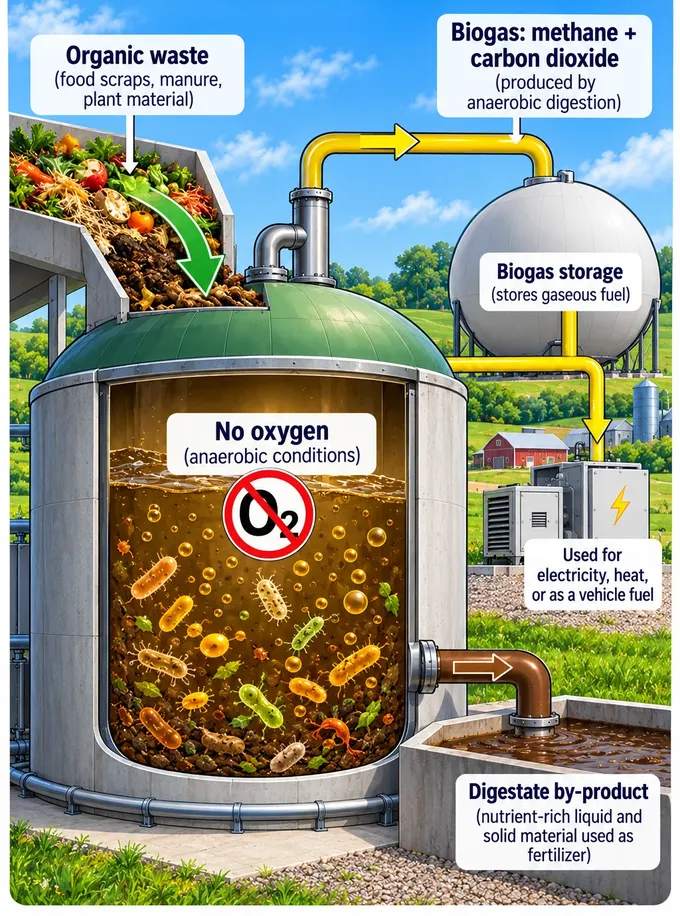
A biological process in which microorganisms break down biodegradable material without oxygen. It produces biogas, typically containing methane and carbon dioxide, along with a nutrient-containing residue called digestate. Suitable feedstocks include food waste, manure, and some agricultural residues.
Also known as: AD, anaerobic biogas production
Microorganisms decompose organic material without oxygen, producing biogas and digestate.
The amount of electrical energy a generating system delivers over a year, usually measured in kWh, MWh, or GWh. It depends on resource conditions, equipment performance, availability, and losses, not just the equipment's rated power. Wind-energy studies commonly use the abbreviation AEP.
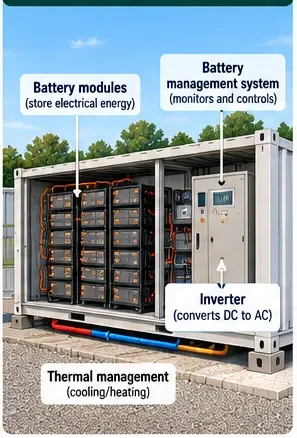
A complete system that stores electrical energy in rechargeable batteries and delivers it when needed. Beyond the battery cells, it includes power electronics, controls, thermal management, and safety equipment. It can help shift solar or wind electricity to different hours and support grid services.
Also known as: BESS, grid battery
Battery storage systems combine electrochemical cells with protection, power conversion and thermal control.
Useful heat, electricity, or fuels obtained from biological materials or their products. Bioenergy can come from sustainably managed biomass and certain waste streams, but its environmental effects depend on the feedstock, land use, emissions, and conversion process. Renewable does not automatically mean carbon-neutral.
Organic material from plants, animals, or biological residues that can serve as an energy feedstock. Examples include agricultural residues, forestry by-products, and some organic wastes. Moisture content, composition, and heating value influence which conversion processes are suitable.
Also known as: biomass feedstock, organic feedstock
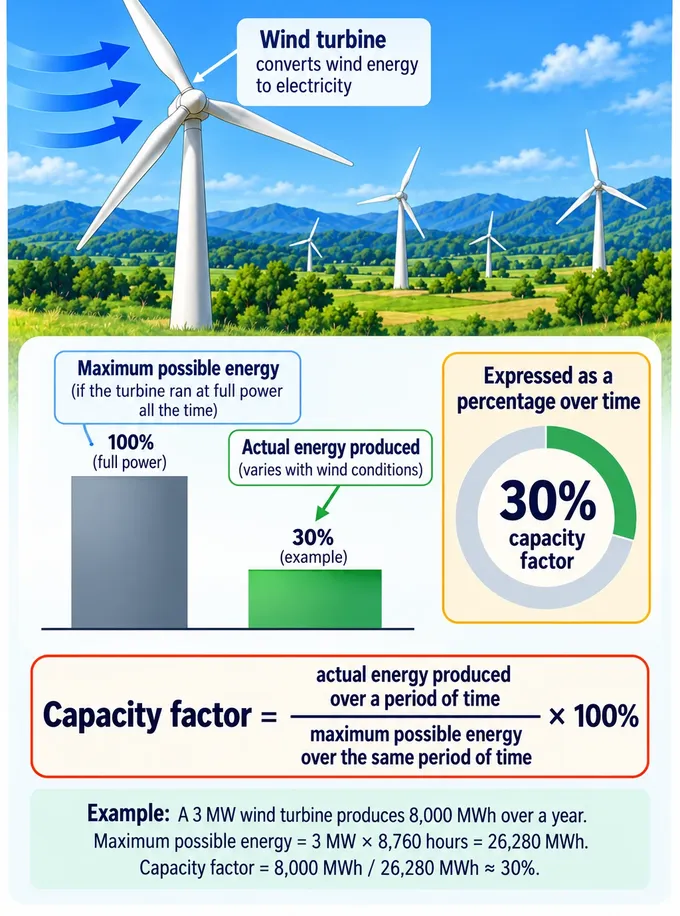
The ratio of actual electricity generated over a period to the energy that would be produced at rated power throughout that period. It measures how fully a plant's rated capacity is used, not its conversion efficiency. Comparisons must use consistent AC or DC ratings and time periods.
Also known as: CF, plant capacity factor
Capacity factor is actual energy output divided by the energy that could be produced continuously at rated power over the same period.
The greenhouse-gas emissions associated with a defined quantity of energy or product, often expressed as g CO₂-equivalent per kWh. Results depend on the measurement boundary: direct operation, fuel supply, equipment manufacture, or full life cycle. A low operating-emissions technology can still have upstream emissions.
Also known as: emissions intensity, lifecycle carbon intensity
A deliberate reduction in the electricity a generator could otherwise produce, often because of network congestion, system balancing, or market and operating constraints. Solar or wind curtailment does not mean the natural resource disappeared; it means some available generation was not accepted or used.
Also known as: renewable curtailment, generation curtailment
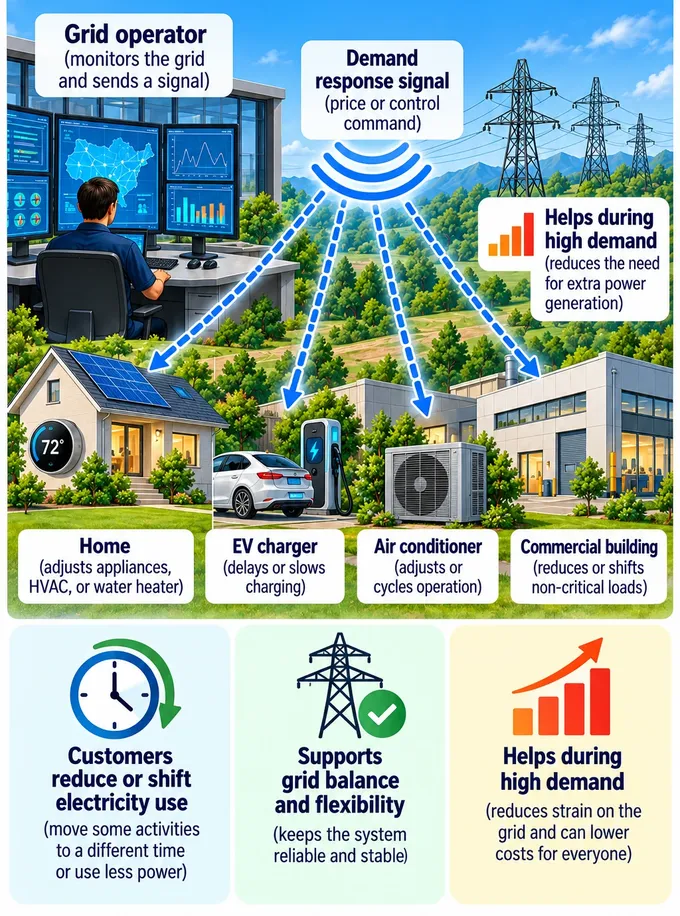
A change in electricity consumption in response to prices, incentives, or grid needs. For example, some industrial loads can shift operation away from periods of peak demand. Demand response can help integrate variable renewable generation, but its usefulness depends on how flexible the affected process really is.
Also known as: demand-side response, load flexibility
Demand response adjusts or shifts flexible electricity use to help balance demand, supply and grid operating conditions.
Electric current that flows in one direction, with voltage polarity normally kept fixed. Photovoltaic cells produce DC electricity, and batteries store and deliver energy through DC terminals. Grid-connected solar equipment normally uses an inverter to turn its DC output into AC.
Also known as: DC power, direct-current electricity
Smaller electricity-generation, storage, or flexible-demand resources connected at distribution level or behind a customer meter. Rooftop solar, household batteries, and controllable loads are examples. Their coordinated operation can improve flexibility, but network protection and voltage management still matter.
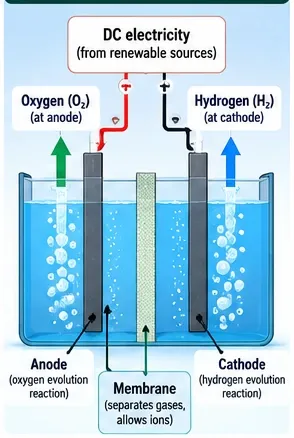
A process that uses electrical energy to drive a chemical reaction that would not proceed spontaneously under the same conditions. In water electrolysis, electricity splits water into hydrogen and oxygen. Energy use and product purity depend on the electrolyzer technology and operating conditions.
Also known as: water splitting, electrolytic hydrogen
Water electrolysis uses electric energy to produce hydrogen at the cathode and oxygen at the anode.
The amount of stored energy per unit mass or volume, such as Wh/kg or Wh/L. It helps compare batteries, fuels, and other storage media, but the appropriate basis must be stated. A material with high energy density may still require complex equipment to use safely.
Also known as: specific energy, volumetric energy density
The fraction of energy input that emerges as the defined useful output. For example, inverter efficiency compares AC electrical output with DC electrical input. Efficiency must be reported with a clear system boundary; power-plant capacity factor and energy efficiency describe different things.
Also known as: conversion efficiency, system efficiency
A policy arrangement that pays eligible electricity generators a specified rate for energy delivered to the grid, often under a defined contract. Rules vary by jurisdiction, project size, and commissioning date. It is different from net metering, which concerns how a customer's imports and exports are credited.
Photovoltaic panels installed on floating structures, usually on reservoirs or other managed water bodies. Floating systems can make use of water surfaces, but their performance and impacts depend on mooring, corrosion control, maintenance, aquatic conditions, and local environmental assessment.
Also known as: floating photovoltaic, floatovoltaics
Actions that help keep an electricity system's frequency close to its intended value by balancing power supply and demand. Batteries, generators, and flexible loads can provide frequency-response services. Grid frequency is not the same thing as the daily amount of electrical energy produced.
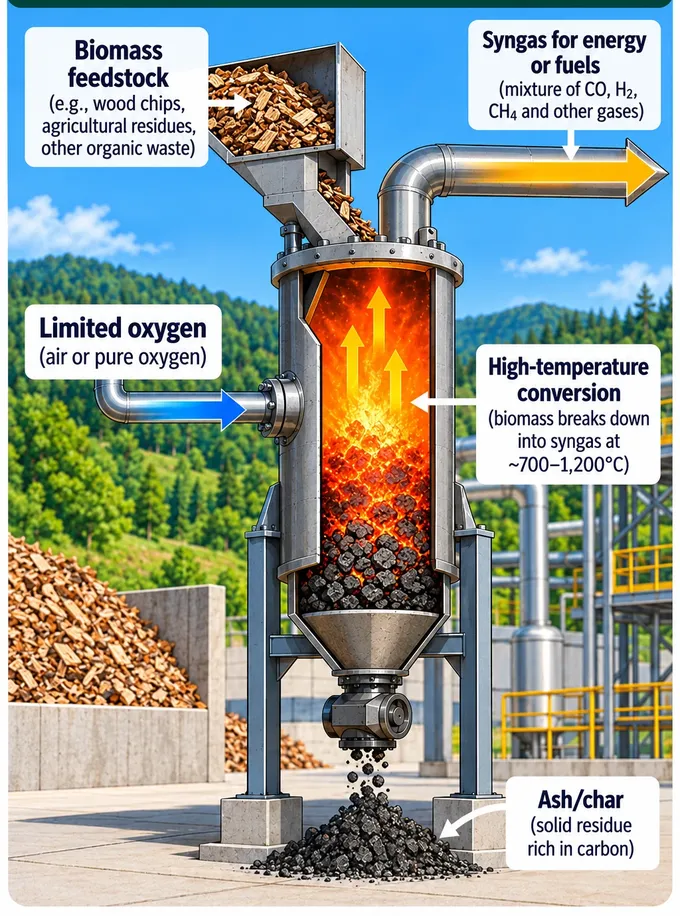
A thermochemical process that converts carbon-containing material into a combustible gas mixture using a controlled amount of oxygen, air, steam, or other gasifying agents. Biomass gasification can produce syngas containing carbon monoxide and hydrogen. Gas composition and cleanup requirements depend on operating conditions.
Also known as: biomass gasification, syngas production
Gasification converts biomass into a combustible producer gas using high temperature and limited oxygen or another gasifying agent.
Heat stored inside the Earth that can be used directly for heating or, where temperature and other conditions permit, converted into electricity. Geothermal resources vary widely by location. Even though Earth's heat is continuously replenished, individual reservoirs require appropriate management to maintain useful production.
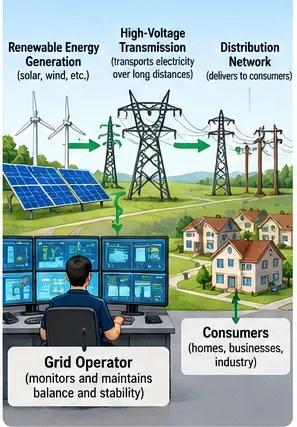
The engineering work needed to connect electricity generators, storage, and flexible demand to the wider power system reliably. It involves inverters, network capacity, forecasts, controls, and system protection. Integrating renewable energy requires maintaining voltage, frequency, and supply-demand balance.
Also known as: renewable integration, power-system integration
Integrating wind and solar generation requires grid infrastructure, dispatch and balancing.
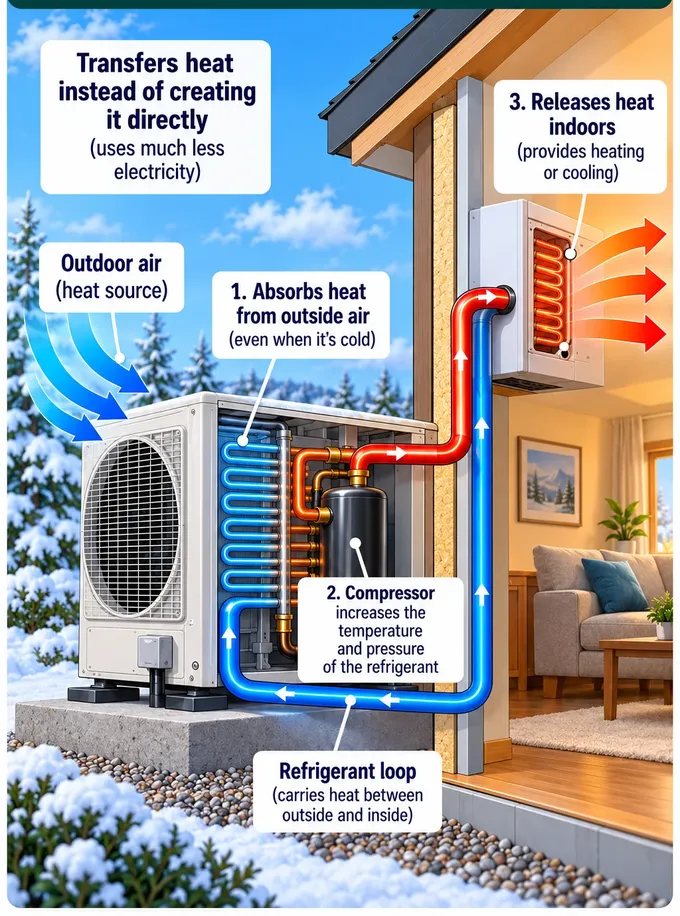
A device that uses work, usually electricity, to transfer heat from a colder place to a warmer one. Heat pumps can heat buildings or industrial processes and often deliver more units of heat than the electrical energy they consume. Their performance depends on temperatures and operating conditions.
Also known as: electric heat pump
In heating mode, an air-source heat pump uses electricity to transfer heat from outdoor air into a building.
The lightest chemical element; molecular hydrogen (H₂) can be used as a fuel and industrial feedstock. Hydrogen is an energy carrier, not an energy source, because making it requires energy. Its environmental impact depends strongly on how it is produced and handled.
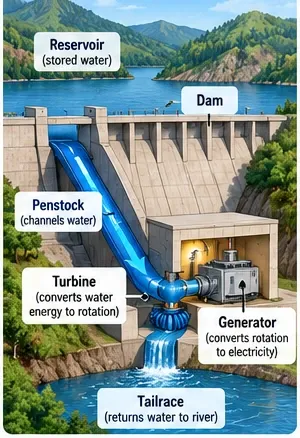
Electricity generated by converting the energy of moving or elevated water through a turbine and generator. Output depends on water flow, hydraulic head, and conversion efficiency. Reservoir and run-of-river plants operate differently, and ecological effects must be considered alongside electricity generation.
Also known as: hydroelectricity, hydroelectric power
Flowing water drives a turbine connected to an electrical generator.
The total solar energy received per unit area over a stated period, often measured in kWh/m²/day. It is different from irradiance, which measures solar power per unit area at a particular moment. Both help estimate photovoltaic and solar thermal energy production.
Also known as: solar irradiation, daily solar energy
A broad term for generation that is not continuously available, often applied to solar or wind power. In engineering, variability and forecast uncertainty are usually more precise descriptions because output changes over time rather than simply being on or off. Storage, forecasting, and grid flexibility can help manage these changes.
Also known as: variable generation, generation variability
Power-electronic equipment that converts direct-current electricity into alternating-current electricity. Inverters connect many photovoltaic and battery systems to AC loads or grids. Some advanced inverters also help control voltage or support grid operation, depending on their design and settings.
Also known as: DC-to-AC converter, solar inverter
An inverter converts DC electricity from sources such as solar panels or batteries into AC electricity.
Heat generated when electric current flows through a material with electrical resistance. In a simple resistor the power loss is I²R, with current I and resistance R. Joule heating is important in cables, batteries, electrical contacts, and electrolyzer stacks, where it may be useful or wasteful.
The SI unit of energy. One joule equals one watt-second, so a device using one watt for one second transfers one joule of energy. Electricity bills normally use kilowatt-hours because a joule is comparatively small for household-scale energy use.
An enclosure that protects electrical connections. On a photovoltaic module, the junction box normally houses terminals and bypass-diode connections that help manage certain shading-related conditions. Junction boxes are not energy generators, and their construction must meet applicable electrical and environmental requirements.
A unit of energy equal to the amount delivered by one kilowatt of power for one hour. It equals 3.6 million joules. Electricity generation, storage capacity, and household consumption are commonly stated in kWh, while equipment power ratings use kW.
A unit of power equal to 1,000 watts. Power describes the rate at which energy is transferred or used, not the total energy used over time. A 5 kW solar inverter rating indicates a power level, whereas its daily generation must be measured in kWh.
Energy possessed by an object because it is moving. Wind turbines extract part of the kinetic energy of moving air, while water turbines can extract energy associated with flowing water and hydraulic head. Increasing the speed of moving fluid can greatly change the energy available for conversion.
A measure of the average lifetime cost of producing electricity, commonly expressed per kWh or MWh. It combines discounted costs and generation under stated assumptions. LCOE helps compare projects but does not by itself capture electricity's value at different times, grid integration costs, or dispatchability.
A rechargeable battery in which lithium ions move between electrodes during charging and discharging. Different electrode chemistries have different cost, energy-density, lifetime, and safety characteristics. A complete energy-storage installation also needs controls, thermal management, and appropriate protection.
The ratio of average electrical demand to the maximum demand over a chosen period. It describes how evenly a load uses power capacity, not how efficiently a device converts energy. Load factor should not be confused with a generating plant's capacity factor.
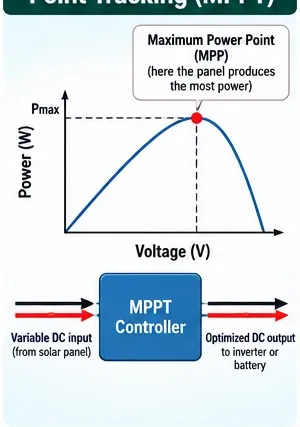
An electronic control method that adjusts the operating point of photovoltaic equipment to extract near-maximum available DC power under changing sunlight and temperature. MPPT does not create additional solar energy; it helps a system operate efficiently relative to the panel's electrical characteristics.
Also known as: MPPT, maximum power point control
MPPT adjusts the operating point of a photovoltaic system to approach the peak of its power-voltage curve.
A unit of power equal to one million watts or 1,000 kilowatts. Wind turbines, solar farms, hydropower plants, and grid batteries often use MW to describe rated power. To describe energy delivered over time, use MWh rather than MW.
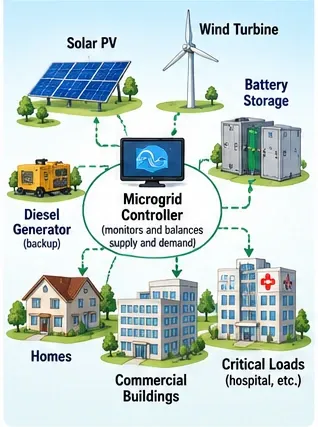
A local group of electrical loads and distributed resources that can operate as a controlled system. Depending on its design, it may remain connected to the main grid or disconnect and operate independently. Microgrids require suitable control, protection, and balancing of local generation and demand.
Also known as: local microgrid, islandable grid
A microgrid coordinates local electricity sources, storage and loads, and may use backup generation.
The rated power capacity stated for equipment under specified conditions, commonly in kW or MW. It is a rating, not a prediction of continuous output. For solar PV, be careful whether a figure refers to DC module capacity or AC inverter capacity.
Also known as: rated capacity, nominal power rating
A billing arrangement under which an electricity customer receives credits for eligible electricity exported to the grid, under local rules. The credits, tariffs, and settlement periods vary by jurisdiction. Net metering does not imply that a rooftop solar system can operate without grid-protection equipment.
A condition in which remaining human-caused greenhouse-gas emissions are balanced by removals over a stated period and clearly defined boundary. It is not the same as having no emissions at all. Credible net-zero claims require transparent accounting, strong emission reductions, and appropriate treatment of remaining emissions.
Energy obtained from marine processes such as tides, waves, and temperature differences. Different technologies capture different physical resources, so their operating principles and development stages vary. Ocean energy is distinct from conventional hydropower, even though both involve water.
Also known as: marine energy, ocean renewable energy
An electricity system that operates without a connection to the main utility grid. It may combine solar panels, batteries, a generator, or other technologies. Its design must account for energy needs, peak loads, seasonal variation, equipment failure, and storage autonomy.
Also known as: stand-alone power system, standalone system
Wind-energy generation using turbines installed in bodies of water, often in coastal or marine areas. Offshore winds can provide a strong energy resource, but projects require complex foundations or floating platforms, subsea cables, maintenance logistics, and environmental planning.
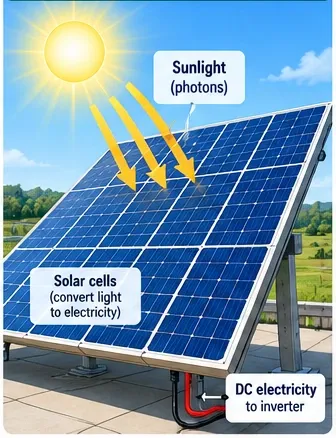
The physical process by which certain materials generate an electrical voltage or current when they absorb light. Solar cells use this effect to convert part of incoming sunlight directly into DC electricity. The conversion efficiency depends on material properties, spectrum, temperature, and other losses.
Also known as: PV effect, solar photovoltaic effect
Solar cells convert absorbed light into electrical energy; a grid-connected system normally uses an inverter for AC output.
For an AC system, the ratio of real power to apparent power. It indicates how voltage and current together deliver useful electrical power, including effects of phase shift and waveform distortion. Power-factor management matters for grid-connected equipment, but it is not identical to energy efficiency.
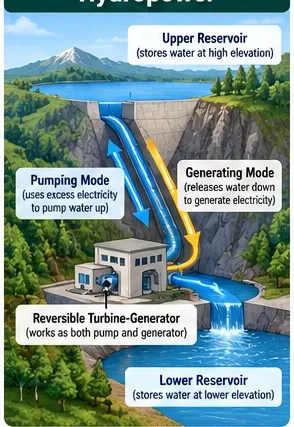
A storage system that pumps water to a higher reservoir when electricity is available and later releases it through turbines to generate electricity. Because pumping consumes more energy than generation recovers, it is an energy-storage method, not a net energy source.
Also known as: pumped hydro storage, PSH
Pumped storage uses electricity to lift water uphill and later generates electricity as the water returns downhill.
For a solar cell or light detector, a measure of how effectively incident or absorbed photons contribute to collected charge carriers. External quantum efficiency counts photons incident on the device; internal quantum efficiency uses photons actually absorbed in the relevant material. It is not the same as total sunlight-to-electricity power efficiency.
Also known as: EQE, IQE, photovoltaic quantum efficiency
Energy obtained from resources replenished by natural processes on human time scales, including sunlight, wind, flowing water, geothermal heat, and some biological materials. Renewable resources still have location, environmental, and engineering constraints. Renewable does not necessarily mean zero-emission or impact-free.
A certificate representing specified renewable attributes associated with a measured quantity of renewable electricity, commonly 1 MWh in systems such as the United States. Accounting rules differ by market. Buying a certificate and physically receiving renewable electricity are related but distinct claims.
Also known as: REC, renewable attribute certificate
The ratio of useful energy recovered from an energy-storage system to the energy put into it over a complete charge–discharge cycle. It must be defined at consistent measurement boundaries. A lower value means more energy is lost, but efficiency alone does not describe cost, duration, or response speed.
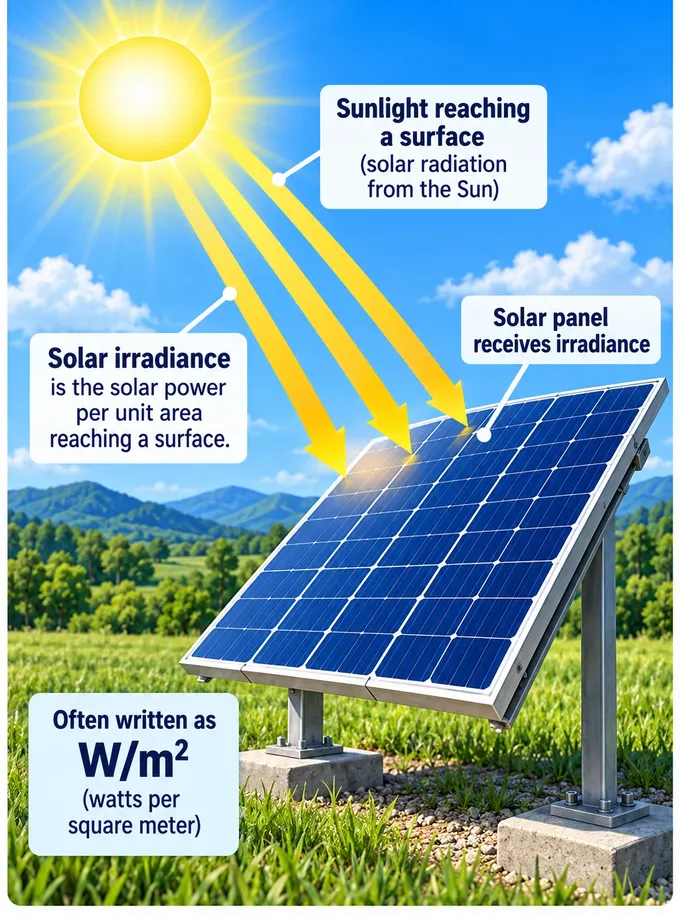
Solar radiant power falling on a surface per unit area at a particular time, typically measured in W/m². It changes with weather, time of day, orientation, and shading. Irradiance is different from insolation, which accumulates received solar energy over a period.
Also known as: solar radiation intensity, irradiance
Solar irradiance measures incoming solar radiation power per unit area, typically expressed in W/m².
Heat produced by capturing and using sunlight. Systems range from solar water heaters to large concentrating solar power plants. Solar thermal equipment is different from photovoltaic panels, which generate electricity directly, although both use sunlight as their input energy source.
Also known as: solar heating, concentrated solar thermal
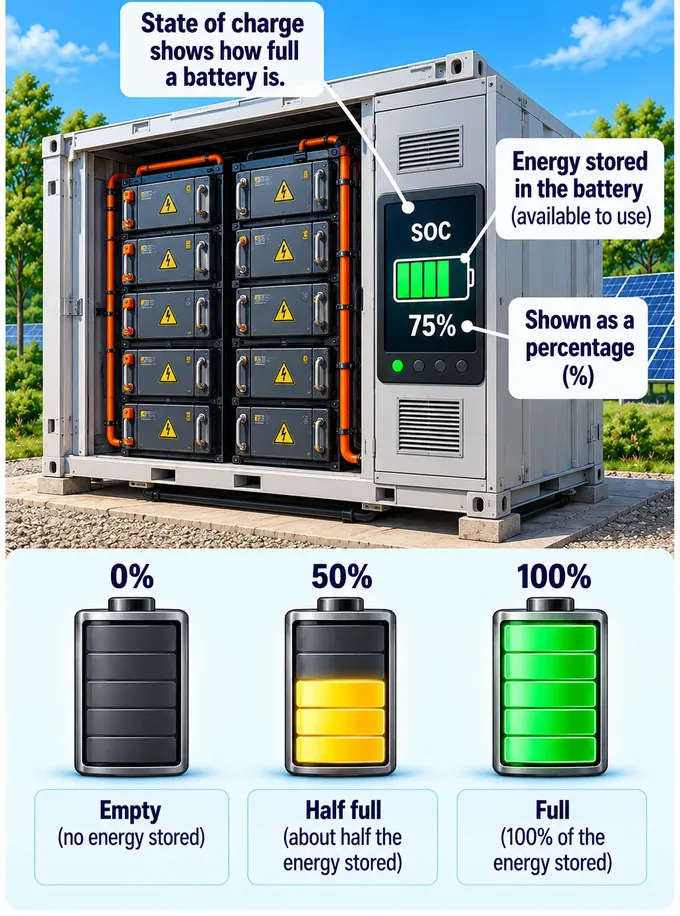
A measure of how much usable charge or energy remains in a battery compared with a defined reference capacity, often expressed as a percentage. The estimate depends on battery chemistry, temperature, age, and the management system. State of charge is not the same as state of health.
Also known as: SOC, battery charge level
State of charge estimates the fraction of a battery’s usable charge remaining; indicated percentages are illustrative.
Technology that stores energy as sensible heat, latent heat, or through reversible thermochemical processes. It can shift heating or cooling demand and support some renewable-energy systems. Examples include hot-water tanks, molten salts, and phase-change materials, each with different temperature and storage characteristics.
Electrical equipment that transfers AC energy between circuits using electromagnetic induction, usually changing voltage and current levels. Transformers are essential in electricity distribution and transmission. Conventional transformers do not convert DC directly and do not create extra energy.
A rotating machine that extracts energy from moving fluid, such as wind, water, or steam, and produces shaft power. A generator can convert that shaft power into electricity. Different turbine types are designed for different flow rates, pressure drops, and operating conditions.
A power-system response triggered when grid frequency falls below an established level, indicating a possible imbalance between electricity supply and demand. Depending on controls and rules, generators, batteries, or flexible loads can help arrest the decline. This is a grid-stability service, not a type of renewable generation.
Also known as: low-frequency response, frequency containment
The amount of battery energy that a system permits users to withdraw under its specified operating limits. It can be smaller than nominal or gross capacity because the battery management system reserves a safety margin. Temperature, ageing, and discharge conditions can also affect usable capacity.
Also known as: usable energy capacity, net battery capacity
A comparatively large solar electricity project designed primarily to supply power to the grid rather than only to one building. It usually comprises many photovoltaic modules, inverters, and grid-connection equipment. Project size thresholds and market definitions differ among jurisdictions.
Renewable electricity generation whose available output varies with conditions such as sunlight or wind speed. VRE is predictable to a useful extent but subject to forecast errors. Electricity systems integrate it through forecasting, flexible generation, storage, networks, and demand-side measures.
A coordinated network of distributed electricity resources, such as rooftop solar, batteries, and flexible loads, operated together through software and communications. A VPP is not necessarily one physical power station. Its services depend on contracts, controls, interoperability, and electricity-market rules.
Also known as: VPP, aggregated distributed resources
The electric potential difference between two points, measured in volts. Voltage helps drive electric current through a circuit, but does not by itself tell us how much energy a device uses. Solar cells, batteries, inverters, and electricity grids operate at different voltage levels.
Also known as: electric potential difference, volts
Processes that recover useful heat, electricity, or fuels from waste streams. Technologies include combustion and some biological conversion routes. Only the biogenic fraction of certain wastes may qualify as renewable under applicable accounting rules; plastics and other fossil-derived waste do not automatically become renewable energy.
The change in wind speed or direction with height above the ground. Wind shear affects the wind resource experienced across a turbine rotor and can influence turbine loads and energy production. Its magnitude depends on terrain, atmospheric conditions, and time of day.
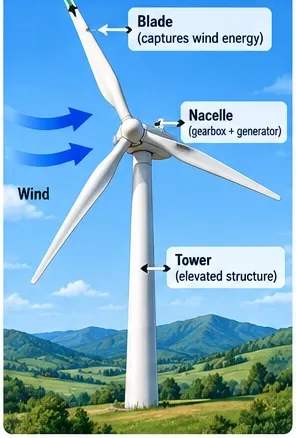
A machine that converts part of the kinetic energy of wind into rotating mechanical power and, through a generator, electricity. Output varies strongly with wind speed within the operating range. Actual performance also depends on controls, aerodynamics, site conditions, and turbine limits.
Also known as: wind generator, wind energy conversion system
Wind turns the rotor, which drives electrical generation through the turbine drivetrain.
A materials-characterization technique that uses X-ray scattering to investigate the arrangement of atoms in crystalline materials. Renewable-energy researchers use it to study battery electrodes, photovoltaic materials, and catalysts. XRD is a supporting laboratory method, not an energy-generation technology.
Also known as: XRD, powder X-ray diffraction
Y
Yaw control
Wind
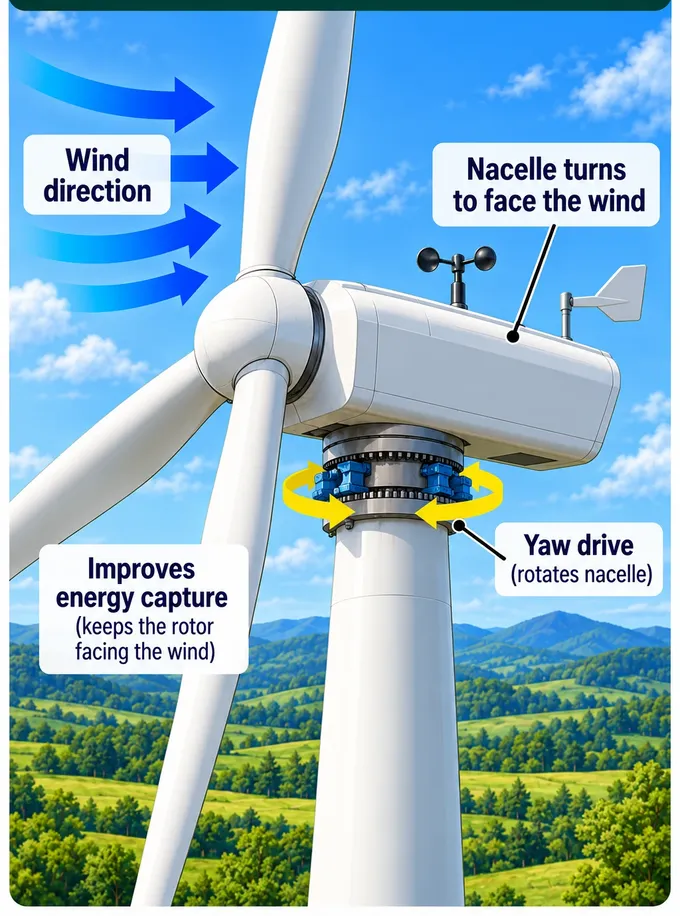
The system that turns a horizontal-axis wind turbine's nacelle to align its rotor appropriately with the wind direction. Good alignment supports energy capture and manages some loads, while excessive movement can increase wear. Yaw control is distinct from blade pitch control.
Also known as: turbine yaw, yaw system
Yaw control adjusts the nacelle orientation of a horizontal-axis wind turbine relative to the prevailing wind.
The quantity of useful energy delivered by a system in one year, often expressed in kWh or MWh. For solar PV, specific yield may also be stated in kWh per kW of installed capacity per year. Yield depends on climate, equipment, losses, and availability.
Also known as: annual energy yield, annual electricity output
A building designed so that, over a defined accounting period and boundary, its energy needs are offset by an equivalent quantity of renewable energy. Definitions vary between site energy, source energy, and other accounting approaches. A zero-energy label does not imply the building never imports electricity.
An electrochemical cell that uses zinc as an active material and oxygen from air as a reactant. It can offer high theoretical energy density, but rechargeable versions face challenges including air-electrode reactions, electrolyte management, and cycle life. It is an energy-storage technology, not a renewable energy source itself.
Try another keyword, clear the topic filter, or explore the full A–Z directory.
These definitions are educational summaries, not engineering specifications. Verify calculations, assumptions and technical information before practical use. Read our disclaimer.
We use optional analytics cookies to understand how visitors
use RENEWIOSITY. You can accept or reject these cookies.
Cookie Policy