
RENEWIOSITY / EXPLAINER
What Is Sustainability? Meaning, Simple Examples, and Why It Matters
Discover what sustainability really means, why it matters and how to recognize sustainable practices using simple examples from water, forests, farming and clean energy.
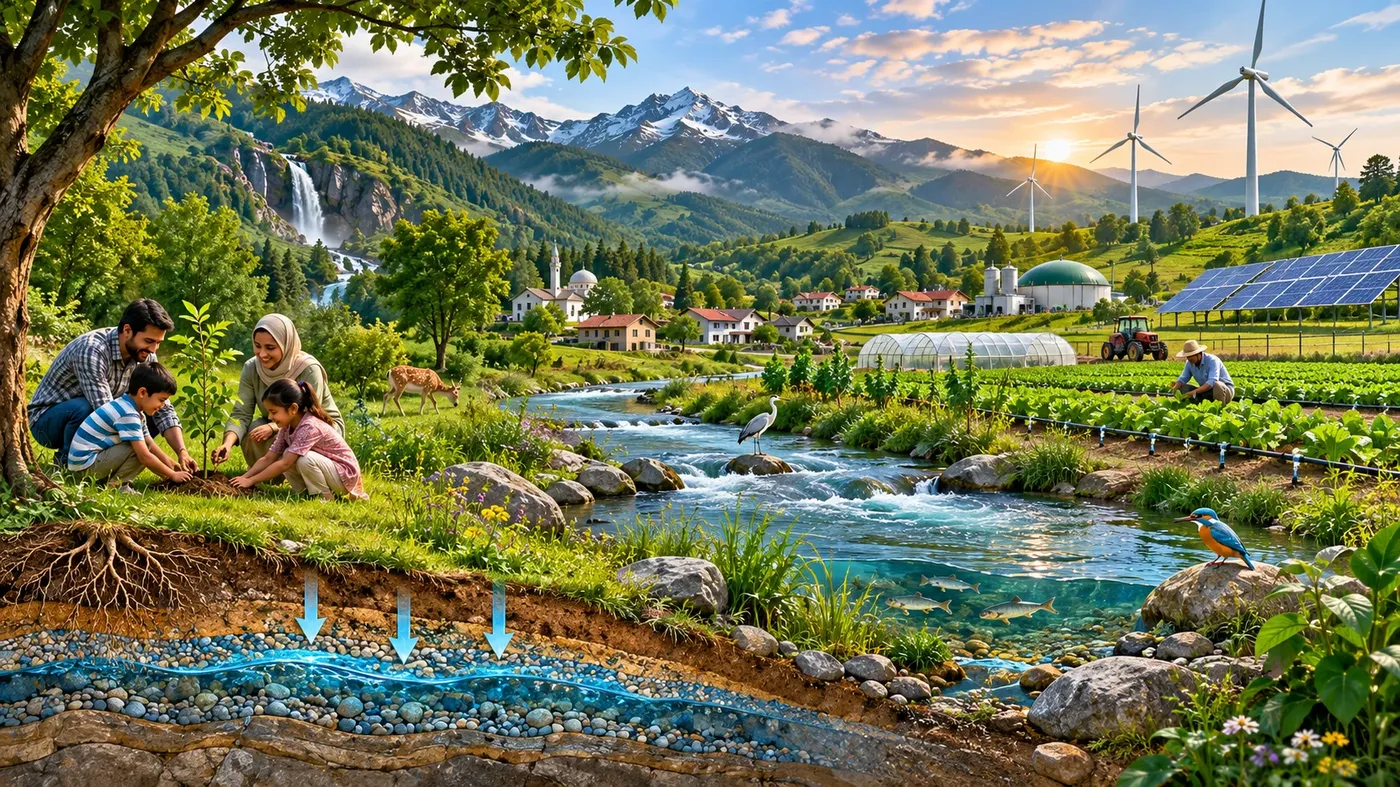
Imagine that a village draws drinking water from an underground aquifer. Rainfall refills part of that supply. If the village keeps pumping out more water than the aquifer receives, people may enjoy plentiful water this year while leaving a serious shortage for their children. A practice can work today and still be impossible to maintain over many years.
That simple observation is the heart of sustainability. It asks a practical question: Can the system continue providing what people and nature need, without exhausting the conditions that make those benefits possible? We will explore that question with water, forests, energy, farms, products, and communities. Sustainability is not a magical label and not a synonym for buying something green.
Learning objectives
- Explain sustainability in everyday words and distinguish it from sustainable development.
- Recognize when resource use, pollution, or unfair treatment makes a practice difficult to maintain over time.
- Describe environmental, social, and economic dimensions without pretending that they always have simple tradeoffs.
- Use a simple, explicitly hypothetical groundwater calculation to see the difference between resource inflows and withdrawals.
- Explain why renewable energy, low-carbon energy, and sustainable energy are related but not identical terms.
- Evaluate sustainability claims by asking about evidence, boundaries, affected people, and the full life cycle.
1. What does the word 'sustain' mean?
To sustain something is to keep it going, support it, or maintain it over time. We might sustain a friendship, a business, a forest, a farm, or a dependable electricity supply. Sustainability describes the ability of a system or activity to continue while maintaining the foundations on which it depends. Those foundations can include freshwater, fertile soils, functioning ecosystems, physical infrastructure, a viable economy, and fair treatment of people.
The time dimension is essential. A project that delivers impressive results for three years but destroys the soil needed for the fourth is not a convincing long-term success. A company that earns profits only by exposing workers to dangerous conditions may be profitable, but its conduct raises serious sustainability concerns. On the other hand, an activity can require resources and still be sustainable when those resources and their impacts are responsibly managed.
There is no single magic sustainability score that applies equally to every farm, city, battery, or business. Evaluations depend on what system we study, which boundaries we draw, who benefits and bears costs, which indicators matter, and what timescale we choose [1,2]. This makes sustainability a useful discipline of asking better questions, not just a reassuring adjective.
2. The three questions that make sustainability understandable
Whenever somebody claims an activity is sustainable, ask three questions: What are we trying to sustain? For whom? For how long? The first identifies the system: a river, a household income, an energy service, or an entire ecosystem. The second identifies people and other affected living systems: residents today, workers, neighbours downstream, and future generations. The third makes the long-term promise testable rather than vague.
A village pumping groundwater may be sustaining drinking-water access today, but is it also maintaining the aquifer and nearby wetlands for the next generation? An inexpensive product may help buyers today, but did its production pollute the neighbourhood around a factory? A new solar farm may lower carbon emissions, but did its design consider biodiversity, land rights, mineral sourcing, maintenance, and end-of-life materials?
Notice that these questions do not make every choice obvious. They help people expose tradeoffs that might otherwise remain hidden. A genuine sustainability assessment compares realistic alternatives, measures consequences, and revises decisions when evidence changes.
3. A simple example: a village's groundwater account
Water provides a clear example because a supply can be stored, replenished, withdrawn, and depleted. Suppose a fictional aquifer receives 50,000 cubic metres per year of net recharge and people withdraw 40,000 cubic metres per year. In a simplified one-year water account, storage rises by 10,000 cubic metres. If withdrawals instead reach 70,000 cubic metres, the account falls by 20,000 cubic metres, assuming the same recharge [3].
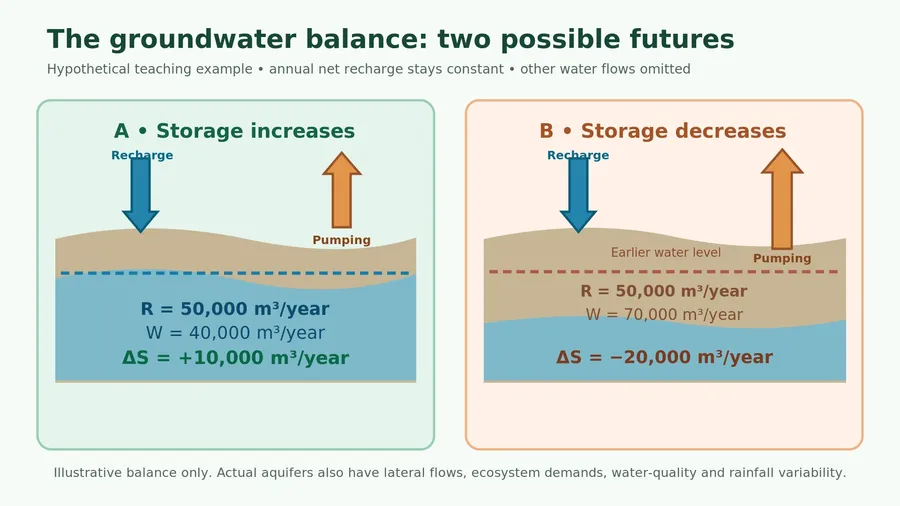
Figure 1. Hypothetical water-accounting example: withdrawals below recharge increase storage, whereas greater withdrawals reduce storage. Real aquifers have additional flows and ecological water needs [3].
The teaching relationship is:
Here, ΔS is the change in stored groundwater, R is recharge, and W is withdrawal over the same period, expressed in cubic metres (m³). With R = 50,000 m³/year and W = 70,000 m³/year, the simplified annual change is −20,000 m³/year. These are invented classroom values, not data from any real village.
Real aquifers are more complicated. Water can also move sideways into or out of an area; groundwater supports springs, streams, and ecosystems; recharge varies with climate; and water quality matters as much as quantity. Therefore, a zero or positive storage change is not, by itself, proof of sustainable water management. The example merely illustrates why a stock can seem ample while withdrawals systematically exceed renewal. UNESCO stresses that groundwater must be protected from both overuse and pollution [3].
4. Sustainability and sustainable development: related but different
The word sustainability describes an enduring condition or goal. Sustainable development describes improving human well-being, economies, and communities in ways that do not undermine the prospects of people who come later. The difference is subtle, and writers sometimes use the terms interchangeably, but separating them helps explain what development is supposed to achieve.
The 1987 report Our Common Future, prepared by the World Commission on Environment and Development, popularized a definition of sustainable development that focuses on present needs without preventing future generations from meeting theirs [1]. Its emphasis was not just environmental protection. The report addressed poverty, fairness, technology, institutions, and the limits imposed by natural systems. The familiar slogan becomes much more meaningful when its two central concerns, needs and limitations, are remembered.
For instance, supplying clean drinking water to a community is a development success. Maintaining the source, making access fair, avoiding damage to surrounding ecosystems, and financing maintenance so the service continues turns it into a sustainability question. Meeting immediate needs and protecting future capacity should be considered together.
5. The environmental, social and economic dimensions
A commonly used framework separates sustainability into environmental, social, and economic dimensions. The United Nations' 2030 Agenda explicitly treats these as connected rather than independent goals [2,4]. The framework is simple enough to remember, but the relationships are more complex than three perfectly balanced, interchangeable circles.
Environmental sustainability asks whether we protect climate stability, biodiversity, water, soils, and the ecological processes on which life depends. Social sustainability asks whether people can live safely and fairly, with access to basic services, good working conditions, education, and participation in decisions that affect them. Economic sustainability asks whether the activities and institutions providing goods and services can remain viable without consuming their own essential resources or transferring costs to others.
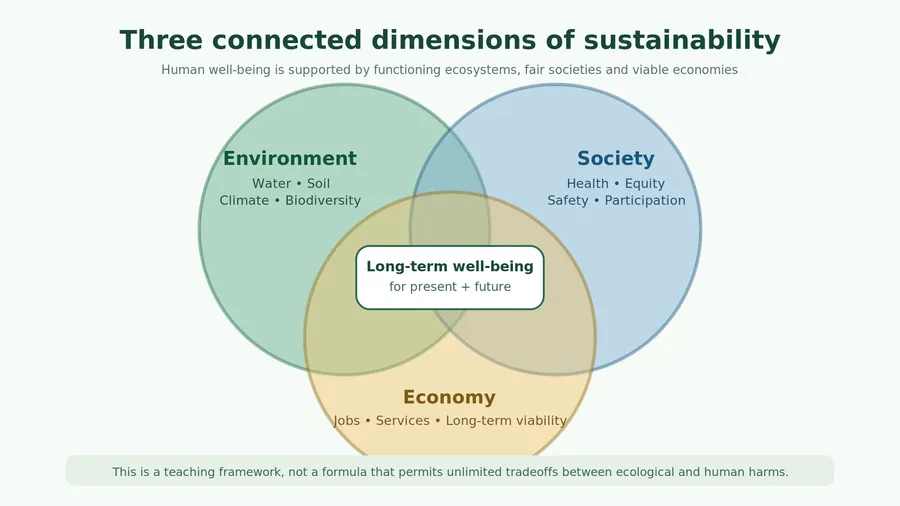
Figure 2. Environmental, social and economic dimensions are connected. Meeting immediate needs must also preserve long-term well-being [2,4].
Consider a rural health clinic powered by solar panels. Environmentally, the system might lower generator fuel consumption; socially, it can help preserve refrigerated medicines and extend healthcare access; economically, its batteries, maintenance, and replacement parts must remain affordable. A project succeeds only when those concerns are addressed together. The same principle applies to a forest, a university, a factory, and a city.
6. Everyday example: a forest is more than a pile of timber
Forests are sometimes discussed as if sustainability means cutting fewer trees than grow back. Regeneration matters, but living forests also provide habitat, store carbon, help regulate water, and support communities that depend on them. Replacing a diverse forest with a single-species plantation may maintain a certain timber yield while losing biodiversity or changing local livelihoods [5].
The UN Food and Agriculture Organization describes sustainable forest management as an evolving attempt to maintain and improve the economic, social, and environmental values of forests for present and future generations [5]. That broader framing is important. It tells us to ask about forest health and people, not just the number of trunks harvested.
A useful practical test is whether a management plan monitors soil condition, regeneration, water quality, biodiversity, local rights, and long-term supply. The most appropriate indicators differ between forests and regions. Sustainability is not the absence of human use; it is informed stewardship of a resource and its many functions.
7. Food, farming, and the difference between harvest and fertility
Imagine a farm that delivers a record crop by irrigating heavily, removing vegetation from fragile land, and neglecting soil organic matter. That year's harvest may look successful. But if erosion, salinity, water depletion, or lost soil fertility make future harvests less reliable, the farming system is not maintaining the foundations of production.
More sustainable approaches can include carefully matching water use to local availability, maintaining soil cover, returning organic matter where appropriate, controlling runoff, reducing wasted inputs, and monitoring actual yields and impacts. The best choices depend on crop, climate, soil, and community needs. There is no universal list of practices that automatically guarantees sustainability in every setting.
Food losses and waste also matter. Producing, refrigerating, transporting, and disposing of uneaten food consumes energy, water, land, and labour. The UN includes food-loss reduction and sustainable consumption and production in Sustainable Development Goal 12 [2,6]. Efficiency helps, but increased efficiency alone can be offset when total consumption grows rapidly.
8. Is renewable energy always sustainable?
This is especially important for a renewable-energy education website. Renewable describes an energy source replenished on human-relevant timescales, such as sunlight or wind. Low-carbon usually describes relatively low greenhouse-gas emissions per delivered unit of energy, including contributions from nuclear and some other technologies. Sustainable asks a wider set of questions: climate, materials, land, water, ecosystems, workers, affordability, reliable supply, and eventual decommissioning.
A wind turbine can generate low-carbon electricity while requiring steel, concrete, roads, minerals, and maintenance. A solar panel can generate electricity without combustion while relying on manufacturing processes and mineral supply chains. A hydropower dam can produce renewable electricity while changing river ecology or affecting communities. These implications do not mean renewable energy is undesirable; they mean that clean electricity production is one dimension of responsible energy development, not proof of zero impact [7].
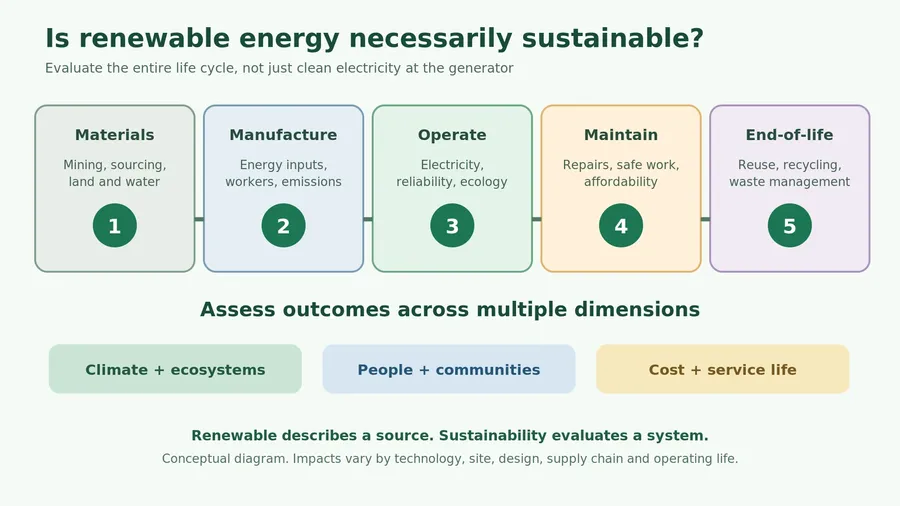
Figure 3. Renewable describes an energy source; sustainability requires assessing the whole system, its life cycle and its local impacts [7–9].
The IPCC explains that low-carbon energy technologies can reduce climate emissions while also introducing other environmental and social effects that must be managed [7]. Comparing alternatives requires a consistent life-cycle boundary and attention to real local conditions. It is possible to support rapid clean-energy deployment and still demand transparent environmental and social safeguards.
9. How do we measure sustainability?
A meaningful sustainability claim starts with a clearly defined system and indicators. For a city's water supply, useful measurements include groundwater levels, water quality, leakage, affordability, and continuity of service. For a solar power project, useful measures include life-cycle emissions per kilowatt-hour, land and biodiversity impacts, reliability, workers' safety, and the cost of maintaining the system. For a forest, they may include tree cover, species diversity, soil health, and local livelihoods.
A life-cycle assessment looks at environmental impacts from material extraction and manufacturing through operation and end-of-life. It prevents us from declaring an item 'impact-free' merely because it produces little pollution during the moment we use it. Life-cycle assessment is an analytical tool, not a complete social or economic sustainability verdict [8,9].
Good measurement also avoids moving the problem elsewhere. A product made in one country may have a small local footprint but large impacts in its imported materials. A community might achieve low emissions by making energy unaffordable to vulnerable households. A reliable evaluation explains such boundaries and who carries the consequences.
10. Sustainable does not mean permanent, perfect, or zero impact
Sustainability does not mean that a particular building, company, battery, or method can last forever unchanged. Technologies age, communities grow, and ecosystems change. A well-managed system adapts by maintaining key capacities, reducing avoidable harm, and changing course when conditions change.
Nor does sustainability require that every impact be literally zero. Supplying food, energy, housing, transport, and healthcare involves real physical resources. The question is whether the impacts are reduced, fairly managed, and compatible with the continued functioning of ecological and social systems. Sometimes important harms cannot be fully compensated by a benefit elsewhere. For example, money cannot simply replace every lost habitat or justify avoidable harm to people.
We should also resist the idea that the environmental, economic, and social dimensions are always exchangeable. A benefit in one area does not automatically cancel a serious, irreversible loss in another. That is why transparent indicators, safeguards, and discussion of thresholds matter.
11. The danger of vague 'green' claims
Words such as 'eco-friendly', 'green', 'natural', and 'sustainable' can be used without explaining what they mean or how they were tested. An item can contain recycled material yet still have a high manufacturing impact. A company can run its office on renewable electricity yet continue to rely on a heavily polluting supply chain. A product may save energy during use but be difficult to repair or recycle.
The UN calls attention to greenwashing, where organizations mislead people about environmental performance, for example by highlighting one small improvement while ignoring larger negative impacts [10]. A credible claim identifies the measured outcome, baseline, time period, evidence, and limits. It should not depend on a reassuring colour or an unexplained badge.
A useful response to any sustainability advertisement is to ask: 'Sustainable in what respect, compared with what alternative, verified by whom, and for how long?' Those questions are more useful than accepting or dismissing a label automatically.
12. What about the United Nations Sustainable Development Goals?
In 2015, United Nations Member States adopted the 2030 Agenda with 17 Sustainable Development Goals. They address poverty, health, education, water, energy, responsible production and consumption, climate action, biodiversity, institutions, and other interconnected challenges [2]. The goals are a shared policy framework, not a certificate that any individual product is sustainable.
The agenda recognizes that improved living standards, functioning ecosystems, and economic opportunities need to be pursued together. It does not imply that every country has the same starting point or the same responsibilities. People who have contributed least to environmental degradation can be among those most exposed to its consequences.
Official UN progress assessments show that progress has occurred but remains insufficient and uneven as the 2030 deadline approaches [11]. This is another reminder that sustainability should be evaluated with measured trends, not only declarations of good intentions.
13. Five practical questions for any sustainability decision
First: What service or benefit is being maintained? Be precise: reliable drinking water, nutritious food, affordable power, worker safety, or a healthy river. Second: What are the underlying resources and processes? Trace the important water, energy, material, and ecosystem dependencies. Third: Who benefits and who bears the cost? Include workers, nearby residents, and future users, not only today's customer. Fourth: What happens throughout the life cycle and over time? Examine installation, operation, maintenance, and eventual replacement or disposal. Fifth: What evidence would show that the claim is false? A measurable indicator is useful only if it can reveal poor outcomes as well as good ones.
These questions work for everyday choices, public policy, and engineering design. They also help separate important tradeoffs from promotional language. Even where data are incomplete, making the uncertainty visible is better than presenting an unjustified sustainability score.
14. What should you remember?
Sustainability means maintaining the conditions that allow people and the natural world to continue meeting needs over time. It is fundamentally about long-term capacity, not merely good intentions or today's performance. Sustainable development combines that long-term outlook with efforts to improve human well-being and address present needs. Environmental, social, and economic dimensions interact, and every decision has a context.
Our fictional groundwater example makes the idea tangible: when withdrawals persistently exceed recharge, stored water declines, even when taps initially keep flowing. The same underlying logic helps us think about soils, forests, resources, ecosystems, public services, and infrastructure, although real systems require richer measurements than a simple balance.
For RENEWIOSITY, sustainability also means asking more than whether energy is renewable or low-carbon. We should consider whether energy services are reliable and affordable and whether their supply chains and facilities are responsibly managed. Readers who understand that distinction can evaluate green claims without needing to become technical specialists.
15. Frequently asked questions
Q1. Does sustainability simply mean protecting the environment? No. The natural environment is indispensable, but sustainability also concerns human well-being, equity, institutions, and viable systems for supplying essential services [2,4].
Q2. Can something be renewable but not sustainable? Yes. A renewable energy source can still be developed in a way that seriously harms ecosystems or communities. Assess the entire project and its local effects, not only the source of energy [7].
Q3. Does sustainable mean a product lasts forever? No. It means benefits can be maintained responsibly across an appropriate timescale, including repair, replacement, and adaptation when necessary.
Q4. Is recycling enough to make a product sustainable? No. Recycling is helpful in many cases, but production, transport, use, toxicity, labour, and end-of-life effects must also be considered [8–10].
Q5. What is the easiest definition to remember? Sustainability asks whether we can keep meeting today's needs without using up or damaging the foundations on which tomorrow's needs depend.
Further learning on RENEWIOSITY
To connect these ideas to climate science, read What Is the Greenhouse Effect?. To see the energy transition over time, read How Much of the World's Energy Comes from Clean Sources? Both articles show why sustainability connects physical processes, long-term planning, and practical decisions.
Technical discussions describe general principles; site-specific engineering decisions require appropriate professional evaluation.