
THE SCIENCE OF CLEAN ENERGY
Understand the energy transition.
Evidence-led guides, engineering perspectives and accessible explanations of the technologies shaping our energy future.
Research-minded. Educational. Engineering-informed.
TWO WAYS TO EXPLORE
Explore RENEWIOSITY Your Way
Whether you're curious about clean energy or working on complex engineering challenges, there's a place for you here.

RENEWIOSITY Learn
For the general public, school students, curious readers, and beginners.
Simple articles, climate awareness, quizzes, curiosity questions, and everyday energy education.
Explore Learning
RENEWIOSITY Engineering
For engineering students, researchers, and practicing professionals.
Technical articles, worked calculations, engineering learning paths, and advanced tools.
Explore EngineeringSTART HERE / BEGINNER LEARNING PATH
New to renewable energy? Begin with the fundamentals.
Five illustrated lessons explain the energy sources, key trade-offs and the transition to cleaner energy systems. No prior engineering knowledge required.
RENEWIOSITY · Test your knowledge
Take the Quiz!
How Much Do You Know About Renewable Energy?
Challenge yourself with 25 randomly selected questions on renewable energy, climate science, sustainability and engineering.
Want to study first? Prepare for Quiz
Free to participate · No registration required
EXPLORE / 01
Renewable energy, organized by technology
Start with the fundamentals, then move toward engineering applications, calculations and current research.
Solar Energy
Photovoltaics, solar thermal systems and deployment
Explore topic ↗Wind Energy
Turbines, wind resources, design and operations
Explore topic ↗Energy Storage & Batteries
Electrochemical storage, grid balancing and safety
Explore topic ↗Green Hydrogen
Electrolysis, production, transport and applications
Explore topic ↗Bioenergy & Biomass
Biomass conversion, biofuels and circular systems
Explore topic ↗Geothermal Energy
Geothermal resources and energy conversion
Explore topic ↗Hydropower
Hydraulic energy, turbines and water systems
Explore topic ↗Grid Integration & Emerging Energy Technologies
Smart grids, microgrids, renewable electricity integration and emerging energy systems.
Explore topic ↗Industrial Energy Efficiency & Heat Recovery
Waste heat recovery, process integration and industrial decarbonization
Explore topic ↗Renewable Energy Economics & Optimization
Energy costs, project economics and optimization
Explore topic ↗Climate, Energy & Sustainability Explained
Climate science, global clean-energy history and everyday sustainability
Explore topic ↗FEATURED LEARNING GUIDE / 02
What Would a Sustainable World Look Like in 2050? Energy, Cities, Food and Climate
A science-based view of possible sustainable futures in 2050 across energy, buildings, cities, food and climate resilience, with clearly marked scenarios, figures and engineering examples.
Read the guide ↗FOR STUDENTS / 03
Learn like an engineer.
RENEWIOSITY is designed to help undergraduate engineering students move from concepts to calculations. Articles combine clear explanations with equations, units, assumptions, diagrams and worked problems.
Useful for renewable-energy coursework
- Core concepts explained from first principles
- KaTeX equations with engineering units
- Worked examples and practice questions
- Process and energy-system diagrams
- Source-cited technical explanations
LEARNING PATHS / 04
Build knowledge in a deliberate sequence
Renewable Energy Fundamentals
Five beginner lessons: sources, comparisons, benefits, technologies and the energy transition.
Start path ↗PATH 02Solar Energy Fundamentals
From sunlight and photovoltaic physics to system design and performance.
Start path ↗PATH 03Wind Energy Fundamentals
Resource assessment, turbines, aerodynamics and power production.
Start path ↗PATH 04Hydrogen Engineering
Electrolysis, storage, transport and process integration.
Start path ↗PATH 05Energy Storage Fundamentals
Batteries, energy density, efficiency, safety and grid services.
Start path ↗ENGINEERING TOOLS / 05
Calculate, compare and test assumptions.
Interactive tools will turn RENEWIOSITY from a reading resource into an engineering workspace.
RESEARCH & TECHNICAL GUIDES / 06
Go beyond definitions.
Understand the engineering.
Technical guides connect thermodynamics, transport phenomena, electrochemistry, process systems and energy conversion to real renewable-energy technologies.
Questions worth asking
Five fresh questions to explore every day.
Why does the global average temperature not rise by the same amount every year?
Ocean-atmosphere variability, volcanic activity, aerosols, and measurement factors influence short-term fluctuations, while long-term human forcing drives the warming trend.
What is the Shockley–Queisser limit?
It is a theoretical efficiency limit for an ideal single-junction solar cell under specified illumination assumptions, arising largely from transmission and thermalization losses.
Why is wind forecasting important for electricity grids?
Forecasts help operators plan generation, reserves, storage dispatch, and power trading because wind output changes with weather.
What is the difference between hydrogen’s higher and lower heating values?
The higher heating value includes the heat recoverable if product water condenses; the lower heating value assumes water remains vapor, so the reported efficiency basis matters.
Why is seasonal energy storage different from daily storage?
Seasonal storage must bridge much longer periods with fewer cycles per year, making capital cost, storage losses, and energy capacity especially important.
LATEST / 08
Latest from RENEWIOSITY
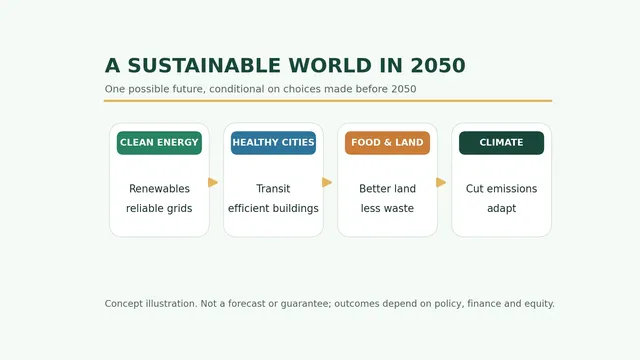
What Would a Sustainable World Look Like in 2050? Energy, Cities, Food and Climate
A science-based view of possible sustainable futures in 2050 across energy, buildings, cities, food and climate resilience, with clearly marked scenarios, figures and engineering …
Read article ↗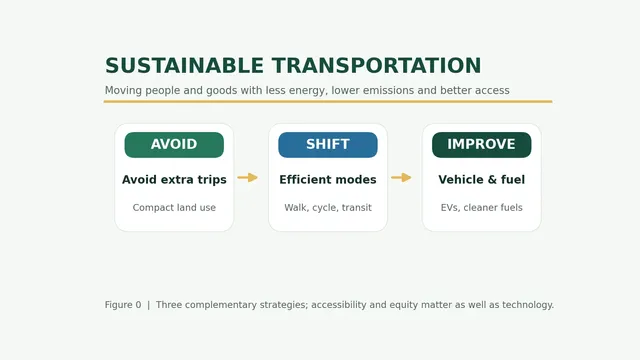
Sustainable Transportation Explained: Electric Vehicles, Public Transit and Cleaner Fuels
A science-based introduction to sustainable mobility, comparing electric cars, public transport and alternative fuels with lifecycle boundaries and worked engineering calculations.
Read article ↗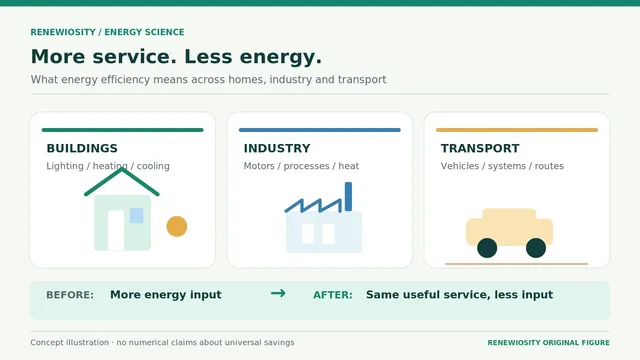
What Is Energy Efficiency? Why Using Less Energy Matters
An accessible introduction to energy efficiency, with equations and worked calculations for LED lighting, heat pumps and industrial motors.
Read article ↗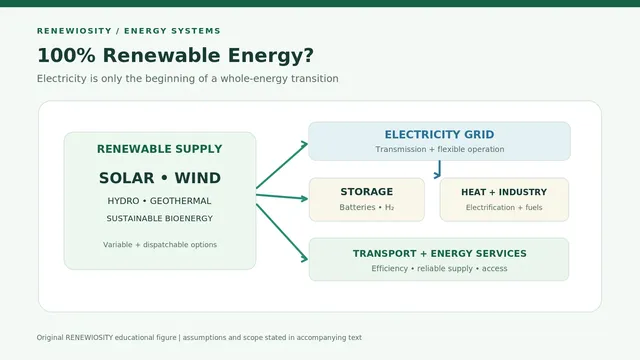
Can the World Run Entirely on Renewable Energy? Opportunities and Challenges
An evidence-based guide to 100% renewable electricity versus total energy, with 2026 data, grid challenges, storage calculations and hydrogen trade-offs.
Read article ↗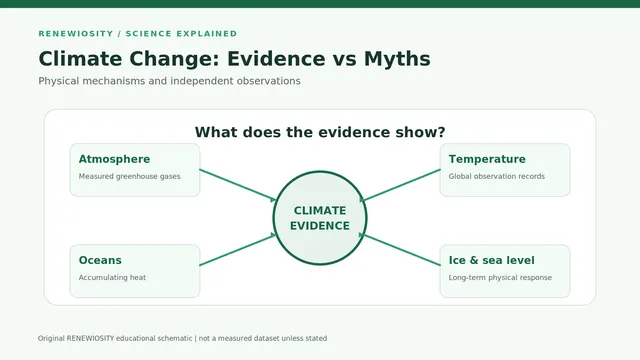
Climate Change Myths vs Scientific Facts: Common Questions Answered
Evidence-based answers to common climate change myths, with 2026 data, IPCC findings and worked greenhouse-gas calculations.
Read article ↗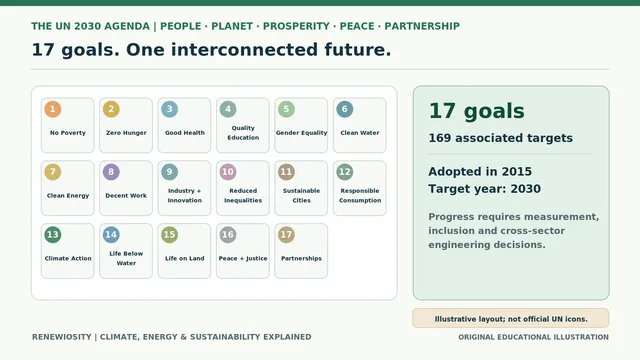
What Are the UN Sustainable Development Goals? Understanding the 17 SDGs
A rigorous introduction to all 17 UN SDGs and 169 targets, including the 2026 progress assessment and worked energy, water and emissions calculations.
Read article ↗RENEWABLE ENERGY, SCIENCE & CURIOSITY
Understand more.
Calculate better.
Stay curious.
RENEWIOSITY connects accessible explanations with the scientific and engineering depth needed to understand modern energy systems.