
RENEWIOSITY / EXPLAINER
What Is the Greenhouse Effect? How Greenhouse Gases Warm the Earth
Understand how sunlight, infrared radiation and greenhouse gases keep Earth warm, and why added emissions strengthen the greenhouse effect.
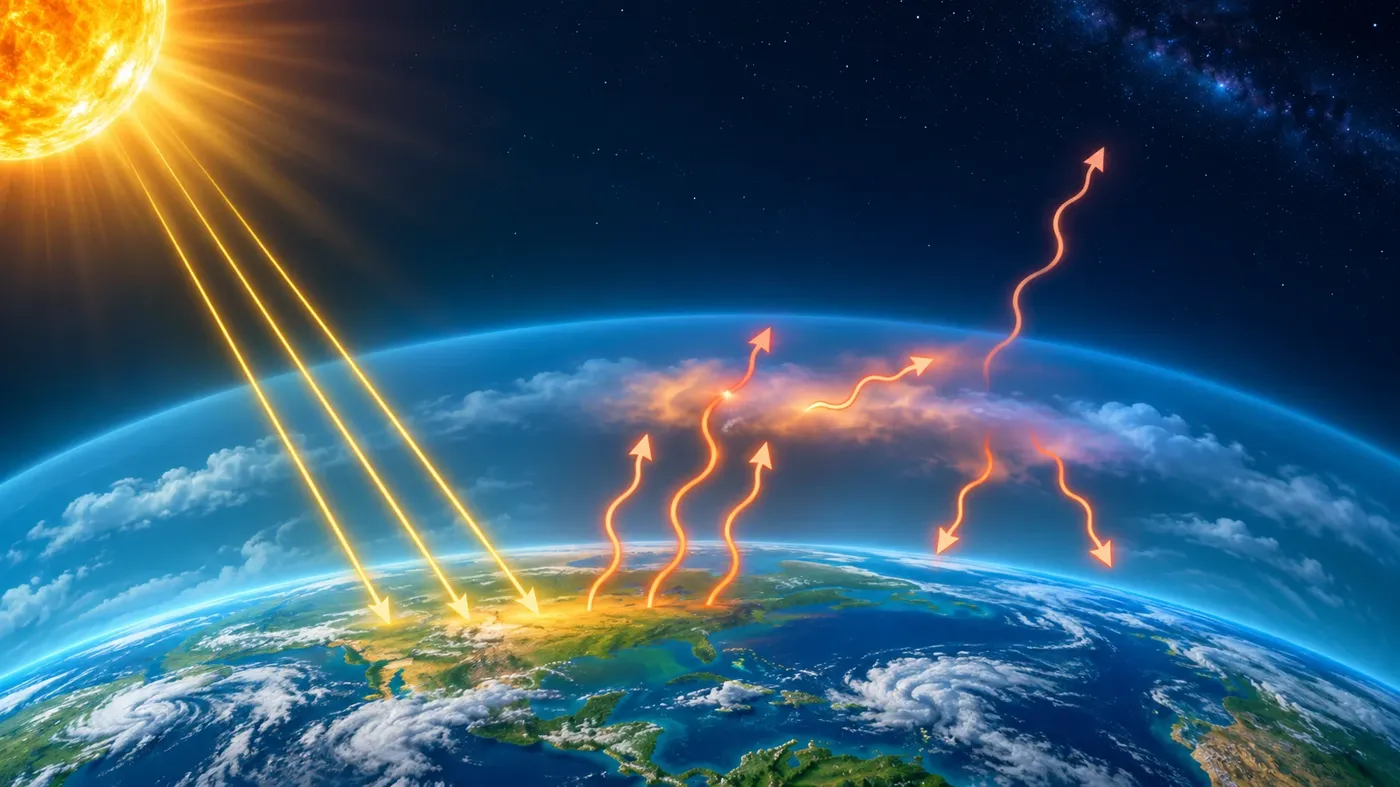
Imagine Earth receiving sunlight all day and radiating energy back into space all night. Why does the planet's surface remain warm enough for liquid water and life? An important part of the answer is the natural greenhouse effect, an atmospheric process that helps keep Earth's surface much warmer than it would be in a simplified world without greenhouse warming. Yet the same process can become stronger when human activity adds more heat-trapping gases to the atmosphere.
The greenhouse effect is neither a mystery nor a theory that scientists have simply guessed. It follows from how sunlight, infrared radiation and atmospheric molecules interact. Understanding it requires one central idea: Earth takes in energy from the Sun and must eventually send energy back to space. Greenhouse gases influence how that outgoing energy escapes [1–3].
Learning objectives
- Explain the greenhouse effect in ordinary language, without saying that the atmosphere is a sealed glass roof.
- Distinguish incoming shortwave sunlight from outgoing thermal infrared radiation.
- Identify important greenhouse gases and explain the special role of water vapor.
- Explain why the natural greenhouse effect is beneficial but an enhanced greenhouse effect warms the planet.
- Interpret a simplified planetary energy-balance calculation using watts per square metre and degrees Celsius.
- Recognize common misconceptions and answer basic climate-science questions.
1. What is the greenhouse effect?
The greenhouse effect is the warming of Earth's surface and lower atmosphere caused by gases and clouds that absorb and emit infrared radiation. Sunlight brings energy into the Earth system. The warmed ground and oceans then emit energy upward, mostly as invisible infrared radiation. Atmospheric greenhouse gases interact with some of that radiation and emit infrared energy in different directions, including toward the surface. Consequently, the surface receives energy not only from the Sun but also from the atmosphere [1,2].
This does not mean that infrared radiation is permanently trapped. Energy ultimately escapes to space. The important point is that greenhouse gases change how efficiently the Earth system loses heat. At a given surface temperature, adding greenhouse gases generally reduces the net infrared energy escaping to space until the system warms enough to approach a new energy balance.
An analogy is useful: a blanket keeps a person warmer by reducing the rate at which their body loses energy. But a blanket does not create heat, and the greenhouse effect is not literally a blanket or glass covering Earth. The scientific mechanism involves the absorption and emission of infrared radiation by molecules in the atmosphere [3].
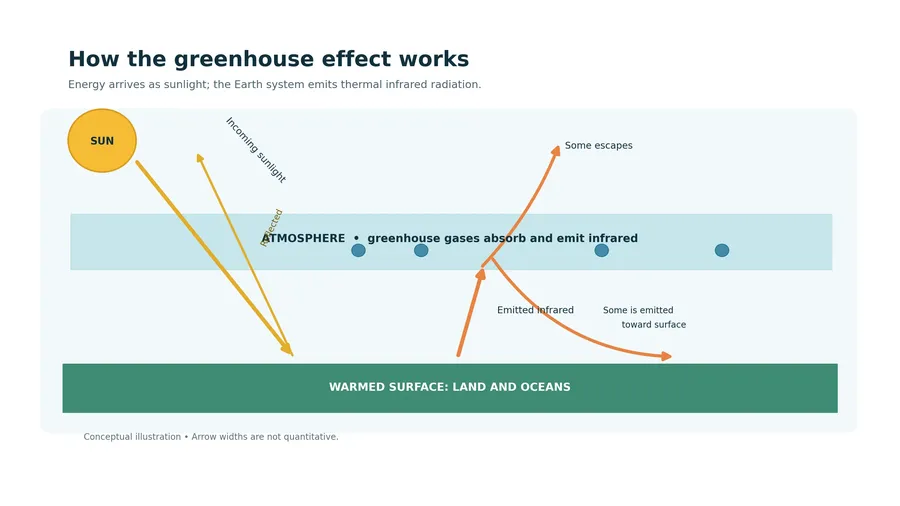
Figure 1. The natural greenhouse effect. Yellow arrows represent incoming and reflected shortwave sunlight; orange arrows represent longwave infrared radiation. The diagram is conceptual, not an energy-flux-to-scale calculation.
2. The difference between sunlight and infrared radiation
Most of the energy reaching Earth from the Sun arrives as shortwave radiation, including visible light. Earth's surface absorbs part of that sunlight and warms. A warm surface also emits electromagnetic radiation. Because Earth is much cooler than the Sun, its emitted radiation is concentrated at longer wavelengths, mainly in the thermal infrared region [2].
Two ideas are especially important:
- Sunlight in: much incoming sunlight passes through the atmosphere; some is scattered or reflected by clouds, airborne particles and the ground.
- Infrared energy out: the surface and atmosphere emit infrared radiation. Greenhouse gases absorb particular infrared wavelengths and then exchange energy with surrounding air and emit radiation again.
A simplified view sometimes says that greenhouse gases merely 'bounce heat back.' That is not an accurate molecular description. Molecules absorb radiation at specific wavelength bands and can subsequently emit radiation; collisions with neighboring molecules also exchange energy. The net effect is to influence Earth's radiative cooling [3,4].
Nitrogen and oxygen make up most of the atmosphere, but their molecular structures make them much less effective at absorbing Earth's infrared radiation than molecules such as carbon dioxide and water vapor [4]. A gas does not need to be abundant to influence climate. What matters includes its concentration, infrared absorption properties, atmospheric distribution and interactions with other components of the climate system.
3. How Earth's energy budget works
The phrase energy budget describes energy entering, leaving and moving within the planet. On average, incoming solar energy at the top of the atmosphere is about 340 watts per square metre (W/m²), after accounting for the fact that only part of a spherical planet faces the Sun at any moment. Roughly 30% is reflected to space; the remainder is absorbed by the Earth system [2,5].
At a stable long-term global temperature, absorbed sunlight must be balanced by energy radiated to space. Clouds, oceans, ice, land surfaces and greenhouse gases all affect this balance. If Earth temporarily absorbs more energy than it sends out, energy accumulates, principally in the oceans, and the climate system warms until the balance changes [2].
It is helpful to distinguish energy arriving at the top of the atmosphere from energy reaching and warming the surface. Not all incoming sunlight gets to the ground: some is reflected and some is absorbed within the atmosphere. Likewise, not all infrared radiation that eventually escapes to space comes directly from the surface. The atmosphere also radiates energy upward.
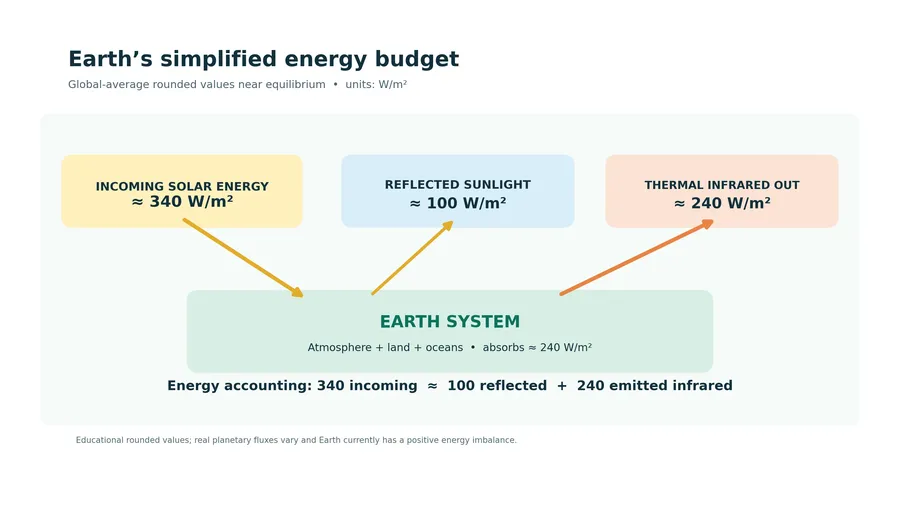
Figure 2. A top-of-atmosphere energy budget using rounded global-average values. The two outgoing branches, reflected sunlight and thermal infrared emission, add to the incoming solar radiation in approximate equilibrium. Real measurements vary and today's climate has a small net energy imbalance.
4. Which gases cause the greenhouse effect?
Several atmospheric constituents absorb infrared radiation. Their importance depends on both their molecular properties and their behavior in the climate system [1,3,4].
Water vapor (H₂O). Water vapor is an important contributor to Earth's natural greenhouse effect. The amount of water vapor air can hold generally rises as temperature increases. Consequently, water vapor acts mainly as a climate feedback on global timescales: initial warming, such as that driven by added carbon dioxide, tends to increase atmospheric water vapor and amplify warming. Human activities can also affect humidity locally, but water vapor is not normally treated as the dominant long-lived external driver of modern global warming [1,6].
Carbon dioxide (CO₂). Carbon dioxide is released naturally through respiration, decomposition, ocean exchange and geological processes. Human activities, especially burning coal, oil and natural gas, as well as land-use changes, add CO₂ beyond these natural exchanges. A substantial fraction of additional CO₂ persists long enough to influence climate over many decades to centuries and beyond [6,7].
Methane (CH₄). Methane absorbs infrared radiation and is emitted by both natural sources, such as wetlands, and human activities, including fossil-fuel operations, agriculture and waste. Methane typically stays in the atmosphere for a shorter period than CO₂, but it is an important contributor to warming.
Nitrous oxide (N₂O). Agricultural soils, fertilizer use, industry and some natural processes release nitrous oxide. Like methane and carbon dioxide, it contributes to the enhanced greenhouse effect.
Ozone (O₃) and industrial gases. Ozone in different parts of the atmosphere has different environmental roles. Certain manufactured gases, including some refrigerants and other industrial compounds, are also effective greenhouse gases. Ozone depletion and global warming are related environmental concerns but are not the same physical problem.
A useful distinction is between a greenhouse gas and an air pollutant. The categories overlap but are not identical. CO₂ is a major greenhouse gas even though it is not necessarily a conventional toxic air pollutant at ordinary outdoor concentrations. Some air pollutants, such as particulate aerosols, may cool or warm the climate through mechanisms different from those of greenhouse gases.
5. Natural versus enhanced greenhouse effect
The natural greenhouse effect is essential to Earth's present climate. Without greenhouse warming, a simplified calculation gives a planetary effective radiating temperature of about −18°C. Earth's familiar global mean surface temperature is approximately +15°C in the conventional teaching comparison. The difference is about 33°C [1,2].
The enhanced greenhouse effect refers to the additional warming influence caused by rising concentrations of greenhouse gases, especially from human activities. The natural effect and the human-caused enhancement are not competing explanations; they are the same basic radiative physics operating under different atmospheric conditions.
Imagine two versions of a planet receiving similar sunlight. In the version with more infrared-absorbing gases, radiation escaping into space is altered. The system can restore its balance by becoming warmer, all else being equal. Real climate behavior also includes changes in clouds, water vapor, ice, land surfaces, ocean heat uptake and atmospheric circulation. Scientists investigate these interactions using observations, laboratory measurements and physical climate models [2,7].
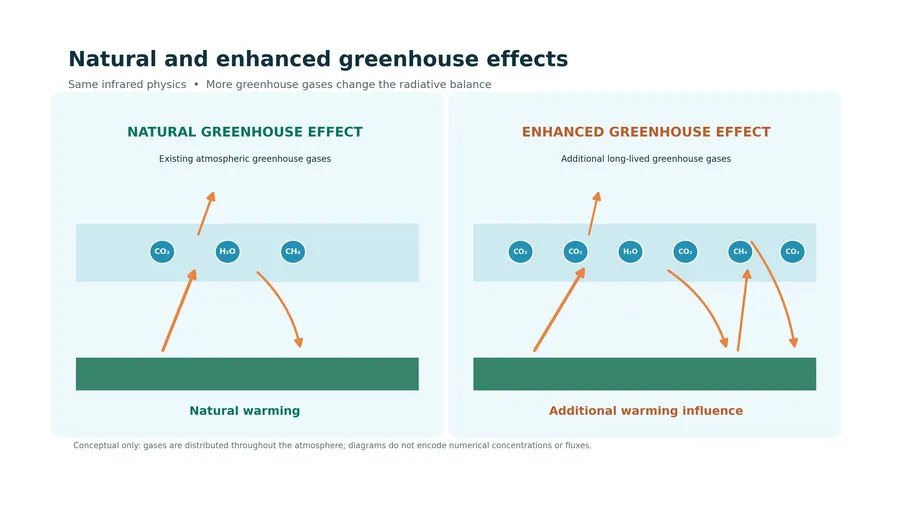
Figure 3. The natural and enhanced greenhouse effects. More greenhouse gases change infrared radiative transfer. Arrows are illustrative and do not specify measured radiative fluxes or temperature outcomes.
6. Worked example: why −18°C and +15°C are often compared
A simplified planetary energy-balance calculation can help explain why greenhouse warming matters. The calculation treats Earth as a sphere with an average incoming solar irradiance and assumes that the planet emits thermal radiation according to a blackbody approximation. It does not simulate a realistic vertical atmosphere, clouds or local climate.
Let the solar irradiance perpendicular to sunlight at Earth's orbit be approximately 1,361 W/m². Averaging over Earth's spherical surface divides this value by four:
If a fraction α = 0.30 is reflected to space, the planet absorbs:
For an idealized effective radiating temperature T, the Stefan–Boltzmann relation gives:
At equilibrium, set emitted thermal radiation equal to absorbed solar radiation:
The resulting temperature is about −18°C after rounding. This is Earth's effective radiating temperature under the stated idealizations, not the temperature of every place on a hypothetical airless Earth. In particular, holding reflectivity fixed at 0.30 while removing atmospheric effects is a mathematical simplification, because clouds and other atmospheric components themselves help determine reflectivity.
The commonly cited observed global mean surface temperature near +15°C is warmer than this effective radiating temperature by roughly 33°C. The comparison illustrates greenhouse warming, but it is not a direct measurement of how much warming an added quantity of CO₂ would cause. It also does not predict future temperature change. Those questions require radiative-transfer physics, climate feedbacks and observations [1,2].
Units check: W/m² is power per unit area, kelvin is absolute temperature, and the Kelvin-to-Celsius conversion is approximately Celsius = Kelvin − 273.15. The numerical values are rounded; avoid treating the result as a precision thermometer reading.
7. What evidence connects human activity to warming?
Scientists do not rely only on the fact that temperatures have risen. Multiple independent forms of evidence support the explanation: measured changes in greenhouse-gas concentrations, laboratory spectroscopy, satellite observations of Earth's radiative energy, the distribution of warming in the atmosphere and oceans, chemical signatures of added carbon, and simulations that compare natural and human influences [6–8].
The Intergovernmental Panel on Climate Change (IPCC) states that human activities, primarily through greenhouse-gas emissions, have unequivocally caused global warming. Its 2023 synthesis report assesses global surface temperature at about 1.1°C above the 1850–1900 baseline over 2011–2020 [7]. This benchmark is a period average, not a claim about the exact temperature anomaly of the current month or year.
The greenhouse effect is therefore a normal, life-supporting part of Earth's climate. The serious modern concern is the additional energy imbalance produced when human emissions raise greenhouse-gas concentrations. The excess energy accumulates mainly in the oceans, with consequences for surface temperatures, ice, sea level and weather patterns [7].
8. Common misconceptions, explained
“The greenhouse effect is bad.” The natural greenhouse effect is necessary for our present climate. The concern is the additional warming from strengthening it.
“The ozone hole is the main cause of global warming.” Ozone depletion and greenhouse warming involve different physical processes. Ozone can itself influence climate, and some ozone-depleting substances are greenhouse gases, but the ozone hole is not the principal cause of current global warming.
“Carbon dioxide is too scarce to matter.” Greenhouse influence depends on absorption and emission of infrared radiation, not simply on the fraction of molecules in air. Nitrogen and oxygen are abundant but weak greenhouse absorbers [4].
“Water vapor causes all climate change, so CO₂ cannot matter.” Water vapor provides major greenhouse warming and often amplifies temperature changes. Long-lived greenhouse-gas increases can initiate warming that leads to greater atmospheric humidity, reinforcing the initial warming [1,6].
“Greenhouse gases stop all heat from escaping.” If no energy escaped, Earth could not maintain a long-term energy balance. Greenhouse gases modify where and how infrared energy leaves the system; they do not make spaceward radiation impossible.
“A real glass greenhouse proves the atmospheric mechanism.” A horticultural greenhouse mainly suppresses convection of warmed air through its enclosure. Atmospheric greenhouse warming is primarily about infrared radiation transfer. The shared name is a teaching analogy, not proof that the mechanisms are identical [3].
9. Why this matters for energy and sustainability
Electricity generation, transport, heating, industry and land-use decisions affect greenhouse-gas emissions. Understanding the greenhouse effect therefore provides a scientific foundation for evaluating clean energy, energy efficiency and sustainability claims. The questions are interconnected but distinct: a system can generate low-carbon electricity, use resources inefficiently, or create impacts elsewhere along its supply chain.
Readers interested in how electricity is generated can continue with What Is Solar Energy? and the Green Hydrogen learning hub. Our forthcoming lessons in this hub will examine how much of global energy consumption comes from clean sources and what the word sustainability actually means.
10. Key takeaways
- The Sun provides incoming shortwave energy; Earth emits thermal infrared radiation.
- Greenhouse gases absorb and emit portions of that infrared radiation, making the surface warmer than in a simple no-greenhouse energy-balance model.
- Natural greenhouse warming is beneficial; rising human-caused concentrations of greenhouse gases enhance the warming.
- Water vapor is an important feedback, while CO₂, methane and other gases can act as powerful drivers of changes in radiative balance.
- The textbook −18°C versus +15°C comparison illustrates greenhouse warming but is not a prediction of CO₂ sensitivity.
11. Five quick review questions (with answers)
Q1. What kind of radiation does Earth's surface emit most strongly? Thermal infrared radiation, because the surface is much cooler than the Sun.
Q2. Do greenhouse gases permanently trap energy? No. They change the pathways and rates of infrared energy transfer. Energy still leaves the Earth system for space.
Q3. Why is water vapor often called a feedback? A warmer climate generally permits more atmospheric water vapor, which amplifies an initial warming influence.
Q4. Why is the greenhouse effect not exactly like a glass greenhouse? Glass enclosures strongly limit convection, while atmospheric greenhouse warming chiefly involves infrared radiative transfer.
Q5. Does a 33°C natural greenhouse comparison mean doubling CO₂ warms Earth by 33°C? No. The 33°C comparison describes the difference between an idealized effective radiating temperature and the conventional mean surface temperature; CO₂ changes require separate analysis.
Technical discussions describe general principles; site-specific engineering decisions require appropriate professional evaluation.