
RENEWIOSITY / EXPLAINER
Advantages and Disadvantages of Renewable Energy: Benefits, Challenges and Trade-offs
A balanced beginner guide to renewable energy benefits and limitations, covering climate, fuel costs, energy security, variability, grid flexibility, land use, materials, and a worked annual-generation example.
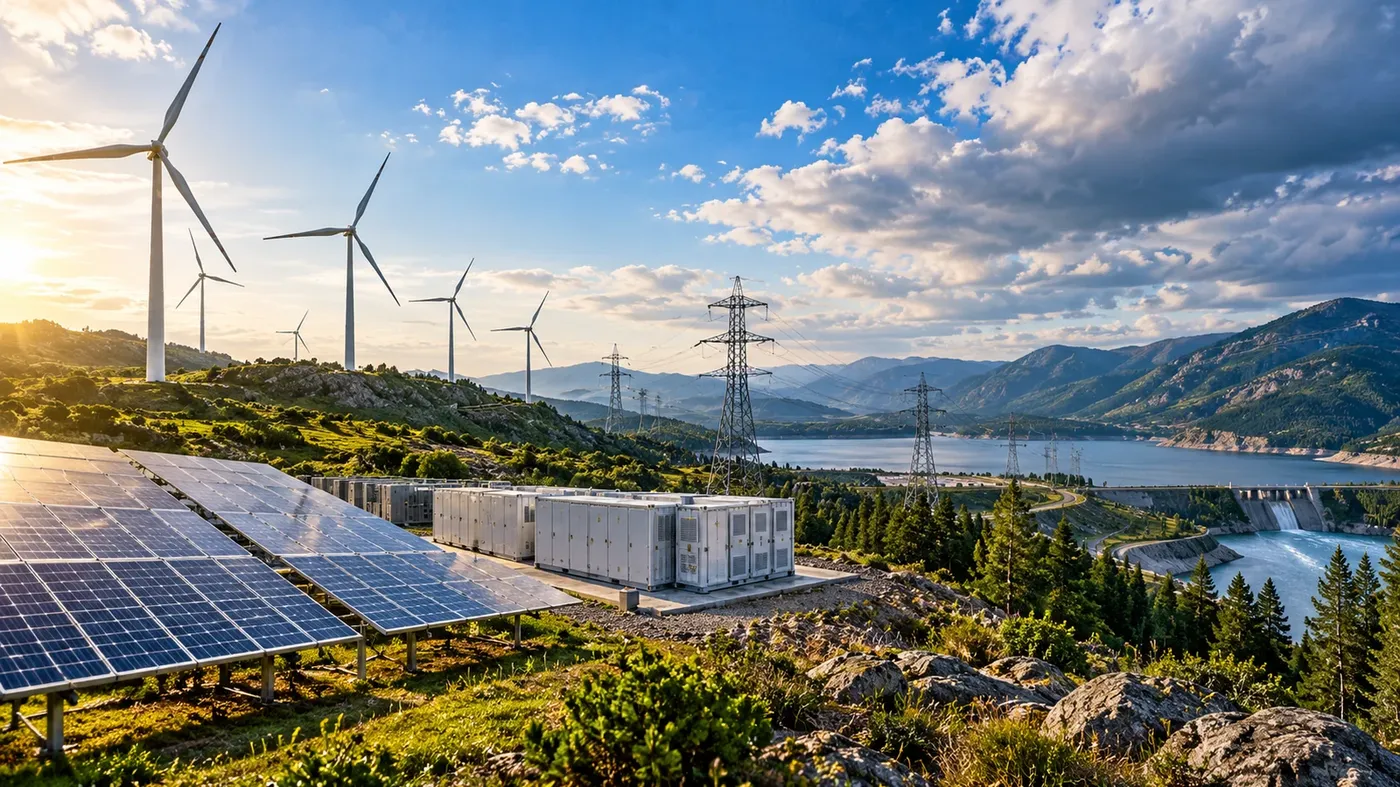
Renewable energy offers important advantages—especially lower greenhouse-gas emissions from many electricity technologies, reduced dependence on purchased fuels, and a more diverse energy supply. But it also has disadvantages and trade-offs. Solar and wind output varies with weather, projects need land and materials, and electricity networks must keep supply and demand balanced. The right question is not whether renewable energy is simply “good” or “bad”; it is where, how and with what safeguards it works best.
This beginner-friendly guide explains the major benefits and limitations of solar, wind, hydropower, geothermal energy and bioenergy. It distinguishes a technology’s direct operating effects from its full life-cycle impacts, and it uses practical examples to show why electricity-system design matters. For an introduction to the underlying energy sources, begin with What Is Renewable Energy?.
What you will learn
- Identify five major advantages of renewable energy.
- Explain five practical disadvantages or planning challenges.
- Recognize that renewable does not mean zero environmental impact.
- Distinguish variable generation from unreliable electricity service.
- Explain how storage, transmission and demand flexibility support renewables.
- Compare the strengths and limitations of major renewable technologies.
- Calculate a simple capacity-factor and annual-energy example.
1. What are the main advantages and disadvantages?
The benefits and drawbacks depend on the technology, project design, location and electricity system. Solar panels on an existing roof do not have the same land-use implications as a new utility-scale solar farm; reservoir hydropower behaves differently from a run-of-river plant; and sustainably managed waste-based bioenergy differs from crops grown on converted forest land.
Main advantages: lower operating greenhouse-gas emissions for many renewable electricity sources, no fuel purchase for sunlight or wind, diversification of supply, opportunities for distributed energy access, and the possibility of pairing clean electricity with electrified transport and heating. Main challenges: variable output for solar and wind, grid and storage investment, site-specific ecosystem effects, mineral and manufacturing supply chains, and financing or permitting barriers. [1–4]
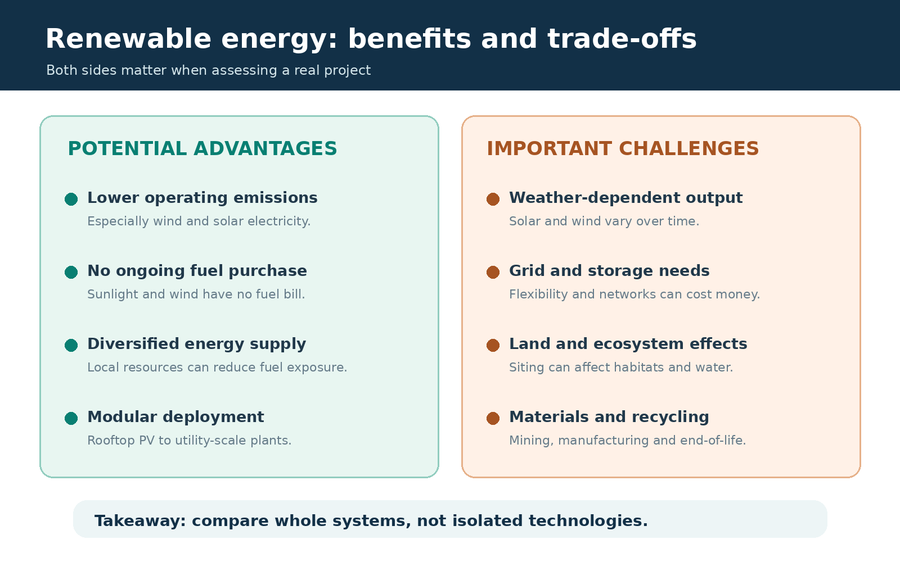
Figure 1. Renewable energy offers multiple benefits, but responsible project assessment also accounts for variability, infrastructure, ecosystems and materials.
2. Advantage: lower greenhouse-gas emissions
Wind turbines and solar photovoltaic panels generate electricity without burning fuel during normal operation. This avoids the direct combustion carbon dioxide emissions associated with coal- and gas-fired generation. Many renewable technologies also have comparatively low greenhouse-gas emissions when manufacturing, construction, operation and end-of-life activities are considered. The IPCC identifies solar and wind as important options for reducing energy-system emissions. [2]
However, “zero emissions” is usually too strong a claim. Manufacturing steel, cement, silicon, batteries and electrical equipment consumes energy and materials. Land-use changes, construction, maintenance and disposal can add impacts. Bioenergy combustion releases carbon dioxide and can create local air pollutants; whether bioenergy reduces net climate impacts depends strongly on feedstock, land management and accounting boundaries. [2, 3]
3. Advantage: no purchased fuel for solar and wind
Once a solar or wind plant is built, the energy resource itself—sunlight or moving air—has no purchase price. This can reduce exposure to volatile fossil-fuel prices. Operating expenses remain: cleaning, repairs, insurance, land leases, inverters, grid charges and eventual equipment replacement all matter. Hydropower, geothermal and bioenergy have different cost structures and operating constraints.
A low fuel cost does not automatically guarantee a low electricity bill. Financing, construction, transmission, system balancing, taxes and market rules affect the final cost paid by households and industry. A fair comparison therefore looks at the cost of delivering reliable electricity, not only the cost of generating one unit at a power plant.
4. Advantage: energy diversification and security
Using several energy sources can reduce reliance on any single imported fuel. Solar rooftops, wind farms, geothermal resources and hydroelectric facilities may help countries diversify their energy mix. Distributed systems can also improve energy access in some remote communities when paired with suitable batteries, controls and maintenance support.
Diversification does not eliminate dependence on international trade. Solar panels, wind turbines, inverters, transformers and batteries depend on manufacturing networks, minerals, skilled labor and transport. Energy security is improved most reliably through a diversified portfolio, robust grids, supply-chain planning and resilient operation. [1, 4]
5. Advantage: scalable applications and new energy services
Renewable systems can range from a small rooftop PV installation to a large wind farm or hydropower station. They can supply electricity to homes, businesses, factories and isolated mini-grids. Clean electricity can also power electric vehicles, heat pumps and some industrial processes, potentially reducing fuel combustion outside the electricity sector.
This flexibility is not universal: a site must have an adequate resource, safe design, grid connection or suitable off-grid architecture, and an economic case. For example, solar PV is modular, while large reservoir hydropower requires substantial civil works and a suitable river basin.
6. Disadvantage: solar and wind generation vary
Solar electricity follows the sun and is affected by clouds, shading and seasonal daylight. Wind generation changes with wind speed and turbine operating limits. These patterns make solar and wind variable renewable energy (VRE) sources. Variable generation does not mean that the grid must become unreliable; it means the rest of the system must be designed to accommodate changing output. [1, 5]
Electricity demand also changes throughout the day. System operators continually match generation and demand using a mix of flexible power plants, batteries, pumped storage, transmission, demand response and forecasting. The appropriate combination depends on local geography, weather, demand, existing infrastructure and the renewable share of the system. [5, 6]
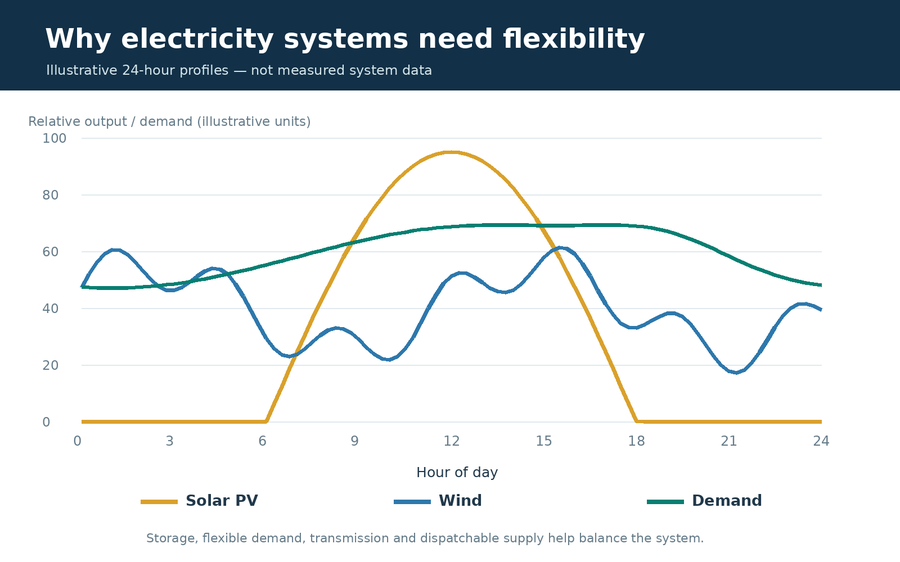
Figure 2. Illustrative daily solar, wind and demand profiles show why electricity-system flexibility is important. These curves are teaching examples, not measured grid data.
7. Disadvantage: grids, storage and flexibility require investment
Solar and wind projects are not useful at scale if electricity cannot reach consumers when it is produced. New lines, substations, inverters, grid controls and sometimes energy storage may be needed. Bottlenecks can delay connections or force operators to curtail renewable output. The IEA identifies grid integration, financing and supply chains among the key challenges to renewable expansion. [1, 4, 5]
Batteries shift electricity from one time to another; they do not create energy. Long low-wind or low-sun periods may require other generators, long-duration storage, transmission imports or demand adjustments. Grid reliability is a system property, not a label that belongs to one generation technology.
8. Disadvantage: land, water and biodiversity impacts
Renewable projects occupy space and can affect local ecosystems. Solar farms may compete with other land uses if poorly sited. Wind farms require attention to birds, bats, landscape and community concerns. Hydropower dams can change river flows, fish migration, sediment transport and downstream livelihoods. Geothermal development may require careful groundwater management, while some bioenergy pathways compete with food production or natural habitats. [2, 3]
These impacts vary widely. Rooftop solar uses existing built surfaces, agricultural co-use can sometimes be compatible with solar arrays, and improved siting or mitigation can reduce wildlife impacts. Environmental review, local consultation, monitoring and adaptive management are essential parts of responsible development.
9. Disadvantage: material demand, manufacturing and end-of-life
Renewable infrastructure requires steel, concrete, copper, aluminum, glass, silicon and, for some technologies, specialized minerals. Mining and refining may cause local pollution or social impacts if poorly managed. Manufacturing has an environmental footprint, and equipment eventually needs repair, reuse, recycling or safe disposal.
These effects should be assessed using life-cycle thinking: from material extraction to manufacturing, construction, operation and end-of-life. A project can have low operating emissions while still creating meaningful local environmental or supply-chain impacts. Conversely, the presence of manufacturing impacts does not erase the benefits of avoiding fuel combustion over years of operation. [2, 3]
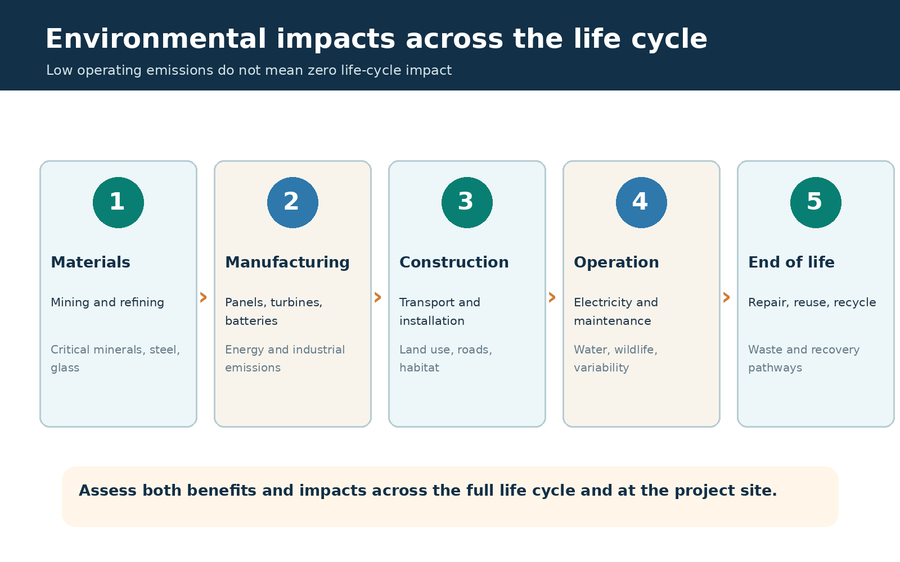
Figure 3. A life-cycle view considers material extraction, manufacturing, construction, operation and end-of-life management rather than judging a project only while it generates power.
10. Disadvantage: upfront costs, permitting and local acceptance
Renewable projects can require substantial capital before they produce electricity. Financing terms, interest rates, project delays, grid-connection costs and permitting processes affect affordability. Even when a technology is economical over its lifetime, investors and communities may face obstacles to building it. [1, 4]
Consulting residents and land users early is important. A technically feasible project may still be unacceptable if it creates unfair impacts, weakens local livelihoods or fails to share benefits. Project-level decisions should consider cost, environment, community preferences and long-term maintenance—not merely the size of the resource.
11. Advantages and disadvantages by technology
Solar PV: scalable and low-emission in operation, but produces mainly in daylight and needs suitable surfaces, grid access and materials. Wind: generates without fuel combustion, but output varies and siting must consider wildlife and nearby communities. Hydropower: some reservoir plants can respond flexibly to demand, but river ecosystems and drought conditions matter.
Geothermal: can provide steady electricity or heat where resources and engineering allow, but drilling is expensive and subsurface conditions create uncertainty. Bioenergy: can provide controllable heat, power or fuels, but emissions and sustainability depend on feedstock origin, processing and land use. No technology is universally best for every location.
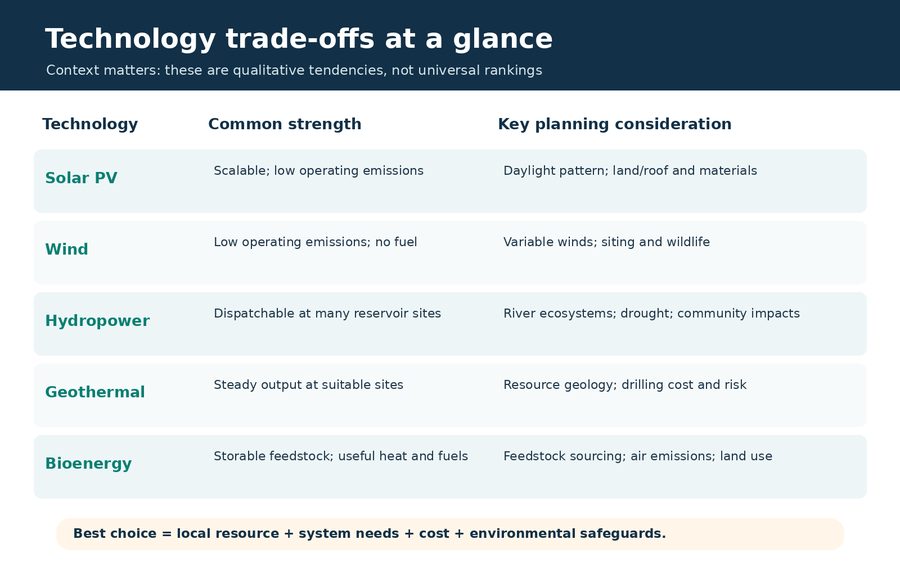
Figure 4. Major renewable technologies have distinct strengths and site-specific constraints. The comparison is qualitative and should not be treated as a ranking.
12. Worked example: how much electricity does a solar plant generate?
A plant’s rated capacity is its maximum specified output under defined conditions, not a promise that it will generate at that power every hour. Capacity factor expresses actual energy produced relative to the energy it would produce if it operated at rated power throughout the period.
E is annual energy, P is rated electrical power, and CF is the capacity factor expressed as a decimal. The 8,760-hour assumption is for a 365-day year.
Worked example — 5 MW solar PV plant
A hypothetical solar PV plant has a rated AC output of 5 MW and an assumed annual capacity factor of 20%. Estimate its annual electricity production. This is an illustrative assumption, not a site forecast.
- Convert the capacity factor to a decimal: 20% = 0.20.
- Multiply 5 MW by 8,760 hours and by 0.20.
- Convert the resulting MWh to GWh if desired.
Answer: 8,760 MWh, or 8.76 GWh, per year. Actual generation would depend on irradiance, weather, system losses, outages and curtailment.
The same calculation works for other technologies when a justified capacity factor is available. It is useful for estimating energy, but it does not establish project profitability, environmental impact or reliability. Those require additional information.
13. How can the disadvantages be reduced?
A practical strategy combines good siting (avoid sensitive habitats and unnecessary land conflicts), sound system design (transmission, storage, forecasting and demand flexibility), transparent life-cycle assessment (materials, manufacturing and end-of-life), and fair local engagement (consultation, safeguards and benefit sharing). These measures improve outcomes but cannot eliminate every trade-off. [2–6]
In many locations, the strongest electricity system combines complementary sources. Solar may be abundant at midday, wind may contribute at different hours, reservoir hydropower or other flexible resources can respond to demand, and batteries can shift short-term energy. The right mix is determined by the local resource, existing grid and required reliability—not by a single technology’s headline advantages.
14. Frequently asked questions
Is renewable energy completely clean? No. Many renewable electricity technologies have low operating emissions, but all projects involve materials, construction and possible local impacts. “Renewable” describes the energy resource, not a guarantee of zero environmental impact.
Can a country use a high share of renewable electricity? Yes, with adequate planning and a suitable combination of generation, networks, storage, demand flexibility and operational controls. The complexity and cost depend on the region and the mix of resources. [5]
Are renewables always cheaper than fossil fuels? No universal comparison is valid. Costs depend on technology, financing, fuel prices, local conditions, system integration and project life. Generation cost and the cost of reliable delivered electricity are not identical.
Does a battery solve every renewable-energy problem? No. Batteries can store energy for later use, but long-duration low-output periods, transmission constraints and grid stability can require other solutions as well.
15. Check your understanding
Why can a solar plant have zero direct fuel-combustion emissions but nonzero life-cycle emissions?
Reveal worked answer
Because manufacturing, transport, construction, materials and end-of-life activities may cause emissions even though solar PV does not burn fuel to generate electricity.
Name two options that help an electricity system handle changing solar and wind output.
Reveal worked answer
Examples include batteries, pumped storage, stronger transmission, flexible demand, improved forecasting and dispatchable generation.
A 2 MW wind project produces 5,256 MWh in a 365-day year. What is its capacity factor?
Reveal worked answer
The maximum theoretical annual energy is 2 MW × 8,760 h = 17,520 MWh. Capacity factor = 5,256 / 17,520 = 0.30, or 30%.
16. Key takeaways
Renewable energy is a major tool for reducing fossil-fuel dependence, but it is not impact-free or automatically reliable on its own. Its advantages include low operating emissions for many technologies, energy diversification and reduced fuel exposure. Its challenges include variable solar and wind output, infrastructure requirements, land and biodiversity impacts, material demand and financing constraints. Good outcomes depend on technology choice, local conditions and careful whole-system planning.
Continue learning with Renewable Energy vs Fossil Fuels, and then explore the major renewable technologies and how the energy transition works in the next lessons of this fundamentals series.
References and further reading
1. International Energy Agency (IEA) — Renewables 2025, Executive Summary. Read the source.
2. IPCC — Climate Change 2022: Mitigation of Climate Change, Summary for Policymakers. Read the source.
3. IPCC — AR6 Synthesis Report, Longer Report. Read the source.
4. IEA — World Energy Investment 2025, Executive Summary. Read the source.
5. IEA — Integrating Solar and Wind (2024). Read the source.
6. IEA — The Value of Demand Flexibility (2025). Read the source.
7. IEA — Renewables 2025, Renewable Electricity. Read the source.
8. IPCC — Climate Change 2022: Mitigation, Chapter 17. Read the source.
Technical discussions describe general principles; site-specific engineering decisions require appropriate professional evaluation.