
RENEWIOSITY / EXPLAINER
What Is Renewable Energy? A Complete Beginner’s Guide
A clear, scientifically grounded beginner’s guide to renewable energy, the five main sources, electricity and heat, fossil-fuel comparisons, limitations and a simple kWh calculation.
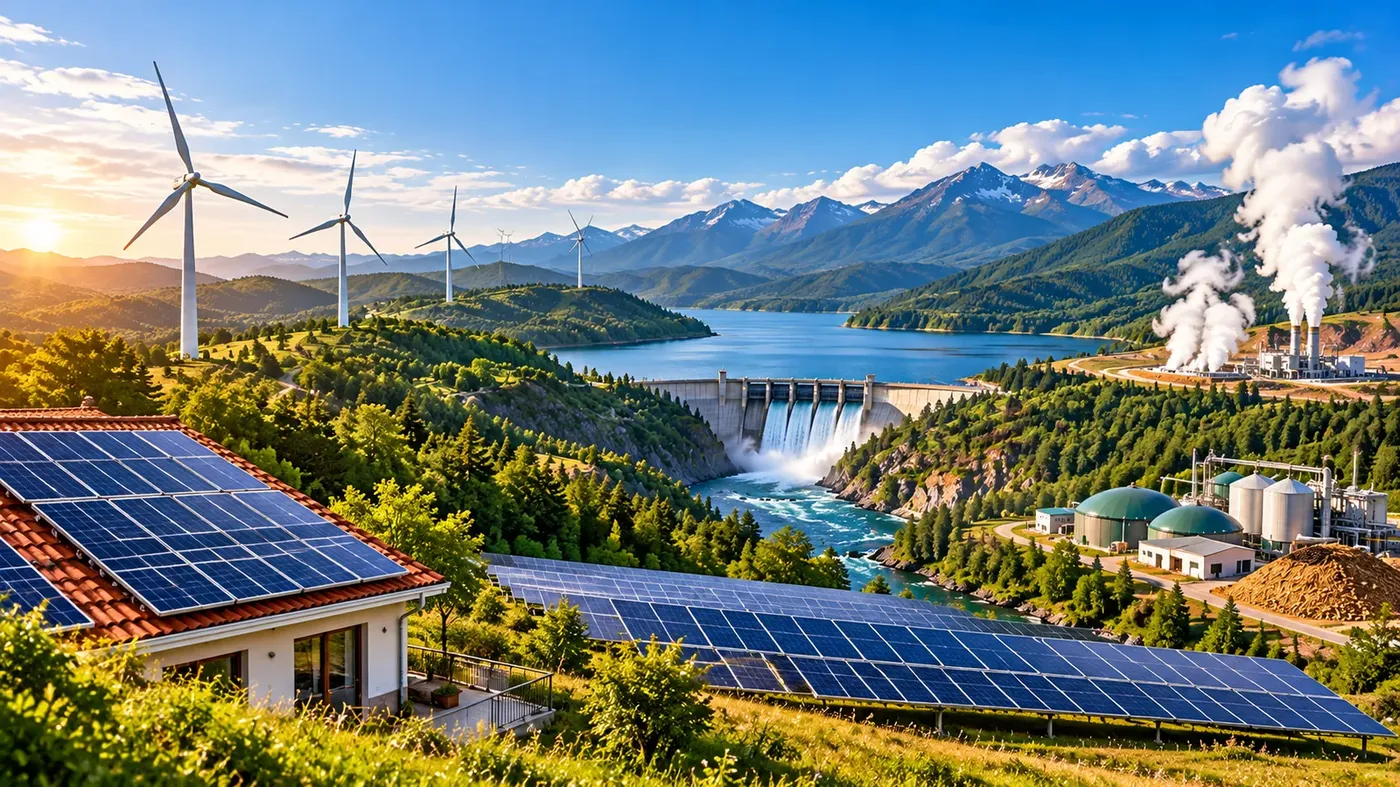
Renewable energy comes from natural resources that replenish on human timescales, including sunlight, wind, flowing water, heat from the Earth and sustainably replenished biomass. These resources can provide electricity, heating and fuels. The central idea is simple: instead of depending only on fuels that take millions of years to form, we can capture energy from processes that nature continually renews. [1, 2]
You do not need an engineering background to understand renewable energy. In this guide, we will begin with everyday examples, explore the five main technologies, explain why renewables matter and discuss their real limitations. You will also learn a small but useful electricity calculation.
What you will learn
- Explain what energy is and what makes an energy source renewable.
- Identify the five major renewable energy families and their useful outputs.
- Distinguish an energy source from electricity, which is an energy carrier.
- Recognize important benefits and limitations without treating any technology as impact-free.
- Understand the difference between power (kW) and energy (kWh).
- Describe how grids combine renewable generation with flexibility and storage.
1. First, what is energy?
Energy is the ability to do work or produce a change. We experience it as light from a lamp, heat from a stove, movement from a bicycle or the electricity that charges a phone. Energy exists in different forms, including light, thermal, chemical, mechanical and electrical energy. We can convert it from one form into another. [2]
Consider a kettle. Electrical energy enters the heating element and becomes thermal energy that warms the water. In a bicycle, chemical energy from food becomes muscle work and motion. A power station also converts energy: the original source may be moving water, wind, sunlight, heat or a fuel.
One useful distinction: an energy source is where the energy originates, while electricity is a convenient form in which energy is delivered and used. Renewable energy is much broader than renewable electricity; it can also supply useful heat and some transport fuels.
2. What makes an energy source renewable?
An energy source is renewable when natural processes replenish it on a timescale relevant to people. Sunlight arrives day after day; winds arise from atmospheric heating and circulation; rivers are replenished through the water cycle; and heat flows from within the Earth. Biomass can be renewable when the organic material is replenished and managed sustainably. [1, 3]
Renewable does not mean that the energy is available in unlimited amounts at every location or at every hour. A solar panel produces little or no electricity at night. Wind turbines need suitable wind speeds. Drought can reduce hydropower production. Biomass harvesting can exceed regrowth. Nature renews the resource, but local availability and responsible management still matter.
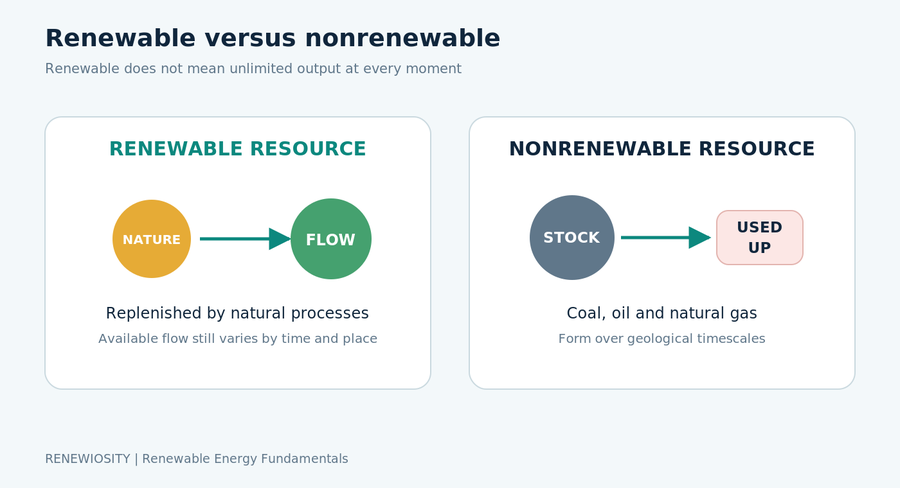
Figure 2. Renewable energy depends on naturally replenishing flows; fossil fuels are depleted far faster than they form.
3. The five major types of renewable energy
The five familiar families are solar, wind, hydropower, geothermal and bioenergy. They differ in where their energy comes from and in the equipment used to capture it. Some primarily make electricity, while others can supply heat or fuel. [1, 3]
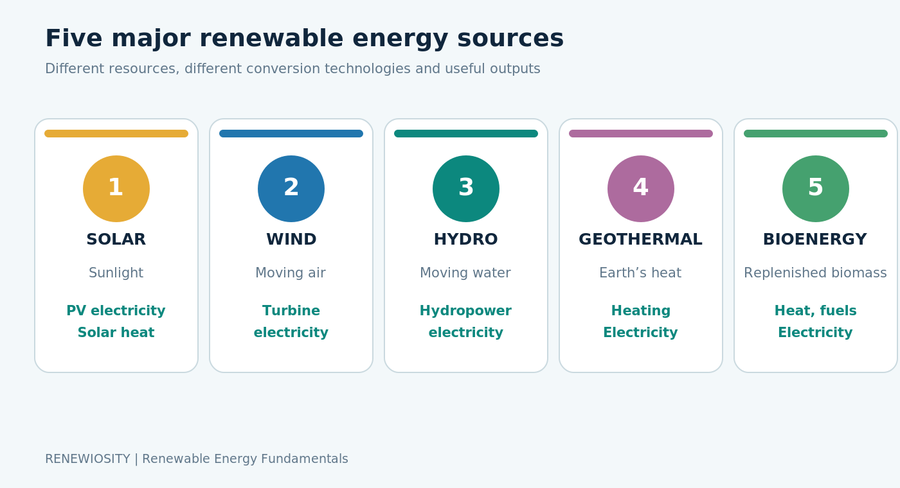
Figure 1. The five main renewable energy families use different natural resources to provide electricity, heat or fuels.
3.1 Solar energy: energy from sunlight
Solar photovoltaic (PV) panels convert light directly into electricity. A rooftop solar array can power household appliances during sunny periods; larger solar farms supply electricity to the grid. Solar thermal collectors instead capture solar heat, for example to warm water. Concentrated solar power plants use mirrors to collect solar heat and can produce electricity through a heat engine.
Solar panels do not need hot weather to function; they need light. Their output depends on sunlight intensity, shading, orientation, temperature and system losses. For a deeper explanation, see How Do Solar Panels Work?
3.2 Wind energy: energy from moving air
Wind turbines capture part of the kinetic energy of moving air. Wind turns the rotor, and a generator converts mechanical energy into electricity. Wind farms can be located on land or offshore. The wind resource is not constant, so output changes with weather and turbine operating limits.
Wind turbines do not create wind; they harvest a small portion of its available energy. They also need suitable sites, transmission connections and environmental planning. Read our introductory guide: What Is Wind Energy?
3.3 Hydropower: energy from moving water
Hydropower uses the motion or fall of water to drive a turbine and generator. Some facilities use reservoirs behind dams; others operate with little storage, relying more directly on river flow. Water availability, seasonal patterns and ecological requirements affect generation.
Hydropower can be flexible when reservoirs and operating rules permit, but large dams may change river habitats, sediment transport and nearby communities. Pumped-storage hydropower is slightly different: it uses electricity to pump water uphill and later recovers some of that energy when the water flows down. It is energy storage, not a net new energy source.
3.4 Geothermal energy: heat from within the Earth
Geothermal energy comes from heat within the Earth. In suitable locations, hot water or steam from underground reservoirs can provide direct heating or generate electricity. Geothermal heat pumps also use the relatively stable temperature of shallow ground to heat and cool buildings; they require an energy input to run the pump.
Geothermal electricity can be available for long periods, but accessible high-temperature resources are geographically uneven. Projects require careful management of underground fluids, reservoir performance and possible local impacts.
3.5 Bioenergy: energy from organic materials
Bioenergy uses organic material such as forestry residues, agricultural by-products, certain organic wastes and sustainably grown energy crops. The material may be burned for heat, digested to produce biogas, or processed into liquid fuels. Some systems also produce electricity. [6]
Bioenergy needs special care in how it is described. Burning biomass releases carbon dioxide and can release air pollutants. Whether a project provides meaningful climate benefits depends on feedstock origin, land use, regrowth, processing, transport and the alternative use of the material. Bioenergy is not automatically carbon-neutral merely because plants are involved.
4. How does renewable energy become useful electricity?
There are several pathways. Solar PV cells convert light directly to electrical energy. Wind and hydro turbines first create rotational mechanical energy, which generators convert to electricity. Geothermal and some bioenergy plants may use heat to produce steam or drive other power cycles. Electricity can then flow through inverters, transformers, transmission and distribution networks to customers.
At home, electricity powers lighting, computers, fans and many other devices. Heat can also be delivered directly: a solar water heater, for example, may warm water without generating electricity first. The best energy pathway depends on the job to be done.
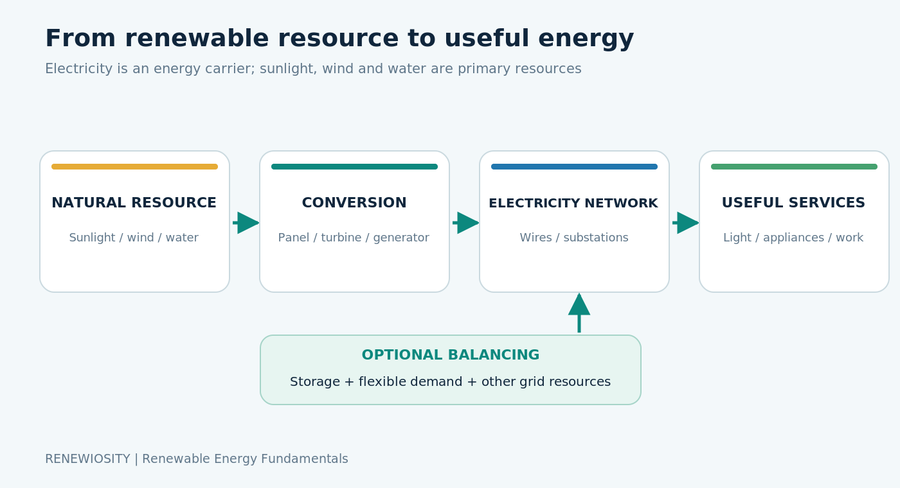
Figure 3. Renewable resources are converted into electricity, delivered through electrical networks and used by customers; storage can help balance supply and demand.
5. Renewable energy versus fossil fuels
Coal, oil and natural gas are fossil fuels. They formed from ancient organic matter over geological timescales and are depleted when extracted and used. Renewable sources, by contrast, are replenished through ongoing natural processes. Fossil-fuel combustion emits carbon dioxide and other pollutants; many renewable technologies have much lower direct operating emissions, although construction, materials, land use and end-of-life management still matter. [2, 7]
Important nuance: nuclear fission is generally classified as nonrenewable because it uses mined uranium, but it is also a low-carbon electricity source during operation. Therefore, renewable and low-carbon are related terms, not synonyms. Likewise, renewable does not always mean zero environmental impact.
Our next beginner lesson will examine this comparison in greater depth, including energy security, reliability, environmental effects and cost. For now, remember the defining distinction: how the original resource is replenished.
6. Why is renewable energy important?
Renewables can reduce reliance on fossil-fuel combustion, diversify energy supply and support lower greenhouse-gas emissions when deployed responsibly. They can also expand access to electricity in suitable settings, such as solar-powered systems in remote areas. Local conditions, costs, materials and infrastructure determine how much benefit each project provides. [4, 7]
Energy security is another reason countries invest in renewables. Wind and sunlight do not need to be imported as fuel, although solar panels, turbines, batteries and other equipment still depend on manufacturing and supply chains. A diverse energy mix can reduce some vulnerabilities while introducing different planning needs.
Renewables are also important beyond the power sector. Renewable heat, renewable electricity for electric vehicles, and responsibly produced biofuels can contribute to reducing fossil-fuel use in buildings, industry and transport. The energy transition involves far more than replacing power plants. [4]
7. What are the limitations of renewable energy?
Renewable energy technologies face genuine challenges. Solar and wind generation vary with weather and time of day. Some resources are geographically concentrated. New projects may require land, materials, skilled workers, transmission lines and permits. Hydropower can affect aquatic ecosystems; bioenergy can create land-use and air-quality concerns; geothermal projects need suitable subsurface conditions.
These challenges do not make renewables unworkable, but they mean that responsible energy planning must consider the whole system: demand, supply, storage, grid infrastructure, reliability, cost and environmental trade-offs. Different technologies complement one another rather than competing for a single universal solution.
8. Can renewables supply electricity when the sun is not shining?
Yes, a grid can serve customers during dark or calm periods by combining resources. Wind may produce electricity when solar output is low; hydropower, geothermal plants, bioenergy plants, batteries, demand flexibility, transmission connections and other dispatchable generators can help balance the system. The appropriate combination depends on the region and its electricity demand. [4, 5]
Electricity supply and demand must remain balanced continuously. Batteries can shift energy from one time to another, but they do not create energy. Stronger networks can share electricity across regions. Flexible consumers can move some activities to periods of abundant supply. Longer periods of low wind or sunlight may require additional resources and careful planning.
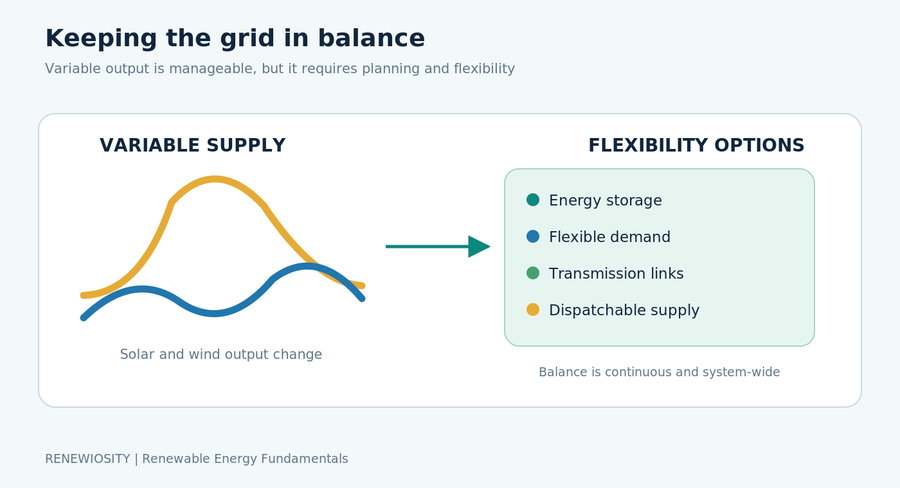
Figure 4. A reliable grid balances variable renewable generation using several complementary flexibility options; no single technology solves every challenge.
9. A beginner calculation: power versus energy
People often confuse power and energy. Power tells us how quickly energy is used or produced, and is commonly measured in watts (W) or kilowatts (kW). Energy tells us how much was produced or used over a period, commonly in kilowatt-hours (kWh). One kilowatt equals 1,000 watts.
This simple relation applies when average power is constant over the stated time interval. Real solar and wind output varies, so longer-term estimates must account for changing conditions.
Worked example — A small solar system
Suppose a solar PV system delivers an average electrical power of 2 kW for 3 hours. How much electrical energy does it generate during that period?
- Identify the average power: 2 kW.
- Identify the duration: 3 hours.
- Multiply power by time: 2 × 3 = 6.
Answer: 6 kWh of electricity. This is an illustrative constant-average-power example, not a promise of daily solar generation.
If an appliance uses 1 kWh, that might mean operating at 1 kW for one hour or at 0.5 kW for two hours. The electricity bill usually reports energy consumption in kWh, not kW. Understanding this distinction makes renewable-energy claims and system sizes much easier to interpret.
10. Five common renewable-energy misconceptions
“Renewable means pollution-free.” Not necessarily. Many renewables have low operating emissions, but equipment manufacturing, land use, construction, maintenance and disposal have impacts. Some bioenergy systems also emit pollutants during operation.
“Solar panels work only in hot places.” They use light, not heat, to generate electricity. Solar production depends strongly on irradiance, orientation, shading and other conditions; very high cell temperatures can reduce electrical efficiency.
“Wind turbines need a constant strong wind.” They operate within a range of wind speeds and stop in unsuitable conditions. Wind-farm production changes over time, which is why planners estimate long-term energy yield rather than assuming full output every hour.
“A battery is a renewable energy source.” A battery stores energy supplied to it. Whether the stored electricity originated from renewable resources depends on how it was charged. For more background, see What Is Energy Storage?
“One technology can replace every other source everywhere.” Energy needs differ across regions and sectors. Reliable, affordable and lower-impact systems typically require a portfolio of technologies and sound engineering decisions.
11. How to keep learning
Start by identifying the renewable resources around you: sunlight on rooftops, wind across open landscapes, flowing rivers, organic residues and heat beneath the ground. Then ask three questions: What is the source? How is it converted? What useful service does it provide? These questions work for almost every energy technology.
After this introduction, continue with our beginner series on renewable energy versus fossil fuels, advantages and disadvantages, types of renewable energy and the energy transition. When you are ready for deeper study, RENEWIOSITY’s engineering topic guides and calculators introduce performance, sizing and energy balances.
12. Frequently asked questions
Is renewable energy the same as clean energy? Not exactly. Renewable describes how the resource is replenished. Clean or low-carbon describes environmental characteristics, which require their own assessment.
Is hydropower renewable? Generally yes, because river flow is renewed through the water cycle. However, drought, environmental constraints and water-management decisions can limit production.
Is hydrogen itself a renewable energy source? Hydrogen is usually an energy carrier made using another energy input. Hydrogen produced using renewable electricity may be called green hydrogen, but its environmental performance depends on the production pathway. See What Is Green Hydrogen?
Can a home run entirely on renewable energy? It is possible in some situations, but it depends on demand, local resources, system sizing, storage, backup options and whether the home is grid-connected.
Are renewable energy systems affordable? Costs depend on technology, site, financing, installation and electricity prices. Upfront cost and lifetime cost are not the same. Project economics should be evaluated rather than assumed.
13. Quick knowledge check
Which characteristic makes an energy source renewable?
Reveal worked answer
Natural processes replenish the resource on timescales relevant to people; it does not mean output is unlimited at every moment.
Name two renewable energy technologies that can generate electricity without burning fuel.
Reveal worked answer
Examples include solar PV panels, wind turbines and hydropower turbines.
What is the difference between kW and kWh?
Reveal worked answer
kW is power, a rate of energy use or production; kWh is the amount of energy over time.
Does a battery produce primary energy?
Reveal worked answer
No. A battery stores energy supplied from another source and later delivers part of it.
Why is bioenergy not automatically carbon-neutral?
Reveal worked answer
Its net climate effect depends on feedstock, land-use change, regrowth, processing, transport and combustion emissions.
14. Key takeaways
Renewable energy comes from naturally replenishing resources. The main families are solar, wind, hydropower, geothermal and bioenergy. These sources can supply electricity, heat and some fuels. They can reduce dependence on fossil fuels, but each has resource, economic and environmental constraints. Understanding energy conversion, power versus energy and system balancing is the foundation for more advanced renewable-energy engineering.
References and further reading
1. U.S. Energy Information Administration — Renewable energy explained. Read the source.
2. U.S. Energy Information Administration — Sources of energy. Read the source.
3. U.S. Energy Information Administration — Renewable energy types and usage. Read the source.
4. International Energy Agency — Renewables 2025. Read the source.
5. Massachusetts Institute of Technology Climate Portal — Renewable Energy. Read the source.
6. U.S. Department of Energy — Bioenergy Basics. Read the source.
7. U.S. Environmental Protection Agency — What Is Green Power?. Read the source.
8. International Energy Agency — Renewable Heat (Renewables 2025). Read the source.
Technical discussions describe general principles; site-specific engineering decisions require appropriate professional evaluation.