
RENEWIOSITY / EXPLAINER
Types of Renewable Energy: Solar, Wind, Hydropower, Biomass and Geothermal
A beginner-friendly illustrated guide to five major renewable energy types, their energy conversion pathways, operating characteristics, environmental considerations and economics.
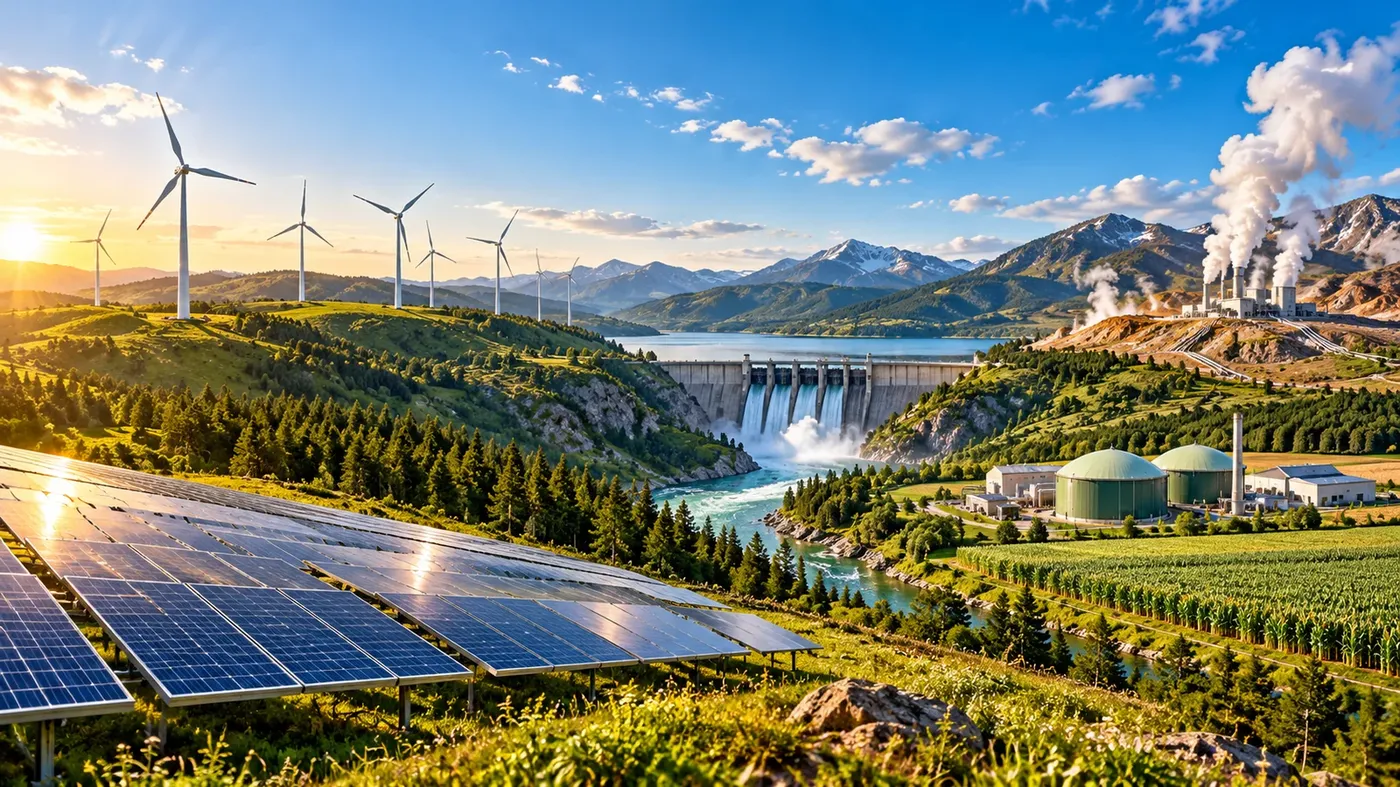
There are five major types of renewable energy: solar, wind, hydropower, biomass (bioenergy) and geothermal. They all draw on resources that are naturally replenished, but they use different physical processes to provide electricity, heat or fuels. Understanding those differences is the first step toward choosing an appropriate energy technology.
This beginner guide explains where each renewable resource comes from, how the main technologies work, what they can be used for and what their limitations are. It also introduces the economic idea of comparing lifetime electricity costs—without turning a fundamentals lesson into an engineering finance course. For context, see Renewable Energy vs Fossil Fuels and Advantages and Disadvantages of Renewable Energy.
Learning objectives
- Name and identify the five major renewable energy resources.
- Describe how each source can provide electricity, heat or fuels.
- Distinguish solar PV from solar thermal and geothermal power from geothermal heating.
- Explain why pumped-storage hydropower is primarily energy storage rather than a primary renewable energy source.
- Compare variability, site requirements and environmental considerations without oversimplifying.
- Estimate solar PV daily energy using peak-sun-hours and a performance factor.
- Understand why LCOE alone does not describe the cost of a reliable power system.
1. What makes an energy source renewable?
A renewable resource is replenished by natural processes on human timescales. Sunlight arrives continuously at Earth, winds are driven by atmospheric circulation, water moves through the hydrological cycle, organic matter can regrow, and geothermal heat is supplied by Earth’s interior. This does not mean that a particular project can generate unlimited energy: sunshine, wind speed, rainfall, suitable land and usable underground heat are all constrained by location and time. [1]
It is useful to distinguish the resource from the conversion technology. Sunlight is the resource; a photovoltaic (PV) panel is a technology. Moving water is the resource; a turbine and generator convert its mechanical energy into electricity. The same renewable resource may support more than one application: solar energy can produce electricity or heat, while bioenergy can produce heat, electricity or transport fuels.
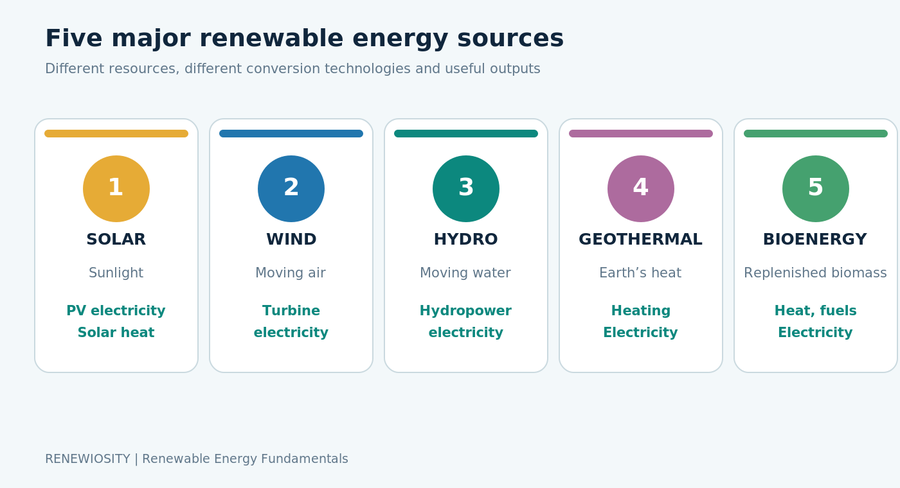
Figure 1. The five major renewable resources and the technologies that turn them into useful energy. These are pathways, not claims that every source is available everywhere.
2. Solar energy: using sunlight
Solar energy is radiant energy from the Sun. The most familiar solar electricity technology is solar photovoltaic (PV): semiconductor cells convert incident light into direct-current (DC) electricity. An inverter converts DC into alternating current (AC) for typical grid and building uses. A PV system may be mounted on a roof, integrated into a building or installed as a ground-mounted power plant. [2]
Solar thermal systems are different. A solar water heater absorbs sunlight to warm water or another fluid. Concentrating solar-thermal power (CSP) systems use mirrors to concentrate sunlight, produce high-temperature heat and drive a power cycle; some can incorporate thermal energy storage. Solar PV and solar thermal should not be treated as synonyms.
Strengths: solar PV is modular, has no ongoing fuel purchase and can operate close to where electricity is consumed. Constraints: generation follows daylight and weather, and practical output depends on orientation, shading, temperature and system losses. Materials, land use, manufacturing and end-of-life management also matter. A battery can shift some solar electricity to later hours, but it does not generate additional solar energy.
For a deeper technical explanation, read How Do Solar Panels Work? and Solar Panel Efficiency Explained.
3. Wind energy: extracting energy from moving air
Wind is caused primarily by uneven solar heating of Earth, pressure differences and planetary rotation. A wind turbine captures part of the kinetic energy of moving air. Its rotor turns a shaft or drive system connected to an electrical generator. Modern wind turbines are deployed onshore and offshore; the best site depends on wind resources, construction conditions, grid access and environmental constraints. [3]
Wind power changes rapidly with wind speed, and turbines have operational limits: they start generating above a cut-in wind speed and stop at sufficiently high speeds for safety. A turbine’s rated power is not its constant output. Annual energy depends on the full wind-speed distribution, turbine performance, availability and losses.
Strengths: low direct operating emissions and no combustion fuel cost. Constraints: changing winds, transmission needs, noise and visual considerations, and possible bird and bat impacts. Responsible siting and monitoring are important. Offshore wind can access strong wind resources but requires specialized marine construction and maintenance.
Explore the engineering behind the technology in How Do Wind Turbines Work?.
4. Hydropower: converting the energy of moving water
Hydropower uses the energy of water flowing from a higher elevation to a lower elevation. In many installations, water passes through a turbine connected to a generator. The potential energy available depends mainly on water flow rate and hydraulic head (the effective height difference). River discharge, rainfall, snowmelt and seasonal conditions influence output. [4]
There are several important arrangements. Impoundment projects store water behind a dam and can often adjust output within water and operating constraints. Run-of-river projects rely more directly on river flow and may have limited storage. Small hydropower describes lower-capacity projects, but “small” does not automatically mean negligible ecological impact.
Pumped-storage hydropower deserves a separate distinction. Electricity is used to pump water to an upper reservoir; later, water flows back through turbines to recover electricity. This is principally an energy storage technology: it consumes more electrical energy in pumping than it delivers during generation because of losses. It should not be counted as a new primary energy source merely because it uses water.
Strengths: many reservoir plants can provide flexible power and grid services. Constraints: drought, river ecosystem changes, sedimentation, fish migration, reservoir land use and possible community displacement. Site-specific environmental assessment is essential. [4]
5. Bioenergy: energy from organic materials
Biomass is organic material such as forestry residues, agricultural residues, suitable energy crops and some organic wastes. Bioenergy is the useful energy obtained from such material. Unlike sunlight or wind, biomass is a physical feedstock that must be collected, transported, stored and processed. It can produce heat, electricity, biogas or liquid biofuels. [5]
One pathway is combustion in a boiler to provide heat or steam for a turbine. Another is anaerobic digestion: microorganisms break down suitable organic material in the absence of oxygen and produce biogas, commonly containing methane and carbon dioxide. Biogas can fuel an engine or boiler after suitable treatment. Some biomass can also be converted into liquid fuels through biochemical or thermochemical processes.
Bioenergy requires careful environmental qualification. Burning biomass releases carbon dioxide and may produce air pollutants; climate outcomes depend on feedstock origin, land-use change, regrowth times, supply chains and what would otherwise have happened to the material. Renewable feedstock does not automatically mean carbon-neutral energy. Using genuine wastes or residues can have different consequences from clearing natural ecosystems to grow fuel crops. [5, 9]
Strengths: some bioenergy systems can provide controllable heat and electricity and make use of appropriate wastes. Constraints: sustainable feedstock availability, land and water demand, emissions controls, logistics and competing uses for organic materials.
6. Geothermal energy: using heat from Earth
Geothermal energy uses heat from Earth’s interior. At suitable sites, wells can bring hot water or steam to the surface. Geothermal power plants use steam or a secondary working fluid to drive a turbine-generator. Where a sufficiently hot resource is available and well managed, geothermal electricity can often provide steady output. [6]
Geothermal is also important for direct heating—for example, district heating, industrial heat and greenhouse heating. A ground-source heat pump is related but distinct: it uses the relatively stable temperature of the shallow ground as a heat source or sink to move heat efficiently. A heat pump uses electricity; it does not produce electricity from geothermal heat.
Strengths: suitable geothermal plants can operate day and night, and direct heat applications can reduce fuel use. Constraints: drilling expense, geological uncertainty, water and mineral management, potential induced seismicity in some projects, and the need to manage the subsurface resource responsibly.
7. How the five technologies convert energy
The technologies are best understood by following their energy-conversion pathways. Solar PV directly converts light into electrical energy; wind and hydropower first convert fluid motion into mechanical rotation; bioenergy releases or converts chemical energy; and geothermal technologies extract heat. These pathways determine the equipment, losses and useful products involved.
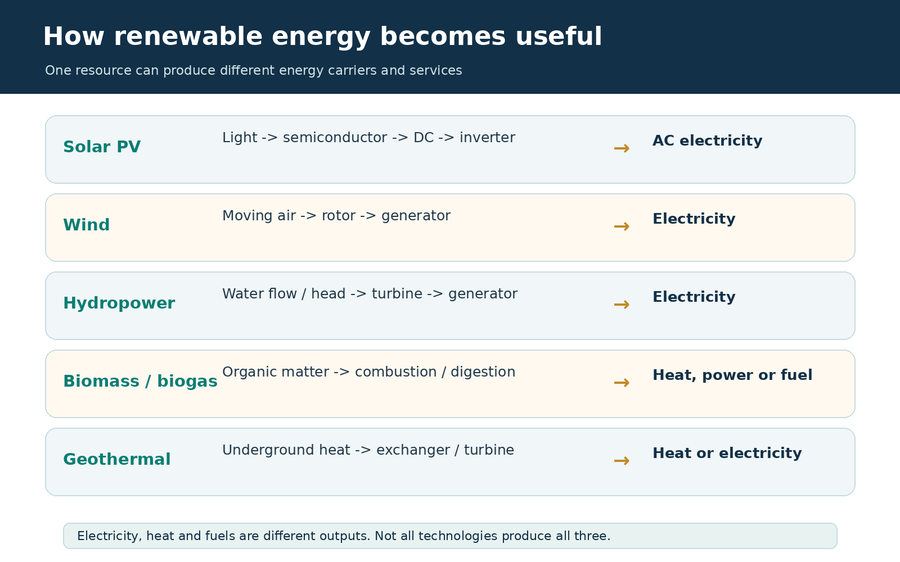
Figure 2. Different renewable resources require different conversion steps and can supply different forms of useful energy.
Not all renewable energy is electricity. Renewable heat can be valuable for buildings and industrial processes, and sustainably sourced biofuels may be used where direct electrification is difficult. The broader energy transition must therefore consider electricity, heating, cooling, transport and industry rather than only power plants.
8. Which renewable sources work at night or during calm weather?
Solar PV output falls to zero at night. Wind generation may continue at night, but only if the wind is suitable. Run-of-river hydropower depends on water flow, while reservoir hydropower can often adjust generation within storage and environmental constraints. Geothermal power can often operate steadily at suitable sites. Bioenergy plants can frequently schedule output when adequate feedstock and equipment are available.
The term dispatchable means that an operator can adjust output when needed within technical and resource limits. It does not mean unlimited power. Solar and wind are often called variable renewable energy because their instantaneous production depends strongly on weather and time. Variability is a planning challenge, not proof that an entire electricity grid must be unreliable. [7]
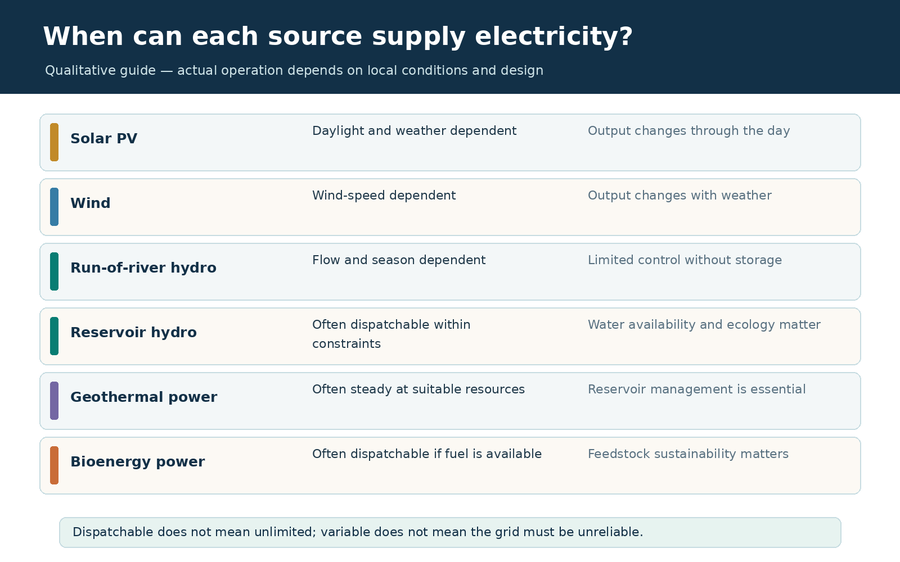
Figure 3. Operating characteristics differ: some sources vary with weather and water flow, while others can be more controllable within resource constraints.
A reliable system can combine several sources with transmission, energy storage, flexible demand, forecasting and other dispatchable generation. Electricity storage shifts energy across time; it does not create energy. In many regions, complementary resources and stronger networks reduce the amount of flexibility any single technology must provide.
9. Environmental impacts: renewable is not the same as impact-free
Solar PV and wind have no fuel-combustion emissions during electricity generation, but equipment production, construction and decommissioning have environmental footprints. Hydropower can alter aquatic habitats and sediment flows. Bioenergy can produce air pollutants and land-use impacts. Geothermal systems may require careful water, gas and reservoir management. Environmental performance therefore depends on life-cycle effects and local siting, not just whether a resource is renewable. [2, 4, 5, 6, 9]
A responsible comparison also asks who benefits and who bears costs. Community engagement, habitat protection, water stewardship, safe materials handling and credible end-of-life plans can improve projects, but no energy technology has literally zero impact. For a balanced overview, see Advantages and Disadvantages of Renewable Energy.
10. Comparing the five renewable-energy types
Solar PV suits rooftops and sunny sites; its output is tied to daylight. Wind suits locations with suitable wind resources and grid access. Hydropower requires suitable water flow and head, with reservoir projects potentially providing flexibility. Bioenergy depends on reliable, responsibly sourced organic feedstock and can supply heat and fuels as well as electricity. Geothermal depends on subsurface resources and can offer useful heat or steady electricity where conditions allow.
The comparison is not a league table. A high-performing solar site may be more useful than a poor wind site, while a region with excellent geothermal resources may prioritize geothermal heat or power. Climate, geology, river flows, demand, available land, transmission, community needs and project economics all influence the result.
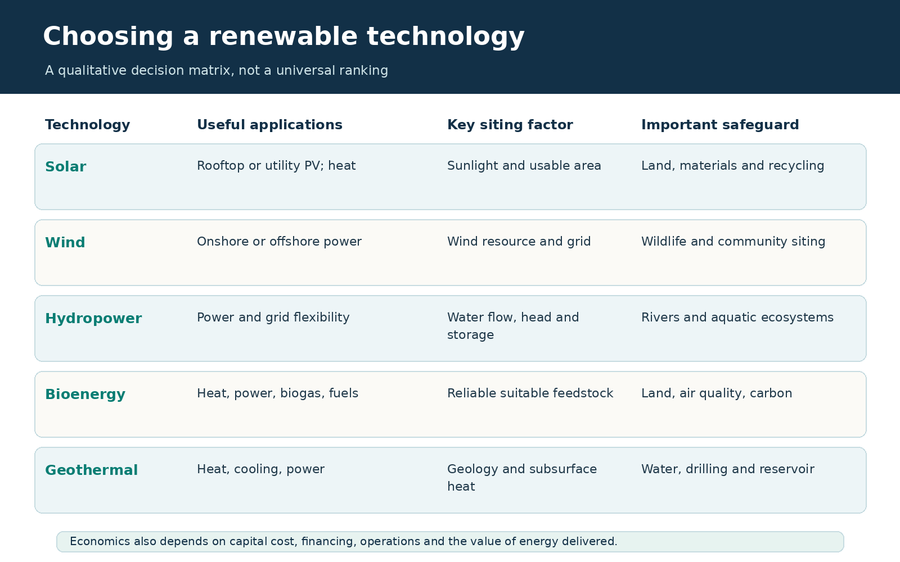
Figure 4. Each renewable technology has distinct applications, location requirements and environmental safeguards; no single technology is best everywhere.
11. A beginner’s introduction to renewable-energy economics
When comparing renewable projects, it is important to distinguish upfront investment (CAPEX), ongoing operation and maintenance (OPEX), financing, equipment life, output and the value of electricity delivered. Solar and wind do not require purchased fuel to generate electricity, but they still require equipment, installation, maintenance and grid integration.
Levelized cost of electricity (LCOE) is a common way to express a project’s lifetime cost per unit of electricity produced, often in dollars per megawatt-hour (USD/MWh). It is useful for comparing generation projects under stated assumptions. But LCOE is not the total cost of reliable delivered electricity: it does not by itself capture transmission, storage, system flexibility or the fact that power at different hours can have different value. [8]
The International Renewable Energy Agency publishes detailed LCOE assessments for solar PV, wind, hydropower, geothermal, bioenergy and other technologies. Those figures depend on project vintage, geography, finance and methodology. We will cover discounted cash flows, LCOE, net present value, internal rate of return and system optimization in separate engineering lessons rather than introduce advanced calculations here. [8]
12. Worked example: estimating solar electricity for a home
One of the simplest engineering questions is: How much electrical energy might a small solar PV system generate on an average day? A preliminary estimate can use installed PV capacity, equivalent peak-sun-hours and a performance factor representing losses. This is an educational approximation, not a substitute for site-specific solar-resource data and system simulation.
E_day is daily AC electrical energy in kWh, P_PV is installed DC PV capacity in kW, H_PSH is daily equivalent peak-sun-hours in hours per day, and PR is a dimensionless performance ratio. This is a simplified estimate; DC-to-AC design and other losses must be represented consistently.
Worked example — 3 kW rooftop solar PV system
A hypothetical rooftop solar array is rated at 3 kW (DC). Assume 4.5 equivalent peak-sun-hours per day and an overall performance ratio of 0.80. Estimate its average daily electrical energy.
- Write the rated capacity: P = 3 kW (DC).
- Use equivalent peak-sun-hours: H = 4.5 h/day.
- Apply the dimensionless performance ratio: PR = 0.80.
- Multiply and check units: kW × h/day = kWh/day.
The estimated average daily electrical energy is 10.8 kWh/day. Actual production changes with season, weather, shading, orientation, temperature, inverter losses and maintenance. The assumed inputs are illustrative, not a forecast for a particular location.
This calculation demonstrates the distinction between power (kW, the rate of energy conversion) and energy (kWh, the amount produced over time). It does not tell us whether the system is financially attractive: that would require installed cost, financing, electricity tariffs, self-consumption, incentives and maintenance information.
13. What about tidal and wave energy?
Ocean energy is another renewable-energy family. Tidal-stream devices use moving tidal currents, tidal-range projects use water-level differences, and wave-energy devices capture energy from ocean waves. These technologies are important to research and development, but they are not part of the conventional five-source introductory grouping used here. Their technical maturity, economics and environmental considerations differ by technology and site.
14. Frequently asked questions
Is nuclear energy renewable? Conventional nuclear fission generally uses mined uranium and is usually classified as nonrenewable, although nuclear electricity has low direct operating carbon emissions. Renewable and low-carbon are not identical categories.
Is all hydropower environmentally friendly? No. Hydropower is renewable when supplied by the water cycle, but dams and river projects can have significant environmental and social effects. Scale and design alone do not guarantee low impact.
Are biomass and bioenergy the same thing? Biomass is the organic material; bioenergy is energy produced from it. Sustainable feedstock management is essential when evaluating environmental outcomes.
Can geothermal energy be used without a power plant? Yes. Direct geothermal heat and ground-source heat pumps can provide heating or cooling. A heat pump requires electrical input and does not generate electricity.
Which renewable energy source is cheapest? There is no universal answer. Location, financing, technology, project size, resource quality and system requirements all matter. LCOE is one useful metric, not the complete economic picture. [8]
15. Check your understanding
Name the five major renewable energy sources and give one common useful output from each.
Reveal worked answer
Solar: electricity or heat; wind: electricity; hydropower: electricity; bioenergy: heat, electricity or fuels; geothermal: heat or electricity.
Why is pumped-storage hydropower better described as storage than as a primary energy source?
Reveal worked answer
It uses electricity to pump water uphill, then recovers some of that energy when water flows downhill. Pumping and generation have losses, so it does not create net energy.
A 4 kW PV array receives 5 equivalent peak-sun-hours per day and has a performance ratio of 0.75. Estimate daily energy.
Reveal worked answer
4 kW × 5 h/day × 0.75 = 15 kWh/day. This is an illustrative estimate, not a site forecast.
Why can two projects with similar LCOE have different value to an electricity grid?
Reveal worked answer
Their electricity may be available at different hours and locations, and they can impose different transmission, storage and flexibility needs. LCOE alone does not describe system value.
16. Key takeaways and what to read next
Solar, wind, hydropower, bioenergy and geothermal are five major renewable resources, but they are not interchangeable. Solar PV and wind are weather-dependent electricity technologies; reservoir hydropower can often provide flexible power; bioenergy can supply heat, fuels and controllable generation when feedstock is responsibly sourced; and geothermal can provide heat or steady power where suitable resources exist.
A sound energy choice depends on resource availability, useful energy needs, reliability, economics, environmental safeguards and local conditions. Continue with Renewable Energy vs Fossil Fuels and Advantages and Disadvantages of Renewable Energy. The next fundamentals lesson will explain how these technologies fit into the wider energy transition.
References and further reading
1. U.S. Energy Information Administration (EIA) — Renewable Energy Explained. Read the source.
2. EIA — Solar Energy and the Environment. Read the source.
3. EIA — Wind Energy Explained. Read the source.
4. EIA — Hydropower and the Environment. Read the source.
5. EIA — Biomass and the Environment. Read the source.
6. EIA — Geothermal Energy and the Environment. Read the source.
7. International Energy Agency (IEA) — Integrating Solar and Wind. Read the source.
8. International Renewable Energy Agency (IRENA) — Renewable Power Generation Costs in 2024. Read the source.
9. IPCC — Climate Change 2022: Mitigation of Climate Change, Summary for Policymakers. Read the source.
Technical discussions describe general principles; site-specific engineering decisions require appropriate professional evaluation.