
RENEWIOSITY / EXPLAINER
Renewable Energy vs Fossil Fuels: Key Differences, Costs and Environmental Impacts
A clear beginner-friendly comparison of renewable energy and fossil fuels, including electricity generation, lifecycle emissions, costs, grid reliability and a worked emissions example.
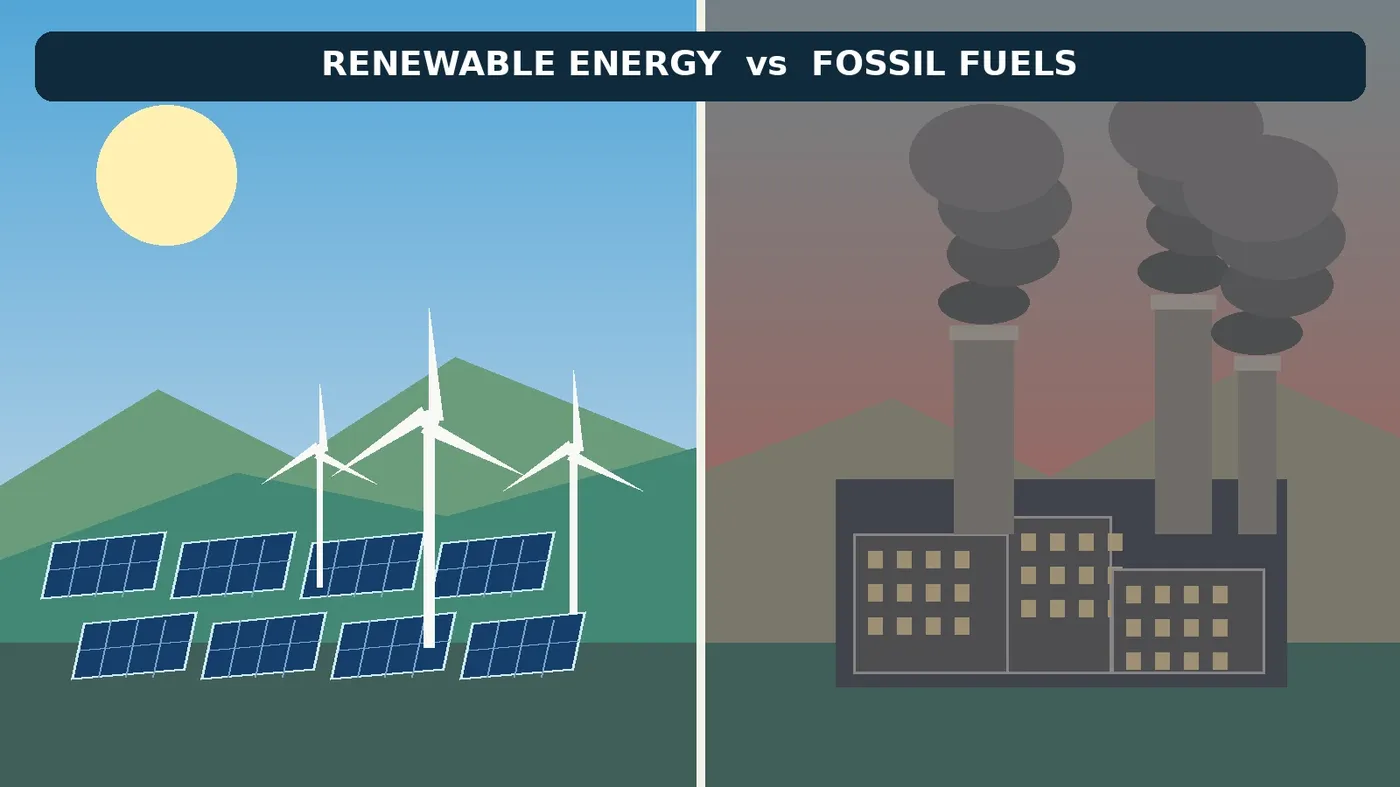
Renewable energy and fossil fuels can both power homes, businesses and industry, but they differ in where the energy comes from, how it is converted and what happens to the environment. Renewable energy draws on replenishing resources such as sunlight, wind and flowing water. Fossil fuels—coal, oil and natural gas—are finite energy stocks formed over geological timescales. [1, 2]
This guide compares their basic science, electricity generation, greenhouse-gas emissions, cost, reliability, land and water impacts, and role in a realistic energy transition. You will also work through a simple emissions calculation. It is written for beginners, with links to more advanced engineering explanations.
What you will learn
- Distinguish renewable energy flows from finite fossil fuel stocks.
- Explain how renewable and fossil-fuel technologies produce electricity and useful heat.
- Compare direct emissions with full lifecycle greenhouse-gas emissions.
- Interpret selected published emissions and renewable-electricity cost data correctly.
- Explain why reliable electricity depends on grid design rather than a single generator.
- Estimate avoided emissions with clearly stated assumptions and units.
1. Renewable energy versus fossil fuels: the essential difference
Renewable resources are replenished by natural processes on timescales relevant to people. Solar radiation, atmospheric circulation, the water cycle and Earth’s heat can supply energy repeatedly. Sustainably replenished biomass may also qualify, but feedstock management matters. [1]
Fossil fuels are energy-rich materials formed from ancient organic matter over millions of years. We extract coal, oil or natural gas from underground reservoirs and typically release their chemical energy through combustion. Once burned, a particular deposit is not replenished on human timescales. [2]
Both categories are energy sources; electricity is an energy carrier that can be generated from either. Not all renewable energy is electricity: solar thermal collectors, geothermal systems and some biomass processes can provide useful heat directly.
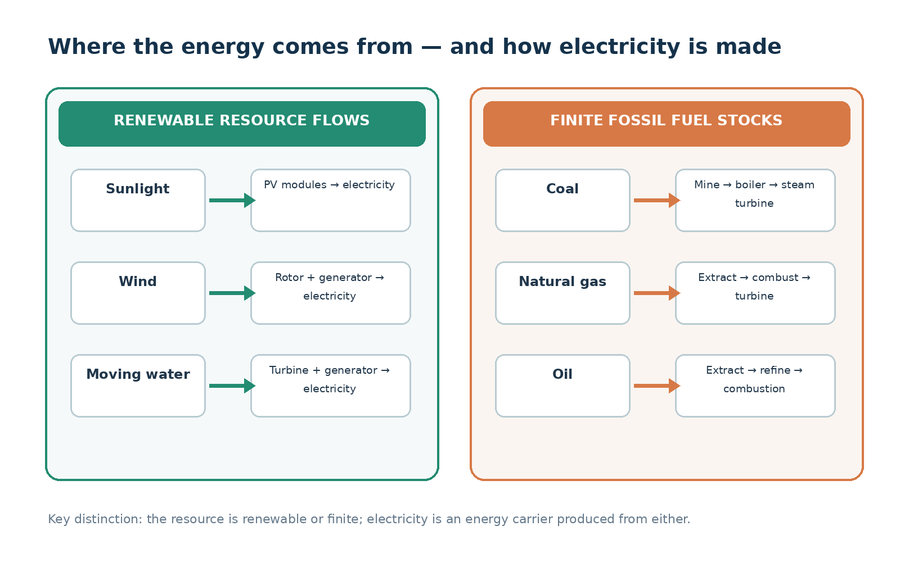
Figure 1. Renewable energy uses replenishing natural flows, whereas fossil energy draws on finite fuel stocks; both can be converted into electricity.
2. Which technologies belong in each group?
Renewables: solar photovoltaic (PV) panels convert light into electricity; wind turbines use moving air; hydropower turbines use moving or falling water; geothermal systems access subsurface heat; and bioenergy systems use organic material that must be sourced and managed responsibly.
Fossil fuels: coal-fired stations commonly burn coal to produce steam for a turbine; natural-gas plants may use gas turbines or combined-cycle configurations; petroleum fuels are especially important in transport and are also used in some power and heat applications.
Important boundary cases: nuclear energy is usually classified as nonrenewable because it uses mined fuel, but it is also a low-carbon electricity technology. A battery is not an energy source—it stores electricity made elsewhere. Hydrogen is an energy carrier, and its emissions depend on how it is produced. These distinctions prevent misleading comparisons.
3. How is electricity produced?
In a solar PV module, light excites charge carriers in a semiconductor and creates electrical power without a fuel-burning step. A wind turbine converts part of the moving air’s kinetic energy into shaft power and then electricity. A hydroelectric station converts water’s potential or kinetic energy through a turbine and generator.
In a conventional coal station, fuel combustion releases heat to make steam, which drives a turbine-generator. In a combined-cycle natural-gas plant, hot combustion gases drive a gas turbine and their exhaust heat produces additional steam for a second turbine. Both rely on a continuing supply of fuel.
The conversion equipment, thermal efficiency, resource availability and operating strategy determine how much electricity a facility delivers. A comparison should therefore distinguish installed capacity (kW or MW) from generated energy (kWh or MWh).
4. Greenhouse-gas emissions: direct versus lifecycle
A wind turbine or solar PV panel normally emits no carbon dioxide while generating electricity at the site. However, manufacturing, construction, transportation, maintenance and end-of-life processing can generate emissions. A full lifecycle assessment (LCA) considers these upstream and downstream activities.
Coal and gas power stations produce substantial direct combustion emissions; their full lifecycle footprints also include fuel extraction, processing, transport and—for natural gas—possible methane leakage. Methane is a powerful greenhouse gas, so supply-chain leakage matters. [3, 4]
The IPCC Fifth Assessment Report compiled medians from published studies. The selected illustrative median values below are in grams of CO₂ equivalent per kilowatt-hour (g CO₂e/kWh): onshore wind 11, hydropower 24, utility-scale solar PV 48, combined-cycle natural gas 490, and pulverised-coal generation 820. They are historical literature medians, not guaranteed performance for a specific plant. Hydropower reservoirs, for example, can have very different methane impacts depending on site conditions. [3]
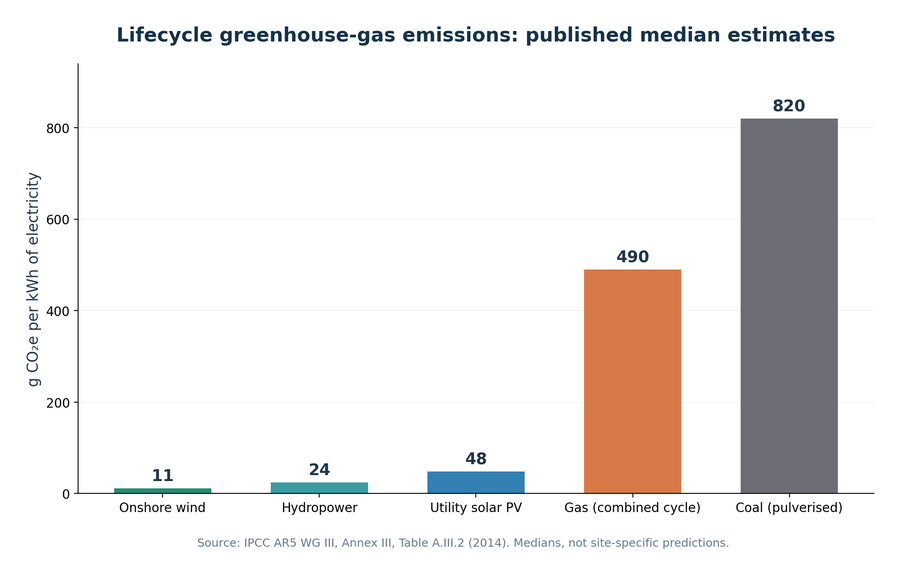
Figure 2. Selected IPCC AR5 lifecycle median emissions: onshore wind 11, hydro 24, utility PV 48, combined-cycle gas 490 and pulverised coal 820 g CO₂e/kWh. Results vary by project.
A practical takeaway is that many non-combustion renewable electricity technologies have substantially lower lifecycle emissions than conventional fossil-fuel generation. Nevertheless, no technology is impact-free, and careful project-level assessment remains important.
5. Does renewable energy cost less?
The answer depends on the technology, location, financing, resource quality, fuel prices and what costs are included. Many new solar and wind projects are economically competitive, but that does not mean every renewable project is cheaper than every existing fossil-fuel plant. [5]
A widely used measure is levelised cost of electricity (LCOE): a project’s discounted lifetime costs divided by its discounted lifetime electricity generation. LCOE is useful for comparing generation projects, but it does not by itself capture all transmission, storage, balancing, reliability or system-integration costs.
IRENA’s Renewable Power Generation Costs in 2025 reports global weighted-average LCOE for newly commissioned projects of USD 33/MWh for onshore wind, USD 44/MWh for utility-scale solar PV and USD 78/MWh for offshore wind. These are worldwide averages for particular project cohorts, not household electricity tariffs or universal prices. [5]
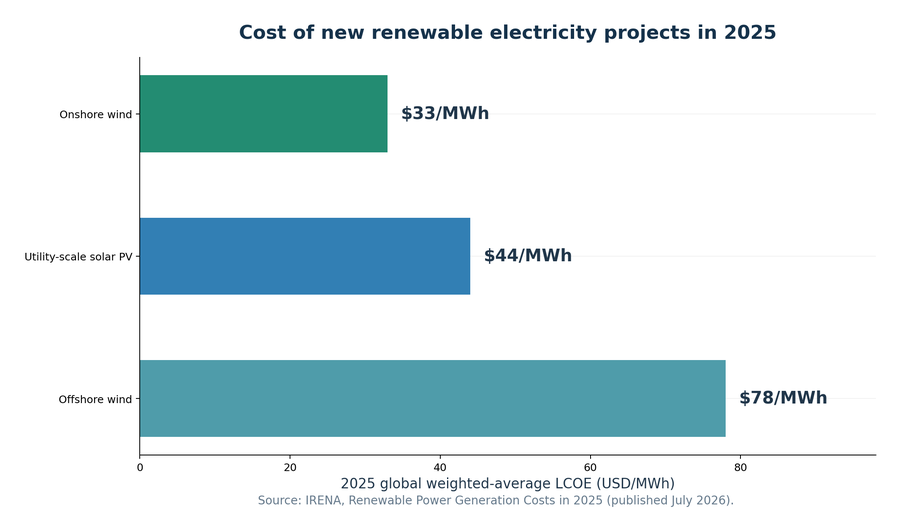
Figure 3. IRENA reported global weighted-average 2025 LCOE of USD 33/MWh for onshore wind, 44/MWh for solar PV and 78/MWh for offshore wind. These are not retail tariffs or guaranteed local prices.
Fossil-fuel generation can face ongoing fuel-price exposure. Solar and wind have no purchased fuel requirement during operation, but substantial upfront capital and financing costs. Comparing systems fairly also requires asking whether generation arrives when electricity is needed and how grid flexibility is provided.
6. Reliability: can renewables keep the lights on?
Solar output changes with daylight and weather; wind output varies with atmospheric conditions. Coal and gas plants are generally dispatchable within their technical constraints, meaning operators can schedule their output more directly when fuel and equipment are available. But fossil-fuel plants can also suffer forced outages, fuel-supply disruptions and water constraints.
A power system must balance supply and demand continuously. This can involve hydropower, storage, dispatchable plants, stronger transmission connections, demand response, forecasting and a diversified geographic mix of generators. The relevant question is not whether one solar panel runs at night, but whether the whole system can meet demand reliably across hours, seasons and extreme events. [6]
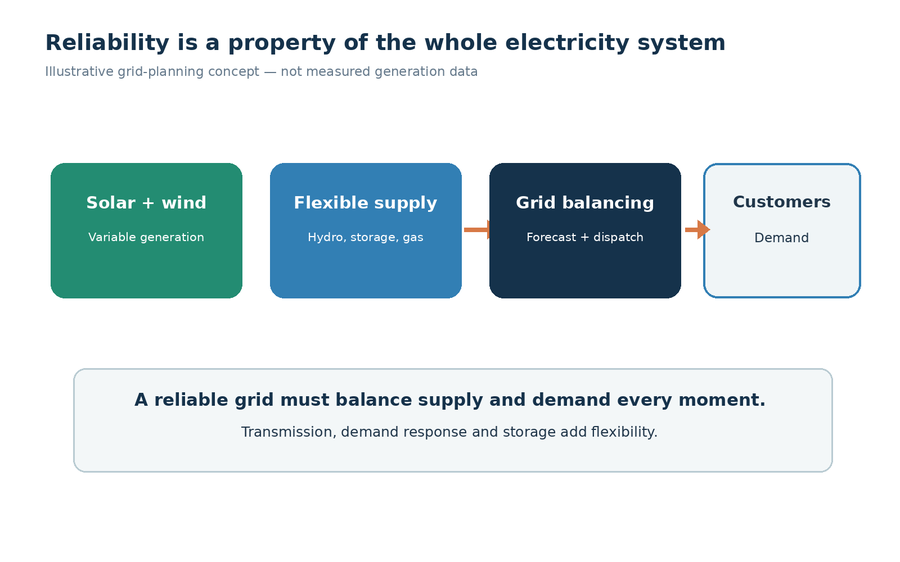
Figure 4. Reliable electricity depends on balancing supply and demand using generation, storage, transmission, forecasting and flexible consumption.
Storage shifts energy across time; it does not create primary energy. A grid with a high renewable share may still use flexible thermal plants during a transition, or combine several non-fossil options with demand-side measures. Grid planning must evaluate reliability, affordability and emissions together.
7. Land, water, air quality and ecosystems
Burning coal, oil or gas can emit air pollutants such as particulate matter, nitrogen oxides and sulfur compounds, depending on fuel and pollution controls. Fossil-fuel extraction and transport also have impacts, including land disturbance, spills, mine waste and water use. [2, 7]
Renewable infrastructure also uses land and materials. Solar projects require panels, support structures and electrical equipment; wind farms affect landscapes and can pose wildlife risks without careful siting; hydropower can alter river flows and ecosystems; geothermal projects have site-specific water and geological considerations. Responsible planning, recycling and mitigation are therefore important.
Bioenergy deserves special care: burning biomass releases carbon dioxide at the point of combustion. Whether a pathway achieves a climate benefit depends on feedstock origin, land-use change, regrowth, transport and the alternative use of the material. Renewable does not automatically mean carbon-neutral. [8]
8. Energy security and resource dependence
Fossil-fuel users may depend on domestic extraction or imported coal, oil and gas. International fuel-price volatility and geopolitical disruption can affect energy costs. Renewable resources are often local, which can reduce exposure to imported fuel, but the equipment supply chain still depends on manufacturing, minerals, trade and infrastructure.
Neither category is entirely independent of global supply chains. A resilient energy strategy can diversify energy sources, improve efficiency, maintain critical equipment, develop transmission and storage, and avoid overdependence on any single fuel or technology.
9. A comparison at a glance
Resource: renewable—naturally replenishing flows or sustainably replenished feedstocks; fossil—finite coal, oil and gas stocks.
Typical operating emissions: solar and wind—no combustion at generation; coal and gas—direct emissions from burning fuel. Lifecycle emissions remain nonzero for all technologies.
Fuel expenses: solar and wind—no purchased fuel during operation; coal and gas—ongoing fuel requirements.
Output control: solar and wind—weather-dependent; gas and many coal units—dispatchable within operating limits. Hydropower and geothermal vary by design and resource.
Other impacts: both categories require responsible siting, materials, infrastructure and environmental management.
10. Worked calculation: estimating avoided emissions
Suppose a solar project delivers 1,000 MWh of electricity over a reporting period and we want a simple illustrative comparison with coal-fired generation. Use the IPCC AR5 lifecycle median factors of 820 g CO₂e/kWh for coal and 48 g CO₂e/kWh for utility PV. [3]
Use consistent units. Here E is electricity delivered (kWh), EF is lifecycle emissions intensity (g CO₂e/kWh), and the result is in grams of CO₂e. Divide by 10⁶ to express metric tonnes.
Worked example — 1,000 MWh of solar electricity versus coal
How large is the illustrative lifecycle-emissions difference if 1,000 MWh of solar electricity is compared with the same electricity quantity generated by coal?
- Convert electricity to kWh: 1,000 MWh = 1,000,000 kWh.
- Subtract emission factors: 820 − 48 = 772 g CO₂e/kWh.
- Multiply: 1,000,000 kWh × 772 g CO₂e/kWh = 772,000,000 g CO₂e.
- Convert grams to metric tonnes: 772,000,000 ÷ 1,000,000 = 772 tonnes CO₂e.
Illustrative difference: 772 metric tonnes CO₂e. This is not a verified real-world avoided-emissions claim: actual displacement depends on which generators change output, grid timing, curtailment, imports, and other system effects.
This calculation is useful for understanding units and emission factors, but actual avoided emissions are not simply a fixed average factor multiplied by solar production. For project accounting, use an appropriate marginal or methodology-specific grid emission factor and document the assumptions.
11. Common misconceptions
“Renewable means zero environmental impact.” Incorrect. Renewable describes the resource, not a guarantee of zero emissions, land use or ecological effects.
“Gas is renewable because it is cleaner than coal.” Incorrect. Natural gas is a fossil fuel. In some operating conditions it emits less CO₂ per kWh than coal, but methane leakage and other impacts still matter.
“Wind and solar can never support a reliable grid.” Incorrect. Reliability depends on the whole grid, including flexibility, dispatchable resources, storage, networks, forecasting and demand response.
“Renewables are always the cheapest option.” Too broad. Cost depends on geography, financing, system design and the comparison being made. Plant-level LCOE is only one part of system cost.
“Fossil fuels will disappear immediately.” Energy transitions unfold over time and differ by country and sector. Industry, heating, transport, infrastructure and investment decisions all influence the pace of change.
12. What role do both play during the energy transition?
The energy transition aims to reduce greenhouse-gas emissions while maintaining energy services. It can involve replacing fossil-fuel electricity with low-emissions generation, improving energy efficiency, electrifying vehicles and heating, expanding grids, and developing lower-emission solutions for difficult industrial processes. [6]
The mix of technologies differs by location. Regions with strong hydropower resources may use flexible hydro generation; sunny regions can expand solar; industrial sites may need renewable heat, electrification or alternative fuels. Technical performance, cost, social needs and environmental trade-offs should guide choices.
For a broader introduction, start with What Is Renewable Energy? A Complete Beginner’s Guide. For engineering detail, see What Is Energy Storage?, What Is Wind Energy? and How Do Solar Panels Work?.
13. Frequently asked questions
Is solar energy more environmentally friendly than coal? Solar PV generally has much lower lifecycle greenhouse-gas emissions than conventional coal electricity, but site-specific manufacturing, land use and recycling still matter.
Is natural gas a renewable source? No. Natural gas is a fossil fuel, even though some gas plants can emit less CO₂ per unit of electricity than conventional coal plants.
Why are renewable electricity prices sometimes low? Sunlight and wind do not require purchased fuel, and equipment costs have declined in many markets. Financing and local conditions remain important.
Do solar and wind need batteries everywhere? Not necessarily. Storage is one flexibility option among several, including hydropower, demand response, transmission and other dispatchable resources.
Is nuclear energy renewable? It is generally considered nonrenewable because it uses mined nuclear fuel, although it is a low-carbon source of electricity. Renewable and low-carbon are different classifications.
14. Quick knowledge check
What is the central difference between renewable resources and fossil fuels?
Reveal worked answer
Renewable resources are replenished on human-relevant timescales; fossil fuels are finite stocks formed over geological timescales.
Why do solar PV and wind have nonzero lifecycle emissions?
Reveal worked answer
Manufacturing, transport, construction, maintenance and end-of-life activities can produce greenhouse gases even when electricity generation involves no fuel combustion.
Which has a higher IPCC AR5 median lifecycle emission factor: onshore wind or combined-cycle gas?
Reveal worked answer
Combined-cycle gas (490 g CO₂e/kWh) is much higher than onshore wind (11 g CO₂e/kWh) in the cited historical IPCC compilation.
Does a lower LCOE automatically mean a lower total electricity-system cost?
Reveal worked answer
No. LCOE is a generation-level metric; transmission, balancing, storage and other system costs also matter.
What is the illustrative emissions difference for 1,000 MWh of solar versus coal using 48 and 820 g CO₂e/kWh?
Reveal worked answer
772 metric tonnes CO₂e, as a simplified lifecycle-factor comparison, not a verified real-world displacement claim.
15. Key takeaways
Renewable energy uses replenishing resources; fossil fuels draw on finite stocks. Many renewable electricity technologies have much lower lifecycle greenhouse-gas emissions than conventional coal and gas generation, though all have environmental impacts. Cost competitiveness depends on technology, location and financing. Electricity reliability is a system-level engineering challenge, and a successful energy transition requires an appropriate mix of generation, networks, flexibility, efficiency and careful planning.
References and further reading
1. U.S. Energy Information Administration — Renewable energy explained. Read the source.
2. U.S. Energy Information Administration — Fossil fuels explained. Read the source.
3. IPCC — Climate Change 2014, Working Group III, Annex III, Table A.III.2. Read the source.
4. U.S. Department of Energy — Greenhouse gas emissions from the U.S. power sector. Read the source.
5. IRENA — Renewable Power Generation Costs in 2025 (2026). Read the source.
6. International Energy Agency — Renewables 2025. Read the source.
7. U.S. Environmental Protection Agency — Electricity and the environment. Read the source.
8. U.S. Department of Energy — Bioenergy basics. Read the source.
Technical discussions describe general principles; site-specific engineering decisions require appropriate professional evaluation.