
RENEWIOSITY / EXPLAINER
Climate Change Mitigation vs Adaptation: What's the Difference?
A clear guide to climate mitigation and adaptation, from clean electricity to flood protection, with examples, a worked calculation and the latest UN evidence.

Imagine a town beside a river. Its council can replace diesel buses with efficient electric public transport, reducing greenhouse-gas emissions that contribute to future warming. The same council can restore wetlands, improve flood warnings and keep new homes away from the most dangerous floodplain. Both are climate actions, but they solve different parts of the problem [1,4].
Climate change mitigation tackles the cause of additional warming by cutting greenhouse-gas emissions or increasing durable carbon removal. Climate change adaptation adjusts people, infrastructure, ecosystems and institutions to climate impacts that are already being experienced or are expected in the future [1,2].
The simplest memory aid is: mitigation limits how much climate change occurs; adaptation limits how much damage it causes. Real life is more complicated because some actions do both, some have trade-offs, and no amount of adaptation can make unlimited warming harmless [2,4].
Learning objectives
- Define climate change mitigation and adaptation accurately and explain why neither can substitute for the other.
- Identify the emissions-reduction mechanisms behind mitigation in energy, buildings, transport, land and industry.
- Recognize adaptation measures that reduce exposure and vulnerability to heat, flooding, drought and sea-level rise.
- Classify practical climate actions as mitigation, adaptation or both while noticing trade-offs and unintended outcomes.
- Calculate avoided electricity-related emissions from a transparent, hypothetical building-efficiency example in SI units.
- Explain climate-resilient development, adaptation limits and why climate finance must support both prevention and resilience.
1. What is the difference between mitigation and adaptation?
Mitigation changes the drivers of climate change. Burning less fossil fuel, improving energy efficiency, reducing methane leakage and protecting long-lived carbon stores can reduce the net addition of greenhouse gases to the atmosphere. Its ultimate climate benefit extends beyond the immediate project and location [1,3].
Adaptation changes how exposed or vulnerable a person, community or ecosystem is to climate hazards. Better heat-health plans, drought-tolerant crops, early-warning systems, appropriately designed drainage and flood-risk planning help people cope with altered conditions [2,5].
These actions usually operate on different measures of success. Mitigation is commonly evaluated in tonnes of CO₂-equivalent emissions avoided or removed, while adaptation may be evaluated in lives protected, reduced heat exposure, lower expected flood losses or continuity of essential services [2,10].
For a homeowner, the distinction can be tested by asking where the benefit appears. A more efficient heater may reduce emissions caused by energy use. A raised electrical panel may reduce flood damage at that home. When an intervention improves both emissions performance and hazard protection, explain and measure each pathway separately.
2. Why do we need both approaches?
Climate change already affects societies and ecosystems, and additional impacts are expected even when emissions fall. Past greenhouse-gas emissions, the ocean’s long response time and the persistence of warming mean that preparing for current and future hazards is necessary [1,12].
But adaptation cannot replace mitigation. A higher sea wall does not reduce global greenhouse-gas concentrations; flood defenses may fail in an extreme event, and the costs or ecological limits of protection can grow as warming increases [2,4].
Conversely, clean power cannot instantly protect a household facing a heat wave tomorrow. A safer future requires both slower warming through lower emissions and better protection against near-term hazards. The IPCC calls their integration part of climate-resilient development [2,4].
One useful analogy is a leaking roof during a storm. Fixing the source of the leak prevents additional water damage; placing buckets and moving valuables reduces harm from water already entering. Climate mitigation and adaptation are not literally the same engineering tasks, but the analogy emphasizes why controlling the underlying cause and protecting exposed assets are complementary.
3. What counts as climate change mitigation?
In electricity, mitigation includes replacing high-emissions generation with genuinely low-carbon sources and reducing unnecessary consumption. In buildings, insulation, efficient appliances and low-carbon heating can cut demand or the emissions associated with it [3].
In transport, useful measures include efficient mass transit, safe walking and cycling networks, better vehicle efficiency and electrification where the electricity supply supports lower life-cycle emissions. In industry, options include efficiency, material savings, process changes and cleaner energy [3].
Land-related mitigation can include protecting carbon-rich ecosystems and restoring degraded habitats. Results depend on baseline conditions, durability, land-use change and potential impacts on biodiversity or food security. A project should not automatically be treated as climate-beneficial simply because it uses the word “green” [3,4].
For any specific project, its climate benefit depends on the counterfactual: what would have happened without the project. Adding renewable electricity to a grid that already has very low emissions will have a different avoided-emissions effect from displacing high-carbon generation. This is why emissions factors and system boundaries matter, not just technology labels.
4. What counts as climate change adaptation?
Adaptation begins by asking what hazards a place faces, who or what is exposed, and what makes those people or systems vulnerable. It may mean installing heat-warning systems, keeping public cooling spaces open, protecting drinking-water supplies or planning shade around schools [2,9].
Coastal communities may restore mangroves where conditions are suitable, limit development in high-risk locations, elevate infrastructure or adopt carefully engineered protective works. Agricultural adaptation can include improving soil moisture retention, adjusting planting calendars and choosing appropriate crop varieties [2,6].
No single measure fits every location. A city’s rainfall patterns, elevation, drainage network, public health system, income distribution and governance all affect whether adaptation is useful, fair and maintainable over time [2,10].
Adaptation also includes institutions, not merely physical structures. Well-tested emergency messaging, trustworthy risk maps, heat-sensitive school schedules and equitable access to safe shelter can be as important as new concrete infrastructure. Monitoring whether information reaches elderly residents or people without smartphones is part of evaluating a plan.
5. Side-by-side comparison: What changes and who benefits?
Main question: Mitigation asks, “How can we cut future greenhouse-gas emissions?” Adaptation asks, “How can we reduce harm from the climate risks we face?” Both should be evaluated using credible baseline conditions [1,5].
Typical timescale: Many adaptation measures provide benefits during present-day weather extremes, although their design must accommodate future changes. Mitigation can provide immediate air-quality and energy benefits but its contribution to limiting warming accumulates over years and decades [3,4].
Typical outcomes: Emissions avoided and removals verified indicate mitigation. Risk, exposure, vulnerability or damage avoided indicate adaptation. These metrics are different and should never be added together as if they were interchangeable [2,10].
For projects spanning both categories, it is especially important not to double count impacts. The same improved insulation might yield one estimated emissions reduction and one measured heat-exposure improvement. Reporting both is useful, but reporting the heat improvement as another emissions reduction would be incorrect.
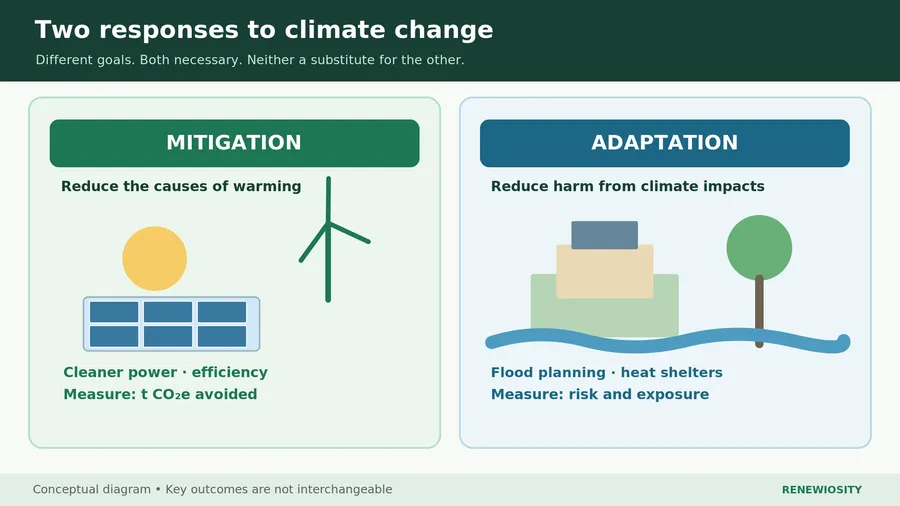
Figure 1. Two complementary responses: mitigation lowers the emissions driving future warming, while adaptation lowers vulnerability and exposure to climate impacts.
6. Energy and transport: Two approaches in one city
Imagine the same city replacing an ageing diesel bus fleet with quieter, energy-efficient buses. When the full energy system and vehicle life cycle are considered, lower greenhouse-gas emissions are a mitigation benefit; reduced street pollution may be a health co-benefit [3].
The city also redesigns bus stops with shade, drinking-water access, reliable flood drainage and accessible storm warnings. Those measures help passengers use transit safely during hotter weather and heavy rainfall and are primarily adaptation [2,9].
Some investments can reinforce one another: resilient transit can help people continue using lower-emissions travel. But equipment, electricity sources, land use and affordability must all be considered before claiming a project delivers both benefits.
A city may also lower its cooling demand through tree shade, reflective pavements and better building design. Such measures could moderate outdoor or indoor temperatures and reduce electricity use; their effectiveness varies with local conditions, including humidity, tree survival, building geometry and the emissions intensity of power supply.
7. Floods, coasts and storms: What does adaptation actually achieve?
Adaptation does not necessarily prevent extreme rain or storm surges. Its purpose is to reduce the consequences of those hazards. This might include avoiding new construction in flood-prone zones, restoring floodplains, enlarging drainage capacity or providing early warnings and evacuation routes [2,10,11].
Risk depends on more than the strength of a hazard. A flood of the same depth can have different consequences where homes are elevated, warnings reach residents, emergency services function and people have safe evacuation options. Exposure and vulnerability therefore matter greatly [10,11].
Poorly planned protection can create maladaptation: for example, a wall that offers temporary safety may encourage further development in a high-risk area and create future lock-in. The IPCC emphasizes inclusive, flexible and long-term adaptation planning [2].
Some hazards cannot be completely eliminated, and residual risk remains even with well-designed adaptation. A drainage system has a finite design capacity. A storm stronger than its design assumptions may still flood streets. Responsible plans disclose those limits, identify backup options and avoid promising absolute protection.
8. Can forests, wetlands and green infrastructure do both?
Yes, in suitable settings. A restored mangrove ecosystem may store carbon, help protect shorelines against erosion and storm waves, and support biodiversity. Urban trees may store some carbon while providing shade, although both benefits depend on species, care, location and the long-term fate of the vegetation [2,3].
This does not mean every tree-planting project is sound climate policy. Plantations in naturally open ecosystems can harm biodiversity or consume scarce water. Planting the wrong species in a floodplain, failing to maintain trees or neglecting local land rights can create costs [2,3].
Good projects consider both sides of the climate ledger: net greenhouse-gas effects and real changes in risk. They also consider people who may be displaced, ecosystem health and maintenance responsibilities.
The interaction can be complex in dry regions. Planting densely may increase shade and carbon storage in one place but reduce water availability somewhere else. Projects should examine water demand, native habitats, land tenure, maintenance and possible displacement alongside carbon claims.
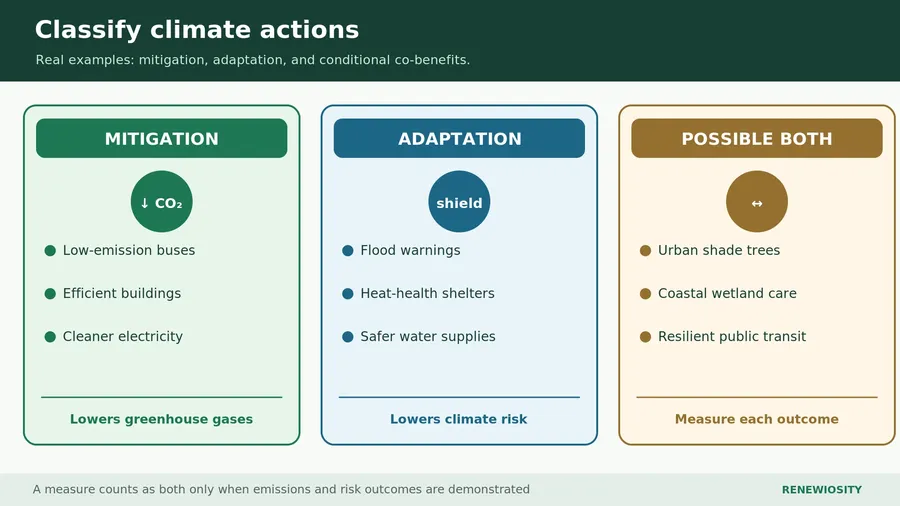
Figure 2. City-level examples of mitigation, adaptation and measures with benefits in both categories. Context and implementation determine outcomes.
9. What is maladaptation, and why does it matter?
Maladaptation occurs when an action intended to manage climate risks instead increases longer-term vulnerability, creates new climate risks or disproportionately shifts costs onto another group. It is often unintentional [2].
For example, badly designed flood pumps may protect one neighborhood while sending more water into another. Expanding air conditioning without improving building design or electricity supply can reduce immediate heat risk while increasing emissions and energy bills [2,9].
The answer is not to avoid adaptation. It is to evaluate alternatives, include affected communities, check impacts over multiple decades and monitor whether the intervention actually makes people safer.
A sound adaptation strategy asks who receives the benefits and who bears the cost. If a new cooling center is distant from the households most exposed to extreme heat, the project may look good on a map but provide little protection to those who need it most. Equity is an operational design question.
10. Worked example: A cool, efficient school building
Consider a hypothetical school that improves roof reflectivity, shading and ventilation, reducing annual electricity use for cooling from 20,000 kWh to 14,000 kWh. Assume, purely for calculation, a constant electricity emissions factor of 0.50 kg CO₂e per kWh [3].
The reduction in electricity demand is 6,000 kWh per year. The estimated electricity-related emissions avoided are therefore 3,000 kg CO₂e per year, or 3.0 tonnes CO₂e per year. This is a mitigation outcome from the specified electricity savings; it is not a measured result for a real school.
The same changes may also help students tolerate heat by lowering indoor temperatures, which would be an adaptation outcome. However, adaptation performance must be measured separately through indoor heat exposure, attendance, comfort and health indicators. The emissions equation alone cannot prove that the building is safe during a heat wave.
Real-world accounting would require meter readings, a suitable marginal or average grid-emissions approach, weather normalization and careful treatment of any changed building use. The assumed 0.50 kg CO₂e/kWh factor here exists only to teach the arithmetic. It is not presented as an official local or national emissions factor.
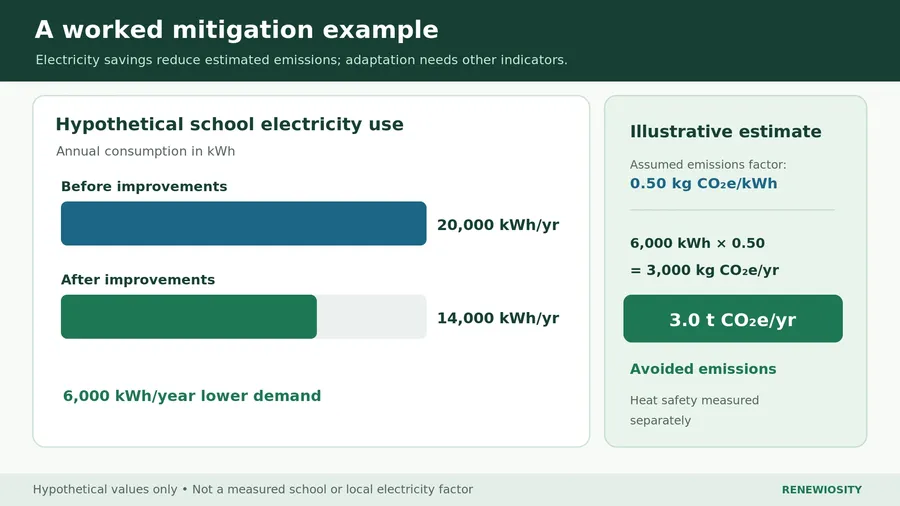
Figure 3. Illustrative school electricity savings: (20,000 − 14,000) kWh/year × 0.50 kg CO₂e/kWh = 3,000 kg CO₂e/year. Heat-safety benefits must be assessed separately.
Illustrative avoided electricity-related emissions only; actual outcomes require a local grid factor, baseline, actual metering and separate assessment of heat safety.
11. How do communities measure success?
For mitigation, decision makers estimate annual emissions under a defined baseline and compare them with emissions after a measure is introduced. Calculations need transparent activity data, emissions factors, system boundaries and any rebound or leakage effects [3].
For adaptation, practitioners track indicators relevant to the hazard and community: people reached by timely warnings, hours of dangerous indoor heat, flood depths, infrastructure downtime, water availability and losses under extreme conditions [2,10].
Comparisons should distinguish observations from model projections and clearly state uncertainty. A project that lowers expected flood losses by a modeled amount is not guaranteed to avoid that exact amount in every future storm.
If a protection project has no adequate baseline or monitoring plan, its claimed resilience benefits may be impossible to verify. A simple before-and-after indicator may also be misleading if weather patterns differ between years. Evaluation must consider changed exposure, climate variability and uncertainty.
12. How do mitigation and adaptation fit into national climate plans?
Countries report emissions-reduction pledges through the Paris Agreement’s nationally determined contributions, or NDCs, while adaptation is also advanced through national, regional and local planning. Effective implementation depends on laws, budgets, data, public participation and the ability to maintain projects over time [4,6].
Mitigation priorities may differ by the structure of a country’s electricity supply, industry, forests and transport. Adaptation priorities differ with exposure to drought, coastal flooding, intense heat or other hazards, as well as the circumstances of particularly vulnerable communities [2,3].
These differences do not make the two approaches competitors. Their combined purpose is a safer, lower-emissions development pathway that fits local needs and respects equity.
National priorities should therefore not be mistaken for household checklists. A country may need grid reform and industrial policy for mitigation, while a municipality may have urgent responsibilities for drainage, shelter access and climate-informed zoning. Coordination matters because policies can complement or conflict with each other.
13. What do the latest 2026 UN reports tell us?
The UNEP Adaptation Gap Report 2026 estimates international public adaptation finance flows from developed to developing countries at about US$28.2–31.7 billion for 2024, compared with central estimates of roughly US$305 billion in developing-country adaptation needs per year by 2035 [7]. These figures describe different years and scopes and are not a direct like-for-like annual funding balance.
The UNEP Emissions Gap Report 2026 separately finds that stronger global greenhouse-gas emissions cuts are needed beyond currently pledged action. It examines pathways for reducing the magnitude and duration of warming above 1.5°C [8].
Together, the reports illustrate why adaptation funding and emissions reduction must move forward simultaneously. More finance without effective planning is insufficient, while better planning cannot offset continued unchecked warming.
The finance comparison is not a forecast of one nation’s spending, and the estimated global adaptation needs are not identical to international public finance flows. Private investment, domestic budgets, institutional delivery and project readiness also matter. Readers should examine definitions and reporting years before quoting a single “funding gap” figure.
14. Why cannot we rely on adaptation alone?
Adaptation has real limits. When heat becomes extreme, water resources fail or ecosystems are irreversibly altered, communities may find that no practical adaptation measure can protect every valued outcome. Those limits may be physical or may arise because funding and institutional capacity are unavailable [2].
Every increment of avoided warming matters because higher warming generally increases risks and narrows the available set of effective responses. Mitigation therefore helps keep future adaptation feasible [4,12].
At the same time, waiting for global emissions to fall would leave today’s vulnerable people exposed. This is why meaningful climate action cannot be reduced to a single technology or slogan.
Some adaptation limits are called soft when possible options exist but cannot currently be implemented due to cost, technology or governance; others are hard when available measures cannot prevent intolerable damage. The distinction matters because more finance can help with some barriers but cannot restore a destroyed ecosystem exactly as it was.
15. What can households, schools and businesses do?
An individual can reduce emissions by improving energy efficiency, choosing lower-emissions transport where available and reducing avoidable waste. Communities can invest in cleaner electricity and reliable shared transport. These actions should be considered alongside affordability and local circumstances [3].
For adaptation, families and schools can learn local heat and flood warnings, improve shade and ventilation, prepare for outages and make sure vulnerable people have support. Businesses can map climate hazards to essential supply chains and sites, then plan continuity measures [2,9].
The best plan asks two questions for each decision: “Will this cut emissions?” and “Will it keep people and essential services safer as the climate changes?” The answers may be yes to one, both or neither.
Not every desirable environmental measure is automatically good climate adaptation. A reliable plan follows local hazard data and the needs of affected people. A one-size-fits-all initiative may consume money without meaningfully lowering exposure or vulnerability, even if it makes an attractive photograph.
16. Five review questions and the main takeaway
Q1. Does installing solar power automatically count as adaptation? Not usually. Its primary climate role is emissions mitigation; it may contribute to adaptation if a resilient system maintains critical services during outages.
Q2. Is building a flood barrier mitigation? Generally no. It primarily addresses climate risk and is adaptation; its construction emissions should still be considered.
Q3. Can one project deliver both benefits? Yes. Appropriately designed urban trees can help store carbon and offer shade; both outcomes must be measured independently.
Q4. Why is adaptation finance important? Because communities need resources to plan, build and maintain protection, especially where climate risks and limited capacity overlap.
Q5. What is the simplest distinction? Mitigation limits the drivers of future climate change; adaptation reduces harm from impacts already occurring or expected. Both matter, and their effectiveness depends on context.
To deepen your understanding, read What Is Climate Change?, What Does Net Zero Mean?, and What Is Sustainable Development?.
The lasting lesson is that a successful climate strategy is not a contest between solar panels and flood defenses. It is an evidence-based portfolio that cuts future emissions, reduces current risks, protects vulnerable people and avoids shifting avoidable harm to others.
Technical discussions describe general principles; site-specific engineering decisions require appropriate professional evaluation.