
RENEWIOSITY / EXPLAINER
What Is Sustainable Development? Meaning, Goals and Real-World Examples
Sustainable development improves lives today while protecting future opportunities. Learn the 17 UN goals, practical examples, trade-offs and an illustrative school-energy calculation.
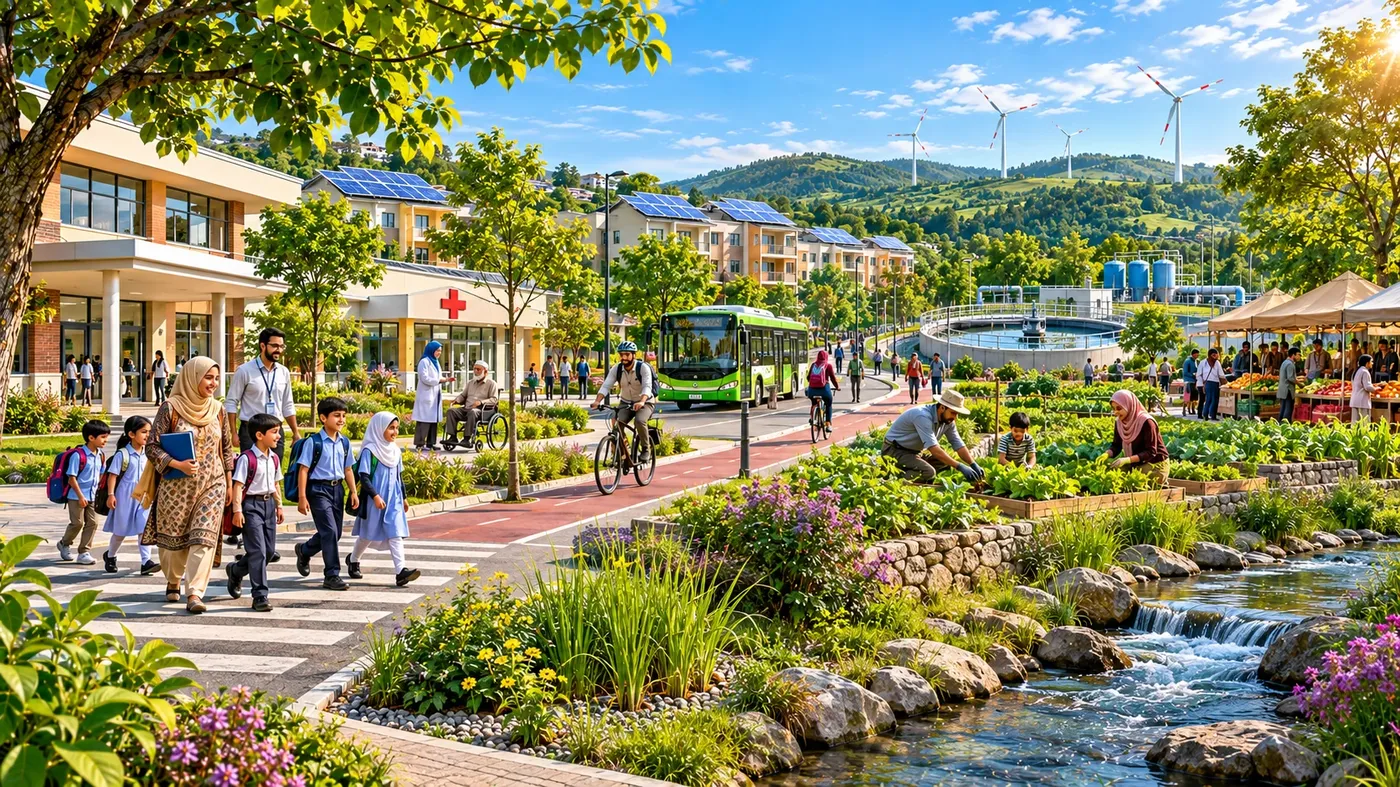
Imagine a town planning a new school. The building could be inexpensive to construct, but what if it becomes too hot for students, has unreliable drinking water, or uses so much electricity that its operating bills become unaffordable? A development decision is not successful merely because something new has been built. The more useful question is whether it improves lives and can continue doing so fairly and responsibly [1,2].
That is what sustainable development tries to achieve. It connects people’s present needs with the health of the environmental, social and economic systems that future generations will depend upon. This article explains how the idea became a global development framework, where its goals overlap and how we can judge real projects rather than rely on attractive slogans.
Learning objectives
- Explain sustainable development in everyday language and distinguish it from the broader concept of sustainability.
- Describe how economic opportunity, social well-being and environmental protection depend on one another.
- Identify the purpose of the United Nations 17 Sustainable Development Goals and the 169 targets adopted in 2015.
- Show how improvements in electricity, water, education and health can reinforce one another within a community.
- Calculate illustrative electricity, emissions and cost savings while stating assumptions and limits of those metrics.
- Evaluate development projects using evidence about fairness, reliability, local impacts and long-term resource use.
1. What is sustainable development in simple words?
Sustainable development means improving people’s quality of life today without undermining the ability of people in the future to meet their own needs. In practice it means asking whether progress is affordable, fair, environmentally responsible and durable. A community needs schools, reliable energy, jobs and clean water, but the ways of providing them should not exhaust critical resources or shift unacceptable burdens to others [1].
The most familiar wording comes from the 1987 World Commission on Environment and Development, often called the Brundtland Commission. Its definition is widely repeated because it includes two essential ideas: meeting human needs and protecting the prospects of future generations. It is a principle for making decisions, not a promise that every problem has an easy solution.
A practical test is to ask: Who benefits today? Who might be harmed? What will it cost to maintain the service? What happens to local water, air, land and materials? And can future people still have a good life? Good decisions consider all of these questions together rather than one at a time.
2. How is sustainable development different from sustainability?
Sustainability describes the desirable long-term condition: healthy systems that can continue supporting people and nature. Sustainable development describes choices and processes intended to move societies toward that condition. The two concepts overlap, but the second emphasizes deliberate improvements in living standards, institutions and infrastructure [1,2].
Consider groundwater. Sustainability asks whether withdrawals can be maintained without damaging the aquifer and related ecosystems. Sustainable development additionally asks how households, farms and industries can obtain adequate water, what infrastructure or rules are needed, and how costs and benefits should be shared fairly.
Our earlier article What Is Sustainability? starts with the meaning of the word itself. Here we focus on the practical question: how does a town, company or country convert that principle into decisions, projects and measurable results?
3. Where did the idea come from?
People have considered the long-term management of forests, soils and water for centuries. The modern international policy language gathered momentum as environmental damage and unequal access to development became harder to ignore. The 1987 Brundtland report connected the improvement of human well-being with the long-term capacity of Earth’s systems [1,2].
A major turning point came in September 2015, when all UN Member States adopted the 2030 Agenda for Sustainable Development. The agenda introduced a common framework with 17 Sustainable Development Goals, or SDGs, and 169 associated targets. It covers more than climate: poverty, hunger, education, health, water, infrastructure, institutions and biodiversity all matter [2,3].
The agenda is universal, meaning that higher-income as well as lower-income countries have responsibilities. It also emphasizes “leaving no one behind.” That phrase matters because an average national improvement can hide persistent problems among rural residents, poorer families or groups whose needs are overlooked.
4. What are the 17 Sustainable Development Goals?
The 17 goals cover a wide set of human and environmental priorities. Their familiar short names include No Poverty (1), Zero Hunger (2), Good Health and Well-being (3), Quality Education (4), Gender Equality (5), Clean Water and Sanitation (6), Affordable and Clean Energy (7), and Decent Work and Economic Growth (8) [3].
The framework continues with Industry, Innovation and Infrastructure (9), Reduced Inequalities (10), Sustainable Cities and Communities (11), Responsible Consumption and Production (12), Climate Action (13), Life Below Water (14), Life on Land (15), Peace, Justice and Strong Institutions (16), and Partnerships for the Goals (17) [2,3].
These are high-level destinations, not 17 independent checkboxes. Each goal contains more specific targets; the United Nations tracks progress using a defined indicator framework. The details of each SDG deserve their own explanation. For now, the most important point is how they work together.
5. Why people, planet and prosperity belong together
One way to understand sustainable development is through three interconnected dimensions. The social dimension includes health, safety, education, inclusion and fairness. The environmental dimension includes climate, biodiversity, clean air, water and resource protection. The economic dimension includes productive livelihoods, infrastructure, affordability and long-term financial viability [1,2].
A new factory may create jobs and tax revenue, yet produce harmful wastewater if controls are inadequate. A protected forest may support biodiversity, but conservation rules designed without consulting local communities can restrict livelihoods. A school may improve access to education, yet become unusable if it lacks reliable power or safe drinking water.
Figure 1 presents the three dimensions as equally relevant questions. It is not a formula in which a benefit to one automatically cancels harm to another. Some limits, such as basic rights and critical ecological damage, require safeguards rather than simple averaging. Good governance and public participation help resolve conflicting objectives.
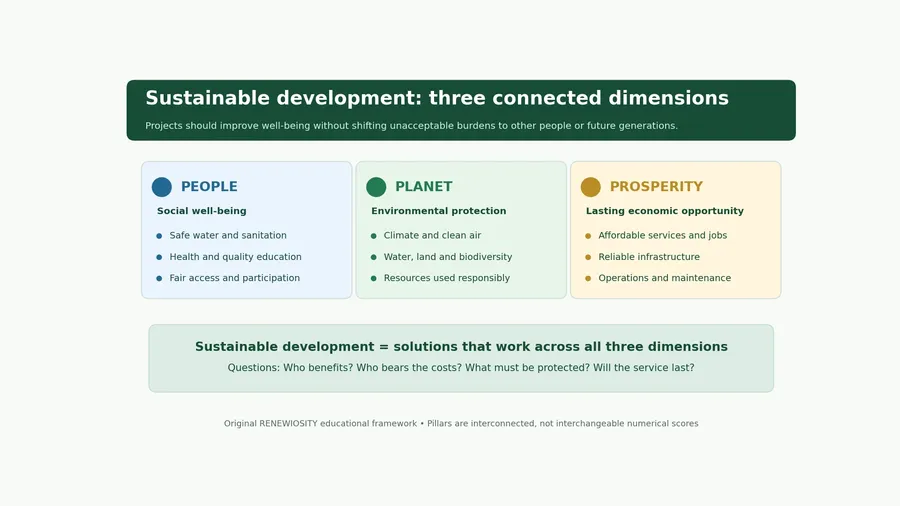
Figure 1. Sustainable development connects social well-being, environmental protection and long-term economic opportunity.
6. How can one development action serve several goals?
A reliable electricity supply can allow a water-treatment plant to operate, a health clinic to refrigerate medicines, a school to use lighting and computers, and local businesses to extend productive hours. One infrastructure investment may therefore support energy access, water, health, education and employment, while potentially reducing emissions if the electricity is low-carbon [6,8,12].
But the connection is not automatic. An electricity project that occupies contested land or threatens river flows may introduce new difficulties. A clinic’s equipment must be maintained; water supply must be safe; and households must be able to afford the service. Designing projects jointly with users can reveal problems that a single-sector calculation would miss.
The IPCC finds that climate action can produce multiple sustainable-development benefits, but also trade-offs that depend on local conditions and implementation. Coordinating across sectors makes the benefits more likely and unintended harms easier to detect [8].
7. A real-world way to think about a sustainable community
Imagine a rural community with unreliable electricity, limited clean-water access and a school that closes activities early each afternoon. Local leaders consider improving the distribution network, adding a properly sized solar-plus-storage system, upgrading pumping equipment and installing efficient school lighting. This is a hypothetical integrated project, not a report of one named village.
Its objectives could include fewer power interruptions, lower operating costs, safe drinking water, better hours for studying and improved business opportunities. The community could monitor hours of electricity availability, water-quality tests, school attendance, maintenance spending and residents’ satisfaction. Those outcome measures are more informative than merely counting installed solar panels.
A sustainable design would also investigate battery replacement, local technician training, safe e-waste handling, fair tariff arrangements and access for households unable to pay full cost. Figure 2 connects these practical questions to multiple SDGs without claiming that every benefit is guaranteed.
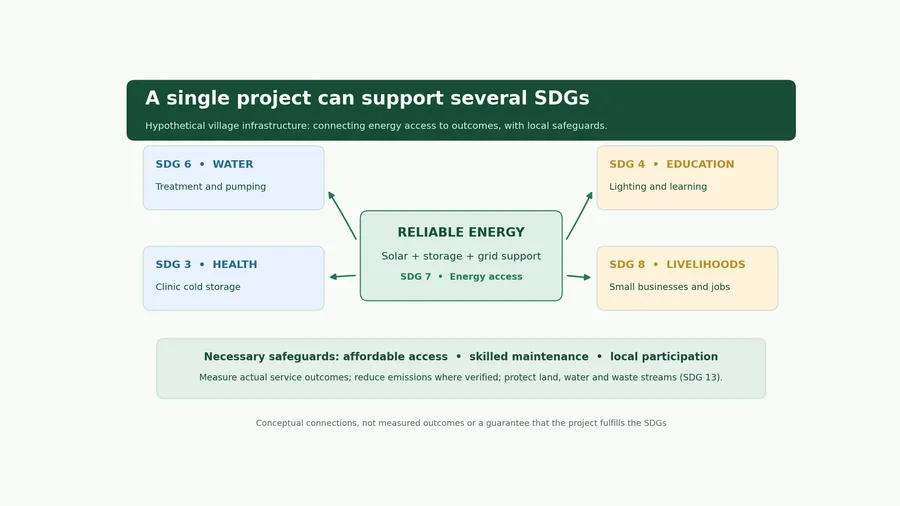
Figure 2. One hypothetical community project may support several SDGs if services, safeguards and maintenance are addressed.
8. Why energy access is central to development
Electricity is an enabling service, not an end in itself. Reliable power supports communication, refrigeration, transport, lighting, water treatment, small businesses and many medical procedures. That is why SDG 7 concerns access to affordable, reliable, sustainable and modern energy, not renewable generation alone [6,12].
The joint Tracking SDG 7 report assesses energy access, clean cooking, renewable energy and efficiency. Its 2026 edition shows meaningful progress but continuing gaps. For instance, the report estimates that 655 million people still lacked electricity in 2024. Those figures illustrate the scale of the task, not the performance of any one country or project [6,12].
An energy project is most valuable when the service is useful and dependable. A school with solar panels but no plan for maintenance may still suffer outages. A clinic with a generator but no fuel budget may be left without power when needed. Sustainable development considers the whole service chain: technology, trained people, governance, finance and long-term support.
9. How can cities develop more sustainably?
Cities bring people closer to jobs, schools, hospitals, markets and services. They also concentrate energy consumption, traffic, construction materials, waste and heat exposure. Planning can either lock residents into expensive, polluting routines or make healthy, efficient options convenient and affordable [2,8].
Consider a neighborhood with safe walking routes, public transit, trees, drainage and accessible schools. These investments may lower congestion and exposure to dangerous heat while improving access to services. They must be designed for people with different ages, abilities and incomes, rather than assuming one solution fits everyone.
Buildings should also be evaluated over their useful lives: energy performance, indoor comfort, flood exposure, repairability and cost of operation all matter. A new structure that is cheap today but very costly to cool and maintain may place avoidable burdens on future users.
10. What about agriculture, water and food?
Food and water connect nearly every aspect of development. Farmers need healthy soil, appropriate water supplies, fair market access and dependable energy. Households need safe food and drinking water, while rivers and ecosystems also require sufficient flows. A plan that improves short-term yields while permanently degrading soil or depleting groundwater is not a durable solution [2,9,10].
Water safety is a measurable development outcome. According to WHO and UNICEF’s 2025 household monitoring update, about 2.1 billion people lacked safely managed drinking water in 2024. That figure reflects a service definition that includes access, availability and freedom from contamination, not merely the presence of a pipe [9].
Efficient irrigation, wastewater treatment, food-waste reduction and soil protection can create benefits, but they also require maintenance, governance and local knowledge. For example, introducing an efficient pump without regulating groundwater extraction can paradoxically accelerate depletion. Technology cannot substitute for good resource management.
11. Why responsible consumption and materials matter
Development often requires infrastructure, transport, housing, food and manufactured goods. The question is how to provide these services while reducing unnecessary resource extraction, waste and pollution. Repairable products, efficient buildings, longer equipment lifetimes and responsible recycling can help, but each option must be assessed for real effects [10].
UNEP’s Global Resources Outlook 2024 warns that, under business-as-usual assumptions, global material extraction could rise considerably by 2060. Its report explores alternatives that improve resource efficiency while meeting human needs. That is an argument for redesigning systems, not for denying essential services to people who currently lack them [10].
A product should not be called sustainable based only on recycled packaging or a vague “eco” logo. Useful evidence includes its material inputs, energy and water requirements, durability, repairability, disposal and effects on workers and communities. The circular economy provides a useful framework for examining these impacts across a product's life cycle.
12. Are we on track for the 2030 goals?
The United Nations publishes an annual global assessment of progress. Its 2026 Sustainable Development Goals Report says that progress is real but still too slow and uneven to achieve the agenda in full by 2030. Out of 139 targets with assessable trend data, only about 36% were on track or making moderate progress; 49% were advancing too slowly and 15% had regressed [4,5].
This is a carefully defined statistic. It does not mean that 36% of the 17 goals have been completed, or that 36% of all 169 targets have been achieved. It describes the share of the assessed target subset falling into two progress categories. The assessment depends on available datasets and methods [5,11].
The data also show that international goals are useful as a framework but do not automatically deliver results. Governments and communities need credible budgets, functioning institutions, accurate measurements and cooperation to turn commitments into real improvements. Understanding both successes and failures matters more than simply memorizing a target date.
13. How do we measure a sustainable-development project?
Start with a baseline: what is life like before the project? Then record a small set of outcome indicators, rather than only counting equipment or money spent. For an energy-and-water project these might include hours of reliable electricity, water safety, time spent collecting water, household bills, the proportion of underserved users, and maintenance performance.
Environmental indicators might include actual energy consumption, emissions, water withdrawals, land impacts and waste handling. Social indicators can include service access, health, safety and community participation. Economic indicators include capital and operating costs, affordability and the ability to maintain the asset. Figure 3 presents a simple checklist [2,8,11].
Not every outcome can be reduced to one numerical score. Some benefits take years to emerge, while the cost of ecological damage may be poorly captured by market prices. A transparent assessment makes assumptions visible, reports uncertainty, listens to affected people and checks whether promised benefits actually occur.
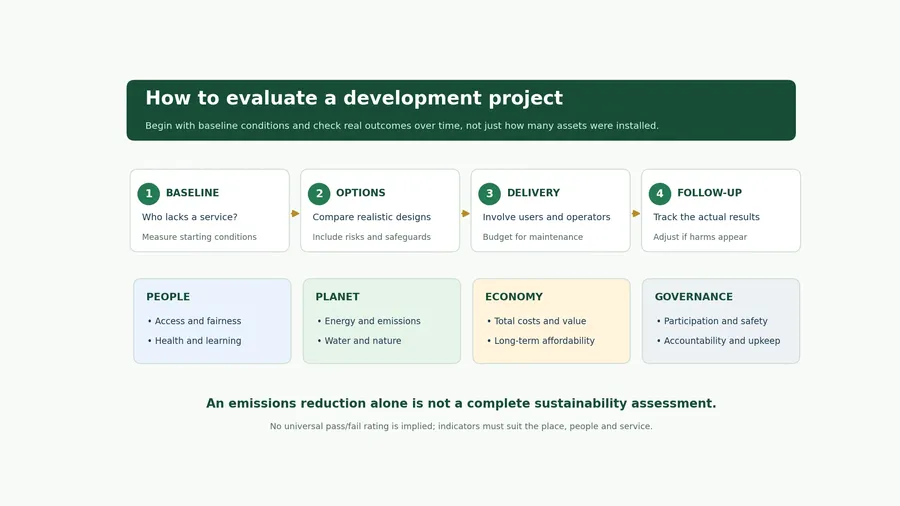
Figure 3. A project scorecard should track people, environmental impacts, costs and the quality of long-term delivery.
14. Worked example: evaluating a school lighting improvement
Imagine a school replaces 100 old 36-watt lamps with 100 efficient 9-watt lamps. Suppose each lamp operates 6 hours per school day for 200 days per year. The difference is 27 watts per lamp, so electricity saved is 100 × 27 W × 6 h/day × 200 days/year ÷ 1,000 = 3,240 kWh/year. These are illustrative assumptions, not measured values at an actual school.
If we also assume an electricity-related emissions factor of 0.60 kg CO₂e/kWh, the illustrative operational emissions reduction is 3,240 × 0.60 = 1,944 kg CO₂e/year. At an assumed electricity tariff of $0.15/kWh, annual bill savings would be $486. If the additional lamp investment is $1,200, simple payback is about 2.47 years, before maintenance and discounting.
These three results measure only selected outcomes. A sustainability assessment would still check lighting quality, safe disposal of old lamps, student comfort, procurement conditions and long-term operation. Actual carbon savings depend on the local electricity supply and timing; local tariffs and lamp performance may differ. No generic emissions factor should be copied into a real procurement decision without verification.
Hypothetical classroom lighting illustration. Electricity-related emissions factor and tariff are assumed, not regional measurements.
15. What trade-offs make the choices difficult?
Development decisions often involve competing interests. A dam may deliver electricity and irrigation but alter river ecosystems or require people to relocate. A highway may improve freight access yet encourage more traffic and increase noise or air pollution. A large solar farm can lower emissions while introducing land-use conflicts if its siting ignores local conditions [8].
Fairness matters within a generation and between generations. Ask who pays, who benefits, who must move, who maintains the infrastructure and what risks are passed to future residents. Meaningful public participation can reveal problems that purely technical models overlook, especially for people who have historically been excluded from decisions.
Trade-offs cannot always be eliminated. The best available choice may be a design that minimizes irreversible harm, protects essential rights, shares benefits more fairly and includes adaptive monitoring. Sustainable development is not synonymous with “everybody wins immediately”; it means making the consequences visible and managing them responsibly.
16. Five practical questions to remember
Q1. Is sustainable development only about the environment? No. It combines human well-being and economic opportunity with environmental limits. Q2. Are the SDGs just climate goals? No. They also concern poverty, education, water, health, equality, institutions and other priorities [2,3].
Q3. Does a solar-powered school automatically count as sustainable? No. Service reliability, affordability, accessibility, materials, maintenance and community needs still matter. Q4. Does one good emissions number prove success? No. It answers one question and may omit important social and ecological effects.
Q5. How can an ordinary reader recognize a credible claim? Look for a baseline, transparent methods, measurable outcomes, costs, local consultation and independent evidence. A good project improves lives in a way that can be maintained without shifting unacceptable burdens elsewhere.
Continue with What Is Sustainability?, Renewable vs Clean vs Sustainable Energy, and What Is a Carbon Footprint?. For calculations and system design, explore the Energy Economics and Industrial Energy Efficiency hubs.
Technical discussions describe general principles; site-specific engineering decisions require appropriate professional evaluation.