
RENEWIOSITY / EXPLAINER
Biomass Combustion Engineering: Heating Value, Excess Air and Flue Gas Analysis
Learn biomass fuel ultimate analysis, HHV versus LHV, stoichiometric oxygen, excess air and wet/dry flue-gas calculations through a reproducible engineering example.
Learning objectives
- Distinguish proximate from ultimate analysis.
- Convert dry-basis composition to an as-fired basis.
- Calculate theoretical oxygen and air demand.
- Determine excess-air effects.
- Construct wet and dry flue-gas balances.
- Estimate HHV and LHV consistently.
- Explain why real stack measurements can differ from a complete-combustion calculation.
Why combustion calculations matter
Biomass boilers, grate furnaces, fluidized beds and combined heat-and-power plants must convert a chemically variable solid fuel into useful heat while controlling oxygen supply, emissions and ash behavior. The starting point is a consistent material balance. Fuel moisture, elemental oxygen already bound in the biomass, and dilution by nitrogen all influence how much air is needed and what the stack analyzer reports.
This lesson uses a fully specified illustrative fuel, not an assay from a particular plant. Every numerical result is reproducible from the stated assumptions. The same method can be applied to measured wood chips, straw or other solid biofuels, provided their composition, moisture basis and operating conditions are known.
1. Fuel characterization: proximate and ultimate analysis
Proximate analysis divides a solid fuel into moisture, volatile matter, fixed carbon and ash under specified laboratory procedures. Ultimate analysis reports elemental mass fractions, typically C, H, O, N and S, together with ash. Oxygen may be determined by difference, so its uncertainty can accumulate from the other measurements. Chlorine and mineral composition should be characterized separately where relevant to corrosion and fouling.
Always label the reporting basis: dry, dry ash-free, or as received/as fired. A dry-basis mass fraction is not the mass fraction of a wet delivery. For a fuel with 20% water by total wet mass, each kilogram of as-fired fuel contains 0.80 kg dry solids and 0.20 kg water.
Wet-basis moisture is the fraction of total delivered fuel mass that is water.
For 20% wet-basis moisture, the dry-basis moisture ratio is 0.25 kg water per kilogram dry fuel, not 20%.
This relationship assumes the dry analysis includes ash and all elemental fractions sum to unity.
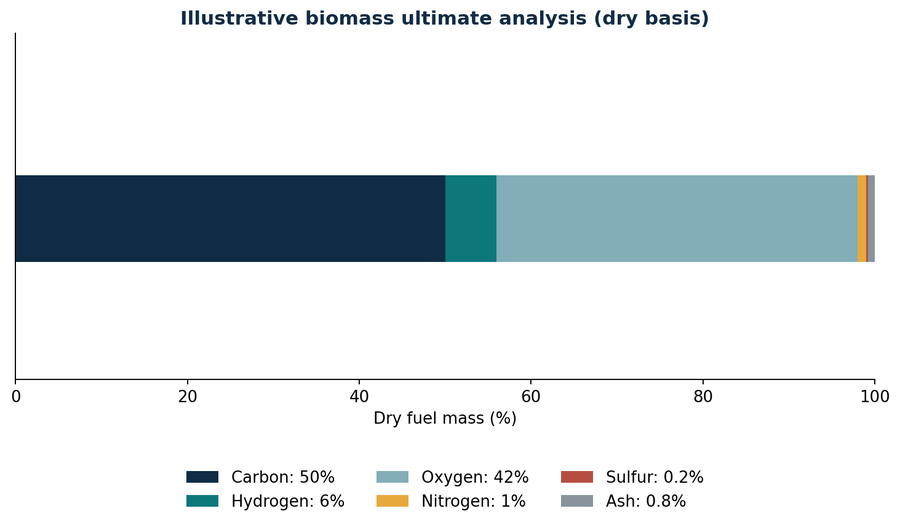
Figure 1. Assumed dry-basis ultimate analysis used throughout the worked example; percentages sum to 100%.
Our illustrative dry fuel has 50.0% C, 6.0% H, 42.0% O, 1.0% N, 0.2% S and 0.8% ash by mass. This is a deliberately simplified composition for engineering teaching. A real sample should be analyzed before equipment design or emissions reporting.
2. Higher and lower heating values
Higher heating value (HHV), or gross calorific value, assumes the water in combustion products is returned to the reference liquid state. Lower heating value (LHV), or net calorific value, assumes water remains vapor at the reference state. The difference is associated with vaporizing water formed from fuel hydrogen and, for as-fired fuel, water already present as moisture. A bomb calorimeter measures a gross calorific value subject to standard corrections; it does not directly measure a boiler’s useful heat output.
Here h_fg is the latent enthalpy in MJ/kg water at the selected reference conditions. The ratio converts fuel hydrogen mass to produced water mass. This is an approximation because standardized HHV/LHV conversions can include additional reference-state corrections.
Fuel water adds mass without adding chemical heat release.
The last term represents evaporation of initial fuel moisture, assuming it enters as liquid water and leaves as vapor at the reference state.
For the teaching fuel, assume dry HHV = 19.00 MJ/kg and latent heat = 2.442 MJ/kg water. The resulting dry LHV is 17.691 MJ/kg dry fuel. At 20% moisture, as-fired HHV = 15.200 MJ/kg and as-fired LHV = 13.664 MJ/kg. Do not mix a dry heating value with a wet fuel feed rate.
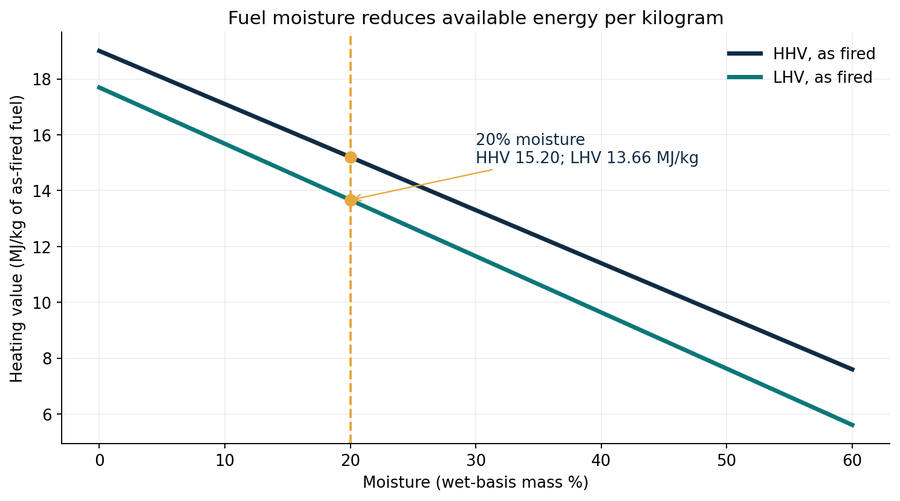
Figure 2. Effect of moisture on the illustrative fuel’s HHV and LHV, using a constant dry composition and the stated reference-state approximation.
Real combustion systems also experience sensible-heat losses, unburned carbon, heat transfer limitations and changing exhaust temperature. Therefore, LHV is not boiler efficiency. It is an energy-input convention. The effect of moisture on useful heat is discussed by Penn State Extension and UK Forest Research.
3. Stoichiometric oxygen requirement from ultimate analysis
For a complete-combustion material balance, carbon becomes CO₂, hydrogen becomes H₂O, sulfur becomes SO₂, and fuel nitrogen is approximated as N₂. These assumptions are useful for a first-pass calculation, but they do not predict NOₓ, CO, soot, unburned hydrocarbons or sulfur retention in ash. Oxygen chemically present in the fuel reduces the external O₂ requirement.
One kilomole of carbon requires one kilomole of oxygen.
Two kilomoles of hydrogen molecules consume one kilomole of oxygen.
This simple model assumes all fuel sulfur forms SO₂; actual sulfur partitioning varies.
All elemental masses are kilograms per chosen fuel basis; molar masses are kg/kmol, yielding kmol O₂ per fuel basis. This formulation neglects additional oxidizable elements and assumes the specified ultimate analysis.
On a 1 kg as-fired basis, the fuel contains 0.400 kg C, 0.048 kg H, 0.336 kg O, 0.008 kg N, 0.0016 kg S, 0.0064 kg ash and 0.200 kg water. Substitution gives 0.03476 kmol O₂/kg as-fired fuel. The oxygen already contained in the fuel must be subtracted; otherwise the calculated air demand is overstated.
4. Theoretical air, actual air and excess air
For this example, dry ambient air is approximated as 21 mol% O₂ and 79 mol% N₂, ignoring argon, humidity and trace gases. The theoretical air supply is the amount that exactly meets the stoichiometric O₂ demand. Actual operation generally supplies more air to improve mixing and reduce incomplete combustion, but too much air can increase exhaust heat loss and fan duty.
Dry air is assumed to contain 0.21 mole fraction oxygen.
Use molecular weights of O₂ and N₂ to convert kmol dry air into kg.
Excess air of 30% corresponds to an air factor λ = 1.30, not to 30% oxygen in the stack.
The fuel basis and air composition must be identical in numerator and denominator.
For the example, theoretical dry air is 4.775 kg per kg as-fired fuel. At 30% excess air, actual dry air is 6.208 kg/kg fuel. The excess oxygen leaving the furnace is 0.01043 kmol/kg fuel in the ideal complete-combustion model.
The optimum excess air depends on furnace geometry, fuel size, fuel moisture, load, mixing, staging and emissions requirements. In practice, a stack oxygen analyzer provides feedback, but oxygen alone does not establish complete combustion: a system can show excess O₂ and still emit CO due to poor mixing or cold zones.
5. Flue-gas species balance: wet versus dry
A wet flue-gas basis includes water vapor from both hydrogen oxidation and the incoming moisture. A dry basis excludes water vapor. Since water occupies a significant mole fraction, the reported dry CO₂ and O₂ percentages are higher than their wet-basis percentages for the same physical exhaust. For a complete-combustion balance, use the following species totals per kilogram of as-fired fuel.
One mole of CO₂ forms per mole of carbon, assuming complete oxidation.
Water comes from fuel hydrogen and evaporation of the water initially present in the biomass.
Valid for the idealized model of complete combustion and fixed air composition.
The final term treats all fuel nitrogen as N₂. It does not model NOₓ formation.
Sum the dry products CO₂, O₂, N₂ and SO₂ in this model.
Include water vapor in the denominator when calculating wet-basis gas fractions.
The calculated dry flue-gas production is 0.21404 kmol/kg fuel, versus 0.24895 kmol/kg fuel wet. At 30% excess air, the dry molar analysis is CO₂ 15.56%, O₂ 4.87%, N₂ 79.55% and SO₂ 0.023%. On the wet basis, water vapor accounts for 14.02% of the exhaust. These idealized results exclude humidity in the inlet air and ash-borne reactions.
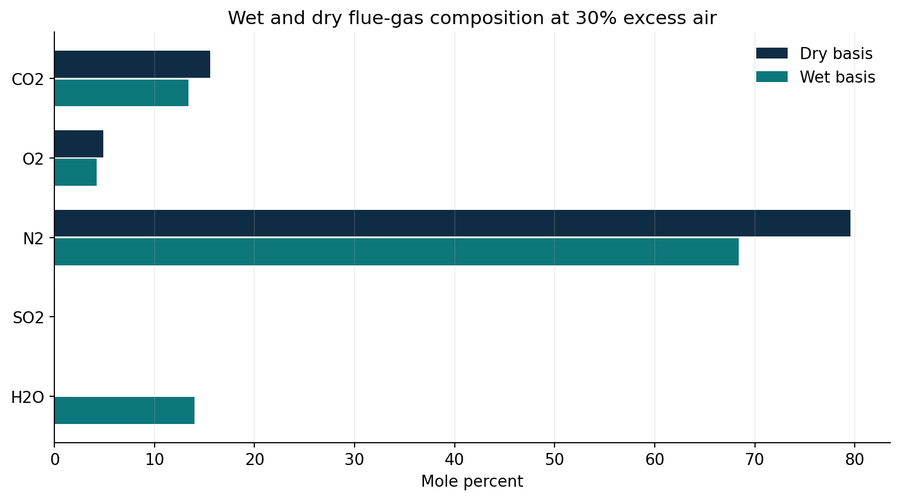
Figure 3. Wet-basis and dry-basis composition differ because water vapor appears only in the wet denominator.
6. Estimating excess air from measured stack oxygen
In the simplified complete-combustion model, increasing the air factor increases dry stack oxygen and dilutes dry carbon dioxide. However, the relation depends on fuel elemental composition, nitrogen in the fuel, incomplete combustion, air leakage, moisture and whether the analyzer reports wet or dry gas. A common quick approximation for excess air from O₂ is not a universal exact identity for biomass. For engineering calculations, solve the species balance for λ using the measured dry O₂ mole fraction and the known fuel composition.
This equation follows directly from the complete-combustion mole balance and the stated dry-air composition.
For the illustrative fuel, the model predicts 4.87% dry O₂ at 30% excess air. A measured dry O₂ value close to this would be consistent with the assumptions, but it would not independently verify burnout or rule out downstream air infiltration.
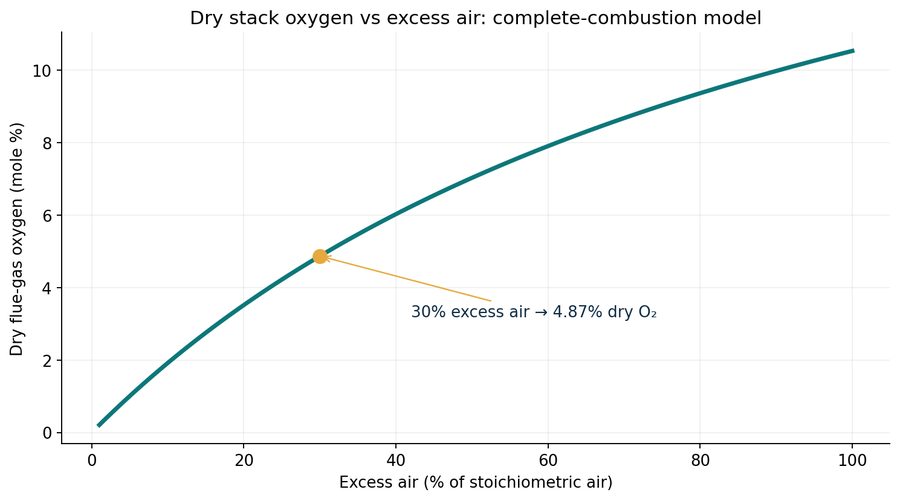
Figure 4. Ideal dry stack oxygen as a function of excess air, computed from the actual elemental analysis used in this lesson.
Environmental monitoring often reports pollutant concentrations on a dry gas basis at specified reference temperature, pressure and oxygen concentration. This is a normalization convention, not a physical change in emissions. The appropriate oxygen reference is defined by the applicable permit and jurisdiction, not by a universal biomass value. See the UK government technical guidance and EEA emissions guidebook.
For compatible dry-basis measurements under applicable regulatory rules; oxygen percentages use the same dry basis and the correction is not valid if the measurement violates the method assumptions.
7. Worked example: complete mass balance for a biomass boiler
Problem. A biomass boiler burns 1,000 kg/h of an illustrative as-fired fuel containing 20 wt% moisture. The dry fuel has C 50%, H 6%, O 42%, N 1%, S 0.2% and ash 0.8%. Assume dry HHV 19 MJ/kg, dry air with 21 mol% O₂, 30% excess air, complete oxidation to CO₂, H₂O and SO₂, and all fuel nitrogen to N₂. Find the stoichiometric air, actual air, wet and dry flue-gas composition, and LHV-based fuel input.
Step 1: Convert the basis. One kilogram of delivered fuel contains 0.80 kg dry fuel and 0.20 kg water. Multiply each dry elemental fraction by 0.80. This prevents a 25% overestimate that would arise from applying dry fractions directly to 1 kg of wet fuel.
Step 2: Theoretical oxygen. Apply the elemental oxygen demand equation: 0.034757 kmol O₂/kg as-fired fuel. Oxygen chemically present in the fuel reduces the required external oxygen.
Step 3: Air requirement. Theoretical dry air = 4.7750 kg/kg as-fired fuel. With λ = 1.30, actual dry air = 6.2075 kg/kg fuel, equivalent to 6,208 kg/h at the specified fuel feed rate.
Step 4: Flue gas. On a dry basis, CO₂ = 15.559%, O₂ = 4.871%, N₂ = 79.546% and SO₂ = 0.023%. On a wet basis, H₂O = 14.023% and dry species fractions decrease proportionally.
Step 5: Fuel heat input. As-fired LHV = 13.6641 MJ/kg. At 1,000 kg/h, the LHV-based chemical energy input is 3.796 MW. This is fuel input, not net steam generation or electric power.
With mass flow in kg/s and LHV in MJ/kg, the result is MW.
These steps form a closed species and energy-input calculation under the stated assumptions. The downloadable Python calculation reproduces the figures without relying on a proprietary combustion simulator. For real engineering work, use site-specific fuel assays, ambient humidity, measured gas composition, ash chemistry, heat losses and regulatory test methods.
8. Practical boiler design and emissions implications
Air staging and mixing. Primary air supports drying, devolatilization and char oxidation; secondary air can promote burnout of volatile gases. A single overall λ cannot describe local oxygen-rich and oxygen-poor regions. Poor mixing can produce CO even when overall stack oxygen is above zero.
Moisture variability. Wet wood chips can reduce flame temperature and increase flue-gas water loading. A change in moisture content affects the as-fired LHV, feeder throughput needed for the same duty, and sometimes the achievable boiler load. Moisture should be sampled on a clearly documented basis.
Ash and fouling. Alkali metals, silica, chlorine and sulfur influence slagging, deposition and corrosion. The 0.8% ash in this example is a bookkeeping assumption; it does not characterize ash fusion behavior or particulate emissions.
Flue-gas sampling. A dry oxygen analyzer can be biased by air ingress after the combustion chamber. A wet measurement must be corrected consistently before comparison with a dry permit limit. Do not confuse normalized mg/Nm³ with total mass emission rate; volumetric flow must be on the matching reference basis.
Efficiency. Boiler efficiency requires a heat-output or loss balance, including exhaust sensible heat, moisture-related losses, unburned carbon and other losses. Do not infer efficiency from HHV or LHV alone, and always identify whether a reported efficiency is HHV- or LHV-based.
9. Common calculation mistakes
Mixing bases: Using dry ultimate analysis with wet fuel mass without conversion. Confusing excess air and oxygen: 30% excess air does not mean 30% O₂ in flue gas. Ignoring fuel oxygen: This overstates theoretical combustion air. Dropping water: Dry and wet gas percentages cannot be interchanged. Assuming complete combustion from oxygen alone: Stack O₂ does not rule out CO. Using illustrative heating values as fuel certificates: Real biomass must be tested.
10. Practice questions
Question 1. If moisture increases from 20% to 30% wet basis while dry composition and dry HHV remain unchanged, how does as-fired HHV change? Answer: From 15.2 to 13.3 MJ/kg. This is a fuel-energy-density comparison, not a boiler-efficiency prediction.
Question 2. For 20% wet-basis moisture, what is the dry-basis moisture ratio? Answer: 0.20/0.80 = 0.25 kg water per kg dry solids, or 25% on a dry basis.
Question 3. If λ = 1.50, what is excess air? Answer: 50% above stoichiometric air. It does not follow that dry O₂ equals 50%.
Question 4. Why is wet-basis CO₂ lower than dry-basis CO₂ for the same stack gas? Answer: The wet denominator includes water vapor while the number of moles of CO₂ remains unchanged.
Continue learning
Review the fundamentals in What Is Biomass Energy?, compare pathways in How Biomass Is Converted into Energy, and practice related energy balances in Biomass Energy Calculations.
References and further reading
The references below support the engineering principles, fuel-property definitions and reporting conventions. The fuel assay, plots and worked numbers are original illustrative teaching examples rather than measured plant data.
1. Penn State Extension: Characteristics of Biomass as a Heating Fuel. Moisture basis, HHV/LHV distinction, and combustion fuel characteristics.
2. UK Forest Research: Effect of Moisture Content. Why water content reduces useful heat and can impair combustion.
3. NREL: Handbook of Biomass Downdraft Gasifier Engine Systems. Biomass elemental chemistry and heating-value definitions; broader biomass thermochemical context.
4. California Agriculture: Thermochemical Properties of Biomass Fuels. Fuel analysis, higher and lower heating values, and variation across biomass types.
5. US EPA: Method for Calculating Emissions Using F Factors. Dry flue gas, oxygen dilution and F-factor method for emissions calculations.
6. European Environment Agency: EMEP/EEA Guidebook, Small Combustion. Standardization of emissions concentrations and oxygen reference basis.
7. US DOE / OSTI: Renewable Energy, Biomass Fuel Moisture and Boiler Performance. Effect of fuel moisture on delivered heat and combustion system performance.
8. ASHRAE Handbook: Combustion and Fuels. Theoretical combustion air, excess air and dry flue-gas analysis.
9. UK Government: Pollution Inventory Technical Guidance and Equations. Wet/dry gas concentration corrections and oxygen normalization.
Technical note: Results are educational approximations. Site-specific design, permitting and performance guarantees require measured fuel properties, qualified engineering review and applicable standards.
Technical discussions describe general principles; site-specific engineering decisions require appropriate professional evaluation.