
RENEWIOSITY / EXPLAINER
Biomass Energy Calculations: Heating Value, Moisture, Efficiency, Mass Balances and Fuel Requirements
A calculation-focused engineering guide to biomass moisture bases, heating values, fuel requirements, combustion air, mass balances, conversion efficiencies and worked SI-unit problems.
Learning objectives
- Convert biomass moisture content between wet-basis and dry-basis definitions without mixing the two conventions.
- Use dry-solids conservation to calculate drying, blending and as-received biomass mass flows.
- Distinguish higher heating value from lower heating value and estimate the energy penalty associated with moisture.
- Calculate fuel-energy rate, useful heat, thermal efficiency and required biomass mass flow in consistent SI units.
- Estimate stoichiometric oxygen and excess-air requirements from a simple ultimate analysis.
- Close simplified biomass boiler mass and energy balances, including ash and flue-gas streams.
- Calculate combined heat-and-power performance, gasification cold-gas efficiency and pyrolysis energy recovery.
- Calculate methane flow and recoverable energy from anaerobic-digestion biogas.
- Apply dimensional checks and reasonableness tests so that apparently precise answers do not hide basis or unit errors.
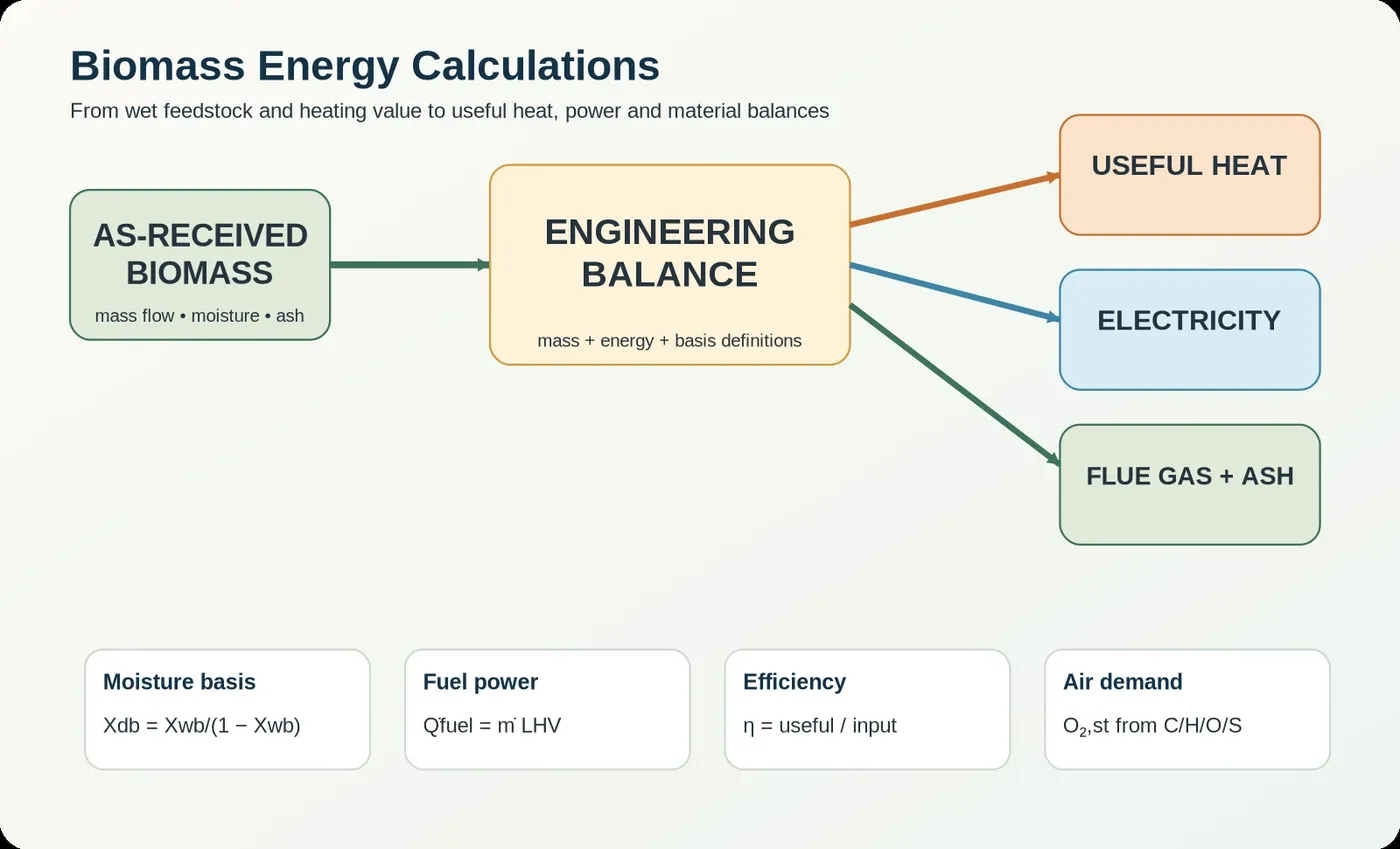
Biomass engineering calculations are deceptively simple until moisture basis, heating-value basis, efficiency definition and system boundary are mixed. A technically correct calculation therefore begins with definitions rather than arithmetic. This article develops a reusable calculation framework for solid biomass boilers, combined heat and power, gasification, pyrolysis and anaerobic digestion. [1,2]
It follows What Is Biomass Energy? and How Is Biomass Converted into Energy?. Those articles establish the feedstocks and conversion routes; here the emphasis is on quantitative chemical-engineering reasoning, SI units and explicit mass and energy balances.
1. Start every biomass calculation with a basis and a boundary
Before writing an equation, state the time basis, material basis and system boundary. A convenient process basis might be 1 hour of operation, 1 kg of as-received fuel, or 1 kg of dry biomass. The boundary may enclose only a furnace, an entire boiler, a CHP plant, a gasifier plus cleanup train, or an anaerobic digester plus engine-generator. Different boundaries legitimately produce different efficiencies.
Also record whether each composition is reported as received, on a dry basis, or on a dry ash-free basis. Biomass properties vary substantially with feedstock, storage and preprocessing, which is why the U.S. Department of Energy treats feedstock variability as a major conversion-interface problem. [3,4]
For a steady process with negligible accumulation, the total mass flow entering the selected boundary equals the total mass flow leaving it. Reaction changes chemical species, but not total mass.
A useful discipline is to write the units next to every intermediate value. For example, multiplying kg/s by MJ/kg produces MJ/s, which is numerically MW. That simple unit check catches many order-of-magnitude errors before they propagate.
2. Moisture content: wet basis and dry basis are not interchangeable
Wet-basis moisture uses the total wet sample as the denominator, while dry-basis moisture uses dry solids as the denominator. A fuel that is 50% water on a wet basis is therefore 100% moisture on a dry basis. Agricultural and biomass literature may use either convention, so the basis must always be stated explicitly. [5]
Here m_w is the water mass and m_d is the dry-solids mass. The wet-basis fraction lies between zero and one for ordinary biomass.
Dry-basis moisture can exceed 1.0 because the water mass can exceed the dry-solids mass. The inverse relation is X_wb = X_db/(1+X_db).
Worked example 1: converting wet-basis moisture to dry basis
A wood-chip sample contains 30% moisture on a wet basis. Express the same moisture content on a dry basis.
- Set X_wb = 0.30.
- Apply X_db = X_wb/(1 − X_wb).
- X_db = 0.30/0.70 = 0.4286.
- Multiply by 100 to express the result as a percentage.
Answer: The equivalent moisture content is 42.9% dry basis.
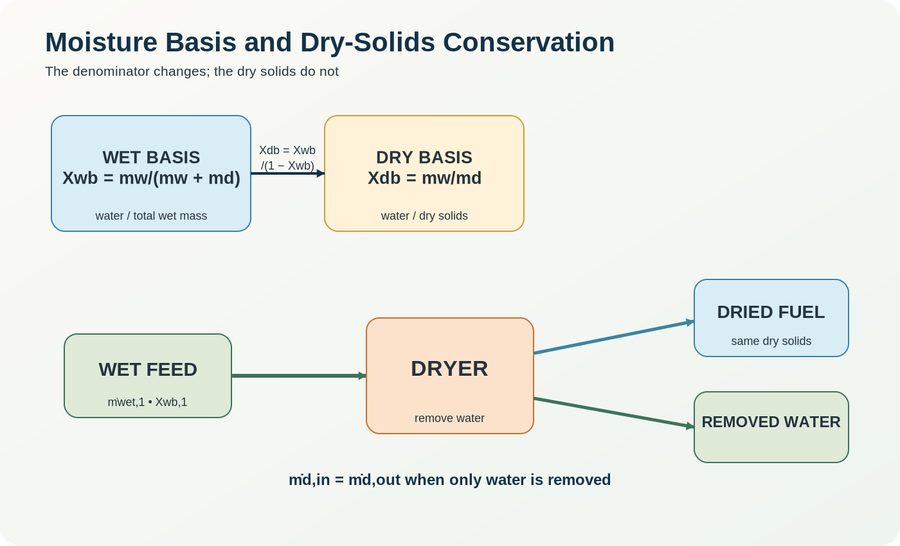
Figure 1. Wet-basis and dry-basis moisture use different denominators; dry-solids conservation links them safely.
3. Dry-solids conservation is the backbone of drying calculations
When a dryer removes only water, the dry-solids flow entering and leaving is unchanged. This is more reliable than trying to subtract moisture percentages directly. The same idea is useful in dewatering, storage-loss calculations and blending problems.
The dry-solids flow is the as-received wet mass flow multiplied by the dry mass fraction.
After dry solids have been established, divide by the final dry fraction to recover the final as-received mass flow.
Worked example 2: water removal in a biomass dryer
A plant receives 5000 kg/h of biomass at 35% wet-basis moisture and dries it to 15% moisture. Assume no dry-solids loss. Calculate the dry-solids flow, final wet flow and water removed.
- Dry solids = 5000(1 − 0.35) = 3250 kg/h.
- At 15% final moisture, dry solids are 85% of final wet mass.
- Final wet mass = 3250/0.85 = 3823.5 kg/h.
- Water removed = 5000 − 3823.5 = 1176.5 kg/h.
Answer: The dryer removes about 1176 kg/h of water.
If dry matter is lost as dust, volatile organics or degraded solids, dry-solids conservation must be modified. The calculation should then include an explicit solids-loss term rather than forcing the simple dryer equation to fit.
4. HHV, LHV and as-received heating value
Higher heating value assumes that water in the combustion products is condensed and its latent heat is recovered. Lower heating value assumes that this water leaves as vapor. The distinction matters for efficiency reporting, and the chosen basis must be consistent on both the numerator and denominator. DOE and NREL references define and discuss these conventions for biomass fuels. [2,6]
Moisture reduces useful fuel energy in two ways: water contributes no combustible energy, and energy is required to heat and evaporate it. A convenient first estimate starts with a dry-fuel LHV and subtracts the energy needed to vaporize the as-received moisture. It is an engineering approximation, not a substitute for a measured fuel analysis.
M is the wet-basis moisture fraction, LHV_d is the lower heating value of the dry fuel, and h_fg is an appropriate latent-heat estimate for water. Use a consistent reference temperature and state all assumptions.
Worked example 3: moisture penalty on lower heating value
A dry biomass has LHV_d = 18.5 MJ/kg. Estimate the as-received LHV at 25% wet-basis moisture using h_fg = 2.44 MJ/kg water.
- Dry fuel fraction = 1 − 0.25 = 0.75.
- Dry-fuel contribution = 0.75(18.5) = 13.875 MJ/kg as received.
- Approximate moisture vaporization penalty = 0.25(2.44) = 0.610 MJ/kg.
- LHV_ar ≈ 13.875 − 0.610 = 13.265 MJ/kg.
Answer: The estimated as-received LHV is about 13.3 MJ/kg.
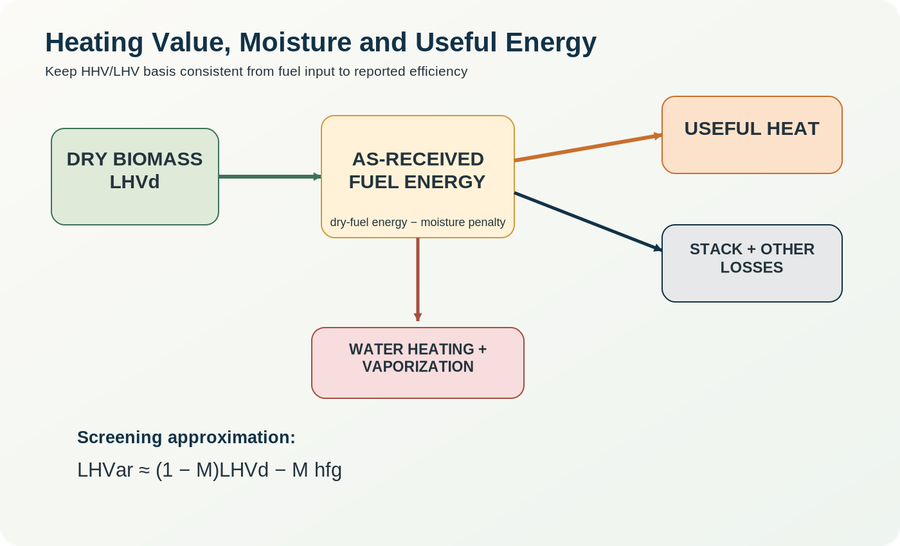
Figure 2. Heating-value basis and moisture losses must be defined before boiler efficiency is interpreted.
5. Fuel-energy rate: converting a heating value into power
Heating value is energy per unit mass; mass flow turns it into an energy rate. For process calculations, MJ/s is especially convenient because 1 MJ/s equals 1 MW.
If mass flow is in kg/s and LHV is in MJ/kg, the result is MW. HHV may be used instead, but every reported efficiency must use the same heating-value basis.
For hourly calculations, kg/h multiplied by MJ/kg gives MJ/h. Divide by 3600 to obtain MW. Conversely, 1 kg/s equals 3.6 t/h.
6. Boiler thermal efficiency and required biomass flow
A biomass boiler converts only part of the incoming chemical energy into useful steam, hot water or process heat. Stack losses, unburned carbon, radiation, convection, moisture evaporation and auxiliary equipment can all reduce useful output. A practical efficiency calculation therefore depends on the boundary and whether auxiliary electricity is included.
This LHV-based definition compares useful thermal output with the incoming fuel energy rate. An HHV-based efficiency will have a different numerical value for the same physical plant.
This rearrangement is one of the most useful sizing equations in biomass heat systems.
Worked example 4: biomass flow required for process heat
A process needs 25 MW of useful heat. Biomass is available at an as-received LHV of 13.3 MJ/kg, and the boiler is expected to operate at 82% LHV efficiency. Estimate the required fuel flow.
- Required fuel-energy input = 25/0.82 = 30.49 MW.
- Fuel flow = 30.49/13.3 = 2.292 kg/s.
- Convert to tonnes per hour: 2.292 × 3.6 = 8.25 t/h.
- Check: 2.292 kg/s × 13.3 MJ/kg × 0.82 ≈ 25 MW.
Answer: The plant requires approximately 2.29 kg/s, or 8.25 t/h, of as-received biomass.
7. Drying duty can consume a meaningful fraction of biomass energy
Drying may improve combustion stability or gasification performance, but it is not energetically free. A first-pass duty includes sensible heating of removed water plus its latent heat of vaporization. Real dryers also heat solids and air, lose heat to the surroundings and may recover heat from exhaust streams.
This expression estimates the heat associated with warming and evaporating removed water. Use the actual dryer temperature and thermodynamic properties for detailed design.
Using the water-removal rate from Worked example 2, heating 1176.5 kg/h of water from 25°C to 100°C and vaporizing it requires roughly 0.84 MW before dryer inefficiencies or solid heating are included. That is large enough to affect whether aggressive drying is economically and energetically justified.
8. Stoichiometric oxygen and excess-air calculations
For a simplified complete-combustion calculation, an ultimate analysis gives the fuel carbon, hydrogen, oxygen and sulfur mass fractions. Nitrogen and ash do not directly contribute to the stoichiometric oxygen expression below, although they affect flue-gas and solids flows. The formula assumes carbon forms CO₂, hydrogen forms H₂O and sulfur forms SO₂.
The terms are kilograms of each element per chosen fuel basis. The result is kilograms of O₂ required for complete combustion on the same basis.
lambda is the excess-air ratio, equal to 1.00 at theoretical air. For ordinary dry air, oxygen is about 23.2% by mass, so Y_O2,air ≈ 0.232.
Worked example 5: stoichiometric and excess air
A dry biomass has mass fractions C = 0.50, H = 0.06, O = 0.42 and S = 0.002. Estimate stoichiometric air and the air requirement at 25% excess air. Use 23.2% oxygen by mass in air.
- O₂ requirement = 2.667(0.50) + 8(0.06) + 0.002 − 0.42 = 1.3955 kg O₂/kg dry fuel.
- Stoichiometric air = 1.3955/0.232 = 6.015 kg air/kg dry fuel.
- At 25% excess air, lambda = 1.25.
- Actual air = 1.25(6.015) = 7.52 kg air/kg dry fuel.
Answer: The estimated requirement is 6.02 kg/kg stoichiometric air and 7.52 kg/kg at 25% excess air.
Detailed combustion calculations should use measured ultimate analysis, fuel moisture, actual air humidity, unburned carbon and measured flue-gas oxygen or carbon dioxide. The simplified expression is most useful for screening and checking more detailed simulations.
9. Ash and flue-gas balances close the boiler material picture
Biomass ash is noncombustible mineral matter that leaves as bottom ash, fly ash or entrained solids. A first estimate assumes all measured ash exits the combustion system, while a more detailed balance partitions it among collection devices and deposits.
x_ash,d is the dry-basis ash mass fraction. If the fuel flow is as received, first calculate the dry-fuel flow.
A complete boiler mass balance includes as-received biomass, combustion air and any injected reagents on the inlet side; outputs include dry flue gas, water vapor, bottom ash, fly ash and sometimes unburned carbon. Nitrogen from air is usually the largest flue-gas mass component.
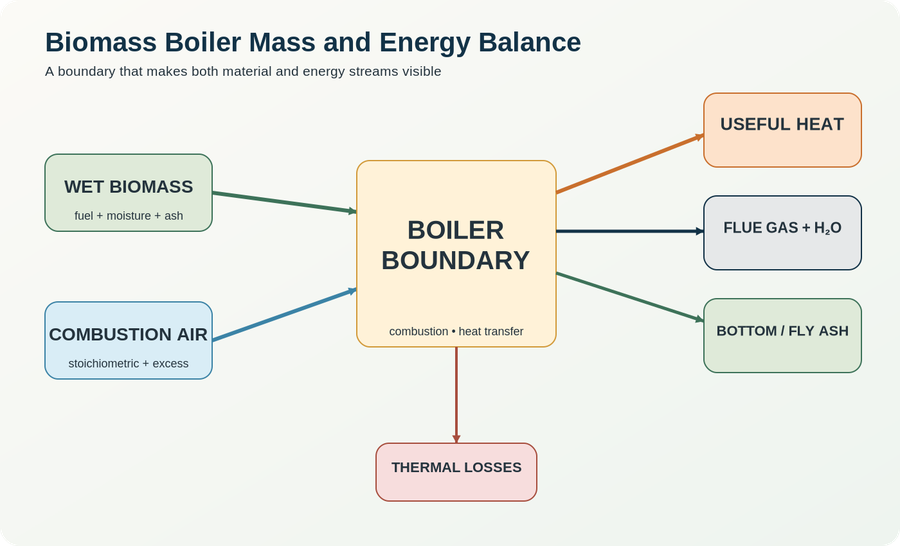
Figure 3. A simplified biomass boiler balance showing the principal mass and energy streams.
10. Combined heat and power requires more than one efficiency
A CHP system produces electricity and useful heat from the same fuel input. Reporting only electrical efficiency can make a well-integrated CHP plant appear inefficient, while reporting only overall efficiency can hide weak electrical performance. State both components and the fuel heating-value basis.
The simple overall efficiency adds useful electrical and thermal outputs when they are expressed on the same energy-rate basis and refer to the same system boundary.
Worked example 6: CHP electrical and thermal outputs
A biomass CHP plant receives 32 MW of LHV fuel input. Its net electrical efficiency is 27% and useful-heat efficiency is 51%. Calculate the useful outputs and overall efficiency.
- Electrical output = 0.27(32) = 8.64 MW_e.
- Useful thermal output = 0.51(32) = 16.32 MW_th.
- Total useful output = 8.64 + 16.32 = 24.96 MW.
- Overall useful-energy efficiency = 24.96/32 = 0.78, or 78%.
Answer: The plant produces 8.64 MW of electricity and 16.32 MW of useful heat, for 78% overall useful-energy efficiency.
11. Gasification uses cold-gas efficiency rather than boiler efficiency
Gasification converts part of the biomass chemical energy into the chemical energy of syngas. Cold-gas efficiency deliberately excludes the sensible heat of the hot product gas, so it should not be compared directly with an overall thermal efficiency that includes recovered heat. NREL describes cold-gas efficiency as the fraction of feedstock heating value retained as syngas chemical energy. [7]
Use consistent normal-volume conditions for gas flow and heating value. If mass-based gas flow is used instead, replace volumetric terms with mass flow and mass-specific LHV.
Worked example 7: gasification cold-gas efficiency
A gasifier processes 2.0 kg/s of dry biomass at LHV = 16 MJ/kg. It produces 3.6 Nm³/s of cleaned syngas with LHV = 6.0 MJ/Nm³. Calculate cold-gas efficiency.
- Biomass chemical-energy input = 2.0(16) = 32 MW.
- Syngas chemical-energy output = 3.6(6.0) = 21.6 MW.
- Cold-gas efficiency = 21.6/32 = 0.675.
- The remaining energy is associated with char, heat losses, sensible heat and other streams depending on the gasifier boundary.
Answer: The cold-gas efficiency is 67.5%.
12. Pyrolysis calculations begin with product yields and energy closure
Pyrolysis distributes dry biomass among condensable liquids, solid char and permanent gases. Product yields should be reported on a clearly defined feed basis because water and ash can otherwise distort comparisons. Thermochemical conversion conditions and feedstock properties strongly influence the distribution. [8]
For a simplified dry-feed balance, the mass fractions of the reported product groups should sum to one. Real experimental balances may include measurement losses or separate water fractions.
This expression compares chemical energy in saleable or useful product streams with the chemical energy of the feed. It does not automatically include sensible heat or auxiliary energy.
For example, a 1000 kg/h dry feed at 18 MJ/kg contains 18,000 MJ/h. If the measured oil, char and gas streams together contain 17,440 MJ/h of chemical energy, the simplified product-energy recovery is 96.9%. Such a high closure should trigger a check that all heating values, moisture bases and product flows are defined consistently rather than being accepted uncritically.
13. Anaerobic digestion calculations revolve around methane, not total wet feed
Anaerobic digestion treats wet biodegradable feedstocks and produces biogas plus digestate. Biogas is primarily methane and carbon dioxide; methane carries most of its combustible energy. EPA describes the same two principal outputs and notes that captured biogas can be used for heat, electricity, vehicle fuel or upgraded gas. [9]
For a gas mixture expressed on a consistent volumetric basis, multiply total biogas flow by the methane volume fraction.
Use methane LHV at the same reference or normal conditions used for the gas-flow measurement. A representative value near 35.8 MJ/Nm³ is often used for screening calculations, but the selected standard conditions must be stated.
Worked example 8: biogas methane and electrical output
A digester produces 500 Nm³/h of biogas containing 62% methane. Estimate methane flow and chemical-energy rate using methane LHV = 35.8 MJ/Nm³. If a CHP engine converts 38% of that methane energy to net electricity, estimate electrical output.
- Methane flow = 0.62(500) = 310 Nm³/h.
- Methane energy = 310(35.8) = 11,098 MJ/h.
- Convert to MW: 11,098/3600 = 3.083 MW of methane chemical energy.
- Net electrical output = 0.38(3.083) = 1.17 MW_e.
Answer: The biogas contains 310 Nm³/h of methane, about 3.08 MW of methane chemical energy, and could produce roughly 1.17 MW_e at 38% net electrical efficiency.
14. Compare efficiency metrics only when their boundaries are compatible
Biomass conversion technologies use different performance metrics because they produce different forms of useful output. Boiler thermal efficiency tracks useful heat. CHP separates electricity and useful heat. Gasification cold-gas efficiency tracks syngas chemical energy. Pyrolysis may report mass yield, carbon yield and chemical-energy recovery. Anaerobic digestion may report methane yield per unit of volatile solids destroyed as well as CHP efficiency.
A percentage is therefore not meaningful by itself. Every efficiency statement should identify the numerator, denominator, heating-value basis, material basis, system boundary and whether auxiliary energy is included.
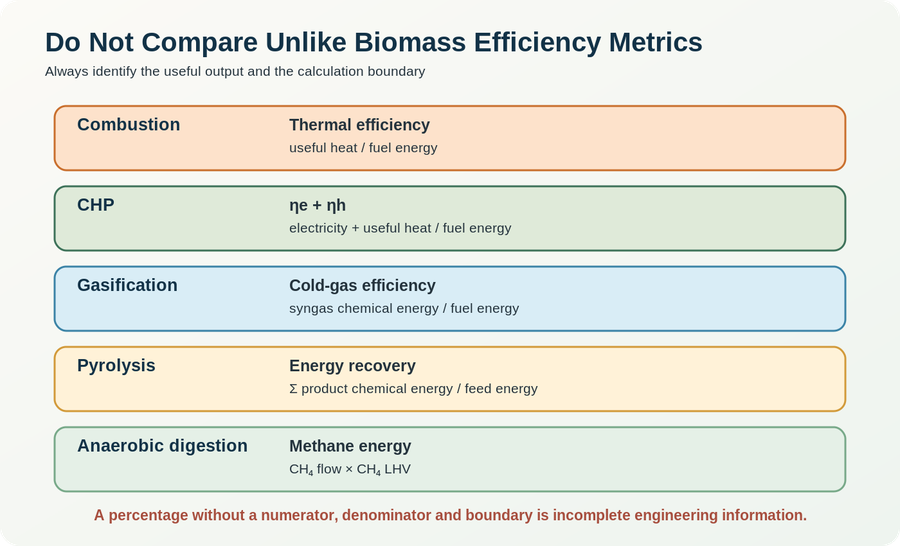
Figure 4. Biomass conversion technologies require different performance metrics because useful outputs and boundaries differ.
15. Unit conversions and reasonableness checks
A small set of unit identities makes most biomass calculations easier: 1 W = 1 J/s, 1 MW = 1 MJ/s, 1 kWh = 3.6 MJ, 1 kg/s = 3.6 t/h, and 1 tonne = 1000 kg. Gas calculations additionally require a stated normal or standard condition because a cubic metre of gas is not a fixed amount of substance without temperature and pressure.
Reasonableness checks are just as important as conversions. Moisture removal cannot exceed inlet water. Dry-solids flow cannot increase across a dryer unless solids are added. Useful boiler heat cannot exceed fuel energy input. Product mass yields should close to approximately one on the stated basis. An efficiency above 100% usually signals mixed HHV/LHV bases, an inconsistent boundary, or an omitted energy input rather than a miraculous process.
16. Integrated engineering workflow for a biomass calculation
A robust calculation sequence is: define the boundary; choose the mass or time basis; convert moisture to one basis; establish dry-solids flow; select HHV or LHV; calculate fuel-energy input; apply the process-specific efficiency definition; close the mass balance; then perform unit and magnitude checks. Only after those steps should the result be rounded for reporting.
For design work, measured feedstock data should replace generic textbook values. Moisture, ash, elemental composition, particle size and contaminants can change both preprocessing and conversion performance. DOE feedstock programs explicitly emphasize quality and variability for this reason. [3,4]
Lifecycle conclusions also require a broader boundary than the conversion equipment. IPCC assessments emphasize that bioenergy outcomes depend on feedstock source, land use, conversion efficiency, displaced products and the time scale used for carbon accounting. A high reactor efficiency does not by itself establish a favorable lifecycle result. [10,11]
17. Key takeaways
1. State wet basis or dry basis every time moisture is reported. 2. Conserve dry solids across simple dryers. 3. Do not mix HHV and LHV efficiencies. 4. Convert fuel flow and heating value into an energy rate before applying efficiency. 5. Treat moisture evaporation as a real energy penalty. 6. Use ultimate analysis for screening-level combustion-air estimates. 7. Match the efficiency metric to the conversion technology. 8. Close both mass and energy balances before trusting a result.
18. Practice questions
A biomass sample is 20% moisture on a wet basis. What is the dry-basis moisture fraction?
Reveal worked answer
X_db = 0.20/(1 − 0.20) = 0.25, so the moisture content is 25% on a dry basis.
A dryer receives 2000 kg/h of biomass at 40% wet-basis moisture. What is the dry-solids flow?
Reveal worked answer
Dry solids = 2000(1 − 0.40) = 1200 kg/h.
Why is subtracting 20 percentage points of moisture from a wet biomass flow not a valid drying mass balance?
Reveal worked answer
Moisture percentage changes its denominator as water is removed. Conserve dry solids and calculate the final wet mass from the final dry fraction.
A fuel flow is 1.5 kg/s at LHV = 14 MJ/kg. What is its chemical-energy rate?
Reveal worked answer
Fuel energy rate = 1.5 × 14 = 21 MJ/s = 21 MW.
A boiler receives 30 MW of LHV fuel input and delivers 24 MW of useful heat. What is its LHV thermal efficiency?
Reveal worked answer
eta = 24/30 = 0.80, or 80%.
Why can an HHV efficiency and an LHV efficiency for the same boiler have different numerical values?
Reveal worked answer
HHV includes recoverable condensation heat of product water while LHV does not. The denominators are different even when the physical boiler output is unchanged.
What does an excess-air ratio lambda = 1.20 mean?
Reveal worked answer
The actual combustion-air supply is 20% above the calculated stoichiometric air requirement.
A dry biomass flow is 4 t/h with 5% dry-basis ash. Estimate ash production if all ash is recovered.
Reveal worked answer
Ash = 4 × 0.05 = 0.20 t/h, or 200 kg/h.
A CHP plant has 28% electrical efficiency and 48% useful-heat efficiency on the same LHV basis. What is overall useful-energy efficiency?
Reveal worked answer
The simple overall efficiency is 28% + 48% = 76%.
A gasifier receives 10 MW of biomass chemical energy and produces syngas containing 6.5 MW of chemical energy. What is cold-gas efficiency?
Reveal worked answer
CGE = 6.5/10 = 65%. This excludes syngas sensible heat unless the definition is explicitly expanded.
Why should pyrolysis mass yields be reported on a clearly stated dry or as-received basis?
Reveal worked answer
Moisture and ash can change the denominator and make product-yield comparisons misleading even when the underlying process performance is unchanged.
A biogas stream is 400 Nm³/h at 60% methane. What methane flow does it contain?
Reveal worked answer
Methane flow = 0.60 × 400 = 240 Nm³/h, provided both quantities use the same gas reference conditions.
19. References and further reading
1. U.S. Department of Energy — Bioenergy Basics Read the source
2. U.S. Department of Energy — Full Text Glossary (heating value and moisture definitions) Read the source
3. U.S. Department of Energy — Feedstock Technologies Read the source
4. U.S. Department of Energy — Feedstock-Conversion Interface Consortium Read the source
5. Oklahoma State University Extension — Solids Content of Wastewater and Manure (wet- and dry-basis moisture) Read the source
6. National Renewable Energy Laboratory — Handbook of Biomass Downdraft Gasifier Engine Systems Read the source
7. National Renewable Energy Laboratory — Biomass Gasification Read the source
8. U.S. Department of Energy — Thermochemical Conversion Processes Read the source
9. U.S. EPA — Basic Information about Anaerobic Digestion Read the source
10. IPCC AR6 WGIII — Chapter 6: Energy Systems Read the source
11. IPCC AR6 WGIII — Chapter 7: Agriculture, Forestry and Other Land Uses Read the source
12. National Renewable Energy Laboratory — H2A Biomethane Model Read the source
Technical discussions describe general principles; site-specific engineering decisions require appropriate professional evaluation.