
RENEWIOSITY / EXPLAINER
What Is Biomass Energy? How Organic Matter Becomes Useful Energy
A university-level introduction to biomass energy: feedstocks, photosynthetic energy storage, moisture and heating value, combustion, gasification, pyrolysis, anaerobic digestion, energy balances, sustainability, and worked SI-unit calculations.
Learning objectives
- Define biomass, bioenergy and biomass feedstock without treating all organic matter as automatically sustainable.
- Explain how photosynthesis stores solar energy in chemical bonds and how bioenergy systems release or transform that energy.
- Classify common biomass feedstocks by origin, moisture, ash, particle form and suitability for thermochemical or biochemical conversion.
- Convert between wet-basis and dry-basis moisture content and calculate dry-matter flow from an as-received biomass stream.
- Distinguish higher heating value from lower heating value and explain why moisture reduces useful energy per kilogram of delivered biomass.
- Apply mass-flow, thermal-efficiency, electrical-efficiency and combined-heat-and-power calculations in SI units.
- Compare combustion, gasification, pyrolysis and anaerobic digestion at a conceptual engineering level.
- Estimate energy from methane-rich biogas and interpret methane yield on a volatile-solids basis.
- Explain why biomass carbon accounting requires system boundaries, time scale, land-use effects and supply-chain emissions.
- Identify the measurements needed before selecting or sizing a real biomass energy system.
1. Biomass energy: the engineering definition
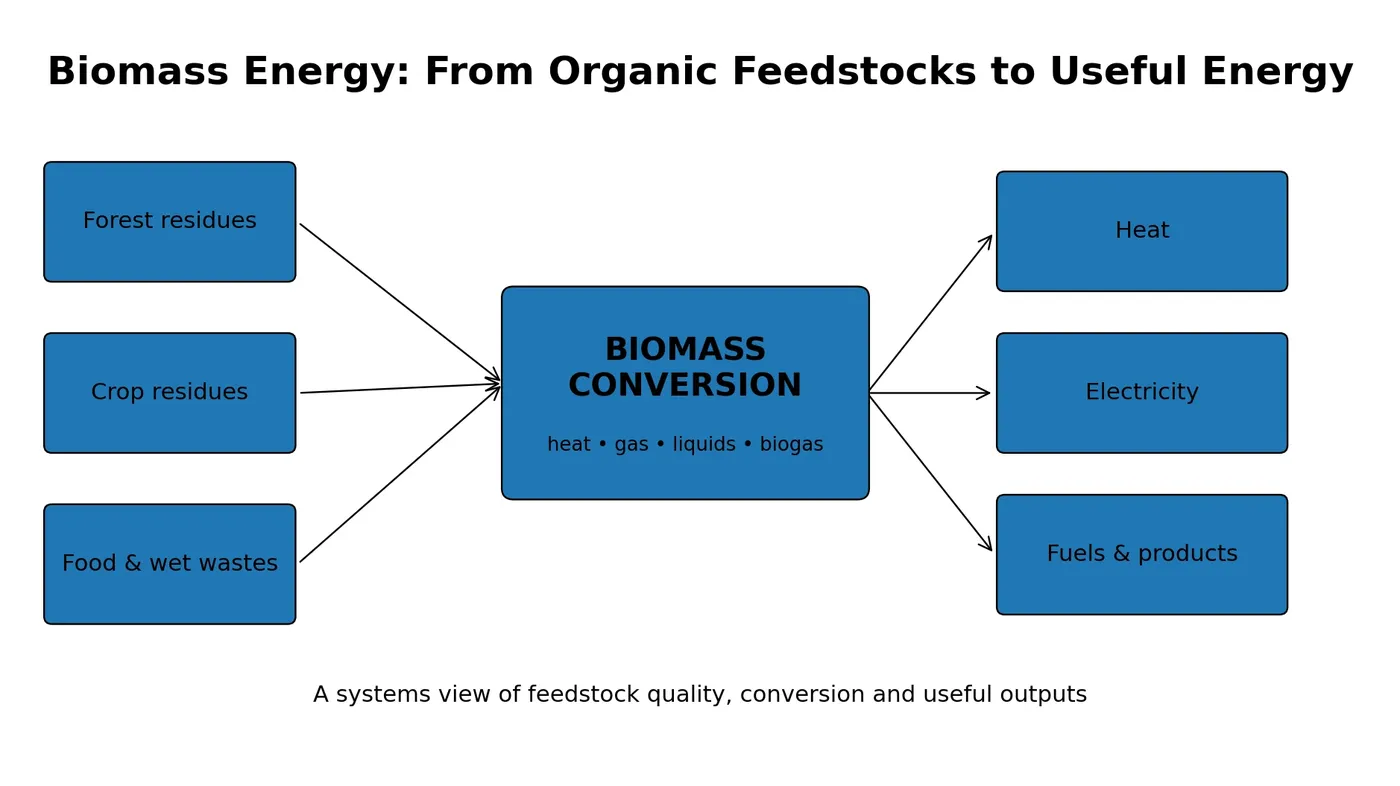
Biomass is recently living or recently derived organic material that can be used as a feedstock for energy, fuels or products. Examples include forestry residues, agricultural residues, purpose-grown crops, wood-processing residues, food waste, manure, wastewater solids and some sorted organic wastes. When biomass is converted to heat, electricity, biogas, liquid fuel or another energy carrier, the resulting energy is generally called bioenergy [1–3].
For engineers, the word biomass is not a guarantee of low emissions or good sustainability. A useful definition must be paired with feedstock origin, moisture content, ash content, chemical composition, collection practice, transport distance and conversion pathway. The same nominal feedstock can behave very differently in a boiler, gasifier or anaerobic digester depending on these properties. In other words, biomass is best treated as a family of variable process materials rather than as one uniform fuel.
2. Where the energy comes from: photosynthesis and chemical bonds
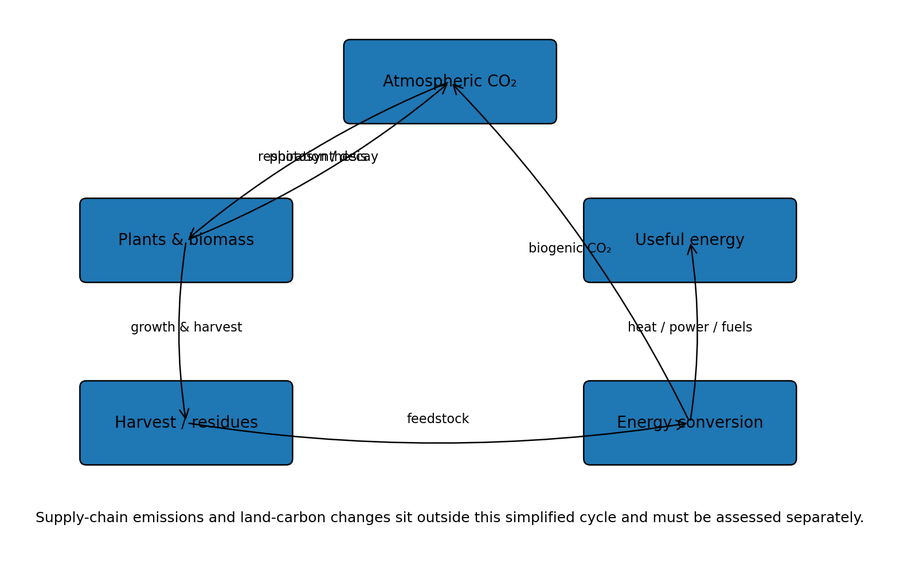
Green plants use sunlight to drive photosynthesis, converting carbon dioxide and water into energy-rich organic compounds. The familiar glucose equation is a simplified bookkeeping representation rather than a literal single-step biochemical reaction, but it is useful for understanding the origin of biomass chemical energy [5].
The symbol hν represents incoming photon energy. Real biomass contains cellulose, hemicellulose, lignin, extractives, proteins, lipids, minerals and water rather than pure glucose.
When biomass is later oxidized, fermented or otherwise converted, part of this stored chemical energy becomes useful heat, electricity or fuel. The chain therefore begins with solar radiation but becomes a problem in reaction engineering, thermodynamics, transport phenomena, microbiology and systems analysis once the biomass is harvested and processed.
3. Major biomass feedstock classes
DOE assessments group biomass resources into several broad categories: agricultural residues, forestry residues, purpose-grown herbaceous and woody crops, algae, municipal and industrial organic wastes, food wastes and wet organic streams [2,4]. A practical engineering classification also asks whether the material is dry and fibrous, wet and biodegradable, oily, or rich in sugars or starches, because these characteristics strongly influence conversion choice.
Dry lignocellulosic materials such as wood chips, sawdust, straw and many crop residues often suit combustion, gasification or pyrolysis after size reduction and moisture management. Wet streams such as manure, food waste and wastewater solids are often poor candidates for direct thermal conversion because evaporating water consumes energy, but they may be suitable for anaerobic digestion. Sugars, starches and oils can be processed into liquid biofuels using biochemical or chemical routes [6–8].
4. Moisture content: why 'one tonne of biomass' is not enough information
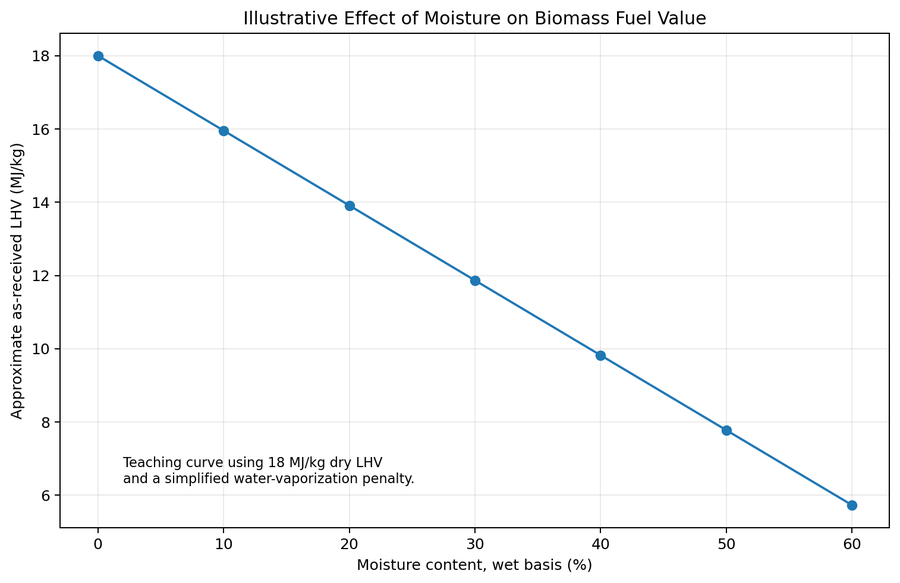
Moisture content is one of the first quantities a biomass engineer should request. A wet tonne of freshly harvested biomass may contain far less dry combustible matter than a tonne of seasoned pellets. Moisture also consumes sensible and latent heat during combustion, lowers flame temperature and can increase the mass of flue gas that must be handled. FAO data illustrate the magnitude of the effect: air-dried wood has substantially more useful energy per kilogram than green wood [9,10].
Wet-basis moisture uses the total as-received mass in the denominator. State the basis explicitly because dry-basis moisture uses a different denominator.
This simple relation is fundamental for converting truck-scale or conveyor-scale wet mass measurements into dry biomass throughput.
Dry-basis values can exceed 100% when water mass exceeds dry-solid mass. Never mix wet-basis and dry-basis data in the same calculation without conversion.
Worked example 1 — Dry biomass in a wet delivery
A plant receives 18.0 t/h of wood chips at 35% moisture on a wet basis. How much dry biomass enters per hour?
- Convert 35% to a wet-basis fraction: Xw = 0.35.
- The dry fraction is 1 − 0.35 = 0.65.
- Multiply the as-received mass flow by the dry fraction.
Answer: 11.7 t/h of dry matter and 6.3 t/h of water enter with the feed.
Worked example 2 — Convert wet-basis moisture to dry basis
A residue contains 40% moisture on a wet basis. Express the same moisture content on a dry basis.
- Use Xdb = Xw/(1 − Xw).
- Substitute Xw = 0.40.
- Convert the fraction to percent if desired.
Answer: 0.667 kg water per kg dry solids, or about 66.7% on a dry basis.
5. Heating value: HHV, LHV and the penalty of water
The higher heating value (HHV) assumes that water in the combustion products is condensed so that its latent heat is recovered. The lower heating value (LHV) assumes water leaves as vapor, so that latent heat is not recovered. Biomass literature may report either quantity and may report it on dry, dry-ash-free or as-received bases. These choices can create large apparent differences if they are not normalized.
A simple teaching approximation for an as-received LHV starts with the dry-fuel LHV and subtracts both the missing dry fuel caused by moisture and the energy needed to vaporize incoming water. The exact result depends on reference temperature, hydrogen content, product state and the chosen calorific-value convention, so rigorous design should use laboratory fuel analysis rather than a shortcut.
The 2.44 MJ/kg term is an approximate latent-heat penalty for incoming liquid water near ambient conditions. Use this only for transparent teaching estimates, not contractual fuel acceptance.
Worked example 3 — Moisture reduces delivered fuel value
Dry wood has an LHV of 18.0 MJ/kg. Estimate the as-received LHV at 30% wet-basis moisture using the simplified relation above.
- Set Xw = 0.30.
- Scale the dry-fuel LHV by the dry fraction 0.70.
- Subtract the approximate water-vaporization penalty.
Answer: approximately 11.9 MJ/kg as received. This simplified estimate illustrates why drying and storage condition matter.
6. From feedstock to energy: the major conversion pathways
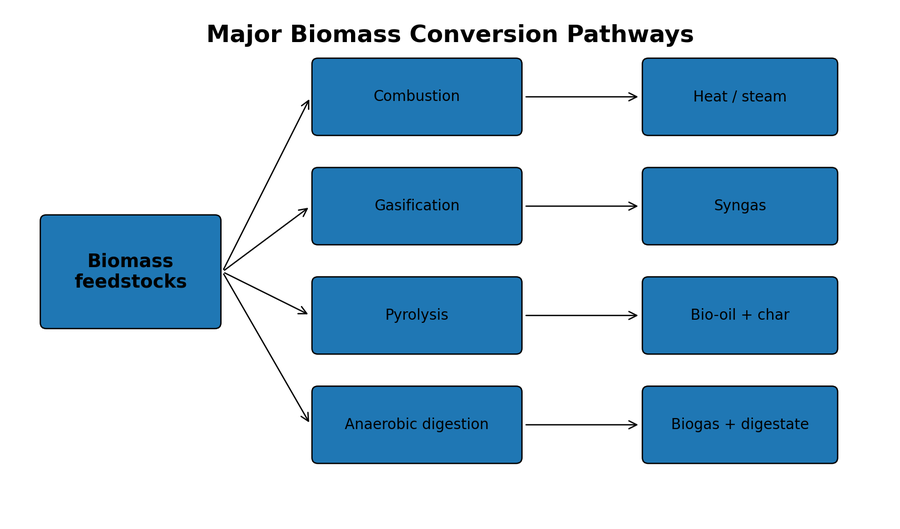
Biomass conversion is commonly divided into thermochemical and biochemical pathways. Thermochemical routes use heat, with or without controlled oxygen, to release or rearrange chemical energy. Biochemical routes use enzymes and microorganisms to transform biodegradable components under milder temperatures [1,3,6–8].
Combustion uses excess oxygen to produce heat. Gasification uses limited oxidant and high temperature to make a combustible synthesis gas containing species such as CO, H₂, CH₄, CO₂ and N₂ depending on the gasifying agent. Pyrolysis heats biomass in the absence of externally supplied oxygen to produce vapors, permanent gases and char. Anaerobic digestion uses microbial communities to decompose wet biodegradable matter without oxygen, producing biogas and digestate.
7. Direct combustion and steam-cycle biopower
Direct combustion remains one of the most established ways to obtain useful energy from dry biomass. A boiler transfers combustion heat to water or another working fluid; steam can then drive a turbine-generator, while lower-temperature heat may serve industrial processes or district heating [3]. Combustion-system performance depends on fuel moisture, particle size, ash chemistry, excess air, furnace residence time, heat-transfer surfaces and emissions controls.
Use consistent units. For example, kg/s multiplied by MJ/kg gives MW because 1 MJ/s = 1 MW.
Here ηth is an overall thermal efficiency defined for the chosen system boundary.
Worked example 4 — Boiler heat output
A biomass boiler burns 2.0 kg/s of fuel at 14 MJ/kg LHV. If 82% of the fuel energy becomes useful process heat, what is the useful thermal output?
- Calculate fuel input: 2.0 kg/s × 14 MJ/kg = 28 MJ/s.
- Recognize that 28 MJ/s = 28 MW.
- Multiply by the 0.82 overall efficiency.
Answer: approximately 23.0 MW of useful heat.
The denominator must use the same heating-value basis throughout the analysis.
Worked example 5 — Biomass power-plant electrical efficiency
A plant receives 45 MW of biomass LHV input and exports 12 MW of net electricity. Estimate net electrical efficiency.
- Use net exported electrical power rather than gross generator output.
- Divide 12 MW by 45 MW.
- Express the result as a percentage.
Answer: approximately 26.7% net electrical efficiency.
8. Combined heat and power: using more of the fuel energy
Combined heat and power (CHP) can improve overall fuel utilization when a real, nearby heat demand exists. A CHP plant may export electricity while also supplying steam, hot water or process heat. The key engineering question is not simply whether heat can be recovered, but whether it can be used at the required temperature, pressure, schedule and location.
This ratio is meaningful only when electricity and useful heat are measured over a consistent time interval and system boundary.
Worked example 6 — CHP overall efficiency
A biomass CHP system receives 30 MW of fuel LHV, exports 7 MW of electricity and delivers 16 MW of useful process heat. What is the overall CHP efficiency?
- Add useful electricity and useful heat: 7 + 16 = 23 MW.
- Divide by the 30 MW fuel input.
- Do not include rejected condenser heat as useful heat.
Answer: approximately 76.7% overall efficiency for the stated boundary.
Worked example 7 — Biomass flow required for a heat duty
A dryer requires 10 MW of useful heat. Biomass LHV is 12.5 MJ/kg and boiler efficiency is 80%. Estimate the required biomass mass flow.
- Rearrange Quseful = η ṁ LHV for ṁ.
- Use 10 MJ/s for the required useful heat.
- Divide by 0.80 × 12.5 MJ/kg.
Answer: 1.00 kg/s, or 3.60 t/h of as-fired biomass at the stated LHV.
9. Gasification: making a combustible gas
Gasification deliberately supplies less oxidant than would be required for complete combustion. The objective is to convert much of the solid fuel into a combustible gas rather than release all chemical energy directly as heat. The gas can contain carbon monoxide, hydrogen, methane, carbon dioxide, nitrogen, water vapor, light hydrocarbons and contaminants such as tars and particulates. Gas cleanup can therefore be as important as the gasifier itself.
Gasification normally uses ER values below 1. Combustion operates at or above the amount needed for complete oxidation, usually with some excess air.
Cold-gas efficiency compares chemical energy in the cleaned product gas with chemical energy entering in biomass and excludes sensible heat unless a broader efficiency definition is used.
Worked example 8 — Cold-gas efficiency
A gasifier receives biomass at 5.0 MW LHV input and produces cleaned syngas carrying 3.4 MW of chemical energy. Estimate cold-gas efficiency.
- Use product-gas chemical energy in the numerator.
- Use biomass LHV input in the denominator.
- Express the ratio as a percentage.
Answer: 68% cold-gas efficiency for the stated measurement boundary.
10. Pyrolysis: bio-oil, gas and char
Pyrolysis heats biomass without externally supplied oxygen. Product distribution depends strongly on temperature, heating rate, vapor residence time, feed particle size and reactor design. Fast pyrolysis is commonly discussed when the objective is a relatively high liquid yield, whereas slower conditions can favor char. The liquid product is chemically different from petroleum crude and typically contains substantial oxygenated compounds and water, so upgrading may be required before many fuel applications.
Char can contain a significant fraction of the original biomass carbon and mineral matter. Depending on feedstock quality and processing, char may be used as a fuel, process intermediate or soil-related product. Claims about long-term carbon storage require careful attention to char stability, application conditions and life-cycle boundaries rather than assuming that every char product is equivalent.
11. Anaerobic digestion and biogas
Anaerobic digestion is particularly important for wet organic materials. Microbial communities break down biodegradable matter in the absence of oxygen, producing biogas and digestate [7,8]. Biogas is mainly methane and carbon dioxide, with water vapor and trace contaminants. The methane fraction carries most of the fuel value. Digestate retains water, minerals and nutrients and must be managed as a material stream rather than treated as disappearing waste.
Here yCH4 is the methane volume fraction. A representative methane LHV near standard reference conditions is about 35.8 MJ/m³; use the value and reference conditions required by the project.
Volatile solids (VS) are commonly used to normalize methane yield for digestible organic matter. Laboratory biochemical methane potential and full-scale digester yield are not necessarily identical.
Worked example 9 — Energy in biogas methane
A digester produces 1,500 m³/day of biogas containing 62% methane by volume. Estimate methane chemical energy using 35.8 MJ/m³ LHV.
- Calculate methane volume: 1,500 × 0.62 = 930 m³/day.
- Multiply methane volume by 35.8 MJ/m³.
- Convert MJ/day to MWh/day using 3.6 GJ/MWh.
Answer: about 33.3 GJ/day, or 9.25 MWh/day of methane chemical energy before conversion losses.
12. Densification, bulk density and transport
Loose biomass often has low bulk density and irregular particle shape. Chipping, grinding, baling, briquetting and pelletizing can improve handling, feeding consistency and transport economics, but these operations consume energy and add capital and maintenance requirements. A high-quality energy balance therefore includes preprocessing rather than treating fuel preparation as free.
Bulk density ρbulk in kg/m³ multiplied by LHV in MJ/kg gives volumetric energy density in MJ/m³.
Worked example 10 — Volumetric energy density
Wood chips have a bulk density of 240 kg/m³ and an as-received LHV of 11.5 MJ/kg. Estimate their volumetric chemical-energy density.
- Multiply bulk density by LHV.
- Keep the result in MJ/m³.
- Convert to GJ/m³ if desired.
Answer: approximately 2.76 GJ/m³.
13. Annual supply, capacity factor and resource constraint
Biomass systems differ from wind and solar in one crucial planning respect: the plant can often be dispatched when fuel is available, but operation is constrained by a physical supply chain. Annual energy output therefore depends on feedstock quantity, seasonal availability, storage losses, plant outages and competing uses. Resource assessments such as DOE's Billion-Ton work are useful for regional planning, but they are not a substitute for a project-specific procurement study [4].
This simple relation should be adjusted when the actual procurement contract is based on as-received mass and moisture varies throughout the year.
Worked example 11 — Annual electricity from a residue supply
A facility has access to 40,000 dry tonnes/year of residue at 17 MJ/kg dry-basis LHV. If net electrical conversion efficiency is 24%, estimate annual net electricity generation.
- Convert 40,000 t to 40,000,000 kg.
- Multiply by 17 MJ/kg to obtain annual fuel energy.
- Multiply by 0.24 and convert MJ to MWh using 3,600 MJ/MWh.
Answer: approximately 45.3 GWh/year, before considering additional curtailment or feedstock shortfall.
14. The carbon question: biomass is not automatically carbon neutral
It is tempting to describe biomass combustion as carbon neutral because plants absorbed carbon dioxide while growing. That statement is incomplete. A credible climate assessment must consider what biomass would otherwise have happened to, whether land carbon stocks change, how quickly regrowth occurs, how harvesting affects future carbon uptake, and what emissions arise from cultivation, collection, drying, processing, transport and conversion [11,12].
Waste and residue pathways can have very different climate implications from harvesting additional stemwood or converting land to energy crops. Time scale also matters: a pulse of combustion CO₂ occurs immediately, whereas re-sequestration may occur over years or decades. For this reason, modern bioenergy analysis uses life-cycle and counterfactual thinking rather than assigning a universal zero-emission factor to every biomass fuel.
15. Sustainability beyond carbon
Sustainable biomass management also involves soil nutrients, erosion, biodiversity, water use, air pollution, land competition, food and feed markets, local livelihoods and waste-management consequences. The correct engineering question is therefore not merely 'Is this biomass renewable?' but 'What resource is being used, under what management practice, for which product, compared with what alternative, and over what time horizon?'
Combustion plants also require conventional air-pollution engineering. Depending on fuel and technology, relevant pollutants can include particulate matter, nitrogen oxides, carbon monoxide, acid gases, volatile organic compounds and trace metals. Ash may contain useful minerals but may also require controlled handling. Regulatory requirements are jurisdiction-specific and must be addressed in real project design.
16. A practical biomass engineering workflow
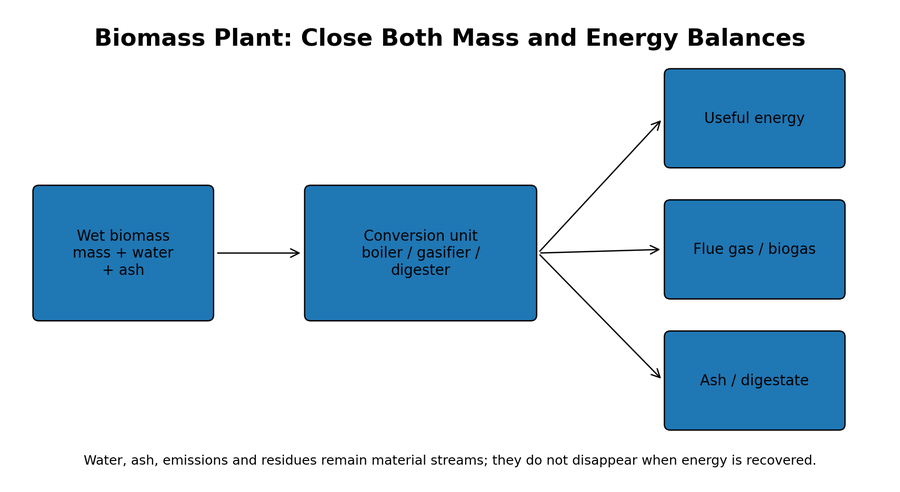
A disciplined preliminary assessment can be organized into six steps: (1) characterize feedstock quantity and seasonality; (2) measure moisture, ash and heating value; (3) choose a conversion family compatible with the feedstock; (4) close mass and energy balances; (5) quantify emissions, residues, utilities and logistics; and (6) evaluate economics and sustainability against a realistic counterfactual.
For a dry-fuel combustion project, the first calculation may be as simple as converting wet tonnes to dry tonnes and multiplying by LHV. For an anaerobic digestion project, volatile-solids loading, methane yield, hydraulic retention time and digestate management become central. For gasification and pyrolysis, product-gas cleanup, tar management, heat integration and product upgrading often dominate feasibility. A technology label alone is never enough.
17. Summary: what to remember
Biomass is a versatile renewable-carbon resource, but it is also a variable process feedstock. Its useful energy depends on dry-matter content, chemical composition and the conversion route. Moisture can dominate fuel quality; combustion and CHP are mature heat-and-power routes; gasification and pyrolysis create intermediate gases, liquids and solids; and anaerobic digestion is well suited to many wet biodegradable streams. Most importantly, biomass sustainability must be evaluated with explicit system boundaries rather than assumed from the word 'renewable'.
The engineering foundation is straightforward: define the feed basis, close the mass balance, use a consistent heating-value basis, state the efficiency boundary, and account for every important output stream. These habits make later topics—combustion stoichiometry, gasifier design, biogas kinetics, biofuel upgrading, emissions control and life-cycle assessment—much easier to analyze rigorously.
Practice questions
A truck delivers 25 t of biomass at 32% wet-basis moisture. What dry mass is delivered?
Reveal worked answer
25(1 − 0.32) = 17.0 t dry matter.
Why can two biomass fuels with the same dry heating value have very different as-received heating values?
Reveal worked answer
Different moisture contents change both the amount of dry combustible matter per kilogram delivered and the energy required to heat and vaporize water.
What is the main difference between combustion and gasification?
Reveal worked answer
Combustion supplies enough oxidant for near-complete oxidation and primarily releases heat; gasification uses sub-stoichiometric oxidant to produce a combustible gas.
What are the three broad product families from pyrolysis?
Reveal worked answer
Condensable vapors or bio-oil, permanent gases and solid char.
Why is anaerobic digestion often attractive for wet wastes?
Reveal worked answer
It processes biodegradable material without first evaporating most of its water and produces methane-rich biogas plus digestate.
A boiler receives 15 MW of biomass LHV and delivers 11 MW of useful heat. What is its thermal efficiency?
Reveal worked answer
11/15 = 0.733, or about 73.3%.
Why should HHV and LHV never be mixed casually in one efficiency calculation?
Reveal worked answer
They use different assumptions about recovery of water-vapor latent heat; mixing bases can create an artificial efficiency error.
What does a gasifier equivalence ratio below 1 indicate?
Reveal worked answer
Less oxidant is supplied than the stoichiometric amount required for complete combustion.
What two main products leave an anaerobic digester?
Reveal worked answer
Biogas and digestate.
Why is bulk density important in biomass logistics?
Reveal worked answer
It controls how much mass and chemical energy fit into a given truck, silo or conveyor volume.
Why is 'biomass is carbon neutral' an incomplete statement?
Reveal worked answer
Climate impact depends on feedstock origin, land-carbon changes, regrowth, time scale, processing, transport, conversion and the counterfactual use of the biomass.
Name four measurements you would request before evaluating a solid biomass boiler feedstock.
Reveal worked answer
Examples include moisture content, ash content, heating value, particle-size distribution, elemental composition, bulk density and contaminant content.
References and further reading
1. U.S. Department of Energy — Bioenergy Basics
Read the source
2. U.S. Department of Energy — Biomass: An Energy Resource
Read the source
3. U.S. Department of Energy — Biopower
Read the source
4. U.S. Department of Energy — 2023 Billion-Ton Report
Read the source
5. National Renewable Energy Laboratory — Biomass Energy Basics
Read the source
6. National Renewable Energy Laboratory — Biofuels Basics
Read the source
7. U.S. EPA — Basic Information about Anaerobic Digestion
Read the source
8. U.S. EPA — How Does Anaerobic Digestion Work?
Read the source
9. FAO — Wood Energy
Read the source
10. FAO — Wood Energy: In More Depth
Read the source
11. IEA Bioenergy — Carbon Neutrality FAQ
Read the source
12. IPCC AR6 WGIII Chapter 6 — Energy Systems
Read the source
Technical discussions describe general principles; site-specific engineering decisions require appropriate professional evaluation.