
RENEWIOSITY / EXPLAINER
How Is Biomass Converted into Energy? Combustion, Gasification, Pyrolysis and Anaerobic Digestion
A university-level guide to biomass conversion technologies, feedstock preparation, combustion, gasification, pyrolysis, anaerobic digestion, process efficiency, cleanup, mass and energy balances, route selection and worked SI-unit calculations.
Learning objectives
- Classify biomass conversion routes as combustion, gasification, pyrolysis, anaerobic digestion, or hybrid pathways and explain the engineering objective of each.
- Relate feedstock moisture, ash, particle size, biodegradability and composition to conversion-route selection and preprocessing needs.
- Write and use practical energy-balance expressions for biomass boilers, gasifiers, pyrolysis systems and biogas plants.
- Distinguish thermal efficiency, cold-gas efficiency, product yield and overall energy recovery without mixing incompatible definitions.
- Perform SI-unit calculations for fuel flow, drying duty, syngas energy, pyrolysis product yields and methane energy recovery.
- Explain why flue-gas cleanup, syngas conditioning and biogas cleanup are integral parts of conversion rather than optional afterthoughts.
- Identify major operating variables and limitations for thermochemical and biochemical biomass conversion.
- Evaluate conversion choices using feedstock quality, desired products, scale, emissions, logistics and lifecycle context.
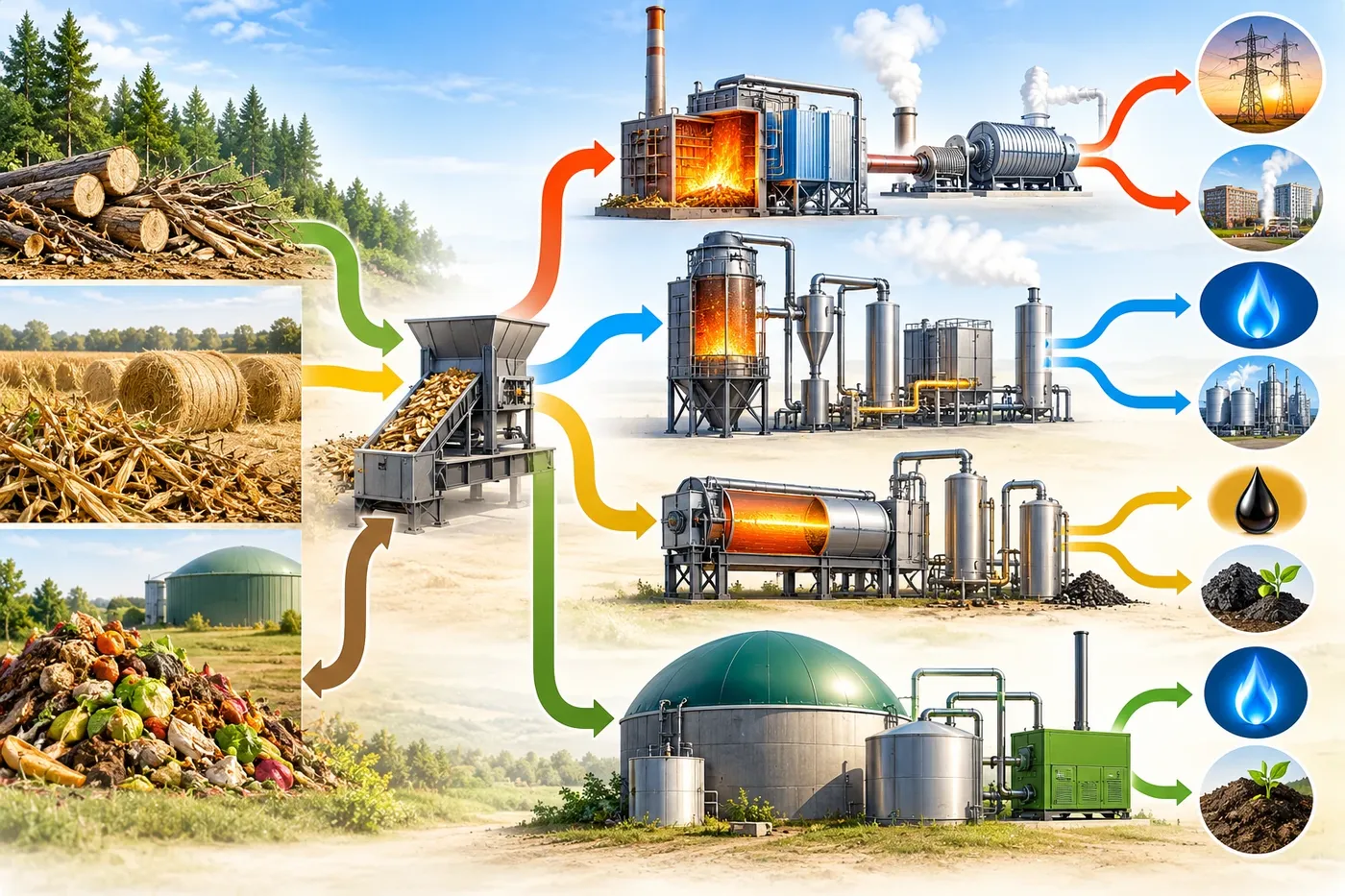
Biomass becomes useful energy only after a conversion process changes the form in which its chemical energy is stored. The most important routes span direct combustion, gasification, pyrolysis and anaerobic digestion. These routes can produce heat, electricity, synthesis gas, bio-oil, biochar, biogas and other intermediates. The engineering challenge is not to ask which process is universally best, but which process best matches a particular feedstock, product target, scale and environmental constraint [1–4].
This lesson follows What Is Biomass Energy?. It focuses on conversion rather than resource definitions, and it uses mass and energy balances to connect process descriptions to chemical-engineering reasoning. Numerical examples are educational illustrations; real plants require measured feedstock properties, equipment performance data, emissions limits and site-specific design.
1. Biomass conversion is fundamentally a matching problem
A dry wood chip, a wet food-waste slurry and a high-ash agricultural residue are all biomass, but they do not behave like interchangeable fuels. Dry fibrous materials are often compatible with thermochemical routes after size reduction and moisture management. Wet, readily biodegradable streams can favor anaerobic digestion because evaporating large quantities of water before thermal processing can consume substantial energy. Feedstock preprocessing therefore sits at the boundary between supply logistics and reactor performance [3,5].
The desired product matters just as strongly. A district-heating system may value hot water or steam directly. A fuel-synthesis plant may instead value clean syngas with a controlled hydrogen-to-carbon-monoxide ratio. A pyrolysis operation may target condensable liquids and char, whereas an anaerobic digestion project may target methane-rich biogas together with nutrient-bearing digestate.
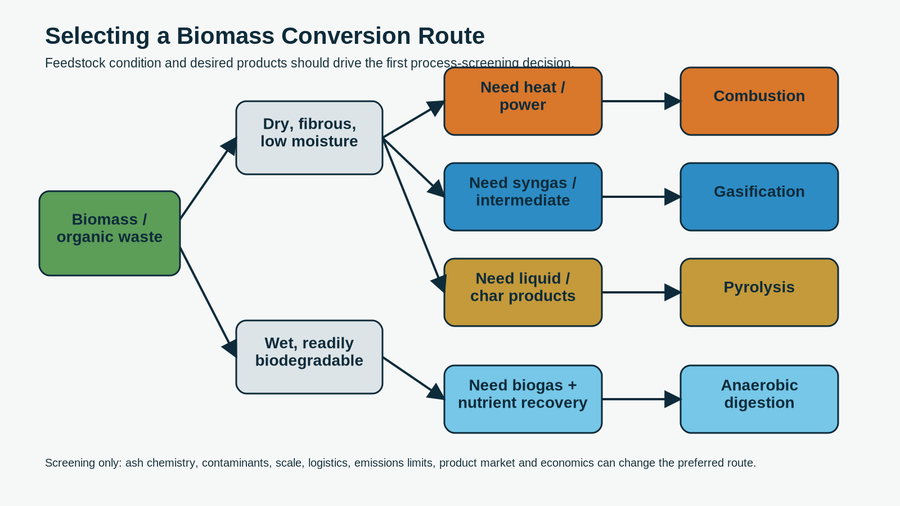
Figure 1. A first-pass biomass conversion route-selection framework.
2. Feedstock properties and preprocessing
Feedstock variability is one of the defining practical problems in biomass conversion. Moisture changes the amount of energy that must be spent heating and evaporating water. Ash can cause slagging, fouling or catalyst contamination. Particle size and bulk density influence feeding, mixing and heat transfer. Chlorine, sulfur, alkali metals and other contaminants can affect corrosion, emissions and cleanup requirements. DOE research explicitly treats the feedstock-conversion interface as a scale-up risk that must be measured and managed [5,6].
Common preprocessing operations include screening, drying, grinding, chipping, densification, blending, dewatering and contaminant removal. Their purpose is not cosmetic uniformity. They change the mass flow, energy demand, flowability and reactor behavior of the material entering the conversion step.
For a first estimate, m_w is the mass of water removed, c_{p,w} is the heat capacity of liquid water, T_b is the boiling or evaporation reference temperature, and h_{fg} is the latent heat of vaporization. Real dryers also have heat losses and may evaporate water below 100 °C depending on humidity and pressure.
Worked example 1: why moisture can dominate preprocessing
A feed stream contains 1000 kg/h of wet biomass at 40% moisture by mass. It is dried to 15% moisture before a thermochemical reactor. Estimate the water evaporated. Ignore dry-solids loss.
- Initial dry solids = 1000(1 − 0.40) = 600 kg/h.
- At 15% final moisture, dry solids are 85% of the final wet mass.
- Final wet mass = 600/0.85 = 705.9 kg/h.
- Final water = 705.9 − 600 = 105.9 kg/h.
- Water removed = 400 − 105.9 = 294.1 kg/h.
Answer: About 294 kg/h of water must be removed before the reactor.
3. Thermochemical and biochemical routes
Thermochemical routes use heat, with the amount of oxidant and residence time helping determine whether the dominant useful product is heat, a combustible gas, liquid vapors or char. Combustion deliberately supplies enough oxidant for extensive oxidation and heat release. Gasification uses a restricted oxidant or gasifying agent to produce syngas. Pyrolysis supplies heat without externally supplied oxygen and distributes products among vapors, gases and char [2,4,7].
Biochemical routes use microorganisms or enzymes under much milder temperatures. Anaerobic digestion is particularly important for wet organic wastes: microbial communities decompose biodegradable material without oxygen, generating biogas and digestate [8,9]. Fermentation and other biochemical pathways are also important in biofuel production, but this article concentrates on anaerobic digestion because it is a major energy route for wet wastes.
4. Combustion: converting chemical energy directly to heat
Direct combustion is the most straightforward thermochemical route. Prepared biomass is burned with excess oxidant, releasing heat that can be used directly or transferred to water or steam. In power generation, steam can expand through a turbine-generator. In industrial plants and district-energy systems, combined heat and power can improve overall fuel utilization because useful thermal energy is recovered instead of rejected [2].
A combustion system is more than a furnace. Fuel receiving and feeding, air distribution, combustion control, boiler heat transfer, ash handling and flue-gas cleanup all influence performance. Moisture and ash can reduce useful output or create operating problems even when the fuel has adequate chemical energy.
The denominator is the chemical-energy input rate based on fuel mass flow and lower heating value. The numerator must use the same time basis. State whether LHV is reported on a dry basis or as-received basis.
Worked example 2: biomass flow for useful boiler heat
A process requires 8.0 MW of useful heat. Biomass has an as-received LHV of 12.5 MJ/kg and the boiler delivers 82% thermal efficiency. Estimate the required fuel mass flow.
- Fuel-energy input = 8.0 MW / 0.82 = 9.756 MW.
- Because 1 MJ/s = 1 MW, divide 9.756 MJ/s by 12.5 MJ/kg.
- Fuel flow = 0.7805 kg/s.
- Convert to hourly flow: 0.7805 × 3600 = 2810 kg/h.
Answer: Approximately 0.781 kg/s, or 2.81 t/h, of as-received biomass.
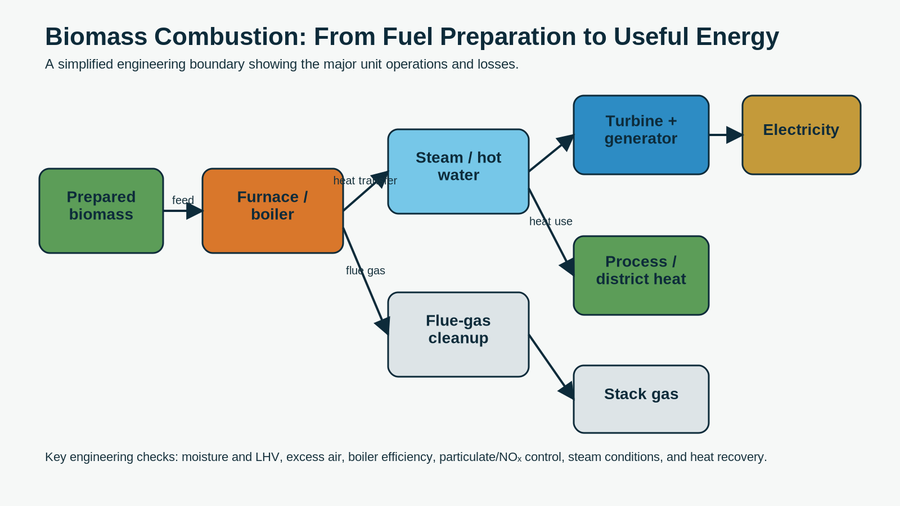
Figure 2. A simplified biomass combustion and CHP train.
5. Gasification: producing a combustible gas intermediate
Gasification converts solid carbonaceous feedstocks into a gas mixture by heating them with a controlled amount of air, oxygen and/or steam. The product gas typically contains carbon monoxide and hydrogen along with carbon dioxide, methane, water vapor, nitrogen when air is used, and contaminants such as tars, particulates, ammonia, sulfur species and alkali compounds. Gas composition depends on feedstock properties, gasifying agent, gasifier type, temperature and pressure [4].
The engineering value of gasification is that the energy in a heterogeneous solid is transferred into a gaseous intermediate that can be burned, cleaned and conditioned, or used as a synthesis feed. That flexibility comes at the cost of additional unit operations. DOE and NREL descriptions emphasize solids removal, tar reforming or cracking, gas cleanup, conditioning and downstream synthesis or power conversion as integral parts of the process [4,7].
ER is less than 1 in gasification because the oxidant supplied is below the amount required for complete combustion. Exact operating ranges depend on the reactor and gasifying agent; ER is a useful organizing parameter rather than a universal design constant.
Cold-gas efficiency compares the chemical-energy rate in cleaned product gas with the chemical-energy rate in the biomass feed. It intentionally excludes sensible heat unless a different definition is stated.
Worked example 3: cold-gas efficiency
A gasifier processes 0.50 kg/s of biomass at 16 MJ/kg LHV. Clean product gas leaves at 1.40 kg/s with an LHV of 4.2 MJ/kg. Calculate cold-gas efficiency.
- Biomass chemical-energy input = 0.50 × 16 = 8.0 MW.
- Product-gas chemical-energy rate = 1.40 × 4.2 = 5.88 MW.
- Cold-gas efficiency = 5.88/8.0 = 0.735.
Answer: The cold-gas efficiency is 73.5% under the stated boundary definition.
6. Pyrolysis: distributing biomass among vapors, liquids, gas and char
Pyrolysis heats biomass in the absence of externally supplied oxygen. Product distribution depends on temperature, heating rate, residence time, feedstock and reactor design. Fast-pyrolysis research systems commonly emphasize rapid heating and short vapor residence times to increase condensable liquid production, while other conditions can shift yield toward char or permanent gases [4,7].
Raw pyrolysis liquids are not automatically equivalent to petroleum fuels. They can contain substantial oxygenated compounds and water, may be acidic or unstable, and often require solids removal, stabilization and upgrading before demanding fuel applications. Char may be used as a fuel or as a carbon-rich product, but environmental claims depend on feedstock, processing, application and lifecycle boundaries.
When yields are expressed on the same feed basis and all products are captured, their mass fractions should close approximately to unity. Water and condensable organics must be defined consistently when reporting liquid yield.
Worked example 4: pyrolysis product mass balance
A dry biomass feed is 1200 kg/h. Measured product yields are 62% liquid, 20% char and 14% permanent gas on the same dry-feed basis. Estimate the unaccounted fraction and the corresponding mass flow.
- Measured yield sum = 0.62 + 0.20 + 0.14 = 0.96.
- Unaccounted fraction = 1 − 0.96 = 0.04.
- Unaccounted mass = 0.04 × 1200 = 48 kg/h.
- The missing 4% may represent measurement error, unrecovered condensables, fines or basis inconsistencies and should be investigated.
Answer: The balance has a 4% closure gap, equal to 48 kg/h.
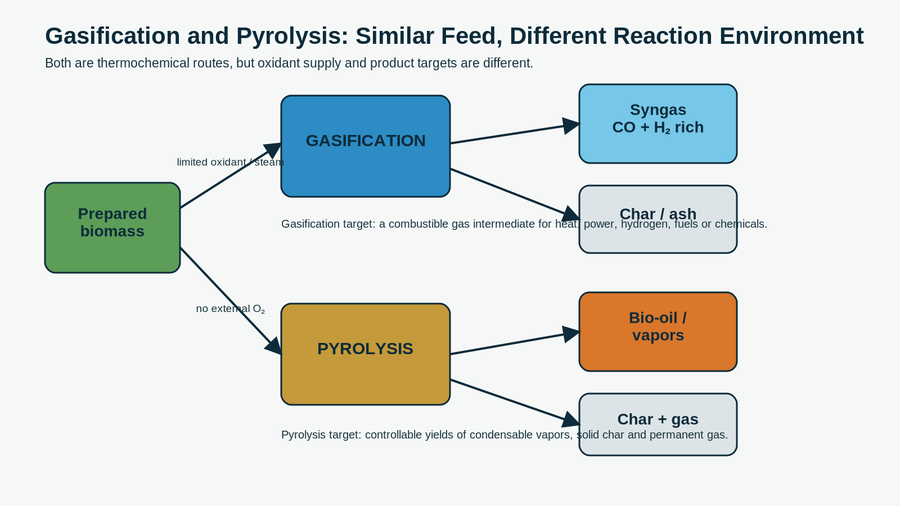
Figure 3. Gasification and pyrolysis use different reaction environments and product targets.
7. Anaerobic digestion: a biochemical route for wet feedstocks
Anaerobic digestion uses microbial communities to break down organic material in oxygen-free reactors. Common feedstocks include manure, food waste, wastewater solids, fats, oils and greases, and other biodegradable residues. The two principal product streams are biogas and digestate [8,9].
Raw biogas is mainly methane and carbon dioxide, with smaller quantities of water vapor and trace contaminants. Depending on the end use, gas cleanup can remove moisture, hydrogen sulfide and other contaminants. Further upgrading can remove carbon dioxide to produce a methane-rich gas suitable for higher-value fuel applications or pipeline specifications where applicable [8].
Anaerobic digestion performance depends on biological as well as transport and mixing conditions. Temperature, pH and alkalinity, organic loading rate, hydraulic retention time, solids retention, nutrient balance, inhibitors and feed variability all matter. A digester should therefore be treated as a biochemical reactor system, not simply a covered storage tank.
Use a methane heating value and volumetric basis consistent with the stated standard conditions. For illustration, approximately 35.8 MJ per normal cubic metre can be used for methane LHV when the normal-volume convention is explicitly stated.
Worked example 5: energy in digester methane
A digester produces 500 Nm³/h of raw biogas containing 62% methane by volume. Estimate the methane chemical-energy rate using 35.8 MJ/Nm³ for methane LHV.
- Methane flow = 500 × 0.62 = 310 Nm³/h.
- Energy = 310 × 35.8 = 11,098 MJ/h.
- Convert to MW: 11,098/3600 = 3.083 MW.
Answer: The methane contains approximately 3.08 MW of chemical energy before conversion losses.
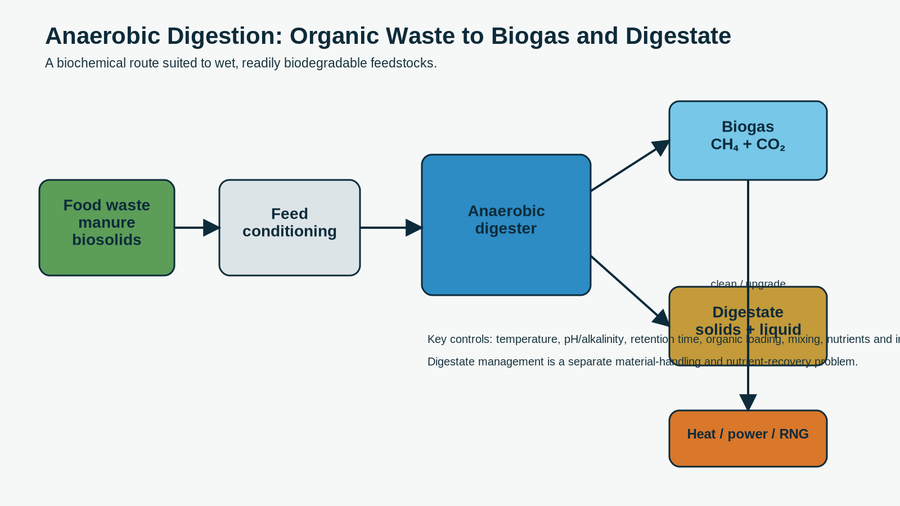
Figure 4. Anaerobic digestion converts wet biodegradable feedstocks into biogas and digestate.
8. How engineers select among conversion routes
Route selection begins with the feedstock but should not end there. Dryness, volatile matter, ash fusion behavior, elemental composition, biodegradability, contaminants, seasonal variability, particle size and logistics all affect design. The desired product then narrows the choice: direct heat favors combustion, synthesis intermediates favor gasification, liquid and char products can favor pyrolysis, and methane plus nutrient recovery can favor digestion.
Scale and integration also matter. A plant with a continuous steam demand may value a combustion CHP system differently from a facility seeking renewable gas. A remote residue source may be constrained more by transport density than by reactor efficiency. A food-processing facility with a wet waste stream may benefit from digestion because dewatering and drying that material for a thermal route would impose a significant energy penalty.
9. Energy balances, efficiencies and the danger of mixing definitions
Biomass conversion performance cannot be summarized by one universal efficiency. Boiler thermal efficiency, electrical efficiency, CHP total efficiency, cold-gas efficiency, carbon conversion, liquid yield, methane yield and overall exergy efficiency answer different questions. Always define the control volume and denominator before comparing numbers.
This general steady-flow balance becomes useful when sensible enthalpy, steam, hot gases and shaft work matter. Chemical energy is usually represented through formation enthalpies or heating-value conventions, but those conventions must be applied consistently.
A system-level metric may credit multiple useful products, but it must also include imported electricity, supplemental fuel or other external energy when material to the boundary.
Worked example 6: CHP utilization
A biomass CHP plant receives 20 MW of biomass LHV. It exports 5.2 MW of electricity and 8.6 MW of useful process heat. Calculate electrical efficiency and total useful-energy efficiency.
- Electrical efficiency = 5.2/20 = 0.260.
- Useful heat fraction = 8.6/20 = 0.430.
- Total useful-energy efficiency = (5.2 + 8.6)/20 = 0.690.
- The 69% figure should not be compared directly with electricity-only efficiency because it credits a second useful product.
Answer: Electrical efficiency is 26.0%; total useful-energy efficiency is 69.0%.
10. Cleanup and emissions control are part of the conversion process
Combustion systems must manage particulates, nitrogen oxides, carbon monoxide and other regulated or site-relevant pollutants, with equipment selected for fuel and jurisdiction. Gasification produces a syngas that may contain tars, particulates, ammonia, sulfur compounds and alkali species; downstream engines, turbines, catalysts or synthesis units can require much cleaner gas than the gasifier itself produces [4,7].
Pyrolysis liquids require solids control and often chemical upgrading for demanding fuel uses [4]. Anaerobic digestion systems may require removal of moisture, hydrogen sulfide and other trace species from biogas before sensitive equipment or fuel-quality applications [8]. The useful conversion product is therefore not necessarily the raw reactor outlet.
11. Product quality and mass balance closure
A robust biomass process model accounts for every major inlet and outlet. For thermochemical routes, this includes dry organic matter, moisture, ash, oxidant or steam, char, condensables, product gas and losses. For anaerobic digestion, it includes feed water, volatile solids, fixed solids, gas, digestate and sometimes recovered nutrients. Missing mass is a diagnostic signal, not merely a bookkeeping inconvenience.
At steady state the accumulation term approaches zero. Batch and semi-batch digesters or startup/shutdown periods require explicit accumulation.
12. Sustainability depends on more than reactor efficiency
A high reactor efficiency does not by itself establish a low lifecycle climate impact. Bioenergy outcomes depend on feedstock origin, land-use effects, regrowth and time scale, harvesting and processing, transport, conversion efficiency, coproduct treatment and the counterfactual use of the biomass. IPCC assessments therefore emphasize that bioenergy carbon outcomes are context-dependent rather than automatically carbon-neutral [10,11].
Waste and residue pathways can have very different system consequences from purpose-grown energy crops, and nutrient recovery from digestion can create additional benefits or trade-offs. Good engineering analysis keeps the reactor boundary clear while also showing where wider lifecycle assumptions enter the decision.
13. A compact engineering comparison
Combustion: usually the most direct route to heat and steam; mature equipment; sensitive to fuel moisture, ash and emissions control. Gasification: creates a flexible syngas intermediate but adds gas cleanup and conditioning. Pyrolysis: creates liquid, char and gas fractions; product upgrading and stability can be important. Anaerobic digestion: is well matched to wet biodegradable feedstocks and can recover both energy and nutrients, but requires biological process control and gas cleanup.
Hybrid systems are also possible. Pyrolysis char may supply process heat; syngas may be burned in a CHP unit; digesters may use recovered heat to maintain reactor temperature; and preprocessing can be shared across pathways. Modern bioenergy engineering is therefore better viewed as systems integration than as four isolated technologies.
14. Key takeaways
First: start with feedstock properties and product needs, not with a favorite reactor. Second: define mass, energy and efficiency boundaries explicitly. Third: treat preprocessing and cleanup as part of the process. Fourth: wet feedstocks can make drying energy decisive, while dry lignocellulosic materials are often better suited to thermochemical conversion. Fifth: lifecycle performance must be evaluated separately from reactor efficiency.
15. Practice questions
Why can a wet food-waste stream be a poor candidate for direct combustion even if its dry solids have a useful heating value?
Reveal worked answer
A large fraction of the released heat may be consumed heating and evaporating water, lowering flame temperature and useful efficiency. Dewatering or a wet-route process such as anaerobic digestion may be more appropriate.
What is the main distinction between combustion and gasification in terms of oxidant supply?
Reveal worked answer
Combustion supplies enough oxidant for extensive oxidation and heat release, while gasification deliberately limits oxidant or uses steam/oxygen conditions that preserve substantial chemical energy in product gas.
Why is syngas cleanup often essential before catalytic fuel synthesis?
Reveal worked answer
Raw syngas can contain tars, particulates, sulfur species, ammonia, alkalis and other contaminants that poison catalysts, foul equipment or prevent the required gas composition.
A biomass boiler receives 15 MW of fuel LHV and delivers 11.4 MW of useful heat. What is thermal efficiency?
Reveal worked answer
η = 11.4/15 = 0.76 or 76%.
Why is pyrolysis described as occurring without externally supplied oxygen rather than simply “at low oxygen”?
Reveal worked answer
The defining thermal-decomposition environment excludes deliberate oxidant feed; if substantial oxidant is added and partial oxidation becomes central, the process moves toward gasification or combustion behavior.
A fast-pyrolysis mass balance closes to 93%. What should an engineer do before accepting the yield data?
Reveal worked answer
Investigate unrecovered condensables, gas measurement, solids losses, moisture-basis inconsistencies and sampling or analytical error. A closure gap is evidence that the data boundary is incomplete or uncertain.
What two principal material products leave an anaerobic digester?
Reveal worked answer
Biogas and digestate. Biogas is rich in methane and carbon dioxide; digestate contains water, residual solids, nutrients and stabilized organic matter.
Why can total CHP efficiency be much higher than electrical efficiency?
Reveal worked answer
CHP credits useful thermal energy as well as electricity. Electricity-only efficiency counts only electrical output, so the metrics have different numerators and should not be compared without defining the boundary.
What does cold-gas efficiency measure in a biomass gasifier?
Reveal worked answer
It compares the chemical-energy rate in product gas with the chemical-energy rate in the biomass feed, typically using heating values and excluding sensible heat unless otherwise defined.
Name four feedstock measurements you would request before selecting a thermochemical route.
Reveal worked answer
Examples include moisture content, ash content and composition, heating value, particle size, bulk density, elemental composition, chlorine/sulfur content and contaminant levels.
Why does a technically efficient biomass conversion process not automatically have low lifecycle greenhouse-gas emissions?
Reveal worked answer
Lifecycle outcomes also depend on feedstock origin, land-use change, regrowth and time scale, transport, preprocessing, external energy, coproducts and the counterfactual use of the biomass.
A digester produces 300 Nm³/h of biogas at 60% methane. What methane flow does this correspond to?
Reveal worked answer
Methane flow = 300 × 0.60 = 180 Nm³/h.
16. References and further reading
1. U.S. Department of Energy — Bioenergy Basics Read the source
2. U.S. Department of Energy — Biopower: Energy for Heat and Electricity Read the source
3. U.S. Department of Energy — Conversion Technologies Read the source
4. U.S. Department of Energy — Thermochemical Conversion Processes Read the source
5. U.S. Department of Energy — Feedstock Technologies Read the source
6. U.S. Department of Energy — Feedstock-Conversion Interface Consortium Read the source
7. National Renewable Energy Laboratory — Thermal and Catalytic Process Development Unit Read the source
8. U.S. EPA — Basic Information about Anaerobic Digestion Read the source
9. U.S. EPA — How Does Anaerobic Digestion Work? Read the source
10. IPCC AR6 WGIII — Chapter 6: Energy Systems Read the source
11. IPCC AR6 WGIII — Chapter 7: Agriculture, Forestry and Other Land Uses Read the source
12. FAO — Wood Energy, Sustainable Forest Management Toolbox Read the source
Technical discussions describe general principles; site-specific engineering decisions require appropriate professional evaluation.