
RENEWIOSITY / EXPLAINER
What Is Geothermal Energy? How Earth’s Heat Becomes Useful Power and Heating
A university-level introduction to geothermal energy, Earth heat, geothermal gradients, hydrothermal reservoirs, direct use, heat pumps, enhanced geothermal systems and introductory SI-unit calculations.
Learning objectives
- Explain where Earth’s internal heat comes from and distinguish geothermal heat from shallow seasonal ground-temperature effects.
- Use geothermal gradient and conductive heat-flow concepts to estimate subsurface temperature and heat flux in simple engineering problems.
- Identify the heat, fluid and permeability requirements of a conventional hydrothermal resource and explain why reinjection is commonly used.
- Distinguish geothermal electricity generation, direct use, geothermal heat pumps and enhanced geothermal systems by resource depth and engineering function.
- Estimate the thermal power carried by a geothermal fluid from mass flow, heat capacity and temperature change.
- Explain why geothermal electricity conversion efficiency can be modest while the resource remains valuable for firm power and direct heat.
- Interpret heat-pump coefficient of performance without confusing it with a thermodynamic power-plant efficiency.
- Recognize major sustainability, scaling, corrosion, induced-seismicity and resource-management considerations in geothermal projects.
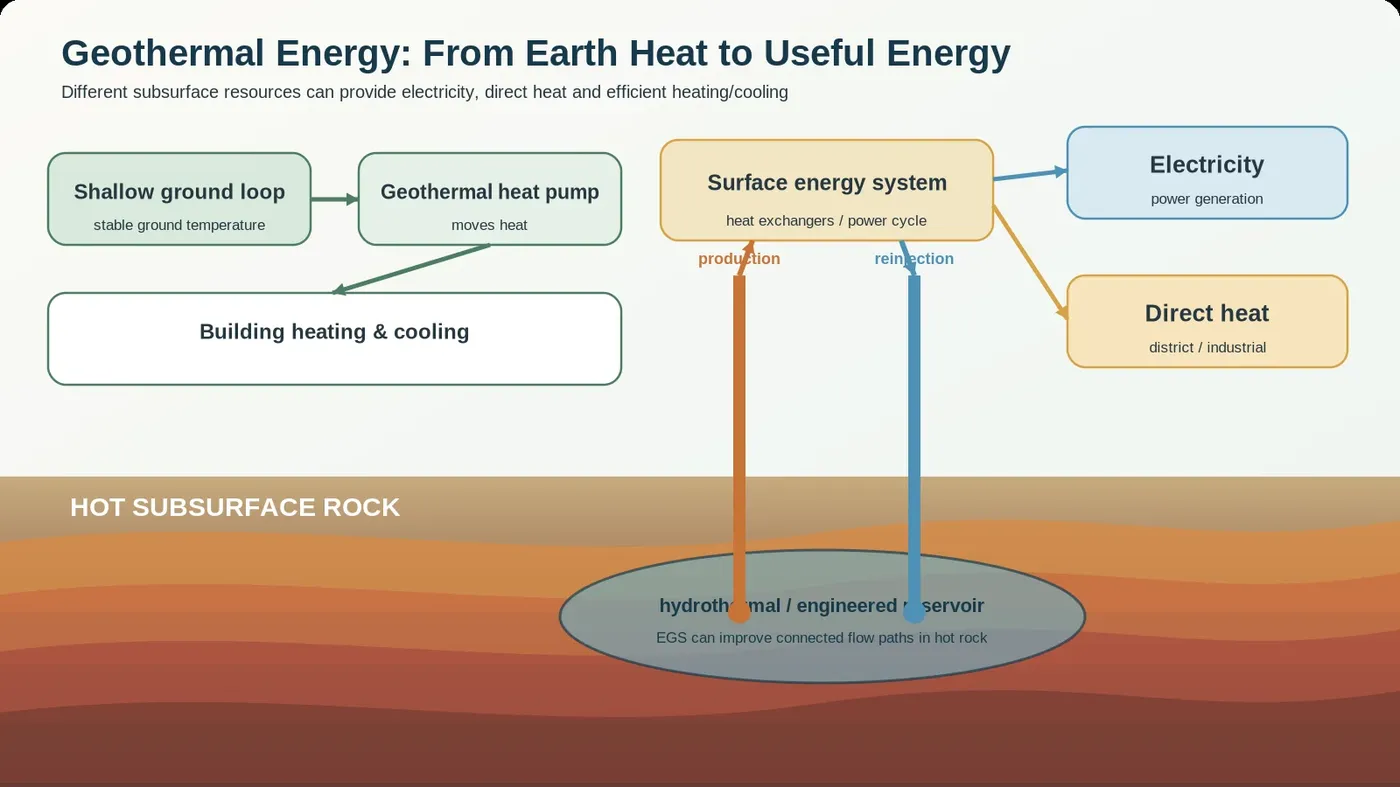
Geothermal energy is energy derived from heat in the Earth and from the comparatively stable thermal environment of the shallow subsurface. Depending on resource temperature, depth and geology, that heat can be used to generate electricity, provide district or industrial heat, or improve the efficiency of building heating and cooling through geothermal heat pumps. [1–4]
For engineers, geothermal is not a single technology. It is a family of subsurface and surface systems linked by heat transfer, fluid flow, geology, thermodynamics and reservoir management. This article establishes the physical foundation needed before studying individual power-plant cycles or detailed geothermal calculations.
1. Where geothermal energy comes from
Earth contains a vast inventory of thermal energy. Important contributors include heat retained from planetary formation and differentiation, together with heat generated by the radioactive decay of naturally occurring isotopes in the crust and mantle. Heat moves outward toward the surface by conduction and, in geologically active regions, by convection and magmatic processes. [1,8,9]
Geothermal resources are therefore not created by sunlight in the way wind, hydro and biomass ultimately are. They are concentrations of subsurface heat that become useful when temperature, depth, rock properties, fluid availability and accessibility combine favorably.
The geothermal gradient G describes the increase in temperature with depth over a specified interval. It is commonly expressed in °C/km or K/km. Real gradients vary strongly with geology, groundwater movement and tectonic setting. [8,10]
For a first estimate in a conductively dominated interval, subsurface temperature may be approximated from a surface or shallow reference temperature T_0 and an assumed gradient G. This linear relation is not a substitute for measured well temperatures.
Worked example 1: estimating temperature at depth
A site has a shallow reference temperature of 15°C and an average geothermal gradient of 30°C/km. Estimate the temperature at 3.0 km depth using a simple linear-gradient model.
- Use T(z) = T0 + Gz.
- Temperature rise = 30°C/km × 3.0 km = 90°C.
- Add the shallow reference temperature: 15 + 90 = 105°C.
- Treat the result as a screening estimate; actual well temperature depends on local geology and fluid circulation.
Answer: The screening estimate is 105°C at 3 km.
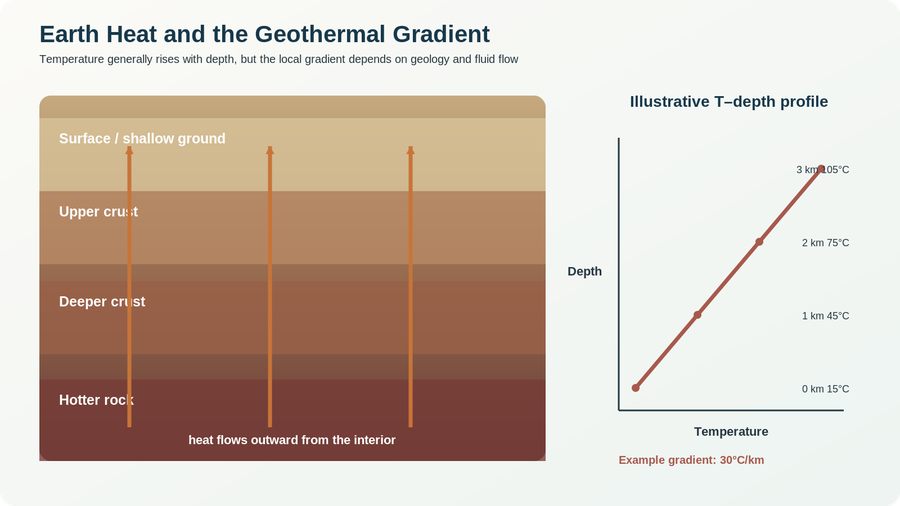
Figure 1. Earth’s internal heat moves outward toward the surface; the geothermal gradient is a local engineering descriptor, not a universal constant.
2. Heat flow is different from temperature
A high subsurface temperature does not by itself tell an engineer how much heat can be extracted. Heat flow also depends on thermal conductivity, reservoir volume, fluid circulation and the rate at which heat is replenished. In conductive rock, Fourier’s law relates heat flux to the temperature gradient. [10]
Here q is heat flux in W/m² and k is rock thermal conductivity in W/(m·K). The minus sign indicates that heat flows from higher to lower temperature. When only magnitudes are needed, engineers often use |q| = k|dT/dz|.
Worked example 2: conductive geothermal heat flux
Assume a rock thermal conductivity of 2.5 W/(m·K) and a conductive temperature gradient of 30 K/km. Estimate the magnitude of conductive heat flux.
- Convert the gradient: 30 K/km = 0.030 K/m.
- Apply |q| = k|dT/dz|.
- q = 2.5 × 0.030 = 0.075 W/m².
- Expressing this in milliwatts gives 75 mW/m².
Answer: The conductive heat flux is approximately 75 mW/m².
This example shows why natural conductive heat flow at the land surface is diffuse even though large quantities of heat are stored at depth. Commercial geothermal systems concentrate extraction through wells and circulating fluids rather than attempting to collect surface heat flux directly.
3. What makes a conventional geothermal reservoir useful?
For conventional geothermal electricity generation, three subsurface ingredients are especially important: sufficiently high temperature, fluid to carry heat, and permeability that allows the fluid to move through hot rock. DOE summarizes these as heat, fluid and permeability. [2]
A hydrothermal reservoir may contain liquid water, steam or a two-phase mixture in fractured or porous rock. Production wells bring hot fluid to the surface. After heat extraction, cooled fluid is commonly reinjected to help manage reservoir pressure, fluid inventory and long-term operation.
A simplified fluid balance highlights the role of reinjection. Real fields may include multiple production and injection wells, natural recharge, steam losses, separated brine and other flows.
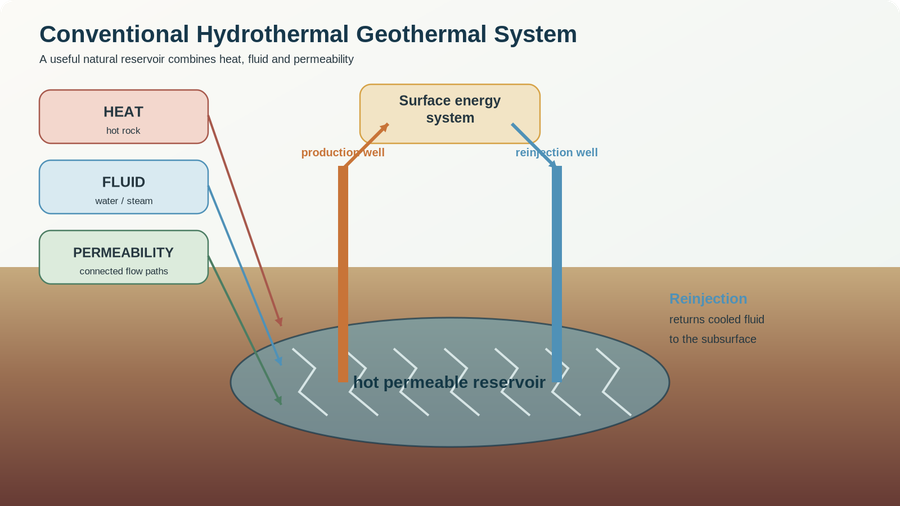
Figure 2. A conventional hydrothermal system combines heat, fluid and permeability, with production and reinjection linking the reservoir to the surface system.
4. The thermal power carried by geothermal fluid
The heat brought to the surface depends strongly on fluid mass flow and the useful temperature drop that can be achieved in heat exchangers or power-plant equipment. For liquid water over a moderate temperature range, a constant heat-capacity approximation is often adequate for first-pass calculations.
The equation estimates sensible heat removed from a single-phase fluid. For flashing, boiling, condensation or high-pressure property changes, enthalpy differences from steam tables or a thermodynamic property model should be used instead.
Worked example 3: thermal power from a production well
A geothermal production stream flows at 80 kg/s and is cooled from 160°C to 80°C in a surface heat-extraction system. Estimate the sensible thermal power using cp = 4.2 kJ/(kg·K).
- Temperature drop = 160 − 80 = 80 K.
- Apply Qdot = mdot cp ΔT.
- Qdot = 80 × 4.2 × 80 = 26,880 kJ/s.
- Since 1000 kJ/s = 1 MW, the result is 26.88 MWth.
Answer: The fluid carries about 26.9 MW of extractable sensible heat over that temperature interval.
5. Four major ways geothermal energy is used
Geothermal resources span a very wide range of temperatures and depths. A useful engineering classification is therefore based on what function the subsurface provides: a heat source for electricity generation, a direct source of useful heat, a stable thermal reservoir for a heat pump, or a hot-rock resource that is engineered to improve fluid circulation. [1,3–6]
Electricity generation uses high-temperature geothermal fluids to drive a turbine directly or through a secondary working fluid. Dry-steam, flash-steam and binary-cycle plants are the three established plant families and will be treated in detail in the next geothermal article. [2]
Direct use delivers geothermal heat without first converting it to electricity. Applications include district heating, greenhouses, aquaculture, food processing, drying and other industrial thermal duties. [4,6]
Geothermal heat pumps, also called ground-source heat pumps, use the relatively stable shallow-ground temperature as a heat source in winter and a heat sink in summer. They do not require a high-temperature geothermal reservoir. [3,7]
Enhanced geothermal systems (EGS) target hot rock where natural permeability or fluid circulation is insufficient. Carefully managed stimulation and injection can create or improve flow pathways so that fluid can exchange heat with the rock and return to the surface. [5,11,12]
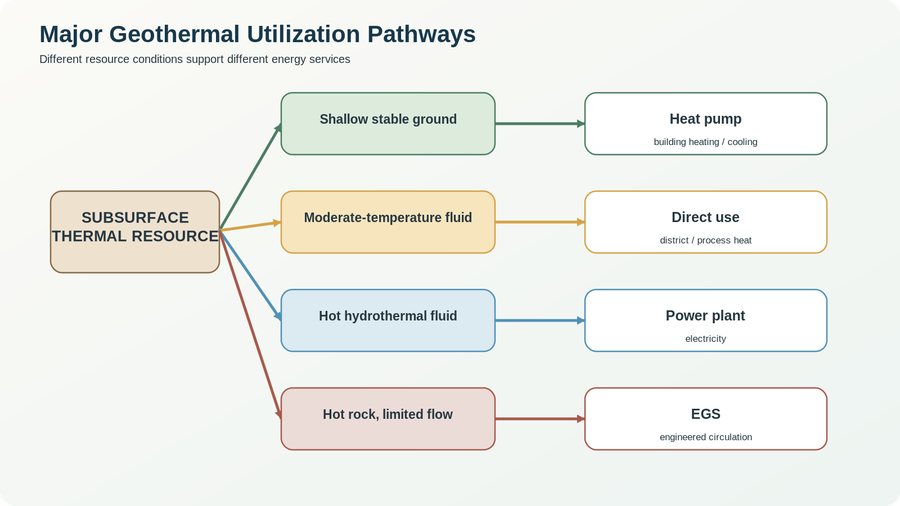
Figure 3. Geothermal is a family of technologies; resource depth, temperature, geology and energy service determine the pathway.
6. Geothermal electricity: turning heat into power
A geothermal power plant converts part of the thermal energy in produced fluid into electricity. The achievable conversion efficiency depends on source temperature, sink temperature, fluid chemistry, plant design and parasitic loads such as production pumps, injection pumps and cooling systems.
This compact relation is useful for screening, but geothermal power cycles require a thermodynamic treatment based on enthalpy, exergy, turbine performance, condenser conditions and auxiliary loads for detailed design.
Worked example 4: screening electric output
Suppose a geothermal system can deliver 26.9 MWth of usable heat to a power cycle and the net conversion efficiency is estimated at 12%. What net electric output does that imply?
- Write Pe = ηconv Qdotavailable.
- Use ηconv = 0.12.
- Pe = 0.12 × 26.9 MW = 3.228 MW.
- The estimate is only a screening value; actual net output depends on the specific cycle and parasitic loads.
Answer: The screening estimate is approximately 3.23 MWe.
Geothermal plants can still be valuable even when thermal-to-electric efficiency is modest, because the heat source is continuously available and many geothermal plants operate at high capacity factors. The relevant comparison is not efficiency alone but delivered energy, reliability, resource sustainability and cost. [1,7]
7. Direct-use geothermal can avoid an unnecessary conversion step
When the energy demand is heat rather than electricity, direct use can be thermodynamically attractive because it avoids converting moderate-temperature heat to electricity and then converting electricity back to heat. The fluid is instead passed through a heat exchanger or heating network and returned to the subsurface when appropriate. [4]
The same sensible-heat balance used for a geothermal well can size a district-heating or process-heating flow. Heat-exchanger approach temperatures and fouling must also be considered in real systems.
Worked example 5: geothermal district-heating flow
A district-heating network requires 10 MW of geothermal heat. If geothermal water can be cooled by 60 K across the heat exchanger, estimate the required water flow using cp = 4.2 kJ/(kg·K).
- Rearrange mdot = Qdot/(cp ΔT).
- Use Qdot = 10,000 kJ/s.
- mdot = 10,000/(4.2 × 60) = 39.68 kg/s.
- A practical design would add margins for heat-exchanger and distribution losses.
Answer: The idealized required flow is approximately 39.7 kg/s.
8. Geothermal heat pumps use shallow ground as a thermal reservoir
Geothermal heat pumps operate on a different principle from geothermal power plants. They use a refrigeration cycle to move heat between a building and the shallow ground. The ground is valuable because its temperature is typically more stable than outdoor air, reducing the temperature lift that the heat pump must overcome. [3,7]
A heat-pump COP is a ratio of delivered heating to electrical work input and can be greater than one because the system moves environmental heat rather than creating all delivered heat from electricity.
In cooling mode, the numerator is the heat removed from the conditioned space. COP should not be interpreted as a power-plant efficiency.
Worked example 6: heat-pump COP
A ground-source heat pump delivers 12 kW of heating while consuming 3.0 kW of electrical power. What is its heating COP, and how much heat is being drawn from the ground and other environmental sources?
- COPH = QH/Win = 12/3 = 4.0.
- Apply the heat-pump energy balance QH = Qin + Win.
- Qin = 12 − 3 = 9 kW.
- Thus three quarters of the delivered heat is transferred from the environment in this simplified operating point.
Answer: The heating COP is 4.0, with about 9 kW transferred from the ground/environment.
9. Resource temperature and depth guide technology choice
There is no universal temperature boundary that separates every geothermal application. Economics, fluid chemistry, flow rate, drilling cost, ambient conditions and technology can shift the practical limits. DOE generally describes low-temperature geothermal resources as below about 150°C, while shallow geothermal heat pumps work with much lower ground temperatures. [6]
As a qualitative rule, shallow stable ground temperatures suit heat pumps; moderate-temperature resources can serve direct heat and, in some cases, binary power; hotter hydrothermal resources are increasingly favorable for electricity generation; and EGS seeks to broaden access to hot rock where natural fluid pathways are inadequate. The boundaries overlap and should be treated as engineering screening ranges, not rigid categories.
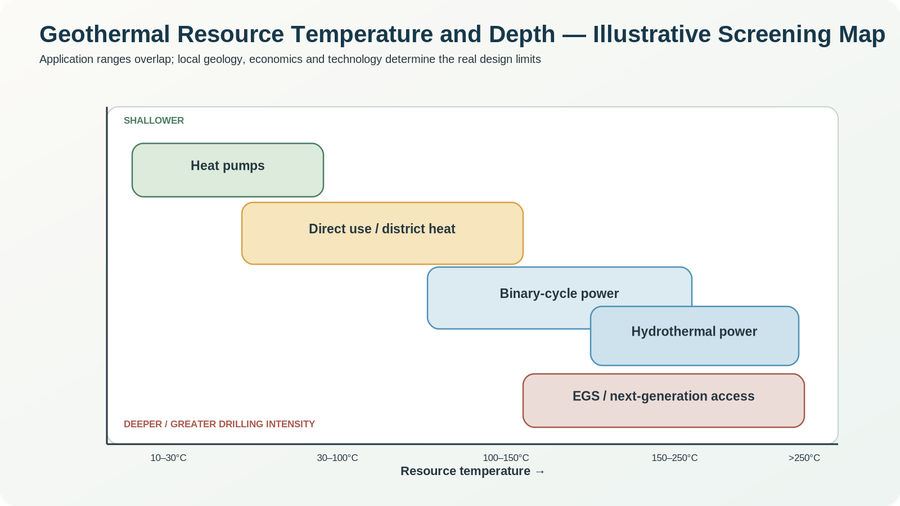
Figure 4. Resource temperature and depth influence technology choice, but the application ranges overlap and are not universal design limits.
10. Enhanced geothermal systems expand the accessible heat resource
Conventional hydrothermal resources require naturally favorable heat, fluid and permeability. EGS is designed for locations where the rock is hot but natural permeability or fluid circulation is insufficient. Fluid is injected under controlled conditions to improve connected flow paths, and production wells recover heated fluid. [5,11]
The engineering challenge is coupled: fracture mechanics, fluid flow, heat transfer, geochemistry and reservoir stress evolve together. This is why EGS development depends heavily on monitoring, reservoir modeling and induced-seismicity management rather than simply drilling into hot rock. [11,12]
11. Reinjection, scaling and corrosion are central operating issues
Geothermal fluids can contain dissolved salts, silica, gases and trace constituents. Cooling and depressurization may change chemical equilibrium and promote mineral scaling. Corrosion can also affect wells, pipelines, heat exchangers and turbines. Fluid chemistry therefore influences materials selection, heat-exchanger design, maintenance and disposal or reinjection strategy.
Reinjection can help maintain reservoir pressure and fluid inventory, but injection location and temperature must be designed carefully. If cooled injected fluid returns too rapidly to production wells, thermal breakthrough can reduce produced temperature and power output.
12. Sustainability means managing heat extraction over time
Geothermal is renewable in the broad sense that heat continuously flows from Earth’s interior, but an individual reservoir can still be overdrawn locally if heat and fluid are extracted faster than the system replenishes them. Sustainable operation therefore depends on production rate, reinjection, well spacing, natural recharge, reservoir size and the time scale of interest. [1,9,11]
Capacity factor measures actual electrical energy generation relative to the energy that would be produced by operating continuously at rated power. It is a utilization metric, not a thermal efficiency.
High capacity factor is one of geothermal power’s distinguishing characteristics, but it does not guarantee that every reservoir can sustain any chosen production rate indefinitely. Field management remains essential.
13. Environmental considerations depend on the geothermal system
Geothermal projects generally have small fuel-supply chains because no combustible fuel must be transported continuously to the plant. Environmental considerations can nevertheless include drilling impacts, water management, mineralized brines, non-condensable gases, land disturbance, noise, subsidence, induced seismicity and well integrity. The significance of each issue is site- and technology-specific. [7,11,12]
For EGS in particular, DOE has developed practices for understanding and managing induced seismicity associated with reservoir stimulation. For geothermal heat pumps, environmental controls focus more on borehole construction, loop-fluid integrity and groundwater protection. [11,12]
14. What geothermal energy is — and what it is not
Geothermal energy is not synonymous with volcanic steam, nor does every geothermal project require very high temperatures. A building-scale ground-source heat pump and a multi-megawatt hydrothermal power field are both geothermal technologies, but they exploit different parts of the subsurface thermal environment.
It is also important not to confuse geothermal heat with geothermal electricity. Electricity is one possible product. In many locations, the most efficient use of a moderate-temperature resource may be direct thermal service rather than power generation.
15. Key takeaways
First: geothermal energy begins with Earth’s subsurface heat, but useful projects require engineering access to that heat. Second: temperature, depth, fluid flow and permeability determine which technologies are practical. Third: geothermal can provide electricity, direct heat and efficient building heating/cooling. Fourth: heat extraction must be paired with fluid chemistry, reservoir and reinjection management. Finally: the correct engineering metric depends on the service being delivered—thermal power, electrical power, COP, capacity factor or long-term resource performance.
16. Practice questions
Why is geothermal gradient alone insufficient to determine the useful power of a geothermal resource?
Reveal worked answer
Because useful power also depends on heat capacity, accessible reservoir volume, fluid flow, permeability, thermal conductivity, extractable temperature drop and the rate at which heat can be replenished.
What three subsurface ingredients are usually required for a conventional hydrothermal electricity resource?
Reveal worked answer
Sufficient heat, fluid and permeability that allows the fluid to circulate through hot rock and reach production wells.
A geothermal gradient is 25°C/km. What temperature rise does that imply over 2 km in a simple linear model?
Reveal worked answer
A temperature rise of 50°C. A reference temperature must still be added to estimate the absolute temperature.
Why is direct-use geothermal often attractive for moderate-temperature resources?
Reveal worked answer
Because it can deliver useful heat without first incurring the thermodynamic losses associated with converting heat to electricity.
How does a geothermal heat pump differ from a geothermal power plant?
Reveal worked answer
A heat pump uses shallow ground as a heat source or sink and consumes electricity to move heat. A geothermal power plant extracts higher-temperature subsurface heat and converts part of it into electricity.
Why can heat-pump COP be greater than one?
Reveal worked answer
Because the heat pump transfers environmental heat in addition to converting electrical work; the delivered heating is therefore larger than the electrical input.
What is the main purpose of reinjection in many geothermal fields?
Reveal worked answer
To return fluid to the reservoir, support pressure and fluid inventory, and help manage long-term field operation after heat has been extracted.
Why can reinjection still cause problems if poorly designed?
Reveal worked answer
Cold injected fluid can return too quickly to production wells, causing thermal breakthrough, and injection can also affect pressure and seismic response.
What does EGS add when hot rock lacks adequate natural permeability?
Reveal worked answer
It creates or improves connected subsurface flow paths so injected fluid can circulate through hot rock and recover heat.
Why are scaling and corrosion important in geothermal surface equipment?
Reveal worked answer
Dissolved minerals and gases can precipitate or react as pressure and temperature change, reducing heat transfer and damaging wells, pipelines and plant equipment.
Is a high capacity factor the same as high thermal efficiency?
Reveal worked answer
No. Capacity factor measures how much energy a plant generates relative to continuous operation at rated power; thermal efficiency measures conversion of input heat to useful output.
Why should geothermal sustainability be evaluated at the reservoir scale?
Reveal worked answer
Because local temperature and pressure can decline if extraction exceeds heat and fluid replenishment, even though Earth’s total internal heat resource is enormous.
17. References and further reading
1. U.S. Department of Energy — Geothermal Basics — Read the source
2. U.S. Department of Energy — Geothermal Electricity Generation — Read the source
3. U.S. Department of Energy — Geothermal Heating & Cooling — Read the source
4. U.S. Department of Energy — Geothermal Direct Use — Read the source
5. U.S. Department of Energy — Enhanced Geothermal Systems — Read the source
6. U.S. Department of Energy — Low Temperature & Coproduced Resources — Read the source
7. U.S. Department of Energy — Geothermal FAQs — Read the source
8. U.S. Department of Energy — Geothermal Glossary — Read the source
9. U.S. Geological Survey — Geothermal Energy: Clean Power From the Earth’s Heat — Read the source
10. U.S. Geological Survey — Geothermal Gradients in the Conterminous United States — Read the source
11. National Renewable Energy Laboratory — Geothermal Resources and Technologies — Read the source
12. U.S. Department of Energy — Subsurface Enhancement and Sustainability — Read the source
Technical discussions describe general principles; site-specific engineering decisions require appropriate professional evaluation.