
RENEWIOSITY / EXPLAINER
What Is Green Hydrogen? Production, Properties, Applications, and the Hydrogen Economy
A chemical-engineering introduction to green hydrogen: water electrolysis, thermodynamics, material balances, electricity demand, applications, safety and lifecycle emissions.
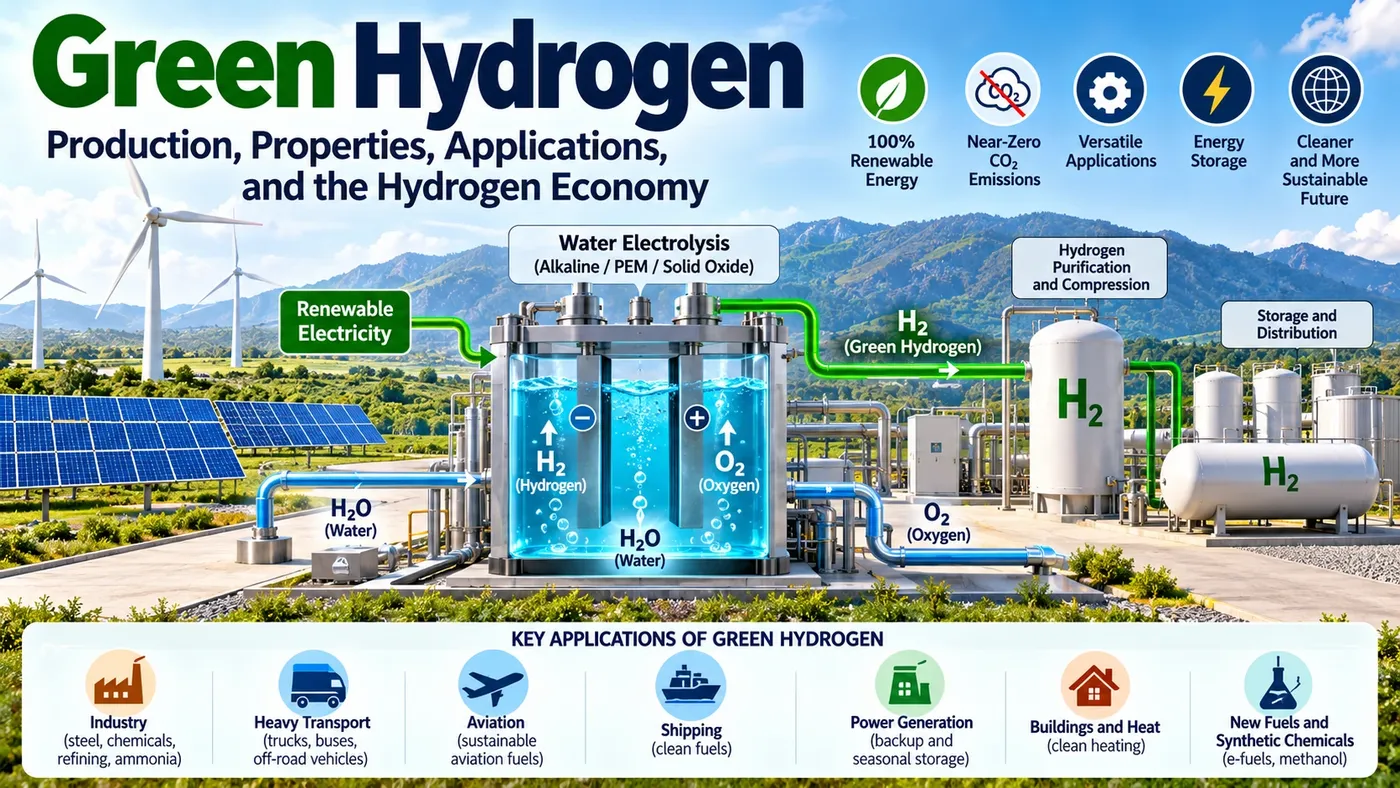
Green hydrogen is hydrogen produced by splitting water using electricity supplied from renewable sources, such as wind or solar. It is an energy carrier and industrial feedstock, not a primary energy source. The defining engineering question is not whether hydrogen burns without emitting CO₂ at the point of use; it is how the hydrogen was produced, what electricity supplied the process, and which emissions arise across the complete value chain.
This foundational RENEWIOSITY lesson introduces hydrogen properties, water electrolysis, production technologies, thermodynamics, system boundaries, material and energy balances, costs, environmental considerations, safety, and practical applications. It is intended for upper-level chemical-engineering and renewable-energy students. For detailed electrolyzer chemistry, see How Does Water Electrolysis Work?; for plant performance modeling, see Green Hydrogen Production Calculations.
Learning objectives
- Define green hydrogen and distinguish it from other hydrogen production pathways without treating color labels as formal emissions certifications.
- Write and balance the water-electrolysis reaction and apply hydrogen, water, and oxygen stoichiometry.
- Distinguish hydrogen lower and higher heating values, reversible electrical work, and thermoneutral energy.
- Calculate first-pass electricity demand, hydrogen output, water demand, oxygen coproduction, and LHV-based efficiency.
- Identify electrolyzer technologies and explain their basic operating principles and practical limitations.
- Assess credible hydrogen end uses, energy losses, emissions boundaries, and safety constraints.
- Evaluate introductory plant-scale production and cost examples using clearly stated assumptions.
1. What is green hydrogen?
Hydrogen (H₂) is the lightest molecular gas and a versatile chemical reducing agent. In the atmosphere and most natural materials it is commonly chemically bound, notably in water and hydrocarbons. Producing useful H₂ therefore requires energy and a feedstock. For green hydrogen, an electrolyzer separates water into hydrogen and oxygen using renewable electricity. The production chain may also include water purification, power conversion, gas drying, compression, storage, and transportation.
The term green is a common descriptive label, not a universally sufficient lifecycle certification. Electricity matching rules, grid interaction, upstream equipment emissions, water supply, and hydrogen leakage can all affect the environmental result. Low-emissions hydrogen can also be produced by other pathways, so green hydrogen and low-emissions hydrogen should not be used as synonyms.
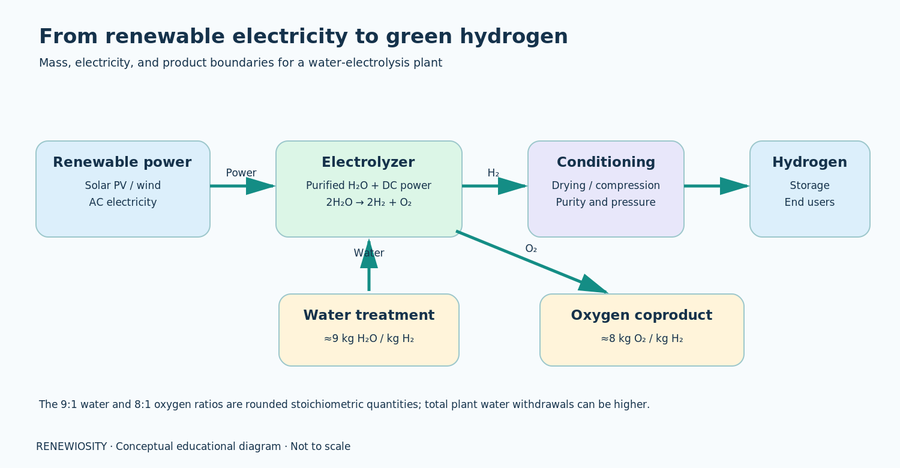
2. Why is hydrogen an energy carrier rather than an energy source?
Electricity or another energy input must first be used to manufacture hydrogen from water or hydrocarbons. The hydrogen then stores chemical energy that can later be used as feedstock, combusted, or converted back to electricity in a fuel cell. Every conversion has losses. Consequently, using renewable electricity directly is often more energy-efficient than converting it to hydrogen and back; hydrogen is most compelling where direct electrification is difficult or where a hydrogen-containing molecule is required by the process.
A battery stores electrical energy electrochemically and returns electricity relatively efficiently. Hydrogen provides a different option for long-duration storage, chemical manufacture, and selected high-temperature or mobile applications, but requires equipment for conversion and safe handling. This distinction is central to evaluating a proposed hydrogen economy.
3. The fundamental chemistry of water electrolysis
Electrolysis is a non-spontaneous reaction driven by an external electrical power source. A direct-current power supply sends electrons through an external circuit while ionic charge passes through an electrolyte or membrane. Hydrogen and oxygen are formed at different electrodes and must be kept separated. The overall reaction is independent of whether the electrolyzer is alkaline, polymer-electrolyte-membrane (PEM), or solid-oxide based.
Two moles of water produce two moles of hydrogen and one mole of oxygen. Electricity is required to drive the reaction.
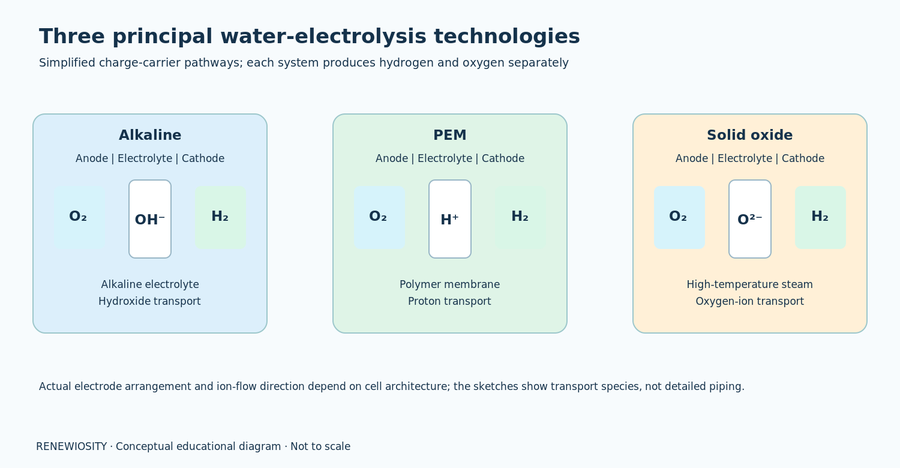
For a conventional acidic PEM cell, the anode evolves oxygen and protons; protons cross the membrane, and hydrogen evolves at the cathode. Alkaline cells instead transport hydroxide ions. The ion-transport mechanism changes the half-reactions but not the net water balance.
Oxygen evolves at the anode; electrons travel through the external circuit.
Hydrogen evolves at the cathode as protons combine with electrons.
The complete cell must also manage product-gas crossover, liquid-water transport, gas purity, heat removal, pressure differences, and changing loads. These practical requirements explain why a real hydrogen-production plant uses more than the theoretical electrolysis energy.
4. Hydrogen properties engineers must know
At ambient conditions hydrogen is a colorless, odorless, highly flammable gas. It has very low density and high gravimetric energy content, but low volumetric energy density at atmospheric pressure. Practical storage can involve compression, liquefaction, chemical carriers, or conversion to derivatives such as ammonia. Storage choices affect energy use, capital cost, boil-off or leakage, and safety requirements.
Approximate standard reference values: molecular mass of H₂ = 2.016 g/mol; lower heating value (LHV) ≈ 120 MJ/kg ≈ 33.33 kWh/kg; higher heating value (HHV) ≈ 141.8 MJ/kg ≈ 39.4 kWh/kg. Hydrogen gas density near 0 °C and 1 atm is approximately 0.090 kg/m³. The chosen standard temperature and pressure must be stated when reporting normal cubic metres.
LHV assumes product water remains vapor; HHV includes the latent heat recovered when product water condenses. Never mix the two efficiency bases.
Hydrogen is not inherently carbon-free in lifecycle terms: the emissions depend on production inputs, energy sourcing, construction and operation of facilities, transport, and end-use conditions. At the point of use, a hydrogen fuel cell emits water; hydrogen combustion in air can produce nitrogen oxides (NOₓ), requiring emission controls.
5. Stoichiometry: hydrogen, water, and oxygen
The balanced reaction provides a powerful first design estimate. Using molecular masses 2.016 kg/kmol for H₂, 18.015 kg/kmol for H₂O, and 31.998 kg/kmol for O₂, two moles of water generate two moles of hydrogen and one mole of oxygen.
Approximately 9 kg of pure water is chemically consumed and 8 kg of oxygen is generated per kg of hydrogen. Rounded values are convenient; actual plant water withdrawals are higher.
Worked example 1 — Water and oxygen balance for 1 tonne/day of hydrogen
A green-hydrogen facility produces 1,000 kg H₂/day. Estimate the minimum stoichiometric pure-water consumption and oxygen coproduct using rounded mass ratios.
- Water consumption = 9 kg H₂O/kg H₂ × 1,000 kg H₂/day.
- Oxygen production = 8 kg O₂/kg H₂ × 1,000 kg H₂/day.
- Separate chemically consumed water from additional process water needed for purification, cooling, and cleaning.
Answer: About 9.0 tonnes/day of pure water are consumed by the reaction and 8.0 tonnes/day of oxygen are produced; total facility water withdrawal may exceed this amount.
A credible water assessment must consider source-water quality, desalination if required, pretreatment losses, cooling, local water stress, wastewater, and the discharge of brines or treatment chemicals. The stoichiometric 9 L/kg H₂ figure is not a universal total-water-use number.
6. Electrolyzer technologies: alkaline, PEM, and solid oxide
Alkaline electrolysis: established technology that uses an alkaline electrolyte and hydroxide-ion transport. It is widely used and can be economical at scale, but operational characteristics depend strongly on system design. PEM electrolysis: uses a proton-conducting polymer membrane and can support dynamic operation, with materials and catalyst costs important to design. Solid oxide electrolysis: operates at elevated temperature, typically using steam and oxygen-ion-conducting ceramics; external heat can reduce electrical demand, although thermal integration and materials durability become important.
No single technology is best in every setting. Selection depends on power price and profile, desired operating flexibility, heat availability, pressure, purity, footprint, capital cost, durability, maintenance, and supply chains. Detailed electrode chemistry, polarization losses, and electrolyzer selection are covered in How Does Water Electrolysis Work?.
7. Thermodynamics: reversible work, heat, and voltage
The minimum reversible electrical work for splitting liquid water at 25 °C under standard-state assumptions is the reaction Gibbs free-energy change, approximately 237.1 kJ per mole of H₂. The total reaction enthalpy is approximately 285.8 kJ/mol H₂. The difference can be supplied as heat. Real cells need additional voltage to overcome kinetic, ohmic, and mass-transport losses, while the plant also needs auxiliary electricity.
Reference values apply to liquid-water electrolysis near 25 °C; other temperatures, pressures, and feed states change the thermodynamics.
F is Faraday’s constant (96,485 C/mol electrons); two electrons are required per H₂ molecule.
This is the reversible electrical-work limit under stated reference conditions, not the total real-plant electrical requirement.
Worked example 2 — Reversible work versus hydrogen LHV
Compare the minimum reversible electrical work of approximately 32.7 kWh/kg H₂ with its LHV of 33.33 kWh/kg. Explain why the reversible electrical input can be smaller than the HHV.
- Use reversible electrical work based on ΔG, not ΔH.
- Compute 33.33 − 32.7 ≈ 0.63 kWh/kg for the numerical difference to LHV; note that LHV uses water-vapor product and is a different thermodynamic convention.
- The remaining energy for liquid-water electrolysis relative to ΔH is supplied as heat at the reversible operating point.
- Do not interpret ratios of unlike reference states as an achievable practical electrolyzer efficiency.
Answer: The theoretical electrical work is about 32.7 kWh/kg under standard liquid-water conditions; heat and reference-state conventions matter. Real equipment uses more electricity.
The HHV corresponds closely to the standard reaction enthalpy for liquid-water electrolysis, whereas LHV uses a different water phase reference. Comparing efficiency figures requires a clearly stated HHV or LHV basis and the same plant boundary.
8. Practical electricity consumption and efficiency
The electrical energy required by a commercial plant includes stack losses, power electronics, pumps, cooling, gas treatment, controls, and possibly compression. A convenient introductory assumption for worked problems is 52 kWh of electricity per kg of hydrogen at a stated plant boundary; this is an illustrative value, not a universal guaranteed specification. Actual consumption varies with technology, operating point, pressure, degradation, and system design.
Specify whether electricity is measured at the electrolyzer stack, plant AC input, or delivery point and whether compression is included.
For SEC in kWh/kg, this is a dimensionless energy-efficiency ratio on the LHV basis. It is not a lifecycle greenhouse-gas metric.
Worked example 3 — Hydrogen energy efficiency at 52 kWh/kg
An electrolyzer system uses 52.0 kWh of AC electricity per kilogram of hydrogen produced. Calculate its LHV-based electrical efficiency.
- LHV of hydrogen = 33.33 kWh/kg.
- Divide the chemical energy per kilogram by the electrical input per kilogram.
- Convert to percent; record that compression outside the system boundary is excluded.
Answer: Approximately 64.1% LHV efficiency for the stated AC-input system boundary.
Worked example 4 — Electricity required for 1 tonne of hydrogen
Estimate electrical consumption to produce 1,000 kg H₂ at a specific electricity consumption of 52 kWh/kg.
- Multiply mass by specific electricity consumption.
- Convert kWh to MWh.
- Note that this is an electricity requirement, not a statement about electricity carbon intensity.
Answer: Approximately 52 MWh of electricity are required.
9. From renewable electricity to annual hydrogen output
An electrolyzer connected to variable wind or solar power will not necessarily run at rated input all year. For an introductory estimate, multiply rated electrical power by operating hours and utilization, then divide by specific electricity consumption. In a detailed model, production is calculated hour by hour using the renewable-generation profile, storage, grid exchanges, part-load efficiency, minimum-load limits, maintenance, and curtailment.
P is in kW, u is dimensionless utilization, and SEC is in kWh/kg. For a leap year, replace 8,760 with 8,784 h.
Worked example 5 — Annual output of a 2 MW electrolyzer
A 2 MW electrolyzer operates at an equivalent full-load utilization of 60% in a 365-day year. Estimate annual H₂ production at 52 kWh/kg.
- Annual electricity = 2,000 kW × 8,760 h × 0.60 = 10,512,000 kWh.
- Hydrogen production = 10,512,000 kWh ÷ 52 kWh/kg.
- Convert kilograms to tonnes; assume utilization already captures downtime and part-load energy equivalents.
Answer: Approximately 202 tonnes H₂ per year under the stated assumptions.
Utilization is not the same as electrolyzer conversion efficiency: utilization measures the amount of time-equivalent electrical input, while efficiency relates electricity input to hydrogen energy output. Confusing them can cause large production-estimate errors.
10. Hydrogen production pathways and emissions boundaries
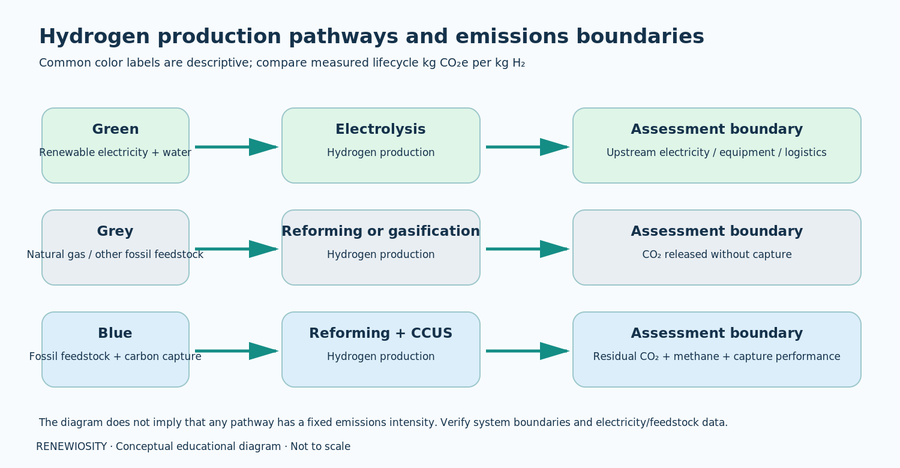
Hydrogen production is often described with color labels: grey commonly refers to fossil-derived hydrogen without carbon capture; blue generally denotes fossil-based production with carbon capture; green generally denotes renewable-powered electrolysis. These labels are informal and can conceal major differences in methane leakage, capture rates, electricity supply, and lifecycle emissions. Quantified emissions intensity (for example kg CO₂-equivalent per kg H₂) is more informative.
A lifecycle assessment can include feedstock production, electricity generation, plant construction, hydrogen conditioning, compression, transport, and losses. Electrolysis powered by carbon-intensive grid electricity can have substantial upstream emissions, despite producing no CO₂ directly at the electrolyzer. Claims of zero emissions require explicit boundary definitions and supporting evidence.
With SEC in kWh/kg H₂ and electricity emission factor EF in kg CO₂e/kWh, the product is kg CO₂e/kg H₂. This simplified equation omits other lifecycle contributions.
Worked example 6 — Why the electricity source matters
Assume an electrolyzer uses 52 kWh/kg H₂ and draws electricity with an illustrative emission factor of 0.40 kg CO₂e/kWh. Estimate electricity-related emissions per kilogram.
- Multiply 52 kWh/kg by 0.40 kg CO₂e/kWh.
- State that the estimate covers electricity-related emissions only.
- Compare qualitatively with low-emissions electricity; do not label the grid-powered product green without evidence.
Answer: 20.8 kg CO₂e/kg H₂ from electricity alone in this hypothetical case.
The International Energy Agency reported that global hydrogen demand was close to 100 million tonnes in 2024, while low-emissions production remained below 1% of the total. These are historical 2024 figures reported in the IEA Global Hydrogen Review 2025, not claims about the current year. The implication is that scaling verified low-emissions supply remains a significant industrial transition challenge.
11. What is green hydrogen used for?
Ammonia and fertilizers: hydrogen reacts with nitrogen to produce ammonia, a foundational feedstock for nitrogen fertilizers. Refining and chemicals: hydrogen is used in hydrotreating and as a chemical reactant. Iron and steel: hydrogen-based direct reduction is an emerging route to lower-emissions ironmaking when supported by low-emissions power and appropriate downstream processes. Shipping and aviation: hydrogen can be converted into ammonia, methanol, or synthetic fuels, each with additional conversion losses and sustainability requirements.
Heavy-duty transport and selected industrial heat: hydrogen may have a role where batteries or direct electric heating are impractical, but its competitiveness depends on infrastructure and system design. Long-duration storage and power: excess renewable electricity may be converted to hydrogen and later reconverted to power; this provides storage duration but incurs substantial round-trip energy losses. Residential heating and ordinary passenger cars: direct electrification is often more efficient, so hydrogen should not be presented as universally preferable.
12. Hydrogen storage, transport, and safety
Hydrogen gas has a very low volumetric energy density at ambient pressure, so transport and storage commonly require compression, liquefaction, underground storage, or conversion to another carrier. Each option creates a different thermodynamic, safety, and cost problem. High-pressure equipment requires pressure-rated vessels, compatible materials, inspection, leak detection, and appropriate codes and standards.
Hydrogen is flammable over a wide concentration range in air, has a low ignition energy, and can leak through small openings. Appropriate design includes ventilation, separation of oxygen and hydrogen streams, ignition-source control, monitoring, and emergency procedures. Certain metals can experience hydrogen-assisted cracking or embrittlement; compatibility must be assessed for the actual alloy, pressure, and operating conditions. Engineering safety is not adequately addressed by treating hydrogen as interchangeable with natural gas.
A hydrogen facility also requires careful management of oxygen by-product. Oxygen recovery is not automatically a revenue stream: purification, compression, local demand, market access, and safety determine whether sale is viable.
13. Preliminary hydrogen project economics
Electricity often makes a major contribution to green-hydrogen production cost, but a full levelized cost of hydrogen (LCOH) also includes electrolyzer capital expenditure, stack replacement, maintenance, water, compression, financing, utilization, and other balance-of-plant costs. The electricity-only component is a useful first calculation, not a complete selling price.
SEC is kWh/kg and electricity price c_e is currency/kWh. The result excludes all other costs and revenues.
Worked example 7 — Electricity-only cost of green hydrogen
An electrolyzer uses 52 kWh/kg H₂ and electricity costs US$0.05/kWh. Estimate electricity cost per kilogram of H₂.
- Multiply SEC by the electricity tariff.
- Identify which cost components are omitted.
- Do not present the result as a complete levelized hydrogen cost.
Answer: US$2.60/kg H₂ for electricity alone, before capital, operating, compression, and financing costs.
Worked example 8 — Average electrical power for a 1,000 kg/day plant
A facility must produce 1,000 kg H₂ every day at 52 kWh/kg. Estimate the continuous average electrical input, ignoring downtime.
- Daily electrical input = 1,000 × 52 = 52,000 kWh/day.
- Divide by 24 h/day.
- The installed rating may need to be higher if operation is intermittent or includes maintenance downtime.
Answer: An average electrical input of approximately 2.17 MW.
14. Hydrogen as an electricity-storage medium
When hydrogen is used for power-to-hydrogen-to-power storage, the electricity-to-hydrogen efficiency must be multiplied by the hydrogen-to-electricity conversion efficiency and other conditioning/storage efficiencies. This is why direct electricity use or batteries often have lower energy losses, while hydrogen may still provide value in long-duration or chemical-energy applications.
The expression uses consistent LHV bases and dimensionless efficiencies. Storage, compression, and power electronics should be included in a detailed calculation.
Worked example 9 — Electricity–hydrogen–electricity round trip
An electrolyzer consumes 52 kWh/kg H₂. A fuel cell converts hydrogen to electricity at 55% LHV efficiency. Neglect storage and compression losses. Estimate electricity recovered per kilogram and round-trip efficiency.
- Hydrogen chemical energy = 33.33 kWh/kg LHV.
- Electricity recovered = 33.33 × 0.55 = 18.33 kWh/kg.
- Round-trip efficiency = 18.33/52 × 100%.
- Real storage and conditioning losses would reduce the overall efficiency further.
Answer: Approximately 18.3 kWh/kg recovered and 35.3% round-trip efficiency before storage and conditioning losses.
15. Design checklist: how to assess a green-hydrogen proposal
Before accepting a production estimate, request: (1) a clear definition of green electricity and its temporal matching; (2) renewable supply profiles and grid-import assumptions; (3) stack versus plant AC-input SEC; (4) operating utilization and degradation; (5) feedwater quality and total water withdrawal; (6) hydrogen pressure and purity at the delivery point; (7) compression and storage energy; (8) the emissions-assessment boundary; (9) product offtake and transport logistics; and (10) a sensitivity analysis for electricity price, utilization, and financing.
For chemical engineers, the central workflow is familiar: draw the process boundary, write balanced species balances, establish an energy balance, estimate thermodynamic limits, add real-unit inefficiencies, and then evaluate economics, safety, and environmental performance. The same approach applies to electrolyzer and design problems discussed in How Does Water Electrolysis Work? and Green Hydrogen Production Calculations.
16. Practice questions with answers
Explain in one sentence why green hydrogen is called an energy carrier.
Reveal worked answer
Energy must first be supplied to manufacture hydrogen; the hydrogen then carries chemical energy to a later use.
Write the balanced reaction for water electrolysis.
Reveal worked answer
2 H₂O(l) → 2 H₂(g) + O₂(g).
A plant makes 250 kg H₂/day. Estimate the theoretical water consumption using 9 kg/kg.
Reveal worked answer
250 × 9 = 2,250 kg/day, or about 2.25 tonnes/day of pure water chemically consumed.
For the same 250 kg H₂/day, estimate the oxygen coproduct using 8 kg/kg.
Reveal worked answer
250 × 8 = 2,000 kg/day, or about 2.0 tonnes/day O₂.
At 50 kWh/kg H₂, what is the LHV-based electricity-to-hydrogen efficiency?
Reveal worked answer
33.33/50 = 0.6666, or approximately 66.7%.
A 1.5 MW electrolyzer receives 9,000 MWh/year and consumes 50 kWh/kg. Estimate annual hydrogen output.
Reveal worked answer
9,000,000 kWh ÷ 50 kWh/kg = 180,000 kg/year, or 180 tonnes/year.
What is the distinction between the reversible and thermoneutral cell voltages?
Reveal worked answer
Reversible voltage corresponds to Gibbs free-energy electrical work; thermoneutral voltage corresponds to reaction enthalpy, with the difference linked to heat.
Why is a 9 L/kg H₂ water-consumption claim insufficient for a facility-level water assessment?
Reveal worked answer
It approximates stoichiometric reaction water only, excluding purification losses, cooling, cleaning, and other plant withdrawals.
An electrolyzer uses 54 kWh/kg and electricity costs $0.07/kWh. Estimate electricity-only cost.
Reveal worked answer
$3.78/kg H₂; other plant costs are excluded.
What happens to electricity-related emissions if grid power has a factor of 0.5 kg CO₂e/kWh at 50 kWh/kg?
Reveal worked answer
50 × 0.5 = 25 kg CO₂e/kg H₂, excluding other lifecycle emissions.
Give two reasons why hydrogen is not always the preferred energy-storage option.
Reveal worked answer
Conversion losses lower round-trip efficiency, and storage/transport require specialized infrastructure; direct electricity use can be more efficient.
Name the principal charge carrier in PEM, alkaline, and common solid-oxide electrolyzers.
Reveal worked answer
PEM: H⁺; alkaline: OH⁻; oxygen-ion-conducting solid oxide: O²⁻.
A 5 MW electrolyzer runs at 40% equivalent full-load utilization and 50 kWh/kg. Estimate annual output for 8,760 h.
Reveal worked answer
5,000 × 8,760 × 0.40 / 50 = 350,400 kg/year ≈ 350.4 tonnes/year.
List four information items needed to support a claim that electrolytic hydrogen is genuinely low emissions.
Reveal worked answer
Examples: electricity source and matching, lifecycle emission factors, compression/transport energy, system boundary, and independently documented emission intensity.
Why must oxygen coproduct revenue not automatically be included in a project estimate?
Reveal worked answer
A saleable oxygen stream requires suitable purity, conditioning, storage, transport, a buyer, and a viable market price.
Does burning hydrogen in air necessarily eliminate all air pollutants?
Reveal worked answer
No. It does not form CO₂ from hydrogen fuel itself, but thermal NOₓ can form and may require controls.
17. Frequently asked questions
Is green hydrogen completely emission-free? No. Electrolysis itself does not release CO₂, but electricity sourcing and upstream/downstream activities can create lifecycle emissions. The claim depends on boundaries and evidence.
How much electricity is needed for 1 kg of green hydrogen? A practical preliminary assumption may be about 50–60 kWh/kg at a specified system boundary, but technology and operating conditions matter. This lesson uses 52 kWh/kg in worked examples; it is not a guaranteed industry-wide value.
How much water is needed for 1 kg of hydrogen? About 9 kg of pure water is chemically consumed, but total facility withdrawals can be greater.
Is hydrogen better than batteries? Not universally. Batteries typically avoid some conversion losses for short-duration electrical storage; hydrogen may be useful for chemical feedstocks, long-duration storage, and certain hard-to-electrify applications.
What is the difference between green and blue hydrogen? Green commonly refers to renewable-powered water electrolysis; blue commonly refers to fossil-based production with carbon capture. Neither label by itself establishes a particular lifecycle emission intensity.
18. Key takeaways and next lessons
Green hydrogen connects renewable electricity to the chemical-process economy. Its core reaction is simple, but engineering decisions depend on thermodynamics, mass balances, plant boundaries, conversion efficiency, utilization, water, product conditioning, safety, and verified lifecycle emissions. A hydrogen plant is not accurately characterized by a single efficiency number or by the word “green” alone.
Continue with How Does Water Electrolysis Work? Alkaline, PEM, and Solid Oxide Electrolyzers Explained for electrode kinetics, polarization losses, cell design, and technology selection. Then study Green Hydrogen Production Calculations for deeper process modeling, electricity matching, equipment sizing, and plant economics. For background in renewable electricity generation, see the existing RENEWIOSITY lessons What Is Solar Energy? and What Is Wind Energy?; for quantitative wind input, see Wind Turbine Power and Energy Calculations.
References and Further Reading
Technical discussions describe general principles; site-specific engineering decisions require appropriate professional evaluation.