
RENEWIOSITY / EXPLAINER
Green vs Blue Hydrogen: Understanding the Different Colors of Hydrogen
A beginner-friendly guide to green, blue, grey, brown, turquoise, pink and natural hydrogen: how each is produced, why labels vary and how to compare lifecycle emissions.
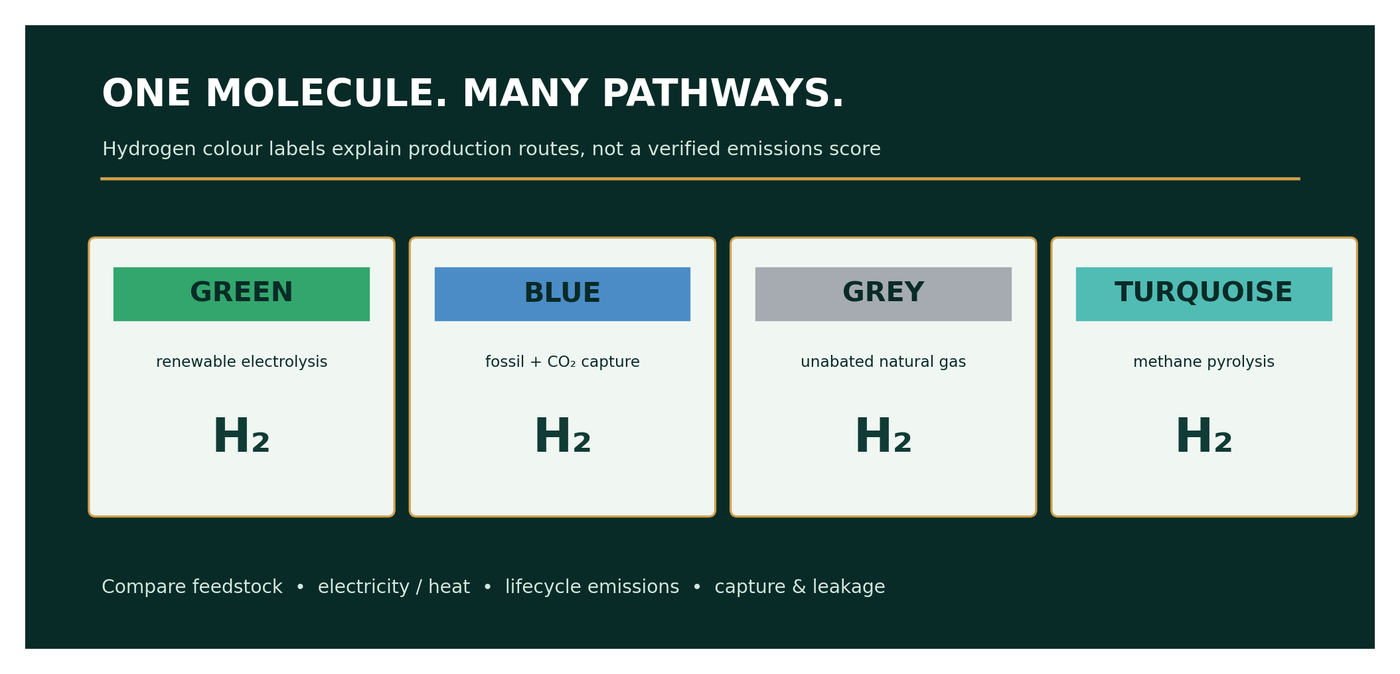
What do hydrogen colours actually tell us?
Hydrogen gas has no colour, yet energy discussions often describe green, blue, grey, brown, turquoise, pink or even white hydrogen. These names are shorthand for the materials and energy used to obtain hydrogen. They are not colours of the gas, certificates of quality, or a universal rating of greenhouse-gas emissions. [1, 2]
This beginner-friendly guide starts with the main production methods, explains the popular colour names, and then shows why the amount of greenhouse gas emitted depends on real-world details. No previous chemical-engineering knowledge is required. It connects the Renewable Energy Fundamentals learning path with our deeper guides to green hydrogen and water electrolysis.
Learning objectives
- Distinguish the major hydrogen production pathways.
- Explain why capturing carbon does not make every blue-hydrogen plant zero-carbon.
- Calculate a simple electricity-related emissions estimate.
- Recognise what lifecycle boundaries leave out.
- Understand when the colour terminology becomes misleading.
1. Why is hydrogen an energy carrier?
In ordinary use, hydrogen is generally obtained by separating it from water, methane, coal-derived gases or biomass rather than collected directly from nature. Hydrogen produced elsewhere can then carry energy to a fuel cell, industrial burner or chemical plant. This makes most manufactured hydrogen an energy carrier, not a primary energy resource. Naturally occurring geological hydrogen is a special case discussed later. [3, 4]
Two hydrogen cylinders may contain essentially the same H₂ molecules, even if one came from renewable-powered electrolysis and the other from natural gas. The important differences are upstream: the fuel, the electricity, the process equipment, the carbon dioxide, and the accounting boundary.
2. A map of the hydrogen colour spectrum
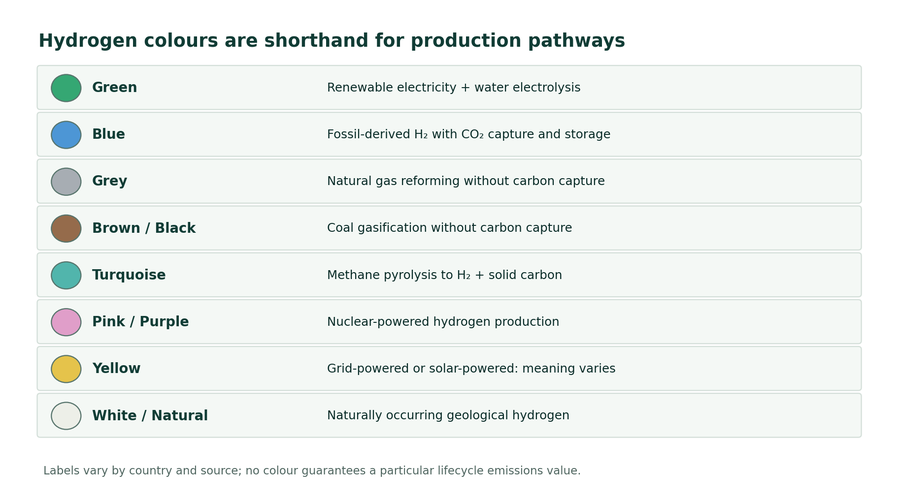
Figure 1. The familiar colour labels describe typical production pathways, not measured emissions intensities; usage of several names varies by source.
Important terminology note: there is no globally agreed colour dictionary. In some sources, yellow means electrolysis powered by grid electricity; others use yellow for solar-powered production. Pink, purple and red may all be used for nuclear-based routes. Neither the IEA nor the U.S. Department of Energy treats colours as a reliable emissions certification system. [1, 3]
3. Green hydrogen: renewable-powered water splitting
Green hydrogen is commonly defined as hydrogen from water electrolysis powered by renewable electricity such as solar or wind. Inside an electrolyser, electricity drives the separation of water into hydrogen and oxygen. The water-splitting reaction itself does not create carbon dioxide; however, constructing the power and hydrogen systems, water treatment and transporting product may still create lifecycle emissions. [3, 4]
Balanced water-electrolysis reaction: two water molecules form two hydrogen molecules and one oxygen molecule.
A simple stoichiometric calculation gives about 9 kilograms of water chemically consumed per kilogram of hydrogen produced. A commercial plant normally needs additional raw water for purification, cooling or other operations. The required electricity, its actual time profile and the emissions associated with it are central to assessing the pathway.
Approximate reaction requirement in kg of water for a given kg of hydrogen. Not a total site water-withdrawal estimate.
Green hydrogen can be useful for replacing fossil-derived hydrogen in existing chemical industries or supporting processes that are difficult to electrify directly. Its economic attractiveness depends on renewable-electricity cost, electrolysis equipment, operating hours and delivery arrangements. “Green” does not mean “free of environmental impacts.”
4. Grey hydrogen: natural gas without carbon capture
Grey hydrogen usually describes hydrogen made by reforming natural gas without capturing the process carbon dioxide for permanent storage. Steam methane reforming (SMR) is a familiar route. The reformer creates hydrogen-rich synthesis gas, followed by a shift reaction and gas purification. Carbon dioxide arises from both chemistry and supplying heat. Emissions also occur when methane leaks during extraction and transport. [4, 5]
Idealised overall steam-methane-reforming plus water-gas-shift chemistry, before practical heat supply, losses and separations.
In its 2024 hydrogen review, the IEA reported an illustrative range of about 10–12 kg CO₂-equivalent per kilogram of hydrogen for unabated natural-gas production. That is not a constant for every facility: gas sourcing, methane leakage, technology and measurement boundary all matter. [2]
5. Blue hydrogen: natural gas plus carbon capture
Blue hydrogen generally begins with a fossil-based route such as reforming natural gas, then uses carbon capture and storage (CCS) to keep some carbon dioxide from entering the atmosphere. The capture equipment must be placed on the relevant process streams, the captured carbon dioxide must be transported and stored durably, and the additional energy needed for capture must be accounted for. [1, 2, 5]
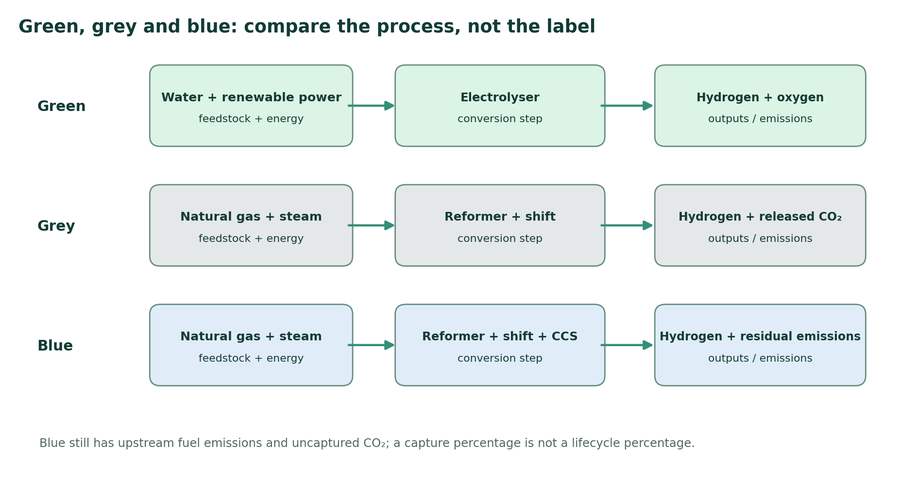
Figure 2. Green, grey and blue describe different feedstock and processing pathways. The blue route includes capture but can retain uncaptured and upstream emissions.
A capture rate is usually the portion of a specific capturable carbon dioxide stream that is collected. It is not automatically the percentage of all lifecycle greenhouse-gas emissions removed. For instance, upstream methane leakage can persist even when the reformer captures much of its process CO₂. Blue hydrogen can therefore have substantially different climate performance across projects. [1, 6]
6. An easy example: why 90% capture does not mean 90% cleaner
Consider a hypothetical natural-gas hydrogen plant with 9 kg CO₂-equivalent of process emissions and 2 kg CO₂-equivalent of upstream emissions per kilogram of hydrogen. Its starting total is 11 kg CO₂e/kg H₂. Now imagine a capture system removes 90% of the 9 kg process portion, while the upstream part stays at 2 kg. This simplified teaching model intentionally ignores extra capture-energy consumption and changes in gas use.
Illustrative emissions accounting when capture applies to process emissions only. All quantities must have the same kg CO₂e/kg H₂ boundary.
With 90% capture of the process portion, the simplified result is 2.9 rather than 1.1 kg CO₂e/kg H₂.
Here the reduction is (11 − 2.9) / 11 = 73.6%, not 90%. If capture covered only 60% of process emissions, the simplified remainder would be 9 × 0.40 + 2 = 5.6 kg CO₂e/kg H₂. These numbers are constructed classroom assumptions, not measured emission factors for blue-hydrogen plants.
The total percentage reduction must use the total starting emissions as denominator, not just the portion subject to CCS.
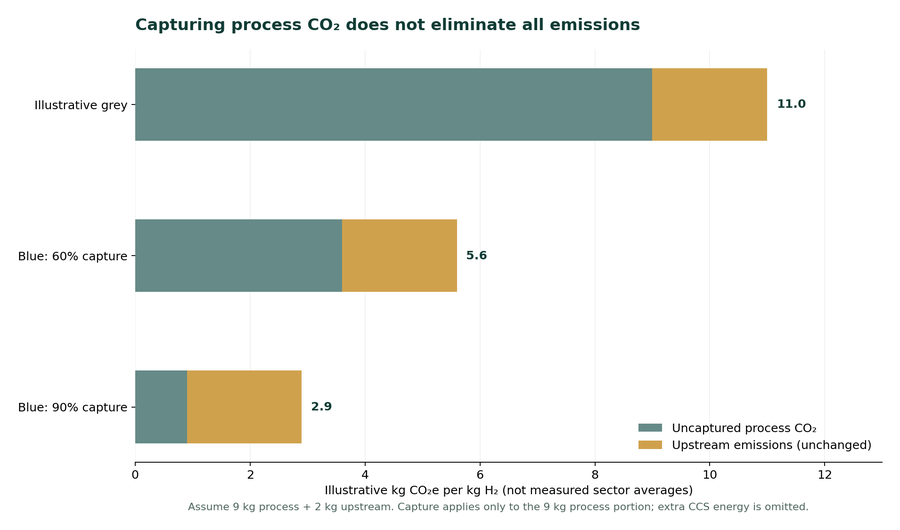
Figure 3. An illustrative mass-balance example: higher capture of one process stream does not remove all upstream emissions.
7. Brown and black hydrogen: coal-based production
Brown and black labels are often associated with coal gasification, sometimes distinguishing lignite (brown coal) from bituminous (black coal). Coal is reacted at elevated temperature with gasifying agents to form a synthesis gas; hydrogen is separated after further processing. Unabated coal routes typically have high greenhouse-gas emissions because carbon-rich coal serves as feedstock and energy input. [2, 4]
IEA 2024 estimates around 22–26 kg CO₂e/kg H₂ for unabated coal-based hydrogen in a global production discussion. The range depends on project boundaries and actual processes. Coal-derived hydrogen with CCS may be described as blue by some authors, which again illustrates that colour labels alone are ambiguous. [2]
8. Turquoise hydrogen: methane splitting into solid carbon
Turquoise hydrogen usually means hydrogen produced by methane pyrolysis. Rather than oxidising methane into CO₂ as part of reforming, the idealised reaction splits methane into hydrogen and solid carbon. Whether this technology delivers low lifecycle emissions depends on the heat source, methane supply chain, reactor operation, carbon handling and the ultimate fate of the solid carbon. It is not automatically zero-carbon. [3, 7]
Ideal methane pyrolysis: one methane molecule becomes solid carbon and two hydrogen molecules; external heat or energy is still needed.
Useful or durable management of the solid carbon may improve economics, but its market value and long-term fate should not be assumed. This pathway is technologically distinct from both conventional SMR and renewable water electrolysis.
9. Pink, purple and red hydrogen: nuclear energy
Pink and purple hydrogen generally refer to using nuclear energy to produce hydrogen, commonly through electrolysis using nuclear electricity. Some sources use red as an additional nuclear-related label. High-temperature systems may also use nuclear heat. Nuclear generation is low-carbon in operation but is not classified as renewable under most definitions because it uses mined nuclear fuel. [1, 3, 4]
The key question remains the same as for renewable-powered electrolysis: what electricity and heat actually power the system, which technologies are included within the boundary, and what lifecycle emissions result? Colour names are not a substitute for an audited emissions figure.
10. Yellow hydrogen and grid electricity: a label with two meanings
Yellow is especially inconsistent: some diagrams use yellow for grid-powered electrolysis; others assign it to solar-powered hydrogen. A reader should always look for a written definition. If an electrolyser is connected to a grid containing both fossil and low-emissions power, its emissions depend on the electricity source, operating hours and any credible matching or additionality rules. [1, 3]
11. White or natural hydrogen: a geological resource
White hydrogen, sometimes called natural or geologic hydrogen, refers to hydrogen that occurs naturally underground, rather than being manufactured in an electrolyser or reformer. Researchers investigate how hydrogen forms, moves, accumulates and can potentially be recovered from geological formations. The USGS emphasises that recoverable resources, extraction economics and environmental consequences remain uncertain. [8]
This category is unusual because naturally occurring hydrogen may represent a primary energy resource, in contrast with manufactured hydrogen. Even if an underground hydrogen accumulation is recoverable, extraction, purification, compression, transport and associated gas emissions still require lifecycle assessment.
12. Which type of hydrogen has the lowest emissions?
A reliable answer must compare a common emissions measurement boundary, not simply match colours. A “well-to-gate” calculation can include raw-material supply, energy production, plant operation, carbon capture and hydrogen processing to a specified delivery point. A “well-to-wheel” or full-use comparison adds more downstream steps. Different boundaries cannot be compared fairly. [6, 9]
The International Energy Agency explicitly avoids using colours as the classification for low-emissions hydrogen. Instead, it evaluates the emissions intensity of the pathway and sets conditions for low-emissions fossil-plus-CCS routes: very low upstream emissions, high capture across CO₂ streams and permanent storage. [1, 6]
13. Worked example: electricity can outweigh the colour label
Suppose an electrolyser consumes 52 kWh of purchased electricity to produce 1 kg of hydrogen at a defined plant meter. For a simplified electricity-only estimate, multiply the electrical energy requirement by the greenhouse-gas intensity of the supplied electricity. This estimate intentionally leaves out equipment manufacturing, water-treatment impacts, storage and transport. It is not a verified lifecycle footprint.
Electricity-associated kg CO₂e/kg H₂ = purchased electricity (kWh/kg H₂) times electricity emissions intensity (kg CO₂e/kWh).
At 0.40 kg CO₂e/kWh the electricity contribution alone is 20.8 kg CO₂e/kg H₂.
At 0.05 kg CO₂e/kWh the electricity-only result is 2.6 kg CO₂e/kg H₂; at 0.70 kg CO₂e/kWh it is 36.4 kg CO₂e/kg H₂. These are hypothetical intensity inputs, not country-specific grid factors or certified footprints. They show why “hydrogen made with an electrolyser” is not the same statement as “low-emissions hydrogen.”
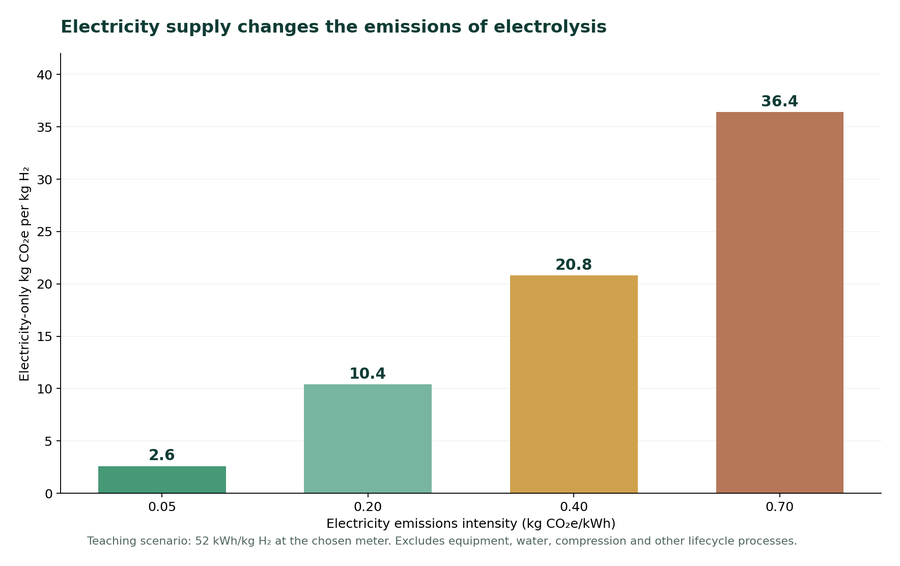
Figure 4. Electricity emissions intensity can dramatically change electrolysis emissions; full lifecycle assessment requires more terms.
14. Is green hydrogen always cheaper than blue hydrogen?
No. The economics depend on local electricity prices, natural-gas prices, capital investment, plant operation, CO₂ transport and storage, financing, water needs, policy rules and delivery location. A simple “green costs X, blue costs Y” claim without a date, geography and system boundary is not dependable. Renewable-based hydrogen has historically tended to cost more than unabated fossil-derived hydrogen, but both technologies and price conditions change. [6]
Costs are also sensitive to how often equipment operates. A solar-powered electrolyser that runs only when sunlight is available pays its capital costs over fewer operating hours than a plant with sufficient continuous electricity. A blue-hydrogen design needs to account for capture equipment, additional energy, CO₂ handling and permanent storage. Use project-specific data for real investment decisions.
15. Can hydrogen produced from biomass be low emissions?
Yes, potentially. Biomass or biogas can provide carbon-containing feedstocks for hydrogen production, and some pathways may pair conversion with carbon capture and storage. The outcome depends on the sustainability of the feedstock, land-use changes, transport, process energy and what happens to the biogenic carbon. Many biomass pathways do not have a widely agreed hydrogen colour, another reason to focus on production details. [3, 4, 6]
16. How to compare any hydrogen pathway responsibly
Ask five questions: (1) What is the feedstock? (2) Which electricity, fuel and heat sources are used? (3) Are process and upstream greenhouse gases included? (4) If CO₂ is captured, which streams and what permanent storage are verified? (5) At what point is hydrogen measured, and is its emissions intensity independently supported? These checks reveal more than the colour name alone.
For beginners, the simplest rule is this: a hydrogen colour tells you something about its usual pathway; an emissions-intensity figure with a transparent boundary tells you much more about its environmental performance. Compare climate, cost, water, infrastructure and safety impacts separately rather than assuming one colour “wins” in all circumstances.
Quick knowledge check
Question 1. Can hydrogen from a grid-powered electrolyser have high greenhouse-gas emissions? Answer: Yes. Electricity may be generated from fossil fuels; at 52 kWh/kg and 0.40 kg CO₂e/kWh, the electricity-only contribution is 20.8 kg CO₂e/kg H₂.
Question 2. Why does 90% CO₂ capture not imply a 90% lifecycle emissions reduction? Answer: Capture may apply only to particular process streams, leaving upstream methane and uncaptured emissions.
Question 3. What is produced alongside hydrogen by methane pyrolysis? Answer: Solid carbon in the ideal reaction; the climate benefit depends on heat supply and the solid carbon fate.
Question 4. Is white hydrogen necessarily ready for commercial extraction? Answer: No. Geologic discovery, resource assessment, recoverability and environmental management remain active research topics.
Key takeaways
Green hydrogen commonly uses renewable-powered electrolysis; grey uses unabated fossil feedstocks; blue adds CO₂ capture; turquoise uses methane pyrolysis; pink/purple commonly imply nuclear-powered production; and natural white hydrogen occurs in geological formations. These useful labels are not universal definitions or emissions guarantees. Assess measured or modeled lifecycle greenhouse-gas emissions at comparable boundaries, and be careful about methane leakage and electricity supply.
Continue learning: explore What Is Green Hydrogen?, How Does Water Electrolysis Work? and the Renewable Energy Fundamentals learning path. For deeper engineering comparisons, see the Green Hydrogen topic hub.
Technical discussions describe general principles; site-specific engineering decisions require appropriate professional evaluation.