
RENEWIOSITY / EXPLAINER
What Is Solar Energy? How Sunlight Becomes Useful Power
From photons and solar cells to rooftop systems and power calculations: a clear, engineering-informed introduction to solar energy.
Learning objectives
- Define solar energy and distinguish photovoltaics, solar thermal systems and concentrating solar power.
- Describe photon absorption, charge separation and DC electricity production in a silicon solar cell.
- Identify major components of a practical rooftop PV system and explain the role of an inverter.
- Calculate approximate module power and daily energy using irradiance, area, efficiency and peak sun hours.
- Evaluate the benefits, limitations and environmental considerations of solar electricity.
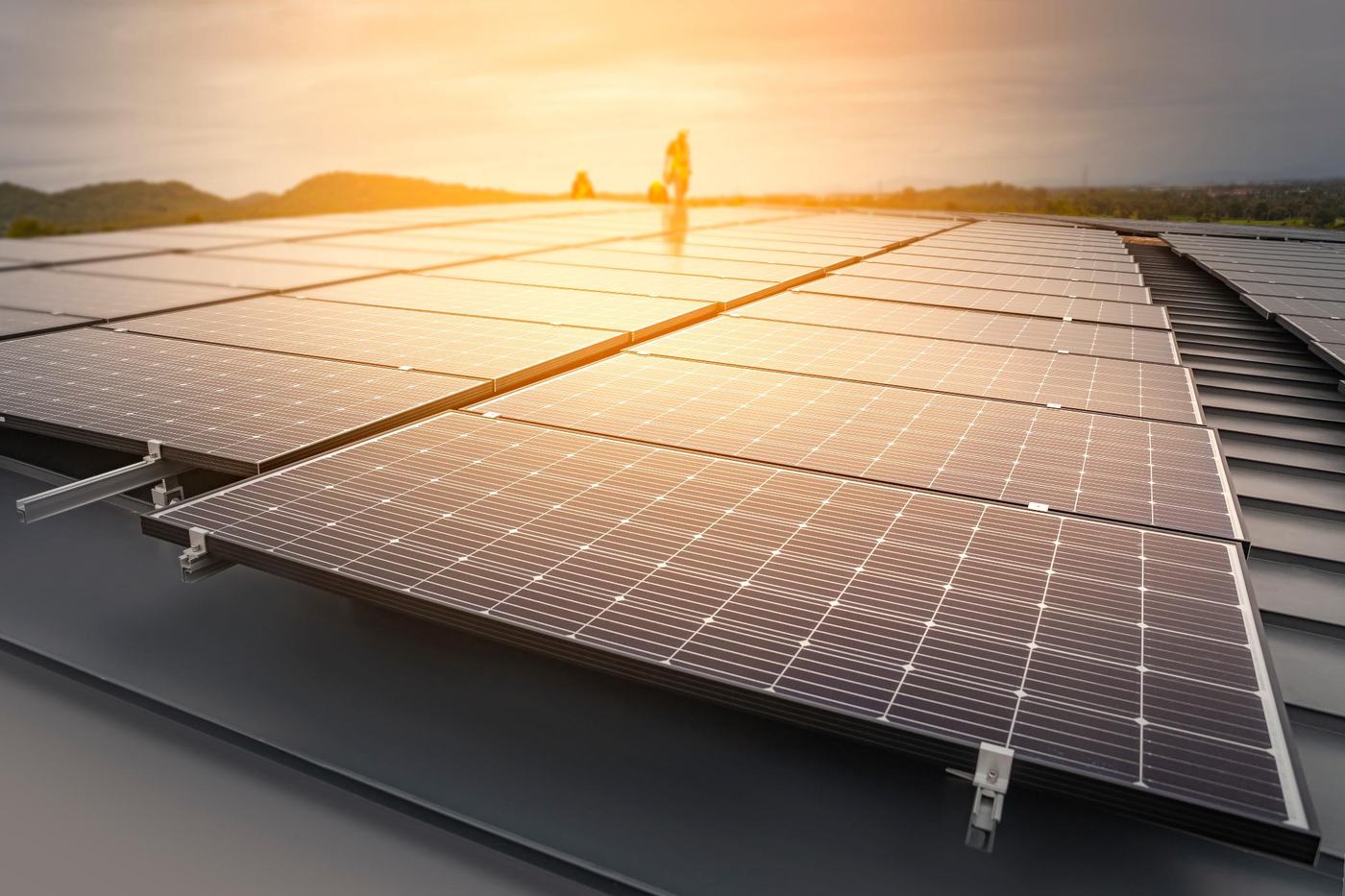
Every second, the Sun sends an enormous amount of energy into space. A tiny fraction reaches Earth, where it warms our atmosphere, drives weather systems, supports plant growth and makes life possible.
Today, that same sunlight is helping power homes, businesses, factories and entire cities. Consider a solar panel resting quietly on a rooftop. It contains no spinning blades, burns no fuel and produces no exhaust. Yet when sunlight reaches its surface, light energy is converted directly into electricity.
How is that possible? What happens inside a solar cell? And why has solar energy become one of the most important technologies in the global energy transition? To understand solar power, we need to begin with the energy itself.
1. What Is Solar Energy?
Solar energy is the energy carried by electromagnetic radiation emitted by the Sun, which can be captured and converted into useful heat, electricity or other forms of energy.
Its ultimate source is nuclear fusion occurring deep inside the Sun. Under immense temperatures and pressures, hydrogen nuclei combine through a sequence of nuclear reactions to form helium, releasing energy. That energy eventually travels outward and leaves the Sun as electromagnetic radiation. Approximately eight minutes later, sunlight reaches Earth.
Solar energy is considered renewable because the Sun continuously supplies energy on timescales relevant to human civilization. Unlike coal, petroleum or natural gas, sunlight does not need to be extracted from underground deposits or replenished through a fuel supply chain.
However, sunlight has an important characteristic: its availability varies with the time of day, weather, season and geographic location. This distinction between an abundant energy resource and a continuously available electricity supply is central to understanding both the promise and the engineering challenges of solar power.
2. How Much Solar Energy Reaches Earth?
Sunlight arrives at Earth’s surface as a combination of direct and scattered radiation. On a clear day, a surface facing the Sun may receive approximately 1,000 watts of solar radiation per square meter under favorable conditions. That is a power density of 1 kW/m².
Imagine placing a flat, one-square-meter surface directly in strong sunlight. At an irradiance of 1,000 W/m², approximately 1,000 joules of solar energy strike that surface every second.
The surface does not automatically convert all this energy into electricity. Some light may be reflected, some may pass through the material, and some becomes heat. A solar technology must capture part of the incoming radiation and convert it into a useful form.
The available solar resource also changes with location. Cloud cover, atmospheric conditions and seasonal changes matter greatly. An unusually sunny location is not necessarily the one with the highest electricity output per installed panel: temperature, equipment design and operating conditions also play important roles.
3. The Three Main Ways We Use Solar Energy
Solar photovoltaic (PV) technology: Photovoltaic devices convert sunlight directly into electrical energy using semiconductor solar cells. These cells are assembled into panels and deployed on rooftops, building façades, open land and other suitable locations.
Solar thermal technology: Solar thermal systems capture sunlight and convert it into heat. Examples include solar water heaters and collectors serving industrial processes, space heating or cooling systems.
Concentrating solar-thermal power (CSP): Mirrors concentrate sunlight onto a receiver to provide high-temperature heat. The heat can run a thermodynamic power cycle and electrical generator. Some installations include thermal energy storage.
The essential distinction is straightforward: photovoltaics convert light directly into electricity; solar thermal systems first convert light into heat. Their engineering requirements and applications differ.
4. How Do Solar Panels Generate Electricity?
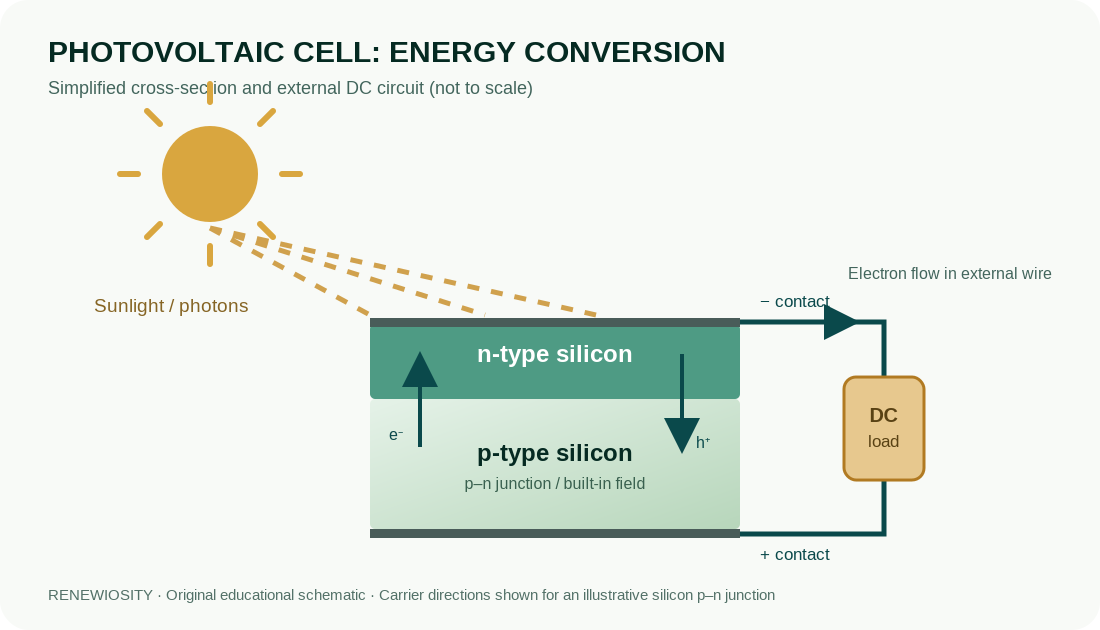
The operation of a solar panel begins with the photovoltaic effect. Most conventional solar cells are made from crystalline silicon, a semiconductor whose electrical properties can be controlled by composition, structure and processing.
Step 1, photon absorption: Sunlight consists of photons. When light strikes a solar cell, some photons are reflected, while others enter the semiconductor and may be absorbed. A photon must have sufficient energy to generate useful charge carriers.
Step 2, charge generation: Absorbed photon energy can excite an electron, leaving a corresponding hole. These electron–hole pairs are mobile charge carriers.
Step 3, charge separation: A typical silicon solar cell contains differently doped regions forming a p–n junction. The built-in electric field helps separate charge carriers, while optimized contacts collect them with reduced losses.
Step 4, electrical current: When the cell is connected to an external electrical circuit, charge flows through the load. Conventional photovoltaic modules deliver direct current (DC).
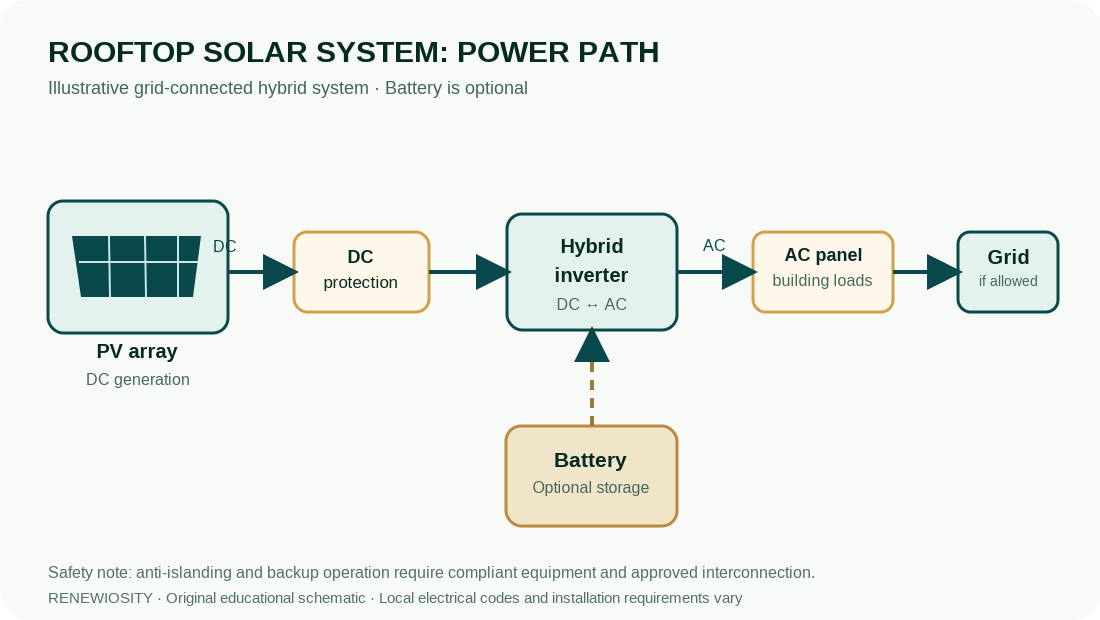
Step 5, inversion: An inverter converts DC power into alternating current (AC), allowing operation with most household electrical systems and electricity grids.
The energy pathway is sunlight → photovoltaic cell → DC electricity → inverter → AC electricity. Unlike conventional power stations, the PV cell requires neither a heat engine nor a rotating generator to create electrical output.
5. What Are the Main Components of a Solar Power System?
Solar modules: These house interconnected photovoltaic cells and provide the primary electricity-generating surface.
Mounting structures: These secure panels and determine their orientation and tilt. They must withstand environmental loads over a long service life.
Inverters: Power electronics convert DC into AC, monitor performance and support safe grid interconnection.
Cables, disconnects and electrical protection: Conductors, isolation devices, earthing/grounding and other protective equipment support safe operation.
Monitoring and optional storage: Monitoring helps diagnose performance; batteries can store part of the generated energy but are not required by every system.
A rooftop installation and a utility-scale solar farm use the same underlying semiconductor principles but differ significantly in physical scale, equipment layout, maintenance, and grid-integration requirements.
6. Understanding Solar Panel Efficiency
Conversion efficiency measures the fraction of incident solar radiation that becomes useful electrical power. A module with 20% efficiency converts approximately one-fifth of the incoming solar power into electricity under the specified conditions.
Some photons have insufficient energy to generate charge carriers. Excess photon energy may be lost as heat. Additional losses arise from reflection, resistance, recombination and other physical processes.
Temperature is also important. Most conventional crystalline-silicon modules deliver less electrical power as cell temperature rises, all else being equal. This is why a very hot panel may underperform relative to its laboratory rating despite strong sunshine.
Improving photovoltaic efficiency requires progress in materials science, optical design, semiconductor physics, contacts, fabrication and thermal management.
7. The Engineering Behind Solar Power: A Simple Calculation
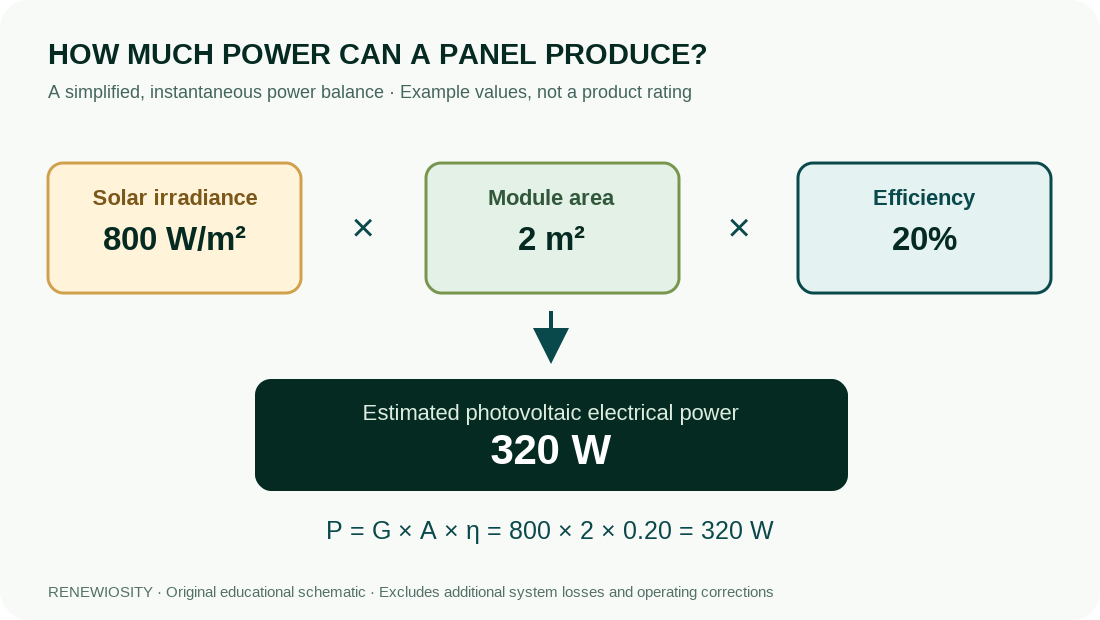
For a simplified photovoltaic device, incident solar irradiance multiplied by illuminated collector area and conversion efficiency estimates electrical power at the operating condition. This calculation is suitable for first-order engineering estimates, not a complete system-design forecast.
PPV is electrical power in W, G is plane-of-array solar irradiance in W/m², A is illuminated area in m², and η is a dimensionless conversion efficiency.
Worked example: electricity from one panel
A solar module has an area of 2 m². Incident irradiance is 800 W/m², and its assumed efficiency is 20%. Estimate its electrical output.
- Convert the efficiency to decimal form: η = 0.20.
- Multiply irradiance by illuminated area: 800 W/m² × 2 m² = 1,600 W of incident solar power.
- Multiply by efficiency: 1,600 W × 0.20 = 320 W.
Result: approximately 320 W of electrical power. This illustration neglects extra operating corrections and downstream electrical losses.
Actual output varies with cell temperature, orientation, shading, spectral effects and electrical losses. Nameplate ratings are generally measured under Standard Test Conditions, including irradiance of 1,000 W/m² and cell temperature of 25 °C. Outdoor conditions often differ substantially.
8. How Much Electricity Can a Rooftop Solar System Generate?
Electrical power (kW) describes the rate of generation; electrical energy (kWh) describes generation accumulated over time. A 5 kW array does not generate 5 kW continuously throughout the day.
Peak sun hours represent daily solar irradiation as an equivalent number of hours at 1,000 W/m². A simple energy estimate multiplies installed DC power capacity by average peak sun hours and a performance ratio representing temperature, inverter, wiring and other losses.
E is daily electrical energy in kWh, P is DC nameplate power in kW, H is peak sun hours per day in h/day, and PR is dimensionless.
Worked example: 5 kW rooftop array
Assume 5 kW DC installed capacity, four peak sun hours per day, and a performance ratio of 0.80.
- Multiply rated power by peak sun hours: 5 kW × 4 h/day = 20 kWh/day.
- Apply the performance ratio: 20 kWh/day × 0.80 = 16 kWh/day.
- If these are representative annual-average conditions, multiply by 365 days to estimate annual energy.
Estimated energy: 16 kWh/day, or about 5,840 kWh/year. This is an educational example; real forecasting requires local irradiance data, shading, equipment and operating models.
9. Do Solar Panels Work When It Is Cloudy?
Yes. Photovoltaic systems can generate electricity under cloudy conditions because diffuse sunlight still reaches the panels. Output generally declines as clouds reduce irradiance, but the magnitude varies.
Panels can also produce electricity in winter when sunlight is available. Cooler cell temperatures may improve conversion performance, although seasonal daylight and irradiation still strongly affect energy production. Solar cells need incoming light, not hot air.
10. Can Solar Power Supply Electricity at Night?
An ordinary photovoltaic array does not generate meaningful electricity without incoming sunlight. Batteries can store energy produced earlier. Electricity networks can balance solar output with other generation, storage, transmission and flexible demand.
A solar-battery installation can sometimes provide backup during a grid outage, but only when its inverter and wiring are designed and configured for that mode. Conventional grid-connected solar systems generally shut down during an outage to prevent unsafe energization of utility conductors.
11. What Are the Main Advantages of Solar Energy?
Widely available resource: Sunlight reaches diverse regions, although its quantity and seasonality differ.
Low operational emissions: Photovoltaic electricity generation requires no continuous combustion of fossil fuels and emits no combustion exhaust while operating.
Modularity: Systems scale from small stand-alone devices to major utility installations.
Potentially long service life: Well-designed modules can operate for decades, typically with gradual performance degradation.
Distributed electricity generation: Rooftop systems can generate electricity close to where it is used, subject to local grid and economic conditions.
12. What Are the Limitations of Solar Energy?
Variability: Output changes with irradiance and cannot be commanded to full power on demand.
Land and area needs: Large amounts of electricity require adequate collection surface, with possible land-use tradeoffs.
Upfront investment: Module, installation, protection, financing and interconnection costs are incurred before most energy savings.
System integration: Higher solar penetration can create challenges in balancing electricity supply, network capacity and voltage regulation.
Manufacturing and end-of-life impacts: Materials processing, energy use, waste management and recycling are significant lifecycle considerations.
Aging and maintenance: Modules degrade over time; inverters and balance-of-system components may need service or replacement.
13. Is Solar Energy Environmentally Friendly?
Solar photovoltaic electricity generally has much lower lifecycle greenhouse-gas emissions than coal- or gas-fired generation, but operational emissions are not the same as whole-lifecycle impacts.
Silicon refining, glass and aluminum production, module fabrication, equipment transport, installation and end-of-life handling all require materials and energy. Lifecycle assessment evaluates these processes together.
IEA Photovoltaic Power Systems Programme research shows that results vary with technology, manufacturing conditions, local sunlight and service lifetime. Responsible supply chains, installation practices, land use and recycling remain important.
The strongest environmental claim is not that a solar system has zero lifecycle impact, but that well-planned solar generation can contribute substantially to reducing electricity-sector emissions.
14. Why Is Solar Energy Growing So Rapidly?
Solar PV has developed from a niche technology into a major component of the global electricity system.
According to the International Energy Agency’s Global Energy Review 2026, global solar photovoltaic generation increased by approximately 600 terawatt-hours in 2025, reaching nearly 2,700 TWh and exceeding 8% of global electricity generation. Solar PV additions surpassed 600 gigawatts in 2025, bringing cumulative installed PV capacity to around 2,800 GW.
These increases reflect technological advances, economies of scale, industrial manufacturing growth and the demand for low-emissions electricity.
Expansion also makes electricity-system design increasingly important. Transmission, storage, flexible demand and modern power electronics help networks use solar energy reliably and economically.
15. What Does the Future Hold for Solar Energy?
Research now extends beyond conventional crystalline-silicon devices. Tandem solar cells combine materials with different light-absorption properties to capture a larger fraction of the solar spectrum.
Perovskite-on-silicon tandem devices are a prominent example, but translating strong laboratory performance into dependable commercial modules requires proven durability, scalable manufacturing and acceptable cost.
Other innovations involve recycling, longer-lived power electronics, forecasting, building integration and electricity storage. Future solar installations may be judged not only by how much electricity they generate but also by how intelligently they support the broader energy system.
16. Frequently Asked Questions
Is solar energy the same as solar electricity? No. Solar energy refers broadly to energy originating from the Sun. Solar electricity is one useful output from photovoltaic or solar-thermal electrical generation.
What is the difference between a solar cell and a solar panel? A solar cell is an individual light-to-electricity device. Multiple cells are connected and packaged to form a module, commonly called a panel.
Do solar panels work without batteries? Yes. Many grid-connected PV installations operate without battery storage.
Do solar panels work in cold weather? Yes. Irradiance matters more than air temperature; cooler cell operation often benefits electrical performance.
How long do solar panels last? Many modules are designed for productive operation of 25 years or longer, with output typically declining gradually.
Is solar energy always cheaper? Not necessarily. The answer depends on local costs, financing, tariffs, sunlight, operating performance and how the electricity is used.
17. Check Your Understanding
A PV module receives 900 W/m² across 1.8 m² and converts 19% of incident radiation into electrical power. Find its idealized output in watts. State one real-world factor that might change the result.
Reveal worked answer
Incident power is 900 × 1.8 = 1,620 W. Electrical output ≈ 1,620 × 0.19 = 307.8 W. Actual power also depends on cell temperature, shading, module angle and system losses.
Explain, in one or two sentences, why a standard grid-connected rooftop array usually cannot keep a house energized during a grid outage.
Reveal worked answer
Grid-connected inverters generally include anti-islanding protection and disconnect when grid power fails to prevent unsafe export onto de-energized lines. Backup operation requires an appropriately designed backup-capable inverter and isolation equipment.
18. Final Thoughts: Learning to Think in Terms of Energy
Solar energy illustrates an important lesson about modern engineering: an abundant natural resource becomes valuable when science and technology allow us to use it effectively.
A photovoltaic cell is fundamentally a semiconductor device governed by the physics of light, matter and electrical charge. A successful installation is also an electrical system, a structural project, an economic investment and part of a larger energy network.
Asking how much energy a system produces, where its losses arise, how storage should be chosen and how grids should adapt turns a familiar rooftop technology into a substantial engineering discipline.
The future of solar power will depend not only on capturing more sunlight, but also on making better decisions about how that energy is converted, managed, stored and used. That is where science, engineering and curiosity meet.
Continue learning: Ready to explore the physics behind photovoltaic electricity? Read our detailed guide, How Do Solar Panels Work?, covering semiconductor physics, the photovoltaic effect, efficiency and practical engineering calculations.
Technical discussions describe general principles; site-specific engineering decisions require appropriate professional evaluation.