
RENEWIOSITY / EXPLAINER
Renewable Energy vs Clean Energy vs Sustainable Energy: What’s the Difference?
Renewable describes a replenishing source, clean describes emissions or pollution, and sustainable evaluates wider long-term impacts. Compare solar, wind, hydro, biomass and nuclear using clear criteria, examples and a life-cycle calculation.
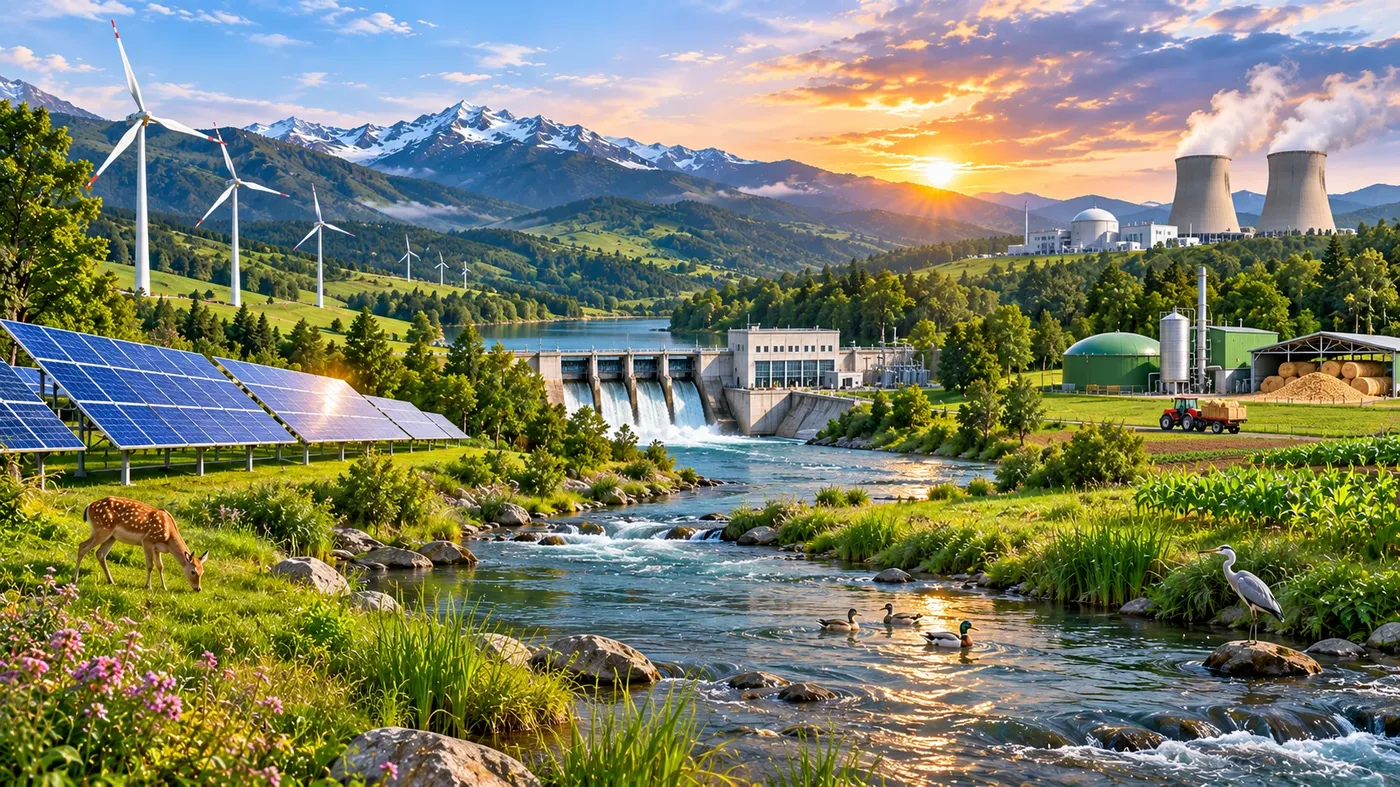
Imagine two electricity projects. One uses a river to turn turbines; the other uses uranium fuel in a nuclear reactor. A visitor calls the river project “renewable” and the nuclear plant “clean.” Someone else calls both “sustainable.” Are all three labels saying the same thing? No. Each label asks a different question, and an energy source can satisfy one without automatically satisfying the others [1–4].
These words appear in government plans, product advertisements, school textbooks and conversations about climate change. Their overlap makes them useful, but also easy to misuse. This article offers a practical framework for comparing energy options fairly, without treating a single reassuring adjective as proof that all environmental and social problems have been solved.
Learning objectives
- Explain renewable energy as a resource-replenishment concept and identify common renewable sources.
- Distinguish low-emissions or clean energy classifications from renewable-source classifications.
- Evaluate sustainable energy using environmental, social and economic evidence across the full life cycle.
- Classify nuclear energy, hydroelectricity, biomass, solar and wind without assuming that one label proves another.
- Calculate a simple illustrative life-cycle greenhouse-gas intensity with consistent units and stated boundaries.
- Ask better questions about energy claims, including emissions, land and water effects, access, reliability and end-of-life management.
1. What is the difference in one sentence?
Renewable asks where energy comes from and whether nature replenishes its source on a human-relevant timescale. Clean usually asks whether an energy source or technology produces low greenhouse-gas emissions or low pollution, although the precise meaning depends on the scheme. Sustainable asks whether the whole arrangement can meet energy needs over time without unacceptable environmental, social or economic damage [1,2,6].
Think of the three labels as questions rather than medals. A project can be renewable but badly designed for its local ecosystem. Nuclear power is not renewable, yet it can supply low-carbon electricity. A carefully designed energy system can combine several technologies while also taking account of affordability, reliable service and local community needs [4,8].
A useful reading habit is to ask, “Renewable in what sense? Clean by which measure? Sustainable according to which criteria and over what time period?” If a claim does not answer those questions, it may be incomplete even when it is not strictly false.
2. What does renewable energy mean?
The United Nations defines renewable energy in terms of natural sources replenished faster than they are consumed. Sunlight arrives continually; winds are driven by atmospheric processes; flowing water is sustained by the water cycle; geothermal systems use heat from within Earth. In statistical classifications, properly sourced biomass is also treated as renewable [1,10].
Renewability describes the source, not every consequence of extracting it. Solar panels need mined minerals, glass, silicon and infrastructure. A wind turbine requires steel and concrete. A dam transforms a river. All three use renewable energy flows, but their equipment and siting still have impacts.
The term does not mean infinite supply at a particular site. Droughts constrain hydropower, low winds reduce wind generation and poor land management can exhaust biomass resources. Renewable energy is a property of an underlying replenishing flow or resource, not a promise of uninterrupted power output.
Renewable electricity is not the same as renewable energy across the whole economy. Modern energy also supplies transport fuels, industrial process heat, heating and cooking. A country may make a large portion of its electricity from solar, wind and hydro while remaining heavily dependent on fossil oil for vehicles and gas for factories. This is why shares of renewable electricity must never be substituted for the renewable share of total energy without a clearly stated denominator. Our earlier historical article explains this distinction using observed international statistics [3,6].
3. What does clean energy mean?
“Clean energy” is less tightly defined across all contexts. In climate discussions it often means low-emissions energy, especially electricity produced with relatively little greenhouse gas over its life cycle. In air-quality discussions, clean may instead emphasize low smoke, sulfur dioxide, nitrogen oxides or particulate emissions at the point of use [2,3,12].
The IEA often groups renewables and nuclear together as low-emissions electricity. That is why a clean-energy statistic can include more generation than a renewable-only statistic. But clean is a shorthand, not a claim of literally zero emissions or no ecological effects [3,8].
A gas plant with pollution controls can be cleaner than an older coal plant in one limited comparison, yet it still emits fossil carbon dioxide when operating. When someone says “cleaner,” ask: cleaner than what, for which pollutant, under which boundary and by how much?
4. What makes an energy system sustainable?
A sustainable energy system aims to provide useful energy services over time while respecting multiple constraints: climate impacts, biodiversity, water resources, health, human rights, access, affordability, reliable supply and future generations. It is broader than counting renewable megawatts or measuring carbon dioxide alone [4,6,7].
For example, a very low-carbon project could still be socially harmful if its construction displaced households without adequate safeguards. A renewable fuel could fail a wider assessment if growing its feedstock destroyed forests or competed with food production. Similarly, a technology might be environmentally promising but unsuitable if an essential community cannot afford or reliably access its service [4,6].
There is no universally agreed single pass-or-fail sustainability label for every energy project worldwide. Some schemes set specific screening rules, such as the European Union taxonomy. The careful approach is to state criteria, evidence, location, technology design and trade-offs rather than assume that a resource name settles the question [7].
Sustainability is also a matter of time. A project may look beneficial in its first years but require costly replacement equipment, inadequate waste management or water consumption that becomes problematic during drought. Conversely, a project with upfront manufacturing impacts may deliver decades of useful energy and avoid much larger fossil-fuel emissions. Decisions should therefore compare realistic project lifetimes and the same energy service, with uncertainty documented, rather than judge a technology from one striking image or isolated number [4,5].
5. Three different questions, not three identical circles
The simplest comparison is to line up three questions side by side. The first concerns source replenishment. The second concerns greenhouse gases or pollution. The third considers long-term outcomes across environmental, social and economic dimensions. These questions overlap, but they are not interchangeable.
For instance, a well-sited solar farm can be renewable and low-emissions and may be strongly compatible with sustainability. But a poorly sited solar project can create habitat or land-use conflicts. The renewable status is largely unchanged while the sustainability evaluation changes. Figure 1 visualizes this distinction [4,5].
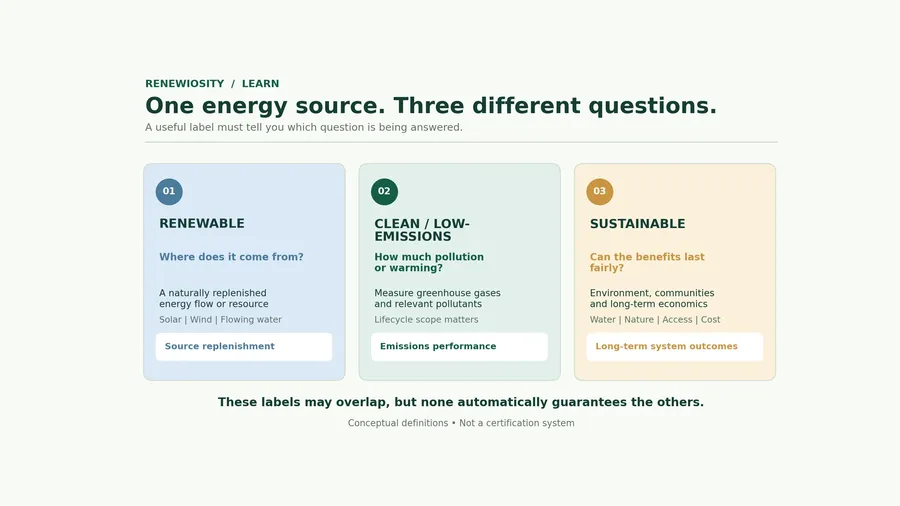
Figure 1. Three different questions: source replenishment, emissions and pollution, and long-term sustainability.
6. Is solar energy renewable, clean and sustainable?
Sunlight is a renewable energy flow, and solar photovoltaic generation generally has much lower life-cycle greenhouse-gas emissions than fossil-fuel generation. Most operating solar panels do not burn fuel to produce electricity, so direct combustion emissions are absent. However, making modules, glass, aluminum frames, electronics and mounting structures requires energy and raw materials [1,5].
Sustainability therefore includes manufacturing supply chains, land use, community consent, worker conditions, water demand where relevant, maintenance and end-of-life recovery. Rooftop solar on an appropriate building and a large solar project clearing sensitive habitat can have very different local outcomes despite using the same renewable source.
A good assessment specifies whether it covers only the generation phase or the whole installation, including manufacturing, grid connection, replacement parts and eventual decommissioning. It also avoids assuming that every kilowatt-hour generated at noon can be used without storage or grid support.
7. How about wind power?
Wind is renewable because atmospheric circulation continually replenishes it. Wind turbines have no combustion at the point of generation, and life-cycle studies generally place their emissions far below those of conventional fossil-fuel electricity. Steel production, foundations, transport, installation and maintenance still contribute to environmental impacts [1,5].
A sustainable wind installation also considers bird and bat interactions, landscape and noise concerns, community participation, offshore marine impacts, end-of-life materials and integration with the power system. Well-designed siting and operational practices can substantially reduce some impacts, while an unsuitable site can create avoidable harm.
So a wind farm can correctly be called renewable and low-carbon without that wording deciding whether its exact location and design are acceptable. Context matters more than the label alone.
8. Can hydropower be renewable but not sustainable?
Yes. Moving water is part of the replenishing water cycle, so hydropower is generally classified as renewable. Its electricity can also be low-carbon, but impacts differ substantially between projects. Reservoir construction can change land use, interfere with fish migration, alter sediment flow and affect people living upstream and downstream [4,9].
Some reservoirs, especially in certain tropical conditions, can also release methane as submerged organic matter decomposes. This is one reason analysts measure actual project conditions instead of assuming every dam has negligible climate impact. At the same time, hydropower can offer dispatchability and energy storage benefits valuable to a low-carbon grid [4,5].
A sustainability assessment asks whether ecosystem impacts were assessed and addressed, whether local and Indigenous communities participated meaningfully, how water is shared during dry periods, and whether benefits and costs are fairly distributed. The Hydropower Sustainability Standard is an example of a project-level assessment framework [9].
9. Why biomass is the most important cautionary example
Biomass uses recently living material, including agricultural residues, wood or purpose-grown energy crops. It can be grouped with renewables because new biological growth can replace harvested material. However, the carbon-accounting and sustainability outcomes depend heavily on feedstock, land-use changes, harvesting rates, combustion pollution and what would otherwise have happened to the material [4,10].
Burning biomass emits carbon dioxide at the point of use. Regrowth may absorb carbon later, but the timing matters, and there is no guarantee that harvesting, soil disturbance or land conversion will preserve carbon stocks. Burning forest material while claiming that it is automatically carbon-neutral because trees can regrow is an oversimplification.
Bioenergy from some wastes and residues can have useful climate and waste-management benefits, especially when produced under careful sustainability rules. Purpose-grown crops that replace forests, require large amounts of irrigation or displace food production may perform much worse. Renewable does not automatically mean clean, and neither label proves sustainable. [4]
The accounting of bioenergy often involves a counterfactual: what would happen to the land and feedstock if they were not used for energy? A residue that would otherwise decompose, a forest harvested beyond its regrowth rate and a new plantation replacing natural habitat are not equivalent cases. Transport, drying, conversion efficiency and the handling of co-products also affect the result. Credible sustainability claims need transparent supply-chain evidence instead of treating all biomass as one category [4].
10. Why nuclear energy is low-carbon but not renewable
Most nuclear power plants use uranium fuel obtained from finite mineral resources. Under the standard renewable-energy definition, nuclear power is therefore not renewable. Nevertheless, nuclear plants generate electricity without burning fossil fuel in their reactors and are widely treated as low-carbon electricity in energy-system assessments [3,8].
This does not make nuclear power impact-free. Mining, fuel processing, plant construction, cooling-water requirements, nuclear safety, radioactive waste management, decommissioning and public governance are part of its broader assessment. Differences in national regulation, geology and public acceptance also matter.
A balanced conclusion is neither “nuclear is renewable” nor “nonrenewable means high-carbon.” Its renewable classification is clear, its life-cycle greenhouse-gas emissions can be low, and its overall sustainability merits careful comparison of risks, alternatives and safeguards [5,8].
11. Where do natural gas and coal fit?
Coal and natural gas are fossil fuels formed over geological time; they are not renewable on the timescale of human societies. Burning either fuel for energy releases carbon dioxide. Coal also often produces considerable conventional air pollution unless pollution controls are present. Gas combustion generally emits less carbon dioxide per unit of useful energy than coal under comparable conditions, but upstream methane leakage can alter its broader climate performance [4,11].
Gas may be described as a transition fuel or as cleaner than coal under a specific emissions comparison. Those labels should not be mistaken for zero-carbon or renewable. Carbon capture can lower some plant emissions, but actual capture rates, upstream emissions, energy penalties and long-term carbon storage must be considered.
A fair comparison asks what energy service is delivered, the system boundary, and the realistic alternatives. Describing a gas plant as “green” without qualifying its emissions and operating assumptions can obscure the real climate trade-off.
12. A source-by-source comparison without false certainty
Figure 2 summarizes typical classifications for seven common energy sources. “Usually low-carbon” is intentionally different from “impact-free,” and the sustainability column is never a free pass. A project can be judged differently when its site, sourcing or operating practices change [4,5,7].
The table distinguishes low greenhouse-gas emissions from general environmental performance. This matters because a nuclear plant, wind farm and reservoir can all be low-emissions electricity sources while facing very different water, land, safety or social questions.
The table is a conceptual learning aid, not a regulatory certification or a substitute for a measured life-cycle assessment. If a product claims a verified sustainable label, check which formal standard and independent evidence support it.
An additional caution concerns the word “green.” It is widely used in marketing but usually does not specify a quantitative threshold. A statement such as “our plant uses green energy” should prompt readers to ask which electricity contract, generation assets, time matching, and accounting method are being invoked. Some systems use certificates or bookkeeping rules that are not identical to physical hourly electricity supply. For a general audience, the safest habit is to look for named metrics and documented evidence rather than rely on the color of the label [2,7].
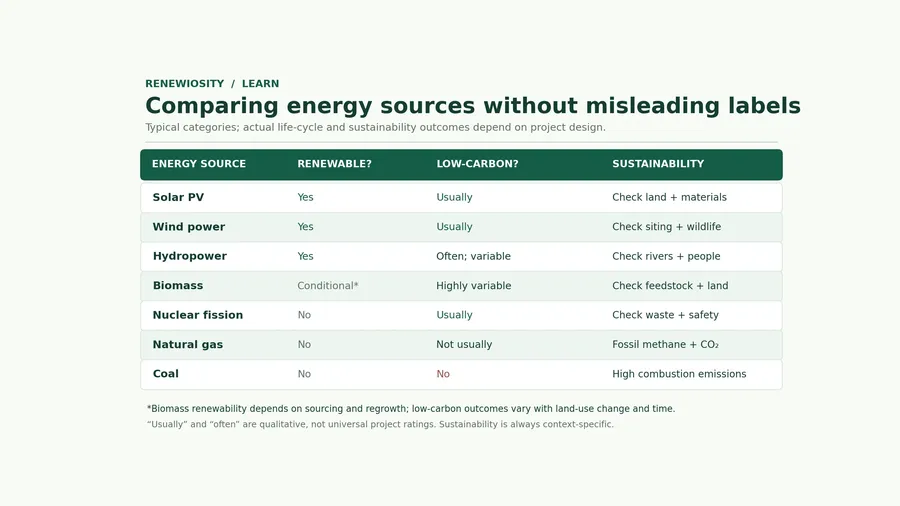
Figure 2. Conceptual energy-source classifications. “Usually low-carbon” does not mean pollution-free or sustainable at every site.
13. Why life-cycle assessment changes the answer
Looking only at the power station during operation can hide earlier and later impacts. A life-cycle assessment may include extraction of raw materials, equipment manufacturing, transport, construction, fuel supply if applicable, operation, maintenance, replacements, decommissioning and waste treatment. Analysts must declare the system boundaries and assumptions [5].
Lifecycle greenhouse-gas intensity is commonly expressed as grams of carbon dioxide equivalent per kilowatt-hour of electricity delivered (g CO₂e/kWh). This is useful for comparing climate impacts when methods and boundaries are consistent. It does not directly measure biodiversity damage, local air quality, labor conditions or energy affordability.
Figure 3 shows a simplified decision pathway: first identify the renewable source, next evaluate climate and pollution evidence, and then examine life-cycle and social criteria. A well-supported sustainability claim needs evidence at all relevant stages, not one attractive photograph or slogan.
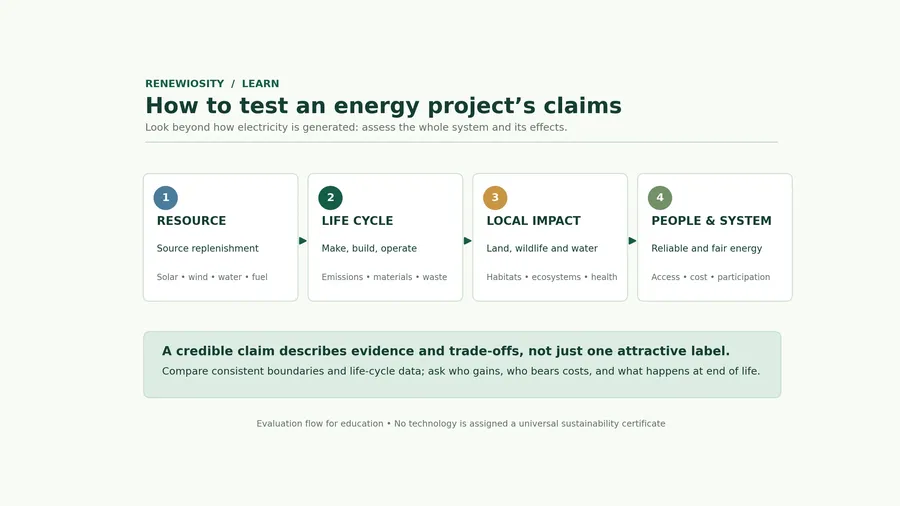
Figure 3. Evaluating a project requires evidence on source, life-cycle emissions, environment, communities and dependable energy service.
14. Worked example: the emissions hidden behind a low-carbon label
Consider a purely illustrative electricity project. Suppose its full defined life-cycle emissions total 30,000 metric tonnes of CO₂-equivalent, while its projected lifetime electricity output is 1,000 gigawatt-hours. This does not describe an actual solar, wind, nuclear or hydropower plant. It is simply a dimensional exercise.
Convert tonnes to grams (1 tonne = 1,000,000 g), and gigawatt-hours to kilowatt-hours (1 GWh = 1,000,000 kWh). Dividing the two totals gives an intensity of 30 g CO₂e/kWh. This value is not zero, even if the project has very low or no combustion emissions during operation. The result depends on the accounting boundary and lifetime output assumption.
For comparison, avoid substituting this invented result into a real technology ranking. Use a reputable source such as UNECE for real-life comparative assessment, and consider uncertainty, geography and the project’s operation. A low figure on this climate metric also does not answer the question of whether the project is socially or ecologically sustainable [5].
Illustrative lifetime screening example. Not a measured technology average.
15. Five questions to ask when someone says “green energy”
First: Is the source replenished in the relevant time frame? Second: What emissions or pollution are counted, and over which stages? Third: What local consequences arise for land, ecosystems, wildlife, water and nearby communities? Fourth: Does the system reliably provide affordable services? Fifth: Which independent evidence or recognized standard supports the claim?
This checklist helps both consumers and students interpret labels such as “100% clean electricity” or “sustainably sourced biofuel.” The first phrase might refer only to electricity purchased under a particular accounting arrangement, while the second may rely on specified feedstock rules. Neither should be accepted as an unlimited statement about all outcomes [6,7].
The same questions apply when comparing technologies for new power stations, school assignments or local policy discussions. Good terminology makes disagreements clearer because everyone can see which impact is being measured and which trade-off is being discussed.
16. Key takeaways and five review questions
Takeaway: Renewable describes the source; clean typically describes pollution or emissions performance; sustainable describes a broader ability to provide energy over time while respecting environmental, social and economic needs. These labels overlap, but none automatically proves the others.
Q1. Is nuclear energy renewable? Answer: No under the standard resource-replenishment definition; it is nevertheless considered a low-emissions electricity source. Q2. Can hydropower be renewable and still harm a river ecosystem? Answer: Yes. Reservoir and river impacts vary by project.
Q3. Is biomass always carbon-neutral? Answer: No. Supply chains, emissions timing and land-use changes matter. Q4. Does a low g CO₂e/kWh number prove sustainability? Answer: No, because other impacts and social or economic conditions are not measured by that single climate metric.
Q5. Why is a solar plant not literally zero-emissions over its full life cycle? Answer: Manufacturing, construction, materials, maintenance and eventual removal can create greenhouse-gas emissions even when the plant generates electricity without burning a fuel.
For a deeper foundation, read What Is Sustainability? and How Much of the World’s Energy Comes from Clean Sources?. Technical readers can explore our energy economics hub and industrial energy-efficiency hub.
Technical discussions describe general principles; site-specific engineering decisions require appropriate professional evaluation.