
RENEWIOSITY / EXPLAINER
What Is the Circular Economy? How Reuse, Repair and Recycling Reduce Waste
Learn how a circular economy reduces waste through reuse, repair and recycling, with real material-flow reasoning, life-cycle tradeoffs and a worked calculation.
Learning objectives
- Explain how a circular economy differs from a linear “take–make–dispose” system.
- Distinguish maintenance, reuse, repair, refurbishment, remanufacturing and recycling.
- Explain why preventing waste and extending useful life often have priority over material recycling.
- Apply a transparent mass balance to a hypothetical recycling stream.
- Compare repair and replacement using a clearly defined service and life-cycle greenhouse-gas boundary.
- Identify the limitations, trade-offs and fair-transition questions associated with circular solutions.
1. What is the difference between a linear and a circular economy?
In a linear economy, virgin resources are extracted, converted into materials and products, used, and often discarded. The familiar shorthand is take → make → use → dispose. This describes a common flow of goods, but the real economy also includes some recovery, reuse and recycling. The distinction is therefore one of overall design and dominant incentives, not an assertion that every existing product is disposed of once. [1]
A circular economy seeks to retain the value of products, components and materials through repeated and carefully managed use. The objective is to deliver useful services with fewer virgin inputs and less waste, while limiting pollution and avoiding practices that degrade ecosystems. Think of an office chair. Repairing a broken caster can preserve the chair and much of the work already invested in producing it. Shredding the whole chair into separated materials may recover some raw material, but it cannot preserve its existing assembly and function. [1,3]
Circularity should not be confused with the impossible promise of zero material loss. Real systems require energy, have collection and sorting losses, and may accumulate contaminants. The meaningful question is whether a proposed system produces better measured outcomes than a realistic alternative. [3–5]
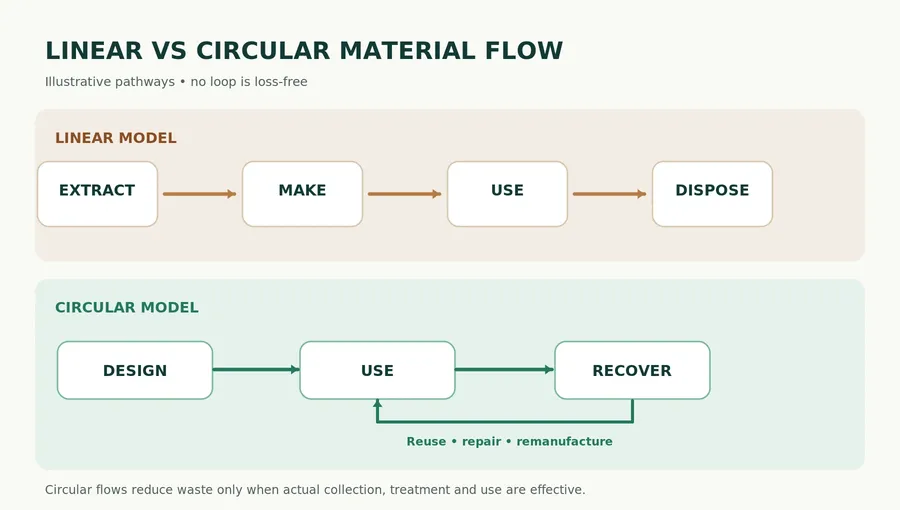
Figure 1. The linear path tends toward disposal; a circular system designs return loops for product life extension, component recovery and material recycling. The loops are illustrative, not loss-free.
2. What are the core principles of a circular economy?
A widely used framework describes three connected principles: eliminate waste and pollution by design; circulate products and materials at their highest useful value; and regenerate nature. These principles are not independent slogans. They affect product design, business incentives and how biological resources are managed. [1]
For example, a product designed with accessible fasteners and replaceable batteries is easier to maintain. A manufacturer that supplies spare parts and repair information can support longer use. A collection system that sorts components safely may improve recovery at end of life. Regenerative approaches in agriculture and land management must still be assessed for real ecological outcomes rather than assumed to succeed simply because they carry a circular label. [1,2]
The circular economy also depends on energy. Moving, cleaning, repairing and reprocessing materials consumes electricity and fuel. Decarbonizing those activities can improve their performance, but energy-efficient processing cannot compensate automatically for excessive material throughput. [2]
3. Why is preventing waste usually better than managing it later?
The European Union's waste hierarchy prioritizes prevention, followed by preparing for reuse, recycling, other recovery and, last, disposal. Prevention includes avoiding unnecessary products and extending product lifetimes before an item becomes waste. Preparing for reuse is a legal term for operations such as checking, cleaning or repairing items already classified as waste. [3,7]
The hierarchy is a useful general guide, not an unconditional ranking for every possible product. Under EU law, life-cycle analysis can justify a different choice when it provides a better overall environmental result. For instance, continuing to operate a highly inefficient, polluting appliance can sometimes be worse than replacing it with a substantially more efficient model. The comparison depends on the manufacturing impacts and the remaining service life. [3–6]
Avoiding waste also includes using a shared product more intensively, reducing excess packaging, choosing refillable systems where repeated cleaning and transport make sense, and designing buildings that can be adapted rather than demolished. None should be treated as automatically superior without considering their actual use patterns and impacts.
4. How do reuse, repair, refurbishment and remanufacturing differ?
Reuse means using a product or component again for its intended purpose without fundamentally remaking it. Maintenance keeps a functioning item in service, for example by cleaning a filter or lubricating a bearing. Repair restores a failed or degraded function, such as replacing a faulty switch. Refurbishment improves the condition or performance of an existing product, often through inspection and replacement of selected components. Remanufacturing is a more systematic industrial process in which components are recovered and a product is restored to specified performance requirements. [1]
These terms overlap in everyday language but are useful to distinguish technically because their resource and energy requirements differ. Remanufacturing a motor can preserve much of the machined housing while replacing worn bearings and winding insulation. Recycling the same motor usually breaks it down to material streams, losing more of its original shape and manufacturing value. This is why keeping a functioning product or component in service can be preferable to immediately melting and remaking it. [1,6]
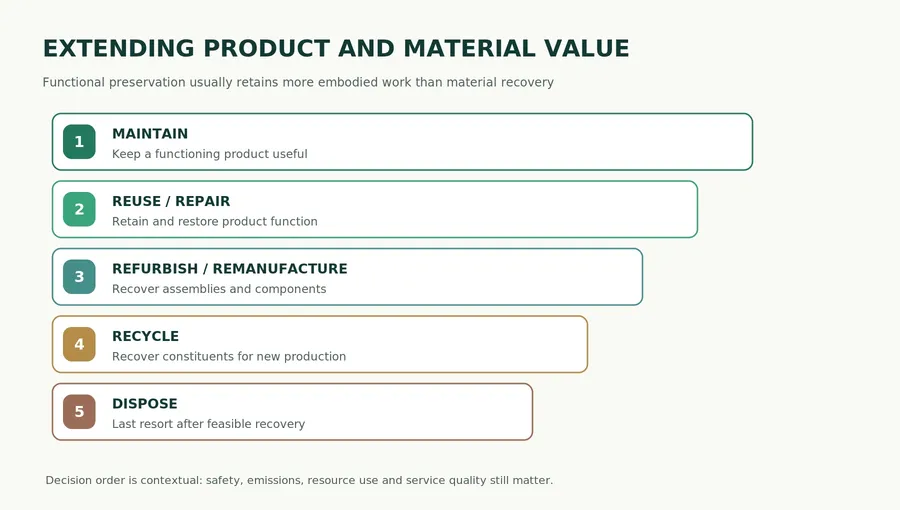
Figure 2. Higher-value loops preserve more of the existing product's function. Actual environmental outcomes still depend on energy, transport, losses and what service is delivered.
5. Why is recycling useful but not sufficient?
Recycling reprocesses discarded materials into new materials or products. It can reduce demand for some primary raw materials, but collection, sorting, contamination and processing losses limit recovery. Recycled material may also fail to replace virgin material in an equivalent application. Material quality matters, especially for composites, multi-material packaging and some plastics. [3]
Consider an object containing metals, plastics, adhesives and electronic parts. Separate collection is only the first step. Shredding and sorting may recover valuable metals while leaving mixed residual material. Chemical or thermal treatment may use energy or create emissions, and quality requirements may prevent direct substitution into the original product. Recycling is therefore an important end-of-use strategy, not a license to design short-lived disposable goods. [1,3]
Energy recovery is not the same as recycling. Burning waste to recover energy destroys the product's material value and is classified separately in the EU hierarchy. Likewise, calling a product “recyclable” does not establish that local collection and recycling infrastructure will actually recover it. [3]
6. How can product design extend useful life?
Much of a product's potential circularity is determined before it is sold. Designers can specify durable components, modular parts, accessible screws instead of permanent adhesive where appropriate, standardized connectors and materials that can be safely separated. Repair documentation and spare-part availability are equally important. A repairable product is of limited benefit if its replacement parts are unavailable or prohibitively expensive. [1,6]
Longevity must be assessed in the context of service. A refrigerator is not more sustainable merely because it is old; a model that consumes unusually high electricity could impose large use-phase impacts. Similarly, a smartphone with good hardware but unsupported security software may not be safe or useful. Longer life is beneficial when the product continues to provide appropriate function without excessive safety, energy or environmental penalties. [6]
Design for disassembly can improve repair and end-of-life recovery, but engineers also have to retain mechanical integrity, fire safety, waterproofing and other essential requirements. There is no single design rule that can optimize every product.
7. How do engineers quantify a material recovery loop?
A circular process can be evaluated using a straightforward mass balance. Define the boundary first: collection, sorting or final material recovery are distinct stages. Let Min be the mass collected, fsort the usable fraction after sorting, and ηrec the fraction of sorted material recovered in processing. Then the simplified recovered mass is:
Suppose a hypothetical collection service receives 1,000 kg of mixed material; 85% survives sorting and 80% of that sorted fraction becomes recovered material. The recovered amount is 1,000 × 0.85 × 0.80 = 680 kg, or 68% of the initial mass. The other 320 kg is outside the recovered stream; this does not establish whether it was disposed, rerouted or subjected to additional recovery.
The two yields must not be added. A high collection rate does not guarantee a high final recycling yield. Real audits also distinguish mass from value, contamination, material purity and actual displacement of primary material. [3]
8. How does circularity relate to greenhouse-gas emissions?
Making products and materials can release greenhouse gases during resource extraction, processing, electricity generation, manufacturing and transportation. A circular strategy may avoid some of those burdens by extending useful life or substituting secondary material for virgin input. It may also create new burdens from collection, logistics, cleaning or repair. [2,4]
A responsible emissions comparison needs a functional unit, a reference scenario, system boundaries and inventory data. For example, compare “providing the same cooling service in one building for four years,” not simply “one repaired refrigerator versus one new refrigerator.” The comparison should include the relevant production, repair, energy-use and end-of-life effects. If these are unknown, a result may be only a screening estimate. [4,5]
Circularity and lower carbon emissions are related but not identical. A higher recycled-content percentage is not proof of lower greenhouse-gas emissions across the full life cycle. Nor is a carbon-footprint result sufficient to capture toxicity, water stress, biodiversity or labor conditions.
9. Worked example: Repair or replace a product?
Assume a functioning but faulty appliance can be repaired for four additional years of equivalent service. For an illustrative greenhouse-gas comparison, suppose repair parts and the repair visit cause 12 kg CO₂e; continuing to operate the repaired appliance causes 50 kg CO₂e over four years. By contrast, producing and delivering a new, more efficient appliance causes 80 kg CO₂e and its four years of electricity use causes 40 kg CO₂e. Assume equal service, no rebound, and that disposal effects are omitted from both scenarios rather than silently assigned a zero value. These numbers are teaching assumptions, not measured emissions factors or product data.
For the repair pathway:
For replacement:
The illustrative difference is 120 − 62 = 58 kg CO₂e in favor of repair over this four-year boundary. This is not a universal rule: a much more energy-efficient new product, longer remaining service, major refrigerant leaks or other life-cycle factors could change the decision.
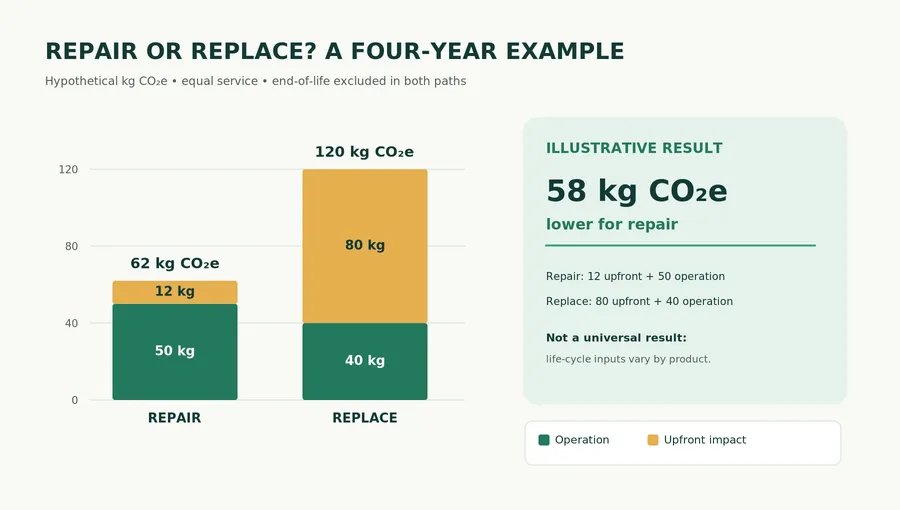
Figure 3. Hypothetical four-year life-cycle greenhouse-gas comparison: repair = 62 kg CO₂e; replacement = 120 kg CO₂e. This is a teaching example, not a product-specific LCA.
10. How can we calculate the break-even point?
Under the same illustrative boundary, replacement becomes competitive when its additional upfront production burden is offset by operational emissions savings. The extra upfront burden of replacement relative to repair is 80 − 12 = 68 kg CO₂e. Divided by four years, the new appliance would need to avoid 17 kg CO₂e per year relative to the repaired one to break even on these assumptions.
In the example, the operational advantage of replacement is only (50 − 40)/4 = 2.5 kg CO₂e per year. This is much smaller than the required 17 kg CO₂e per year. Therefore repair wins for the specified numbers, but the calculation demonstrates how to decide rather than assuming any fixed answer. A full assessment would also consider uncertainty, end-of-life processing and any difference in performance. [4–6]
11. What does a life-cycle assessment add?
Life-cycle assessment (LCA) is a systematic method for evaluating potential environmental impacts associated with a product system. ISO 14040 describes four phases: goal and scope definition, life-cycle inventory, life-cycle impact assessment, and interpretation. ISO 14044 supplies requirements and guidance for carrying out these studies. [4,5]
The functional unit matters. Comparing one bottle with one refillable container without accounting for the number of uses is misleading. So is comparing two appliances without specifying their operating lifetimes and the service they deliver. Boundary choices matter too: some studies include transportation, maintenance and disposal, whereas others stop at the factory gate. Differences must be transparent before results are compared. [4,5]
Good LCA also includes sensitivity analysis. A reusable product might be favorable after enough cycles but not under a low return rate or excessive washing and transport burdens. A conclusion should show how it changes when realistic assumptions change, rather than presenting one optimistic scenario as a guaranteed outcome.
12. How can renewable-energy technologies become more circular?
Renewable-energy systems use substantial physical infrastructure: steel in wind towers, copper in generators and cables, glass and semiconductor materials in solar modules, and metals and electrolytes in batteries. Their operational emissions profile can be relatively low, but manufacturing, installation, maintenance and end-of-life management still require responsible resource planning. [2]
For wind turbines, circular design may include life-extension assessments, repairable drivetrains and appropriate recovery routes for composite blades. For photovoltaic systems, good maintenance and safe recycling can recover portions of valuable materials, though actual rates vary by design and local processing technology. For energy-storage systems, testing and safe sorting determine whether modules should be reused, repurposed or recycled; safety and degradation constraints must not be ignored.
These examples show why renewable energy and circular economy strategies complement each other without being identical. A wind turbine can generate low-carbon electricity while still needing better material management across its lifetime.
13. What happens in biological resource cycles?
A circular approach to biological resources can include reducing food waste, directing unavoidable organic residues to appropriate uses, composting suitable materials, and designing farming systems that maintain soil health. Biological materials must be managed safely: contamination, pathogens, greenhouse-gas emissions and nutrient losses can turn an apparently beneficial loop into a problem. [1,2]
Composting is not interchangeable with recycling metal or plastic, and not all “biodegradable” materials break down safely under ordinary environmental conditions. Compostability depends on the material and treatment conditions. Sustainable resource management also needs to avoid clearing biodiversity-rich habitats merely to produce more feedstock for a so-called circular bioeconomy. [2]
14. What can households, schools and communities do?
Practical strategies begin with avoiding unnecessary purchases, choosing products that deliver needed service reliably, maintaining equipment, repairing when safe and worthwhile, and sharing underused items when sharing reduces overall burdens. Schools can maintain computers and furniture, audit paper use, and teach sorting rules tied to actual local recycling facilities. Communities can support repair services, safe collection of hazardous items and high-quality reuse networks.
But responsibility cannot rest only with consumers. Product design, warranties, service access, repairability, collection systems and regulations strongly shape what households can do. A community cannot easily recycle a complex composite if no safe technical recovery route is accessible. Policies and infrastructure are necessary for circularity to work at scale. [3,6,7]
15. Which indicators show progress, and what do they miss?
Useful measures include service life, repair frequency, returned-product yield, remanufactured content, virgin-material input per unit of service, actual recycled output, and life-cycle impacts. No single indicator tells the whole story. A high collection rate can conceal poor sorting or material losses. An increase in the mass recycled can occur alongside an even larger rise in total material consumption.
For engineering assessment, track multiple quantities: total demand, raw-material intensity, fraction genuinely recovered, quality of outputs, energy use, greenhouse-gas impacts and economic or safety constraints. Avoid double-counting recycled material as both new virgin input avoided and another independent resource saving without clearly specifying the accounting method. [2–5]
Social outcomes matter as well. Repair, reuse and recycling can support employment, but poorly managed waste processing can expose workers to harmful substances. Good circular practice therefore includes safe facilities, traceable supply chains and fair working conditions rather than focusing on tonnage alone.
16. Five review questions and the main takeaway
- Why can repairing a functioning product preserve more value than recycling all of its materials?
- What is the difference between a collection rate and a final material recovery yield?
- How does the EU waste hierarchy prioritize prevention, preparing for reuse and recycling?
- In the worked example, what additional annual operating-emissions savings would make replacement break even with repair?
- Name two reasons that a more circular material flow might not automatically be the lowest-impact option.
Takeaway: A circular economy is not simply a better rubbish bin. It is a way of delivering products and services with less waste and unnecessary resource extraction, while protecting safety, the environment and human well-being. Preventing waste, extending functional life and recovering quality materials can all contribute, but the benefits must be tested using real material flows, life-cycle boundaries and plausible alternatives. [1–5]
Technical discussions describe general principles; site-specific engineering decisions require appropriate professional evaluation.