
RENEWIOSITY / EXPLAINER
What Are Carbon Offsets and Carbon Removal? How They Work and Their Limitations
Carbon offsets, credits and carbon removal are not interchangeable. Learn additionality, baselines, permanence, carbon accounting, direct air capture and worked engineering examples.
Learning objectives
- Differentiate direct emissions reduction, project-level avoided emissions, credited carbon offsets and physical carbon dioxide removal.
- Explain baseline setting, additionality, leakage, uncertainty, monitoring, verification, registration and retirement in carbon-credit accounting.
- Distinguish nature-based carbon storage and engineered removal with respect to durability, reversal risk and environmental safeguards.
- Compute hypothetical credit quantities and net atmospheric CO2 removals using transparent system boundaries and consistent units.
- Explain why carbon credits are reported separately from an organization’s Scope 1, 2 and 3 greenhouse-gas inventory and science-based targets.
- Evaluate credible net-zero claims using residual-emissions, credit-integrity and international double-counting safeguards.
1. The key distinction: cutting emissions is not removing CO2
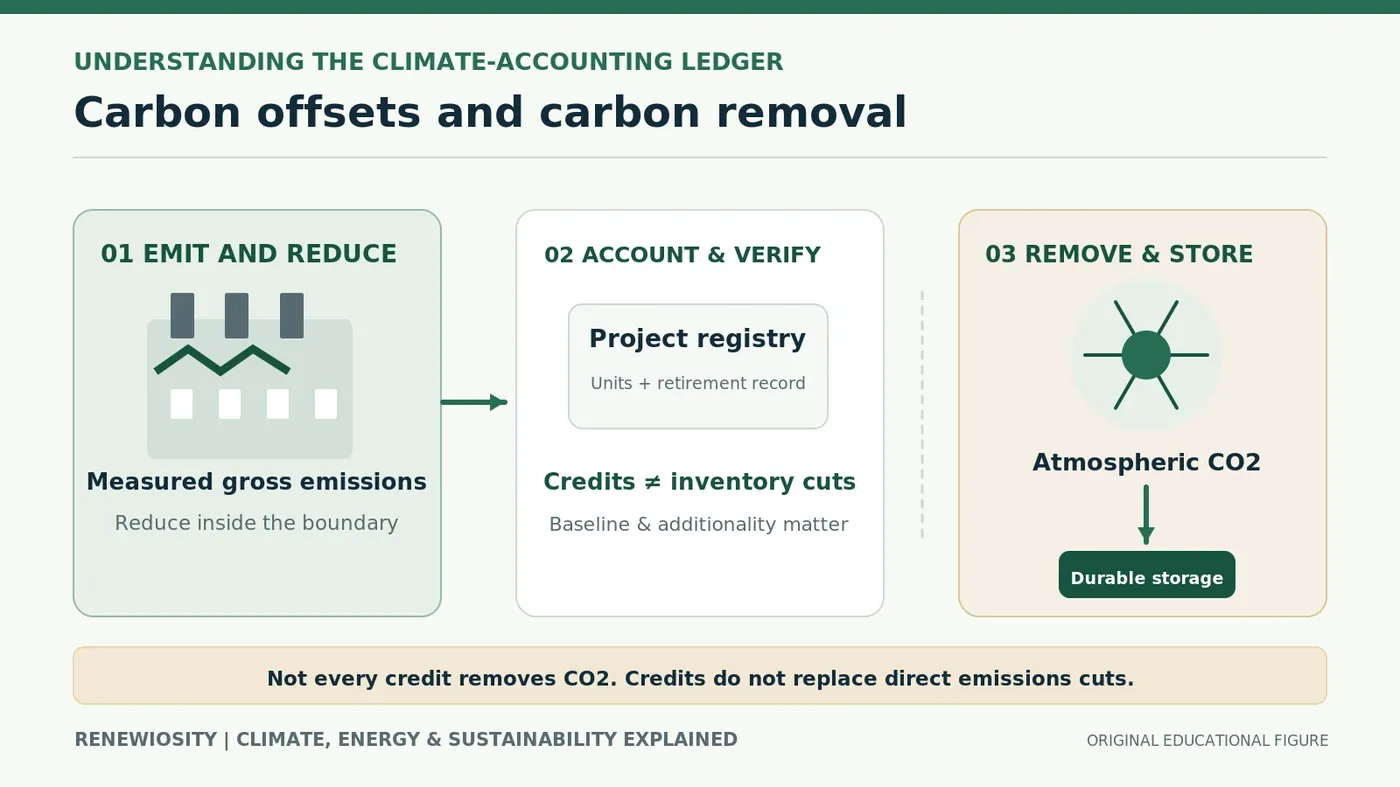
Carbon credits can direct money toward climate mitigation, but buying a credit is not the same physical action as stopping emissions at their source. An organization may cut fuel use, finance an emissions-reduction project elsewhere, or pay for carbon dioxide already in the air to be extracted and stored. Each action changes a different part of the climate-accounting ledger [1, 2, 5].
An emissions reduction lowers emissions relative to an activity or inventory boundary. An avoided-emissions credit represents a claimed difference between a project and an uncertain counterfactual baseline. Carbon dioxide removal (CDR) physically withdraws atmospheric CO2 and stores it, with the storage and entire process included in the accounting boundary. A carbon credit may represent a reduction or a removal, depending on the methodology [1, 7].
A reliable climate strategy therefore begins with measuring and reducing gross emissions. Credits and removals can finance additional mitigation and address rigorously defined residual emissions, but they cannot justify postponing feasible reductions [3, 4, 5].
2. What is a carbon offset and what does a credit represent?
A carbon offset describes a claim that a quantified reduction or removal outside an emitting activity compensates for emissions associated with that activity. The tradable accounting unit is typically a carbon credit, usually expressed as one metric tonne of CO2 equivalent (tCO2e), issued under a specified program and methodology after applicable validation and verification. One credit is not necessarily one tonne of CO2 physically extracted from air [2].
Projects may reduce methane emissions, prevent an expected loss of forest carbon, change industrial processes, or remove atmospheric CO2. The project's type, baseline, uncertainty, monitoring period and storage conditions matter more than the generic label "offset." Credits must be uniquely tracked and retired or cancelled when used for a claim, rather than repeatedly resold as a new climate result [2, 6].
Important terminology: Avoiding a hypothetical future emission does not erase a tonne of CO2 already emitted by the buyer. It is a different intervention and needs a carefully qualified public claim [3, 4].
3. A practical classification: avoid, reduce, remove and store
A project that avoids emissions may protect an existing carbon stock against a credible projected threat. A project that reduces emissions may destroy landfill methane or improve the efficiency of an industrial process. A removal project enhances an atmospheric sink or uses machinery and chemistry to capture CO2 from ambient air, followed by storage. All need sound attribution and measurement, but only the last category directly withdraws atmospheric CO2 [1, 7].
Some systems combine categories. Bioenergy with carbon capture and storage (BECCS), for example, can deliver net removal if the biomass carbon came from the atmosphere and the full supply chain plus durable storage yields a genuinely negative balance. Capturing fossil CO2 at a factory is ordinarily an emissions-reduction measure, not atmospheric removal [1, 9].
4. How a carbon-credit project is assessed
A rigorous project begins with a methodology and defined boundary. It describes a baseline scenario, project intervention, gases, measurement methods, risk of displacement or leakage, monitoring period, uncertainty treatments and a credit-issuance rule. The baseline is not simply "what happened before"; it is a defensible estimate of what would otherwise have happened [2].
Additionality asks whether the mitigation result would occur without the carbon-credit incentive. Leakage concerns emissions shifted outside the monitored boundary. Permanence concerns whether stored carbon will be released later. Validation, monitoring, independent verification and transparent registry records each reduce, but cannot eliminate, uncertainty [2].
A project may then receive serial-numbered credits after third-party checks. A buyer can purchase them, but only retirement or cancellation establishes that particular units have been used for a designated claim. Issuance itself does not prove that a buyer's own emissions were reduced [2, 4].
5. Worked example: calculating hypothetical carbon credits
Consider a deliberately simplified land-management project with a modeled baseline of 5,000 tCO2e over a specified monitoring period. Monitored project emissions are 3,000 tCO2e, with 400 tCO2e of quantified leakage. Assume, solely for this classroom example, that the chosen methodology requires a further 20% reserve applied to the remaining eligible outcome. These inputs are illustrative, not representative project data [2].
The pre-reserve difference is 5,000 - 3,000 - 400 = 1,600 tCO2e. The illustrative reserve is 0.20 × 1,600 = 320 tCO2e. That leaves 1,280 tCO2e of candidate creditable benefit, if additionality, baseline validity, safeguards, third-party verification and every rule of the actual methodology are satisfied. A methodology might structure its reserves differently, or reject issuance entirely. The exercise does not establish real-world credits [2].
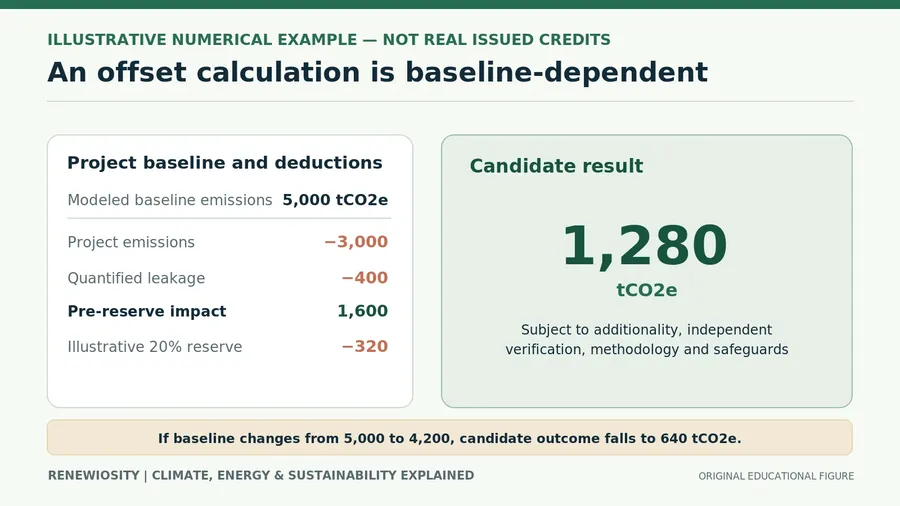
Sensitivity check: If the defensible baseline were 4,200 rather than 5,000 tCO2e, the same calculation gives (4,200 - 3,000 - 400) × 0.80 = 640 tCO2e. A baseline change alone halves the candidate figure. This is why baseline uncertainty can dominate claims based on avoided emissions.
6. Additionality: the counterfactual problem
A project receives little genuine credit for a result that would have happened anyway. If a wind project was already economic and legally required without credit revenue, attributing its full output as additional mitigation may overstate climate benefits. Similarly, a claimed forest threat must reflect credible land-use evidence rather than an extreme hypothetical loss rate [2].
Additionality tests use financial, legal, regulatory, common-practice or other approved methodology-specific evidence. Their strength varies by activity and regulatory setting. Even a formally validated methodology cannot make an uncertain counterfactual directly observable. Students should inspect project documents, scenario assumptions and sensitivity analyses rather than treating issuance as definitive proof of physical impact [2, 3].
7. Permanence, reversal and land-based storage
Stored carbon is beneficial only while it remains out of the atmosphere over the relevant time horizon. Forest carbon can be released by wildfire, disease, drought, harvesting or later land-use change. Soil-carbon stocks can also be reversed if land management changes. Durable geological or mineral storage generally has different, often lower, reversal risks but still requires monitoring, sound site selection and governance [1, 3].
Land-based projects can also deliver real biodiversity, soil and watershed benefits, but they introduce competing land demands, tenure questions and local-community safeguards. Durability should not be inferred solely from the project label "nature-based," nor should engineered storage be presumed risk-free [1, 2, 3].
The revised Oxford Principles encourage a transition toward removals with increasingly durable storage for genuine residual emissions while prioritizing deep emissions cuts [3].
8. What counts as carbon dioxide removal?
The IPCC describes CDR as anthropogenic activities that remove CO2 from the atmosphere and store it durably in geological, terrestrial or ocean reservoirs, or products. Examples include some reforestation and soil-carbon activities, biochar, enhanced mineral weathering, BECCS and direct-air capture with storage (DACCS). Their measurement, land, energy and environmental impacts differ sharply [1, 7].
In contrast, a scrubber on a natural-gas power station captures fossil-source CO2 before release; this may reduce emissions but does not make the station a carbon-removal facility. Similarly, capturing atmospheric CO2 and quickly releasing it again from a short-lived fuel is not durable removal. The storage stage and full system boundary are essential [1, 9].
The 2026 State of Carbon Dioxide Removal assessment estimated roughly 0.002 GtCO2 per year of novel CDR. It describes a small but growing portfolio, not evidence that future removals can effortlessly compensate for continued emissions [8].
9. Direct air capture, biochar and enhanced weathering
DACCS moves ambient air across a chemical sorbent or solvent, regenerates the capture material using heat or electricity, conditions the captured CO2 and stores it in an appropriate reservoir. Because atmospheric CO2 is dilute, energy use, capital cost, sorbent performance, upstream emissions and storage integrity matter greatly [7, 9].
Biochar converts sustainably sourced biomass into a carbon-rich material through thermochemical processing. A credible removal balance depends on feedstock sourcing, process emissions, the persistent fraction of carbon and end use. Enhanced weathering applies reactive minerals to accelerate CO2-consuming geochemical reactions; robust monitoring and the rate at which durable carbon storage occurs are challenging [1, 8].
No method should be called 'carbon negative' without a defined assessment boundary, conservative lifetime accounting and credible evidence for net atmospheric withdrawal and storage. The underlying technologies can complement, but not substitute for, emissions cuts [1, 7].
10. Worked example: gross capture versus net removal
Assume an illustrative DACCS project captures 1,000 tCO2 from ambient air. Across the monitoring period, 40 tCO2 of that captured amount is lost or subsequently released from storage, and the full capture-to-storage process causes 180 tCO2 of electricity and heat emissions plus 20 tCO2 of other lifecycle emissions. Assume all numbers are independently measured with nonoverlapping boundaries [1, 7].
Here the retained storage is 1,000 - 40 = 960 tCO2. Lifecycle emissions total 180 + 20 = 200 tCO2. The resulting net atmospheric removal is therefore 760 tCO2. This does not imply that 760 credits can automatically be issued: measurement uncertainty, baseline treatment, monitoring, accounting rules and buffer provisions still apply [2].
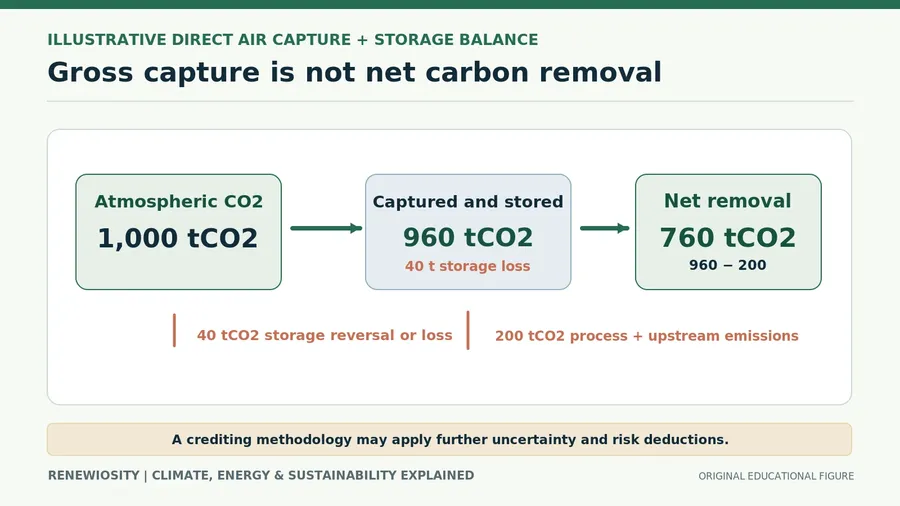
If process-related emissions instead totaled 380 tCO2, net removal would fall to 580 tCO2. Source energy and upstream supply chains are therefore critical design parameters for engineered removal.
11. CO2, carbon and CO2-equivalent: units matter
The mass unit tCO2 is the mass of carbon dioxide. tC is the mass of carbon alone. Carbon dioxide has a molecular mass of approximately 44 g/mol, while carbon is about 12 g/mol, so one metric tonne of elemental carbon corresponds to roughly 3.67 tonnes of CO2 when fully oxidized. These are not interchangeable units [1].
For example, storing 300 tC of atmospheric carbon corresponds to approximately 1,100 tCO2 (300 × 44/12), before corrections for permanence, saturation, displaced emissions and measurement uncertainty. tCO2e instead expresses the climate effects of different greenhouse gases on a chosen global-warming-potential basis. The gas, metric and assessment period must be identified; 1 tCO2e of methane mitigation is not automatically equivalent to storing 1 tCO2 for centuries [1, 10].
12. What carbon credits do and do not do to a corporate inventory
A company's Scope 1, 2 and 3 inventory measures its operational and value-chain greenhouse-gas emissions under a defined reporting system. Buying external credits does not cause the physical values in those inventory categories to fall. Under SBTi guidance, credits cannot be counted as emission reductions toward its near-term or long-term science-based abatement targets [5].
Suppose an illustrative company begins with 10,000 tCO2e in its inventory and reduces in-boundary emissions by 6,500 tCO2e. Its remaining reported emissions are 3,500 tCO2e, even if it buys 2,000 tCO2e of externally generated avoided-emissions credits. Those credits may be disclosed as a separate climate contribution under appropriate claims guidance, but the reported inventory remains 3,500 tCO2e. Claims of net zero additionally require a credible emissions-reduction pathway and appropriately durable removals to neutralize eligible residual emissions [3, 4, 5].
13. Price, verification and the real cost of removals
The price of a carbon credit alone reveals little about its integrity. Prices reflect project type, counterfactual assumptions, storage durability, verification costs, buyer demand and contract risk. Comparing a temporary land-carbon claim with long-lived geologic storage on price alone confuses very different products [2, 3].
As a purely hypothetical budgeting exercise, acquiring 3,500 verified net removal tonnes at $200 per tonne would cost $700,000 before transaction, monitoring and insurance expenses. Neither the volume nor the price is a forecast, and buying that amount does not by itself justify a corporate net-zero declaration. Feasible direct reductions, residual-emissions eligibility and storage matching must be assessed first [3, 5].
The 2026 State of CDR report highlights rapid expansion in novel removals from a very small base and major uncertainty around future costs and scale [8].
14. Leakage, double counting, Article 6 and claim integrity
Even accurately measured project activity can have a smaller climate benefit if consequences occur elsewhere. Protecting one forest area may shift clearing to another; building an industrial facility can move emissions upstream; and storing carbon in biomass may lead to later reversals. These effects should be addressed within the project boundary and monitoring framework [2].
Double issuance occurs when the same mitigation is issued more than once; double use when the same credit is claimed or retired repeatedly; and double claiming when incompatible claims are made by different parties. Registries and transparent retirement records address some but not every accounting risk [2].
Article 6 of the Paris Agreement provides cooperative accounting and reporting rules for certain internationally transferred mitigation outcomes. Corresponding adjustments are relevant to authorized transfers used for nationally determined contributions, but not every voluntary credit or private contribution claim is treated identically. Claims must state their authorization and accounting context rather than assuming all units are interchangeable [4, 6].
15. How to evaluate a carbon-credit or removal claim
A useful due-diligence sequence is to identify: (1) whether the activity is avoidance, emissions reduction or atmospheric removal; (2) the baseline and additionality test; (3) source and sink boundaries; (4) leakage and lifecycle emissions; (5) physical storage medium and reversal-management plan; (6) validation, monitoring and independent verification; (7) registry identifier and retirement status; (8) environmental and social safeguards; (9) government authorization and double-claiming arrangements where relevant; and (10) the exact public claim the credit is being used to support [2, 4, 6].
An ICVCM label, a registry listing or a verifier's report may be useful evidence, but is not proof that every project and every claim is free of uncertainty. Scientific assessment needs the underlying method and data, not marketing language alone [2].
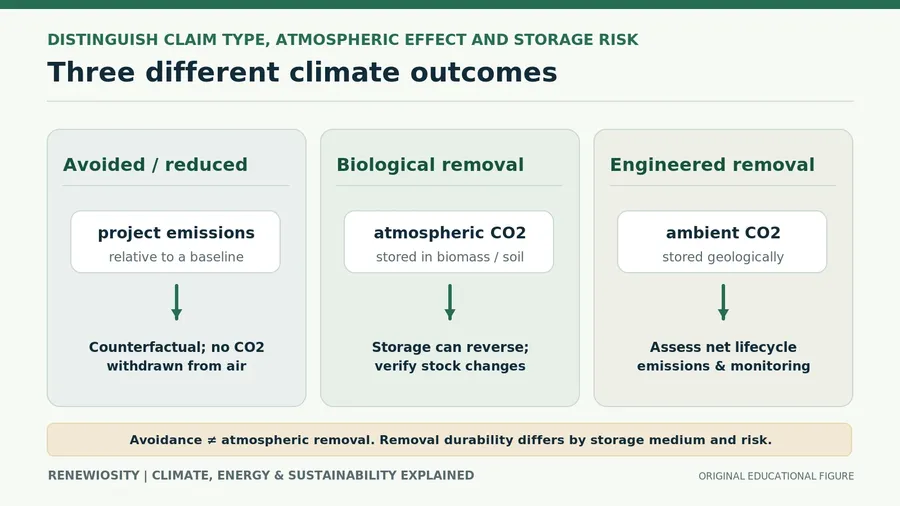
The most defensible order of action is measure emissions, reduce them as deeply as possible, contribute to additional climate mitigation, then neutralize genuinely residual emissions with suitable verified removals. This follows the direction of the revised Oxford Principles and SBTi accounting guidance [3, 5].
16. Review questions and takeaways
Review questions
- How does a credit for avoided deforestation differ physically from a credit for DACCS with geological storage?
- What does additionality test, and why can it never be observed directly as a historical fact?
- Calculate candidate creditable tonnes for a baseline of 5,000 tCO2e, project emissions of 3,000, leakage of 400 and a 20% illustrative reserve.
- Recalculate candidate creditable tonnes if the baseline is lowered to 4,200 tCO2e.
- Why is point-source CO2 capture from fossil fuel combustion not automatically classified as carbon removal?
- A DAC plant stores 960 tCO2 from atmospheric capture and causes 200 tCO2 of lifecycle emissions. What is net removal?
- Why must a forest-based removal account for reversal risk?
- Can externally purchased avoided-emissions credits reduce a company's reported Scope 1–3 emissions under SBTi targets?
- What is one major difference between tCO2, tC and tCO2e?
- How do registry retirement and Article 6 corresponding adjustments address different accounting questions?
Concise answers: (1) An avoided project compares outcomes against a counterfactual; DACCS physically removes and stores atmospheric CO2. (2) Whether credited finance caused an otherwise unrealized outcome; the alternative future cannot be directly observed. (3) 1,280 tCO2e. (4) 640 tCO2e. (5) It primarily prevents new fossil CO2 from entering the air. (6) 760 tCO2. (7) Storage can reverse through fire, disturbance or land change. (8) No, they are reported separately. (9) CO2 is gas mass, C is elemental carbon mass, and CO2e is a common climate-impact accounting unit. (10) Retirement prevents re-use of credit units; corresponding adjustments address certain international accounting claims [1–6].
Takeaway: High-quality credits may finance additional mitigation, and verified removal can play a role for residual emissions, but neither replaces immediate, verifiable cuts in gross greenhouse-gas emissions.
Technical discussions describe general principles; site-specific engineering decisions require appropriate professional evaluation.