
RENEWIOSITY / EXPLAINER
How Much Energy Does a Typical Household Consume? Electricity, Heating and Transport
How much energy does a household really use? Compare electricity, heating and transport with current UK and U.S. benchmarks, clear system boundaries and worked SI calculations.
Learning objectives
- Distinguish electricity purchased, household site energy, useful heating energy and transport fuel energy.
- Convert appliance power, fuel quantities and annual mileage into consistent kWh per year.
- Interpret dated national benchmarks without treating them as universal household averages.
- Construct an annual household energy inventory without double-counting electrically supplied services.
- Calculate an illustrative heat-pump conversion and a petrol-to-electric-vehicle comparison.
- Explain why site energy, household spending, primary energy and greenhouse-gas emissions require different accounting boundaries.
1. The short answer: there is no single typical household
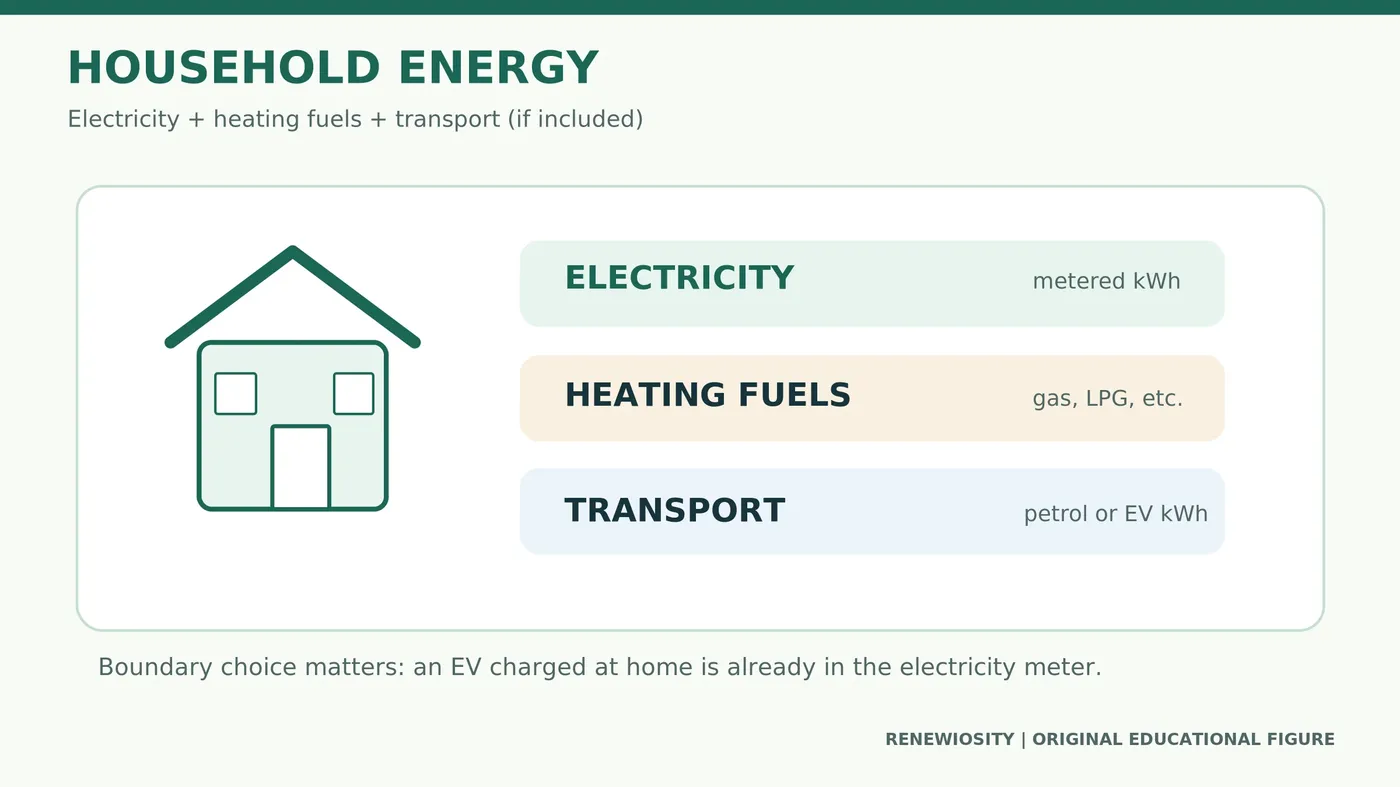
A household uses energy for lights and appliances, space conditioning, hot water, cooking and, when the accounting boundary includes household mobility, transport. The answer depends on country, climate, dwelling size, building fabric, occupancy, prices, access to energy and what the analyst counts. Electricity bills therefore answer only one part of the question.
For a useful benchmark, Ofgem's medium-use values for Great Britain, effective 1 July 2026, are 2,500 kWh of electricity and 9,500 kWh of gas per year. These are billing comparison assumptions, not measured totals for every household, and they exclude personal-vehicle petrol or diesel consumption. Their sum is 12,000 kWh/year of purchased electricity plus gas for a hypothetical two-fuel benchmark household. Homes without gas, with electric heating or with rooftop solar require a different interpretation [1].
In another market, EIA reports 10,791 kWh of electricity purchased per residential customer in the United States in 2022. The U.S. figure is a mean electricity-purchase statistic from a different year and statistical population, not a directly comparable total household-energy statistic. Comparing it with the British medium-use median without those qualifications would be misleading [3].
2. Draw the energy accounting boundary first
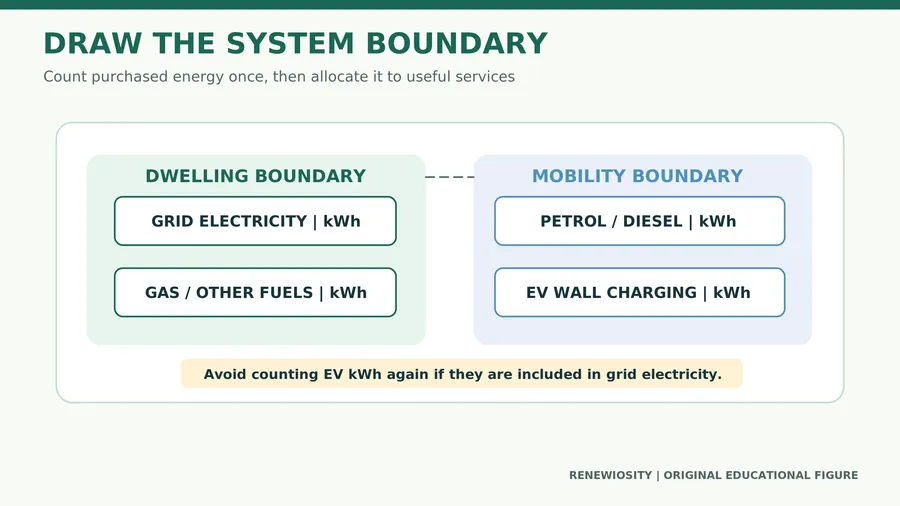
An energy inventory should define three connected but distinct domains: energy delivered to the dwelling, useful services (heat, cooling, lighting or mobility), and fuel or electricity used by vehicles associated with the household. Natural gas burned for space heating appears as purchased fuel input; the useful heat is its output. These are not two separate energy purchases.
A house electricity meter can already include charging an electric vehicle or powering a heat pump. If it does, adding those same kWh again as separate transport or heating energy double-counts consumption. Conversely, household residential-energy datasets commonly exclude petrol burned in a private car, which must be added only when assessing the enlarged 'home plus mobility' boundary [2, 7].
3. Understand kW, kWh, MJ and annual averages
Power measures the rate of energy use: 1 kilowatt (kW) is 1,000 watts (W). Energy accumulates power over operating time, so kilowatt-hours (kWh) are suitable for annual bills. A 2 kW heater operated at rated input for 3 hours uses 6 kWh of electricity; a nameplate rating alone cannot tell you annual use.
One kWh equals 3.6 MJ, and one MMBtu is approximately 293.071 kWh. Always state whether a gas meter reports a volume converted into energy, whether a fuel factor uses lower or higher heating value, and whether equipment output is heat or electrical input. These distinctions determine whether numbers can legitimately be added.
4. Electricity: appliances, refrigeration and cooling
Electricity runs refrigerators, fans, lighting, communications, electronics, pumps, some cooking equipment and, depending on the home, air conditioning, electric heaters and water heaters. Electricity consumption can rise considerably with electric space or water heating. Cooling loads can dominate in hot, humid climates and vary with air-conditioner efficiency, insulation, operating temperature and daily occupancy [6, 8].
A transparent estimate is built from a list of devices, their actual average input power, and annual operating hours. For instance, a refrigerator whose measured average electrical demand is 75 W over a full year uses about 657 kWh/year (0.075 kW × 8,760 h). A device's compressor may switch on and off, so 75 W here is a hypothetical time-averaged input rather than its nameplate peak.
Rooftop solar further complicates utility-bill comparisons: net electricity bought from the grid can be below total electricity consumed when some on-site PV output is used directly. Report both if possible [3].
5. Space heating: energy input versus useful warmth
Heating demand depends heavily on indoor and outdoor temperatures, insulation, air leakage, ventilation, solar gains and floor area. A fuel-fired boiler or furnace converts fuel energy into useful heat with losses. When calculating the input required for a prescribed useful heat demand, divide by the heating-system seasonal efficiency, with the energy-content convention stated.
For example, if a house needs 7,650 kWh/year of useful heat and a boiler's illustrative seasonal efficiency is 85%, the required fuel input is 9,000 kWh/year. A 9,000 kWh gas bill is not evidence of 9,000 kWh delivered to occupied rooms. Appliances, cooking and hot water may also consume gas and must be separately allocated if the objective is space heating alone [2, 4].
6. Hot water, cooking and other thermal loads
Domestic hot-water demand depends on occupancy, shower duration, inlet temperature, tank losses and how the heater is powered. Water heating can use gas, electricity, solar thermal energy or a heat-pump water heater. A simplified water calculation uses water mass, specific heat capacity and temperature rise. Tank, circulation and distribution losses increase the purchased energy above this idealized load.
Cooking fuels similarly vary across households and countries. Some use electricity alone; others use gas, LPG, biomass or several fuels. Do not infer that all gas consumption is space heating or that all electric use is 'appliances': heat and cooking cross these categories. A consistent ledger assigns each purchased energy source exactly once [6].
7. Cooling, weather and changing seasonal loads
An annual total conceals hourly variation. Space heating can peak during cold months; air conditioning can peak during hot afternoons; water heating, refrigeration and information equipment often operate throughout the year. Temperature-sensitive energy use changes with weather even when the building and occupants do not change.
For comparing years, use seasonal or monthly meter records, weather indicators such as heating and cooling degree days, and a clear statement of occupancy or thermostat changes. The IEA notes that space and water heating dominate in many advanced-economy households, while cooling demand grows in warmer and developing regions. A single global end-use percentage is therefore not appropriate for each house [6].
8. Household transport: petrol, diesel and electricity
Transport energy is usually calculated from distance travelled, vehicle energy intensity and fuel energy content. A litre of petrol is not equivalent to one kWh; for educational lower-heating-value calculations we use 8.8 kWh per litre as a rounded assumption, not an exact universal fuel specification. Real fuel properties vary with composition and test convention [5].
Here d is annual distance in km, c₁₀₀ is litres per 100 km, and H is kWh per litre. This is chemical energy entering the vehicle, not useful mechanical energy at its wheels. For an EV, use electricity at the wall or charging meter and state whether charging losses are included. Do not compare a car's useful work directly with petrol-input kWh [5].
9. Worked example: the annual household energy ledger
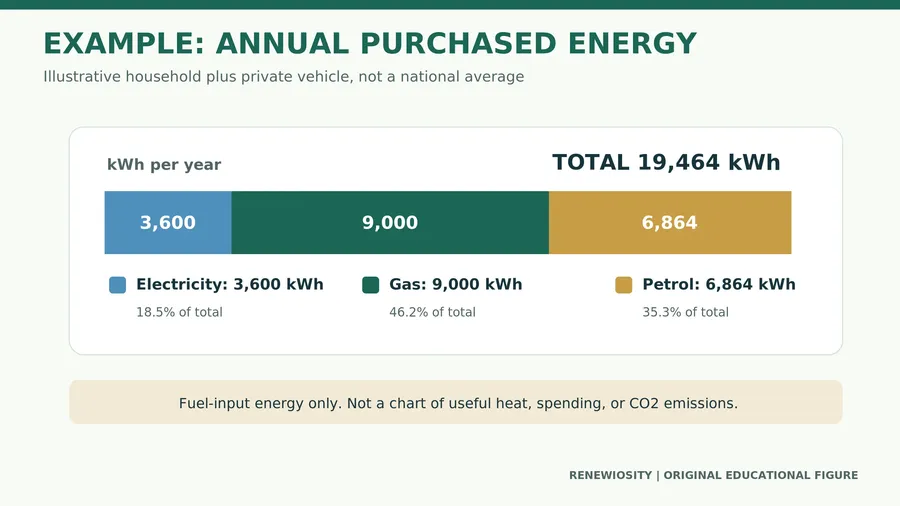
Consider a hypothetical household, not a national average. Its annual purchased electricity is 3,600 kWh, gas energy input 9,000 kWh, and petrol consumption is 780 L. Use the explicit petrol assumption of 8.8 kWh/L. Assume the electricity meter excludes EV charging, since the household owns a petrol car.
Petrol input = 780 × 8.8 = 6,864 kWh/year. Total purchased site and vehicle-fuel input = 3,600 + 9,000 + 6,864 = 19,464 kWh/year. This total deliberately joins the home and private-transport boundaries; it is not a standard residential-building energy statistic.
The shares are approximately 18.5% electricity, 46.2% gas, and 35.3% petrol. These are shares of purchased final energy inputs, not monetary cost, useful service, primary energy or carbon emissions. The plot shows this accounting example only [5].
10. Worked example: electrifying household heating
Keep the useful heat requirement fixed at 7,650 kWh/year from Section 5. Suppose a correctly sized heat pump achieves a seasonal performance factor (SPF) of 3.0, an illustrative assumption rather than a promise for any home. Its annual electricity consumption for that heat is 2,550 kWh/year.
Compared with 9,000 kWh of boiler fuel input, the heat pump uses 6,450 fewer delivered final-energy kWh for the same heat service. A real comparison should use actual seasonal performance, auxiliary heat, local electricity and fuel tariffs, and relevant grid emissions. Equipment installation and weatherization may also affect outcomes [4].
11. Worked example: petrol car versus electric car
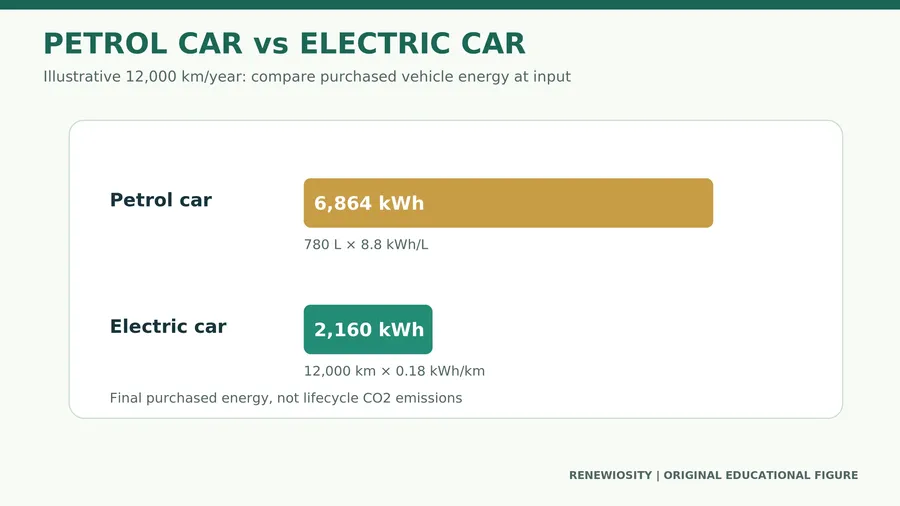
Suppose annual distance is 12,000 km. The petrol vehicle uses 6.5 L/100 km, yielding 780 L/year and therefore the 6,864 kWh/year petrol input calculated earlier. Consider an EV using a hypothetical 0.18 kWh/km measured at the wall. It would require 2,160 kWh/year for the same annual distance.
The difference is 4,704 kWh/year, about 68.5% less purchased vehicle energy input. This comparison does not by itself establish a 68.5% reduction in upstream or lifecycle emissions. Charging losses are already captured if the 0.18 kWh/km really is measured at the wall; if instead it is a battery-to-wheel figure, further charging input must be included [5].
12. How national benchmarks differ
The British 2026 Ofgem medium benchmarks are 2,500 kWh of electricity and 9,500 kWh of gas annually, while U.S. EIA reported a mean of 10,791 kWh electricity purchased per residential customer in 2022. They describe different statistical concepts, dates and regions. The UK benchmark does not include transport and assumes a gas/electric comparison profile; the U.S. electricity purchase statistic says nothing by itself about gas or fuel burned in vehicles [1, 3].
The U.S. 2020 RECS reported approximately 76.8 MMBtu, or 22,500 kWh, of mean annual energy consumed within the dwelling across measured fuels. This is a different denominator, period and scope from the utility-electricity statistic, and it excludes private-car transport. These three values should never be placed on one unqualified 'typical household consumption' ranking chart [2].
13. Why one home differs from another
At least six influences matter: climate, floor area and building envelope, household size and time spent at home, equipment efficiency, fuel availability and energy-service expectations. A badly insulated dwelling may consume more energy than a larger well-insulated one. Electric resistance heating may raise the electricity bill, whereas a gas-heated dwelling shifts part of the same heat service into fuel purchases.
Income, prices, housing conditions and access to adequate cooling or heating also affect observed use. Low observed energy consumption is not automatically high efficiency: it may reflect energy poverty, fewer services or unsafe underheating during winter. Comparative energy assessments should therefore normalize appropriately and examine comfort and service quality [6, 7].
14. Energy, costs and greenhouse-gas emissions are not interchangeable
Electricity, gas and transport-fuel bills may have different energy prices, taxes and fixed charges. Dividing currency spend by a single price cannot recover a mixed-fuel energy balance unless each unit rate, standing charge and fuel quantity is separated. Similarly, the lowest purchased-energy option is not necessarily the lowest-carbon option without emission factors and a well-defined boundary.
Heat pumps and EVs can deliver the same heat or mobility service with lower purchased final energy because energy conversion pathways differ. Primary-energy accounting includes upstream generation or extraction; greenhouse-gas analysis also needs grid intensity, combustion and potentially lifecycle effects. These are distinct assessments and should be labeled as such [4–6].
15. Build your own 12-month inventory
Start with 12 consecutive months of electricity import readings and, where available, solar PV generation and self-consumption. Add gas or LPG in energy units using a stated heating-value convention, then account for other heating fuels. Record annual vehicle mileage, litres purchased or measured EV charging electricity. Separate commuting and other household travel only if the study's scope requires it.
Check overlap before addition. If home electricity already includes EV charging, record EV usage as a sub-category of that electricity, not as a second purchase. If the analysis is about buildings alone, leave private road fuel outside the total and report it separately. Where measurements are missing, tag each estimate with its assumption, uncertainty and data period.
A transparent spreadsheet might include 'fuel or meter', 'service', 'quantity', 'unit conversion', 'kWh/year', 'meter overlap flag' and 'source'. Revisit the inventory after insulation changes, replacing heating appliances or acquiring an EV rather than assuming the previous pattern remains valid.
16. Review questions and engineering takeaway
- Why is household electricity use not necessarily equal to household total energy consumption?
- An electric heater draws 1.5 kW for 4 hours. How many kWh does it consume?
- Why must useful heat not be added to the gas or electrical input used to produce it?
- In the worked household example, how many kWh of petrol input correspond to 780 L at 8.8 kWh/L?
- How would a heat pump change final-energy purchases when the useful heat requirement stays constant?
- If EV charging is already in a household electricity meter, how should the transport figure be shown without double counting?
- Why is comparing Britain's medium-use benchmark with a U.S. mean electricity statistic potentially misleading?
- Can a lower purchased-energy total alone prove a lower lifecycle carbon footprint?
Answers: (1) Other fuels and transport may lie outside the electricity meter. (2) 6 kWh. (3) Heat is output from the same input, not another purchase. (4) 6,864 kWh. (5) With SPF 3, 7,650 kWh of useful heat requires 2,550 kWh of electricity, subject to operating assumptions. (6) Treat EV charging as a category within the measured electricity total. (7) Geography, dates, mean versus median, and measurement boundaries differ. (8) No; carbon intensity and lifecycle boundaries are needed.
Takeaway: Report household energy with a named year, region, fuel boundary and method. For practical engineering, a reproducible ledger is more informative than an unqualified 'average home uses X kWh' headline.
Technical discussions describe general principles; site-specific engineering decisions require appropriate professional evaluation.